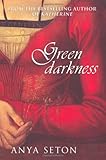
Green Darkness by Anya Seton

I finished reading Green Darkness a couple of weeks ago and have been wondering what to write about it or whether to write anything at all. I thought I’d read the book years ago, not long after it came out, but as soon as I began what I thought was a re-read I realised that this was completely new to me – I just thought I’d read it because I’d visited Ightham Mote, a beautiful 14th century moated manor house in Kent where part of Green Darkness is set.

A brief synopsis from Goodreads:

This story of troubled love takes place simultaneously during two periods of time: today and 400 years ago. We meet Richard and Celia Marsdon, an attractive young couple, whose family traces its lineage back to medieval England. Richard’s growing depression creates a crisis in Celia, and she falls desperately ill. Lying unconscious and near death, Celia’s spirit journeys backward to a time four centuries earlier when another Celia loved another Marsdon.

I wasn’t enthralled by it and nearly abandoned it after the first few chapters set in 1968, because the characters didn’t come over as real and the writing in accents was awful. But once I got on to the historical part, set in the 16th century it was better, so I read on.

There are some books that are easy to write about – this isn’t one of them so this is a brief post. Green Darkness is written around the premise of reincarnation, so the characters/personalities feature in both time periods. I didn’t think this was successful, but seemed contrived. For me the book would have been better as straight historical fiction.

Reading Challenges: Color Coded Challenge – green (I don’t know why this book is called Green Darkness – if the book explains the title I missed it). What’s In a Name – a book with a colour in its title. Historical Fiction challenge – 16th century England. My Kind of Mystery Challenge.

Historical Fiction Reading Challenge 2015

I’ve been looking out for this challenge after Historical Tapestry announced that they were no longer running it and there is a new host this year – Amy at Passages to the Past. I hadn’t seen Amy’s blog before, but it looks very interesting, full of historical fiction reviews etc.

The challenge runs from January 1st to December 31st 2015 and there are six different levels to choose from:

20th century Reader – 2 books
Victorian Reader –  5 books
Renaissance Reader – 10 books
Medieval – 15 books
Ancient History – 25 books
Prehistoric [ 50+ books

Any type of historical fiction is accepted including sub-genres such as Historical Romance, Historical Mystery, Historical Fantasy and Young Adult.

Historical fiction is one of my favourite genres and last year I met my target level reading 26 books – just over the Ancient History level. I’m tempted to aim for the Prehistoric Level, but as I want to be more relaxed about challenges this year I’ll be aiming for the Ancient History level again, and if I read more then so much the better.

TBR Pile Challenge 2015

I’ve been dithering for some time now about taking on reading challenges because I really want to concentrate on reading without thinking whether the books I read fit any of the challenges I’ve joined, but I’ve decided that I’m not going to worry about that – if they do, they do and if they don’t it doesn’t matter and so here’s another challenge for 2015.

official tbr challengeAdam from Roof Beam Reader is running his TBR Pile Challenge for the SIXTH YEAR!

I’ve not joined in before because I’ve been doing Bev’s Mount TBR Challenge, but this is slightly different because the books you read must have been on your bookshelf or ‘To Be Read’list for AT LEAST one full year and you have to list them in advance. This means the books cannot have a publication date of 1/1/2014 or later (ie any book published in the year 2013 or earlier qualifies, as long as it has been on your TBR pile ‘“ Adam will be checking publication dates!)

The Goal: To finally read 12 books from your ‘to be read’pile (within 12 months). Books have to be listed and reviewed so that you can link back to Adam’s challenge. You are allowed two alternates just in case you just can’t finish a book for whatever reason.

For the full run-down of challenge details, see Adam’s blog (click on link above).

I’m a bit doubtful that I’ll complete this challenge because I often find that planning in advance what I’m going to read doesn’t work for me – I seem to find reasons for reading other books instead of the ones on my list! But I’m going to give it a go anyway – here’s my list:

  1. The House of the Spirits by Isabel Allende (pub 1994 – on my TBR since 2008)
  2. The Robber Bride by Margaret Atwood (pub 1994 – on my TBR since 2009)
  3. The Needle in the Blood by Sarah Bower (pub 2007 – on my TBR since 2007)
  4. The Burning by Jane Casey (pub 2010 – on my TBR since 2013)
  5. Martin Chuzzlewit by Charles Dickens (pub 1844 – on my TBR since 2007)
  6. Zen there was Murder by H R F Keating (pub 1960 – on my TBR since 2012
  7. Mrs Jordan’s Profession by Claire Tomalin (pub 1995 – on my TBR since 2011)
  8. Fresh from the Country by Miss Read (pub 1970 – on my TBR since 2012)
  9. The Interpretation of Murder by Jed Rubenfeld (pub 2006 – on my TBR since 2007)
  10. Bad Land by Jonathan Raban (pub 1985 – on my TBR since 2011)
  11. We Were the Mulvaneys by Joyce Carol Oates (pub 1997 – on my TBR since 2011)
  12. The Secret Keeper by Kate Morton (pub 2010 – on my TBR since 2013)

Alternatives:

  1. Diamonds are Forever by Ian Fleming (pub 1956 – on my TBR since 2011)
  2. Nineteen Eighty Four by George Orwell (pub 1949 – on my TBR since 2011)

And here are the books:

TBR pile 2015

Read Scotland 2015

Read Scotland 2015Read Scotland 2015 is back again for a second year, Hosted by Peggy Ann @ Peggy Ann’s Post!

Challenge levels:

Just A Keek (a little look): 1-4 books
The Highlander: 5-8 books
The Hebridean: 9-12 books
Ben Nevis: 13-24 books
Back O’ Beyond: 25+ books

Read and review Scottish books -any genre, any form- written by a Scottish author (by birth or immigration) or about or set in Scotland.

Challenge runs January 1 to December 31, 2015

I’m going to do the “Just A Keek” level, 1-4 books to start with and maybe progress to the higher levels later.

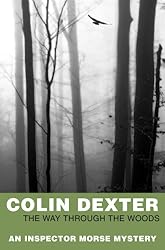
The Way Through The Woods by Colin Dexter: Mini Review

I really enjoyed reading Colin Dexter’s The Way Through The Woods, the tenth book in his Inspector Morse series. It’s nicely complicated and full of puzzles as Morse aided by Sergeant Lewis investigate the case of a beautiful young Swedish tourist who had disappeared on a hot summer’s day somewhere near Oxford twelve months earlier. After unsuccessfully searching the woods of the nearby Blenheim Estate the case was unsolved, and Karin Eriksson had been recorded as a missing person.

A year later Morse is on holiday at Lyme Regis when The Times published an article on the missing woman together with an anonymous poem that had been sent in that the police thought could help pinpoint the whereabouts of her body. This sets in motion more letters to The Times and ultimately to Morse being assigned to re-open the case.

I was completely engrossed in this book, trying to follow all the possible interpretations of the poem and the witness statements as Morse and Lewis go over the old evidence and turn up new information. This involves a trip to Wales for Morse and one to Sweden for Lewis, Wytham Woods is searched and a body is found – but whose is it? This book sees the first appearance of forensic pathologist, Dr Laura Hobson. But it’s not just the mystery, the crossword type clues, the characterisation and all the twist and turns that make this book so enjoyable, it’s the writing, the descriptions of the scenery and locations bringing them vividly to my mind.

This book has been sitting unread on my shelves for three years and is the last of my to-be-read books of 2014. An excellent book!

Corvus: A Life With Birds by Esther Woolfson

Corvus by Esther Woolfson is a remarkable book about the birds she has has had living with her; birds that were found out of the nest that would not have survived if she had not taken them in.

‘Corvus’ is a genus of birds including jackdaws, ravens, crows, magpies and rooks. The specific birds Esther Woolfson has looked after are a rook, called Chicken (short for Madame Chickieboumskaya), a young crow, a cockatiel, a magpie, two small parrots and two canaries. But it all started with doves, which live in an outhouse, converted from a coal store into a dove-house, or as they live in Aberdeen in Scotland, a doo’cot.

Although the book is mainly about the rook, Chicken, Esther Woolfson also writes in detail about natural history, the desirability or otherwise of keeping birds, and a plethora of facts about birds, their physiology, mechanics of flight, bird song and so on. As with all good non-fiction Corvus has an extensive index, which gives a good idea of the scope of the book. Here are just a few entries for example under ‘birds’ the entries include – aggression in, evolution of, navigation, in poetry, speeds of, vision, wildness of, wings’

It’s part memoir and part nature study and for me it works best when Esther Woolfson is writing about Chicken and the other birds living in her house, how she fed them, cleared up after them, and tried to understand them. Although at times I had that feeling I get when I visit a zoo – these are wild birds kept captivity and I’m not very comfortable with that, I am reassured by Esther Woolfson’s clarification that reintroducing these birds to the wild was unlikely to be successful and indeed they lived longer than they would have done in the wild. Though Chicken and Spike (and the other birds) live domesticated lives they are still wild birds:

I realise that if ‘wild’ was once the word for Chicken, it still is, for nothing in her or about her contains any of the suggestions hinted at by the word ‘tame’. Chicken, Spike, Max, all the birds I have known over the years, live or lived their lives as they did by necessity or otherwise, but were and are not ‘tame’. They are afraid of the things they always were, of which their fellow corvids are, judiciously, sensibly; of some people, of hands and perceived danger, of cats and hawks, of things they do not know and things of which I too am afraid. ‘Not tamed or diminished’. (pages 115-6)

At times, where Esther Woolfson goes into intricate detail, for example in the chapter on ‘Of Flight and Feathers‘ I soon became completely out of my depth, lost in the infinity of specialised wing shapes and the complexities of the structure of feathers. But that is a minor criticism, far out weighed by her acute observations of the birds, her joy in their lives and her grief at their deaths – her description of Spike’s unexpected death and her reaction is so moving:

I wept the night he died. Sitting in bed, filled with the utter loss of his person, I felt diminished, bereft. I talked about him, but not very much, in the main to members of the family, who felt the same, but to few others.

It’s the only way, this compact and measured grief, for those of us who are aware that there has to be proportion in loss and mourning; we laugh at ourselves for our grief, trying to deal with this feeling that is different in quality, incomparable with the loss of a human being.

We felt – we knew – that something immeasurable had gone. (page 209)

Anyone who has lived through the death of a loved animal can recognise that sense of loss.

Corvus is a beautiful book and I have learned so much by reading it. I must also mention the beautiful black and white illustrations by Helen Macdonald – I think this is the Helen Macdonald who was awarded the 2014 Samuel Johnson Prize for Non-Fiction for H is For Hawk.

Esther Woolfson was brought up in Glasgow and studied Chinese at the Hebrew University of Jerusalem and Edinburgh University. Her acclaimed short stories have appeared in many anthologies and have been read on Radio 4. She has won prizes for both her stories and her nature writing and has been the recipient of a Scottish Arts Council Travel Grant and a Writer’s Bursary. Her latest book, Field Notes from a Hidden City (Granta Books), was shortlisted for the 2014 Thwaites Wainwright Prize for Nature and Travel Writing. She lives in Aberdeen. For more information see her website.