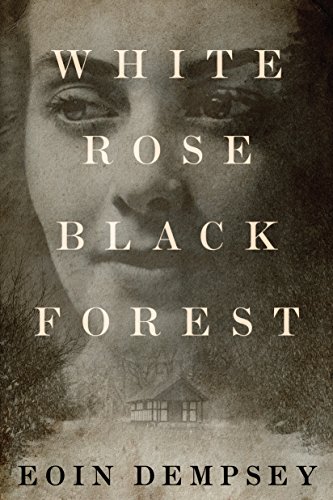
White Rose, Black Forest by Eoin Dempsey

Rating: 3 out of 5.

This is the second of several short posts as I try to catch up with writing reviews of books I read earlier this year.

White Forest, Black Rose by Eoin Dempsey is a World War 2 novel which is different from other books set during the War that I’ve read before, told from the perspective of a German who opposed the Nazis. It is set in the Black Forest, Germany in 1943, where Franka Gerber is living alone in an isolated cabin, having returned to her home town of Freiburg after serving a prison sentence for anti-Nazi activities.

It is December and the Forest is blanketed in deep snow when she discovers an unconscious airman lying in the snow wearing a Luftwaffe uniform, his parachute flapping in the wind. Taking him back to the cabin she saves his life, but whilst he is unconscious she hears him speak in English and so it seems that he is not who she first thought he was. Both his legs are broken and, having been a nurse, Franka is able to set the bones, and tries to discover his true identity. Trapped in the cabin they both gradually reveal details of their past lives and learn to trust each other.

It is a tense, claustrophobic novel and as soon as he is able to walk they decide to leave the cabin and so begins a race against time, as they are hunted by the Gestapo. Can they trust each other enough to join forces on a mission that could change the face of the war and their own lives forever?

White Rose, Black Forest is a novel inspired by true events, although the author doesn’t clarify what is fact and what is fiction. I enjoyed it, especially the historical aspects. The White Rose movement in Germany was a non-violent intellectual resistance group in Nazi Germany, who conducted an anonymous leaflet and graffiti campaign that called for active opposition to the Nazi regime.

It slots into the Forest box in the Wanderlust Bingo card and is also one of my TBRs, a book I’ve owned since 2018.

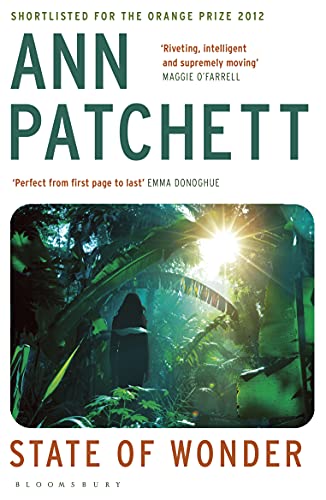
State of Wonder by Ann Patchett

Once more I’m behind with reviews of some of the books I’ve read in June, July and August, so this is the first of several short posts as I try to catch up with writing reviews.

Rating: 5 out of 5.

I loved State of Wonder by Ann Patchett!

After a slow start I began to realise that this was a book I was really going to enjoy. In some ways it is similar to Heart of Darkness by Graham Greene, but set in the Brazilian jungle along the Rio Negro instead of the Belgian Congo in Africa. It slots into the River box in the Wanderlust Bingo card. It is also one of my TBRs, a book I’ve owned since 2015 and so qualifies for the Mount TBR Challenge.

Dr. Annick Swenson, a research scientist, is developing a drug that could alter the lives of women forever. But she refuses to report on her progress, especially to her investors, whose patience is fast running out. Anders Eckman, a lab researcher, is sent to investigate. When Dr. Swenson reported that Anders had died of a fever in a remote part of the jungle, Dr. Marina Singh, a former student of Dr. Swenson, is sent to find out what has happened to him.

From that point onwards it gets more and more complicated. First of all it’s very difficult for her to meet Dr. Swenson, and when she does eventually reach her there are all the dangers of the rain forest to deal with, including deadly snakes, hundreds of insects, mysterious natives and exotic diseases plus the intense heat. There are also secrets and lies that are only gradually revealed.

The novel raises questions about the morality and ethics of research into the use of extreme fertility treatments and drug studies in general, along with the exploitation of native populations. It is wonderfully descriptive and I could easily imagine that I was there in the jungle, experiencing the oppressive heat and humidity. I found it all fascinating and I was totally absorbed in the story.

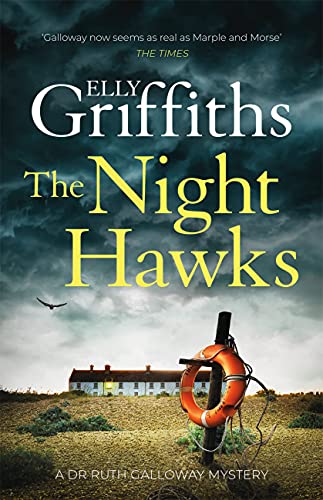
The Night Hawks by Elly Griffiths

Quercus| 4 February 2021|e-book| Print Length 321 pages| My own copy| 4*

Synopsis:

Dr Ruth Galloway returns to the moody and beautiful landscape of North Norfolk to confront another killer. A devastating new case for our favourite forensic archaeologist in this acclaimed and bestselling crime series.

The Night Hawks, a group of metal detectorists, are searching for buried treasure when they find a body on the beach in North Norfolk. At first Nelson thinks that the dead man might be an asylum seeker but he turns out to be a local boy, Jem Taylor, recently released from prison. Ruth is more interested in the treasure, a hoard of Bronze Age weapons. Nelson at first thinks that Taylor’s death is accidental drowning, but a second death suggests murder.

Nelson is called to an apparent murder-suicide of a couple at the isolated Black Dog Farm. Local legend talks of the Black Shuck, a spectral hound that appears to people before they die. Nelson ignores this, even when the owner’s suicide note includes the line, ‘He’s buried in the garden.’ Ruth excavates and finds the body of a giant dog.

All roads lead back to this farm in the middle of nowhere, but the place spells serious danger for anyone who goes near. Ruth doesn’t scare easily. Not until she finds herself at Black Dog Farm …

My thoughts:

The Night Hawks is the 13th book in the Dr Ruth Galloway books. I’ve enjoyed the earlier books, despite the fact that they are written in the present tense. But it’s been a while since I last read one, 5 years to be precise and I’ve missed a few of them as the last one I read was the 9th book, The Chalk Pit.

So, Ruth’s life has moved on the three books I haven’t read! There is a Who’s Who of the main characters at the end of the book giving their backstories which helps if you haven’t read the earlier books, and reminded me of who they all are and their relationships.

Ruth, the central character, is now Head of the Department of Archaeology at her old university, the fictional University of North Norfolk, having been promoted after the retirement of her old boss, Phil Trent. Her replacement as the archaeology lecturer is David Brown, who Ruth finds annoying. She doesn’t really know why as they have the same academic speciality, the prehistoric era, particularly as that is partly why she employed him to teach the courses that she used to teach. She is also a special advisor to the north Norfolk police.

Her complicated relationship with Detective Chief Inspector Nelson, the father of her daughter, Kate, now ten years old, continues in this book. Nelson thinks of himself as an old-fashioned policeman. But Superintendent Jo Archer is keen to bring the force into the twenty-first century and wants him to retire. He dismisses that idea, maintaining that the police force needs his experience and know-how. He has no plans to retire and avoids talking to her whenever he can.

A body is found on the beach at Blakeney Point, a young man who Nelson guesses is an illegal immigrant, an asylum seeker, and then a skeleton, buried in a mound of what appears to be Bronze Age weapons, discovered by the group known as the Night Hawks when they were searching for buried treasure.

The police are also investigating what at first appears to be a case of murder-suicide at Black Dog Farm, an isolated farm said to be haunted by the Black Shuck. Shuck is the name given to an East Anglian ghostly black dog that is said to roam the coastline and countryside of East Anglia, a large, shaggy dog said to be an omen of death. And there had been quite a few sightings of such a dog near Black Dog Farm.

I was thoroughly entertained by this mystery, glad to get re-acquainted with Ruth, her family and her friends and colleagues. There is a really strong sense of place, so much so that I could easily visualise the scenes and gain a sense of what it’s like to be there at the beach, with the shingle and the sand dunes at Blakeney Point and the north Norfolk countryside.

I hope to read books I’ve missed, namely The Dark Angel, The Stone Circle and The Lantern Men, before too long, and then the 14th in the series, The Locked Room.
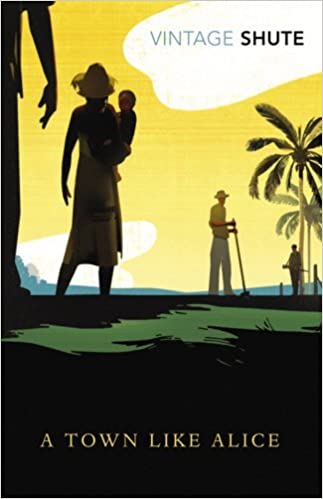
A Town Like Alice by Nevil Shute

Rating: 4 out of 5.

First published in 1950 A Town Like Alice by Nevil Shute is one of those books I’ve been meaning to read for years and now I have at last read it. It was not quite what I had imagined it to be, about Alice Springs in Australia. It is actually set in three parts, with just the third part set in Australia, not in Alice Springs but in Willstown, a fictional town in the outback.

Narrated by Noel Strachan, a solicitor, this is the story of Jean Paget. It begins a few years after the Second World War, when he tells her she has inherited a considerable sum of money from her uncle. But it is held in trust until she reaches the age of thirty five. Until then she will receive about £900 a year to spend. She wonders what to do with the money and eventually decides she wants to go back to Malaya, where she had been a prisoner of war, to dig a well. She tells Noel about what had happened to her in Malaya.

The second part is about that time in Malaya during the War at the time when the Japanese invaded the island. Jean and a group of European women and children were forced by the Japanese to walk for hundreds of miles from place to place before finally managing to stay in one village. Able to speak Malay and being courageous and resourceful, she takes on the role of the leader of their group. She met an Australian soldier, Sergeant Joe Harman, also a prisoner, who was driving a lorry for the Japanese and they became friends with disastrous consequences. This section is the best in the book to my mind.

On her return after the War she writes to Noel telling him how she set about organising the villagers to dig the well so that the women would have fresh water close to their houses and also build a washing-house. And it is here that she learns more about what had happened to Joe and decides to carry on travelling to Australia to find him and thank him for the help he had given her and the other women.

The third part is set in Australia. Jean is an organiser and on her arrival in Willstown she discovers that this is a place where the young women leave as soon as they are old enough. There are no jobs or entertainment to keep them there. So Jean decides she wants to make the town into a town just like Alice Springs. And she does this with remarkable success building a workshop for the girls to make shoes and handbags, providing an ice cream parlour and a public swimming pool and shops. At the same time her search for Joe is eventually successful. She continues writing to Noel about her life in the Australian outback, letters full of detail about her enterprises and the difficulties of cattle ranching in such isolated places – a bit too much detail for me really. But the episode where Jean helped in rescuing an injured stockman is full of drama.

This is really just the bare bones of the story – there is so much more to it than that. Others have commented on the casual racism in the book. It tells it as it was, how people lived at the time, and reflects the attitudes that people had. Jean is of course the main character, a woman somewhat ahead of her time with great strength of character, determination and entrepreneurial skills. The resourcefulness she showed in Malaya is developed in Australia.

In his Author’s Note Shute explains that the forced march during WW2 took place in Sumatra and not in Malaya and the women in the group were Dutch and not British. As in his novel, the local Japanese commander was reluctant to assume responsibility for these women and, to solve his problem, marched them out of his area and took them on a trek all around Sumatra that lasted for two and a half years.

Jean Paget was based on Mrs Geysel, whom Shute had met when he visited Sumatra in 1949. She had been one of the Dutch party, then aged 21, recently married and with a young baby she had carried for over twelve hundred miles around Sumatra. A remarkable story that I really enjoyed.

The Riddle of the Third Mile by Colin Dexter

Rating: 5 out of 5.

Pan| February 2011| 289 pages| e-book| 5*

From the Back Cover

Inspector Morse isn’t sure what to make of the truncated body found dumped in the Oxford Canal, but he suspects it may be all that’s left of an elderly Oxford don last seen boarding the London train several days before. Whatever the truth, the inspector knows it won’t be simple — it never is. As he retraces Professor Browne-Smith’s route through a London netherworld of topless bars and fancy bordellos, his forebodings are fulfilled. The evidence mounts; so do the bodies. So Morse downs another pint, unleashes his pit bull instincts, and solves a mystery that defies all logic. 

My thoughts

The Riddle of the Third Mile is Colin Dexter’s 6th book in his Inspector Morse series, first published in 1983. I remember watching the TV adaptation based on this book, The Last Enemy, but, as with most TV adaptations, it has several changes from the original. Like all of Dexter’s books this is a most complicated mystery, one of the ‘puzzle’ types. Dexter, himself, constructed crossword puzzles and made Morse a crossword aficionado. I agree with Sergeant Lewis when he asks Morse: ‘Aren’t you making it all a bit too complicated?‘ (page 145). I enjoyed trying to follow all the clues that Dexter planted in the mystery, although I had little idea about most of it. But I thoroughly enjoyed it.

The identity of the dismembered and headless corpse could have been that of Morse’s his old classics tutor, Browne-Smith or Browne-Smith’s hated rival, Westerby, or even one of the Gilbert twins who both harboured a grudge against Browne-Smith dating back to the Second World War. Or one of the twins could have been the murderer. Morse eventually works it out, by various means, including considering ‘the most improbable notions, in the sure certainty that by the law of averages some of them stood a more reasonable chance of being near to the truth than others.’ ( page 145) He’s also helped by his intuition, when a passage of scripture springs to his mind about forgiving one’s enemies: ‘ And whosoever shall compel thee to go a mile, go with him twain (Matthew 14.1)’ which he checks in a Gideon Bible, and letting his mind ponder this he remembers a sermon he had heard on the ‘Religion of the Second Mile’:

And it was with the forty-watt bulb shedding its feeble light over the Gideon Bible that Morse smiled to himself in unspeakable joy, like one who has travelled on a longer journey still – that third and final mile …

At last he knew the truth. (page 220)

I can’t say I was also enlightened, and so I just had to read on to find out what Morse had managed to deduce.

Along with the mystery details of Morse’s earlier life when he was a student at St John’s College, Oxford are revealed. He had failed the classics degree, known as ‘Greats’, after his love affair with a postgraduate student at St Hilda’s, Wendy Spencer, came to an end. It had had a disastrous effect on his academic work.

… he departed from Oxford, a withdrawn and silent young man, bitterly belittled, yet not completely broken in spirit. It had been his sadly disappointed old father, a month or so before his death, who suggested that his only son might find a niche somewhere in the police force. (page 61)

I’ve now read 9 of the 13 Morse books:

1. Last Bus to Woodstock (1975) – read in October 2020 not reviewed
2. Last Seen Wearing (1976)
3. The Silent World of Nicholas Quinn (1977)
4. Service of All the Dead (1979)
5. The Dead of Jericho (1981)
6. The Riddle of the Third Mile (1983)
7. The Secret of Annexe 3 (1986)
8. The Wench Is Dead (1989)
9. The Jewel That Was Ours (1991)
10. The Way Through the Woods (1992)
11. The Daughters of Cain (1994)
12. Death Is Now My Neighbour (1996)
13. The Remorseful Day (1999)

Inspector Morse: A Mysterious Profile by Colin Dexter is also available, published as one of the Mysterious Profiles series of 26 books.

Synopsis:

The international-bestselling author answers readers’ questions and discusses the origins of the Oxford inspector with a penchant for classical music.

In 1975, Inspector Morse debuted, working to solve the case of a murdered hitchhiker in Colin Dexter’s Last Bus to Woodstock. The book led to a multimillion-bestselling mystery series and a television show that spawned a spinoff and a prequel. But how did the beloved DCI from Oxford come to be exactly?

In this quick read, Colin Dexter addresses some of the many questions posed to him by his readers. He reveals what motived him to break into crime writing and which authors and novels influenced him. He discusses Morse’s many traits and inner workings, as well as how he got his first Morse novel published. He also shares how he maintains a discipline with writing, how he deals with critics, and what it’s like to transform a series of novels into a television series.

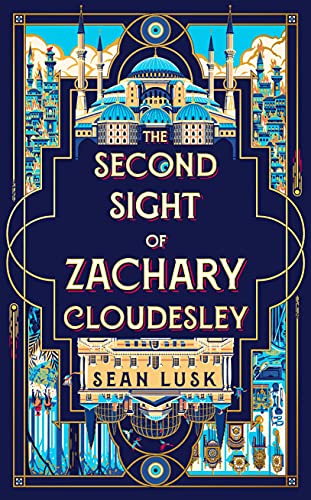
The Second Sight of Zachary Cloudesley by Sean Lusk

Random House UK, Transworld| 9 June 2022| e-book, print length 355 pages| Review copy| 4*

Synopsis from Amazon

In 1754, renowned maker of clocks and automata Abel Cloudesley must raise his new-born son Zachary when his wife dies in childbirth.

Growing up amongst the cogs and springs of his father’s workshop, Zachary is intensely curious, ferociously intelligent, unwittingly funny and always honest—perhaps too honest. But when a fateful accident leaves six-year-old Zachary nearly blinded, Abel is convinced that the safest place for his son is in the care of his eccentric Aunt Frances and her menagerie of weird and wonderful animals.

So when a precarious job in Constantinople is offered to him, Abel has no reason to say no. A job presented to him by a politician with dubious intentions, Abel leaves his son, his workshop and London behind. The decision will change the course of his life forever.

Since his accident, Zachary is plagued by visions that reveal the hearts and minds of those around him. A gift at times and a curse at others, it is nonetheless these visions that will help him complete a journey that he was always destined to make—to travel across Europe to Constantinople and find out what happened to his father all those years ago.

With a Dickensian cast of characters that are brilliantly bonkers one moment and poignant the next, Sean Lusk’s debut will take listeners on an immersive journey into the wonders of the world of Zachary Cloudesley.

I’ve enjoyed novels about clockwork and automata inventions before, so I was hoping Sean Lusk’s debut novel, The Second Sight of Zachary Cloudesley would be just as enjoyable – and it is. It’s a mixture of historical fact and fantasy set in the 18th century, in London and in Constantinople.

It follows the events in Zachary’s life from his birth in London, brought up two strong-minded women, surrounded by the clocks and clockwork automata in his father’s workshop, to his teenage years, when he travelled to Constantinople in search of his father, Abel. Zachary, an intelligent and gifted child, who had visions of future events, had an unusual most unusual life – as indeed, did Abel.

For me this book was as much about Abel as about Zachary and I loved the rich descriptions and all the detail that Lusk packed into his book. It did slow the action down at times, but it didn’t spoil my enjoyment at all. The characters are fabulous, the settings are beautifully described and the historical background is fascinating.

Lusk begins his book with an extensive note about Ottoman heirachy in the mid eighteenth century and ends it with a section of Historical and Other Notes explaining that his inspiration to write his novel came when he discovered an eighteenth century Ottoman clock made in England, in a shop in Istanbul. He finally produced his book after several years of research into clockmaking, Anglo-Ottoman relations and other 18th century matters, and having spent numerous hours in the British Library. He also includes a list of books for further reading. It is a remarkable book on a grand scale that entertained me enormously. I’m looking forward to reading more books by Sean Lusk.

About Sean Lusk

Sean Lusk is an award-winning short story writer, winner of the Manchester Fiction Prize, the Fish Short Story Prize and runner-up in the Bridport and Tom-Gallon Trust prizes. He has lived in Greece, Pakistan and Egypt, working variously as a gardener, speechwriter and diplomatic official. He now lives near Forres on the Moray Firth. The Second Sight of Zachary Cloudesley is his debut novel.

My thanks to Random House, UK for a review copy via NetGalley.