Britain in Books

A few days ago Cath at Read Warbler wrote about doing her own personal USA Challenge, which got me thinking about doing something similar but based in Britain. I love books with a strong sense of location so it seemed quite straightforward – I’d read books set in Britain.

Then I realised it’s not as simple as that – how was I going to decide on the locations? For centuries the people of the British Isles have been discussing, debating and even fighting over how we should divide up the land. Now, I don’t want to get into politics (I’m not saying anything about moves from different sections of our community for ‘independence’), so I thought I’d focus around our counties.

Again not simple. At first I thought I’d use the current local administrative areas, forgetting all the reorganisation that seems to be always on the go! How could I have forgotten after working for over 20+ years in local government! It’s not only the physical areas that keep being tinkered with but also the names of our counties. It’s  complicated and confusing. Eventually I came round to the idea of using the Historic Counties of the United Kingdom – there are 92. With so many counties, I’m making this an open ended project, because I shan’t be restricting my reading to just British books, by any means.

Map source: The Association of British Counties

I’ll read fiction in different genres, I’ll stray into poetry and drama occasionally and I’ll also include non-fiction – history, travel, diaries, biographies and so on. As well as focusing on the counties I’m also going to include regional books and books about the four countries that make up the United Kingdom of Great Britain and Northern Ireland – England, Northern Ireland, Scotland and Wales, not forgetting the surrounding islands.

I shall most likely expand/adapt this project and I plan to make a separate page on this blog to record my progress.

I’m not waiting until next year to start – I’m beginning now, in the far north, in the Shetland Isles reading White Nights by Ann Cleeves.

Saturday Snapshots – Great Hetha Walk

We’ve been having a mix of weather recently what with wet days, windy days, dull grey days and a few beautiful sunny days. Wednesday was one of the days when the sun shone the sky was blue and it even felt a bit spring-like. So that afternoon Dave and I decided it was time we took a walk in the Cheviot Hills.

We’ve lived just north of the Cheviots for nearly two years now and have been saying ever since we arrived that we must go walking in the hills. I don’t know how many hills there are that form the range, but there are many of these rounded hills bisected by valleys. They straddle the border between England and Scotland, that area of land fought over in the past, a land where the Border Reivers held sway. The Cheviot, itself is the highest point at 815 metres and the last major peak in England, but we decided to start small with Great Hetha above College Valley and work up to walking the Marilyns.

The photo above shows the view at the start of our walk with Great Hetha on the skyline. It’s 210 metres at the summit where there are the remains of an ancient hillfort. We parked in the car park just south of Hethpool and the walk began easily enough along the private road through the Valley. The photo below shows the Valley looking south:

After a short distance and turning right it’s a steep uphill climb described in Walks in the Cheviot Hills by David Haffey as a ‘strenuous climb‘! I was soon struggling for breath. We stopped halfway up to look at the view northwards to Scotland (and to get our breath back!).

Looking up at that point we could see a small cairn on the summit, still a steep climb ahead.

It was worth the climb to reach the hillfort. This is an Iron Age hillfort dating from about 500BC. The remains of the stone ramparts are still there and it was easy to imagine what it must have been like in such an isolated place, being able to see for miles around, aware of any approach to the hill. According to the Walks guidebook such hillforts would have contained several timber-built round-houses within the stone ramparts, probably being occupied for several centuries.

From there we left the route in the guidebook and walked down the other side of the hill to the valley below and crossed the Elsdon Burn. The sky was most dramatic:

It was getting towards the end of the afternoon and as we headed back to the car, the sheep were being rounded up in the field, below a wooded dome-shaped hill known locally as the Collingwood Oaks (after Admiral Lord Collingwood – there is a hotel in Cornhill called the Collingwood Arms, more about that another time maybe). I wasn’t quick enough to take a photo of the running sheep (they were galloping!) but I managed to snap the farmer and his three sheepdogs on their way back, with the Collingwood Oaks in the background.

There are more photos of our walk on Flickr.

Saturday Snapshot is hosted by Alyce, At Home With Books.

Saturday Snapshot

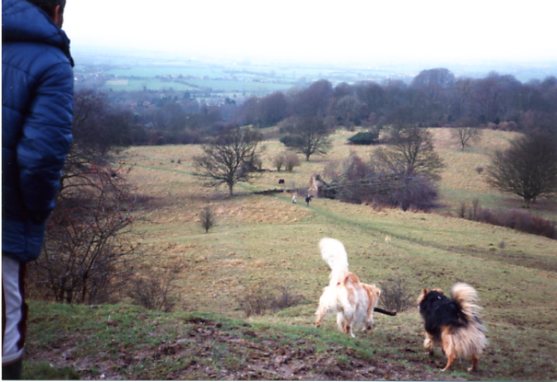
I’m stepping back in time again this week for my Saturday Snapshot, but not quite as far back as last week. This is a photo of the two dogs we used to have, enjoying running for a stick in the Chiltern Hills, near our home at that time, in Great Kimble in Buckinghamshire. We were on the footpath below Pulpit Wood looking down on the old rifle range.

Zoe is the golden retriever, who always had to get the stick first with Ben, the border collie cross following on behind.

Saturday Snapshot is hosted by Alyce of At Home With Books.

Saturday Snapshot

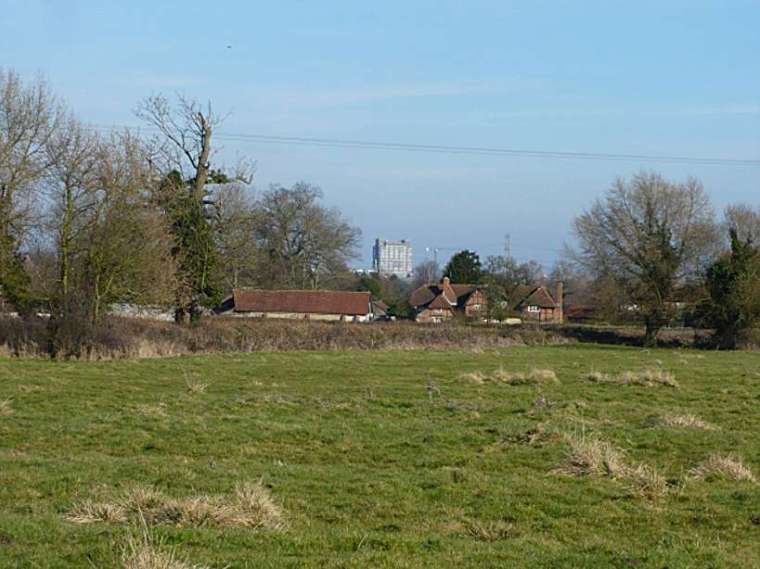
I have a scrolling photo viewer on the computer desktop and this photo greeted me this morning when I switched the computer on. It’s the view from the field near to my previous house looking towards the town of Aylesbury in Buckinghamshire. The grey tower block in the background is where I used to work at the County Council offices – I was on the 8th floor, just over halfway up the building.

I like this photo because it shows the contrast between the old and the new, although the County Hall tower block is not new, completed in 1966, it’s certainly centuries older than the timber-framed house in the foreground.

Believe it or not, the tower block, sometimes called Pooley’s Folly after the architect, is a Grade II Listed Building. It’s constructed out of concrete and glass and whilst I was working there it was discovered that the core of the building was crumbling and it had to be reinforced. We were surrounded by scaffolding for months. It’s also a most inconvenient building to work in, boiling hot in the summer, freezing in the winter, draughty windows and only two lifts serving 13 fours and no service lift. I spent hours in total over the years I worked there just waiting for the lift. Still, that meant I had more time to read whilst waiting.

Saturday Snapshot is hosted by Alyce of At Home with Books.

Tryfan, Snowdonia

Tryfan is the 14th highest peak in Wales at 3010 feet.

I took this photo from the car as we were travelling along the A5 in the Ogwen Valley, part of the Nant Ffrancon Pass. The A5 Holyhead to London trunk road was re-engineered by Thomas Telford between 1810 and 1826.

Here it was shrouded in clouds.

And here is a photo taken later that same day when the clouds had cleared a bit. The speck in the sky is a helicopter, possibly a mountain rescue helicopter from RAF Valley stationed on Anglesey.

An ABC Wednesday post T is for …