A Death in the Dales by Frances Brody

A Death in the Dales (Kate Shackleton #7)

A Death in the Dales is the 7th book in Frances Brody’s Kate Shackleton series of historical crime fiction books set in 1920s Yorkshire. Kate is an amateur detective. I’ve read the first two, Dying in the Wool and A Medal For Murder, and so I’ve jumped ahead in the series with this book. It’s not always possible to read a series in order and in this case I don’t think it matters – A Death in the Dales reads well as a standalone.

It’s 1926 and Kate Shackleton’s friend, Dr Lucian Simonson, has offered her the use of his late Aunt Freda’s cottage in Langcliffe for a short holiday with her niece Harriet, who is recovering from diphtheria. Ten years earlier Freda had witnessed the murder of the landlord of the alehouse across the street from her house. A man was found guilty of the murder and hanged – but Freda was convinced that they had convicted the wrong man.

Freda’s friend Mr Wigglesworth, the local apothecary, asks Kate to investigate the murder and gives her Freda’s papers regarding the trial. Although she had intended to have a holiday from her investigations she can’t resist looking at the papers and is convinced that Freda had wanted to her to solve the mystery and find out who had killed the pub landlord.

As well as investigating the murder, Kate also helps Harriet and her new friend, Beth to find out what has happened to Beth’s young brother who has gone missing from the farm where he was working, and then a suspicious death on the same farm.

I enjoyed reading about life in the 1920s; Frances Brody paints a very believable picture of life in a rural setting in the Dales during the post World War One years. Kate is a very likeable character and has to overcome the suspicion of strangers from the local community once she starts digging into the past. And there is the added complication of Kate and Lucian’s personal situation. All in all it’s a complicated mystery with several strands, numerous suspects and plenty of red herrings.

Frances Brody is an excellent storyteller and her books are well-plotted and complex murder mysteries in the historical setting of the 1920s and in the style of the golden age crime fiction.

The series so far is:

1. Dying in the Wool (2009)
2. A Medal For Murder (2010)
3. Murder in the Afternoon (2011)
4. A Woman Unknown (2012)
5. Murder on a Summer’s Day (2013)
6. Death of an Avid Reader (2014)
7. A Death in the Dales (2015)
8. Death at the Seaside (2016)
9. Death in the Stars (to be published in October 2017)

Reading Challenges: Mount TBR 2017 and What’s in a Name? in the category: ‘A title in which at least two words share the same first letter ‘“ alliteration!’

  • Paperback: 384 pages
  • Publisher: Piatkus (1 Oct. 2015)
  • Language: English
  • ISBN-10: 0349406561
  • ISBN-13: 978-0349406565
  • Author’s website: Frances Brody
  • Source: I bought it

The Classics Club Spin Result

The spin number in The Classics Club Spin was announced yesterday. It’s number …

12

which for me is Wives and Daughters by Elizabeth Gaskell. The rules of the Spin are that this is the book for me to read by May 1, 2017.

Wives and DaughtersI’m pleased with the result as it will give me the push to get round to reading more of Elizabeth Gaskell’s novels.

Here’s the blurb from Amazon:

Gaskell’s last novel, widely considered her masterpiece, follows the fortunes of two families in nineteenth century rural England.  At its core are family relationships ‘“ father, daughter and step-mother, father and sons, father and step-daughter ‘“ all tested and strained by the romantic entanglements that ensue.

Despite its underlying seriousness, the prevailing tone is one of comedy.  Gaskell vividly portrays the world of the late 1820s and the forces of change within it, and her vision is always humane and progressive.

The story is full of acute observation and sympathetic character-study:  the feudal squire clinging to old values, his naturalist son welcoming the new world of science, the local doctor and his scheming second wife, the two girls brought together by their parent’s marriage’¦

Everything but the Truth by Gillian Mcallister

A brilliant book full of secrets and lies

Just how much can you trust the person you love?

Everything but the Truth is Gillian McAllister’s stunning breakthrough thriller about deceit, betrayal and one woman’s compulsive need to uncover the truth

It all started with the email.

Rachel didn’t even mean to look. She loves Jack and she’s pregnant with their child. She trusts him.

But now she’s seen it, she can’t undo that moment. Or the chain of events it has set in motion.

Why has Jack been lying about his past? Just what exactly is he hiding? And doesn’t Rachel have a right to know the truth at any cost?

My thoughts

I was hooked right from the start of Everything but the Truth by Gillian McAllister. It has everything – it’s very readable and well written, with a great sense of place, set in both Newcastle and Oban, with clearly defined and believable characters, a complex plot with plenty of twists and turns, and a dark secret. It is up to date about social media and information about the internet and how to find hidden information (which as I’m not that computer savvy I had to Google to see if it was genuine – it is). The atmosphere in this book is tense and increasingly dark and claustrophobic. Everything but the Truth is an outstanding book in my opinion.

I didn’t want to stop reading it and when I wasn’t reading it I was thinking about it. As well as being about lies and secrets it’s also about relationships. How we get to know people and learn to trust them. Rachel and Jack are in a very new relationship and there is still an awful lot they don’t know about each other. And when Rachel realises Jack has a secret she doesn’t know how to get him to open up to her about it. Just what is his secret and is it really so terrible that he can’t talk about it? And why can’t he drive? But what does Jack really know about Rachel? Is she hiding something too, or is she paranoid?

Gillian McAllister’s debut book is simply excellent, written with assurance and with great insight into human nature. It is without doubt one of the best books I’ve read this year.

Thank you to Gillian McAllister, the publishers and NetGalley for my copy of this book for review.

  • Format: Kindle Edition
  • File Size: 1230 KB
  • Print Length: 420 pages
  • Page Numbers Source ISBN: 1405928263
  • Publisher: Penguin (9 Mar. 2017)

Let the Dead Speak by Jane Casey

A murder scene, but where’s the body?

The first book in Jane Casey’s Maeve Kerrigan series was The Burning, published in 2010, but I didn’t get round to reading it until February 2015. I was hooked immediately and read the next five books in quick succession by the end of August 2015. These are all police procedurals, fast-paced novels, with intriguing and complex plots and developing the relationships between the main characters. So, I think that although the books read well as stand-alones, it helps enormously to read them in order.

Let the Dead Speak  is the seventh Maeve Kerrigan book (published today, 9 March 2017 ) and it is no less intriguing and complex than the earlier books. I loved it.

Blurb:

When eighteen-year-old Chloe Emery returns to her West London home she finds Kate, her mother, missing and the house covered in blood. There may not be a body, but everything else points to murder. Maeve Kerrigan is young, ambitious and determined to prove she’s up to her new role as detective sergeant.

In the absence of a body, she and maverick detective Josh Derwent turn their attention to the neighbours. The ultra-religious Norrises are acting suspiciously; their teenage daughter definitely has something to hide.

Then there’s William Turner, once accused of stabbing a schoolmate and the neighbourhood’s favourite criminal. Is he merely a scapegoat or is there more behind the charismatic facade?

As the accusations fly, Maeve must piece together a patchwork of conflicting testimonies, none of which quite add up. Who is lying, who is not? The answer could lead them to the truth about Kate Emery, and save the life of someone else.

Let the Dead Speak continues to develop the detectives’ personal lives as well as detailing the investigations into Kate Emery’s disappearance. Maeve has been promoted and is now a detective sergeant (a long over-due promotion I think) and the murder investigation team has a new member, DC Georgia Shaw, a graduate on a fast-track scheme. Maeve finds her rather irritating. DI Josh Derwent is still her boss and neither he nor Maeve stick to the rules, but act independently as they see fit. The chemistry between the two of them is still there and is still full of undercurrents. DCI Una Burt is acting up as their Superintendent and the working relationship between her and Maeve is now improving.

There are several strands to the investigation – first of all if Kate was killed where is her body and who had the motive and opportunity to kill her? If she was not killed why is there so much blood in the house, whose blood is it, and where is Kate?

I enjoyed the fast-paced action, the interaction between the characters, both the police and the other characters. Chloe, who is very shy and lacking in confidence as well as in social skills is of little help in discovering what has happened to her mother. I liked the portrayal of the Norris family, Bethany and her parents and uncle, who are all members of an evangelical church, the Church of the Modern Apostles. Bethany refuses to answer Maeve’s questions and is openly hostile. Then there is the local ‘bad boy’ William Turner – what is his involvement? Similarly are Chloe’s father and stepmother and her step-brothers responsible in any way?

I kept changing my mind about what had happened and who was the guilty party, but it had me foxed. And then when I had it worked it out the last chapter surprised me yet again with the twist at the end. Maeve Kerrigan really is an excellent detective.

Thanks to the publishers via NetGalley for my copy.

  • Format: Kindle Edition
  • File Size: 1803 KB
  • Print Length: 352 pages
  • Publisher: HarperCollins (9 Mar. 2017)

The earlier books in the series are

0.5. Left For Dead (2013)
1. The Burning (2010)
2. The Reckoning (2011)
3. The Last Girl (2012)
4. The Stranger you Know (2013)
5. The Kill (2014)
6. After the Fire (2015)

My Week in Books: 8 March 2017

This Week in Books is a weekly round-up hosted by Lypsyy Lost & Found, about what I’ve been reading Now, Then & Next.

IMG_1384-0

A similar meme,  WWW Wednesday is run by Taking on a World of Words.

Now: I’m reading Northanger Abbey by Val McDermid and to compare and

Northanger Abbey (The Austen Project, #2) contrast I’m also reading Northanger Abbey by Jane Austen.

Northanger Abbey

I first read the Austen version many years ago and reading it now it’s only vaguely familiar. The McDermid version is amazingly similar in a modern context – Cat Morland goes to the Edinburgh Festival instead of to Austen’s Bath, John Thorpe is really awful, much worse than Austen’s Thorpe. McDermid’s Cat uses Facebook, instead of writing in a journal as Austen’s young ladies do and so on. I haven’t got them to Northanger Abbey itself in either version. It’s funny comparing the two books written almost 200 years apart.

And by way of yet more contrast I’m also reading See What I Have Done by Sarah Schmidt. This has a really creepy feel, looking into the mind of Lizzie Borden – it’s compelling reading.

Blurb:

Lizzie Borden took an ax
And gave her mother forty whacks
When she saw what she had done,
She gave her father forty-one.

Or did she?

In this riveting debut novel, See What I Have Done, Sarah Schmidt recasts one of the most fascinating murder cases of all time into an intimate story of a volatile household and a family devoid of love.

On the morning of August 4, 1892, Lizzie Borden calls out to her maid: Someone’s killed Father. The brutal ax-murder of Andrew and Abby Borden in their home in Fall River, Massachusetts, leaves little evidence and many unanswered questions. While neighbors struggle to understand why anyone would want to harm the respected Bordens, those close to the family have a different tale to tell’”of a father with an explosive temper; a spiteful stepmother; and two spinster sisters, with a bond even stronger than blood, desperate for their independence.

As the police search for clues, Emma comforts an increasingly distraught Lizzie whose memories of that morning flash in scattered fragments. Had she been in the barn or the pear arbor to escape the stifling heat of the house? When did she last speak to her stepmother? Were they really gone and would everything be better now? Shifting among the perspectives of the unreliable Lizzie, her older sister Emma, the housemaid Bridget, and the enigmatic stranger Benjamin, the events of that fateful day are slowly revealed through a high-wire feat of storytelling.

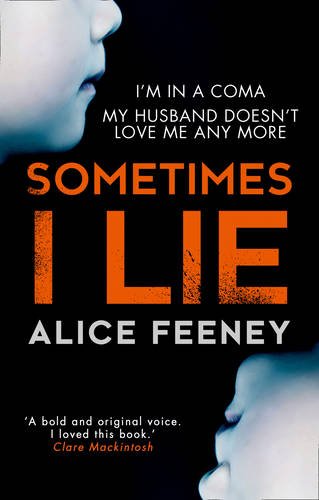
Then: The last book I read is Sometimes I Lie by Alice Feeney, an absolutely amazing and gripping psychological thriller due out on 23 March 2017. My review will follow soon. I loved it.

Next: I never decide what to read next until the time comes to choose a new book. It could be one of my TBRs – I’ve been neglecting them a bit this year. So, it could be The Gathering by Anne Enright, which is also one of the books I provisionally earmarked to read for the Begorrathon.

The Gathering

Blurb:

The nine surviving children of the Hegarty clan gather in Dublin for the wake of their wayward brother Liam. It wasn’t the drink that killed him – although that certainly helped – it was what happened to him as a boy in his grandmother’s house, in the winter of 1968.

The Gathering is a novel about love and disappointment, about thwarted lust and limitless desire, and how our fate is written in the body, not in the stars.

What are you reading this week’¦and in the future?

At the Edge of the Orchard by Tracy Chevalier

I’ve been reading some good books this year and At the Edge of the Orchard by Tracy Chevalier is no exception, which is no surprise to me as I’ve enjoyed all of her books that I’ve read so far.

At the Edge of the OrchardThis is historical fiction, a mix of fact and fiction. Most of the places are real (and there is a helpful map at the beginning of the book) and some of the characters are historical figures. There is a lot of information about trees – apple trees, redwoods and sequoias, all of which fascinated me (especially the sequoias) and formed integral parts of the book.

It’s the story of the Goodenough family, James and his wife Sadie and their five surviving children. It begins in 1838 in Black Swamp, Ohio where James and Sadie are arguing over apples and practically everything else. James is obsessed with apples and prefers the sweet variety, the eaters , whilst Sadie loves the ‘spitters’, the bitter apples to make cider and even better, applejack. Theirs is a marriage of opposites. They had settled in the only land available – the swamp and had struggled first of all to clear the land and plant the apple seedlings and seed they had brought with them from Connecticut.

Their story alternates between James’ perspective and Sadie’s – their voices clearly distinctive and recognisable. Sadie is bitter and vindictive, picking fights wherever she can and their family life is terrible. James, although he loves his children is unable to show his feelings and Sadie moves between extremes, is unpredictable, at times loving but more often vicious and cruel to them or simply indifferent. She constantly taunts James, and their relationship going from bad to worse. Of all the children Robert is the one who shows an interest in the apple trees.

In the second part of the book the focus is on Robert, the youngest son who leaves Black Swamp after an incident that is only revealed later in the book. He went west, working where he could including a stint as a gold miner in California, until he reached the ocean ending up in San Francisco where he worked for William Lobb (a real historical figure), collecting seeds and seedlings to send to England. His story is told through the unanswered letters he sent to the family over seventeen years.

The characters are wonderful, from the dysfunctional Goodenough family, to Molly, the strong, independent and resourceful woman Robert meets during the time he worked as a gold miner. I also liked Martha, Robert’s younger sister, who shows determination and spirit despite the heart-breaking situations she has to live through.

I loved the settings, and would love to visit places described such as Calaveras Grove and South Grove to see the giant redwoods and sequoias for myself, but I doubt very much that I will ever be able to see them. In the Acknowledgements Tracy Chevalier refers to a place nearer to home that I could visit. It is in Wales – the Charles Ackers Redwood Grove which was planted in 1857 by John Naylor of Leighton Hall.

The one criticism I have is the ending. I came to the last page and thought ‘is that it?’ – I wanted to know more. I hope there will be a sequel.

My thanks to the publishers and NetGalley for my copy of this book for review.

  • Format: Kindle Edition
  • File Size: 1824 KB
  • Print Length: 305 pages
  • Publisher: HarperCollins UK,  HarperFiction The Borough Press (10 Mar. 2016)