Six Degrees of Separation: Pride and Prejudice to Digging to America

Six Degrees of Separation is a monthly link-up hosted by Kate at Books Are My Favourite and Best. Each month, a book is chosen as a starting point and linked to six other books to form a chain. A book doesn’t need to be connected to all the other books on the list, only to the one next to it in the chain.

This month’s chain begins with the universally loved classic, Pride and  Prejudice, by Jane Austen.

Pride and Prejudice

This is a long time favourite of mine, a book I first read when I was about 12 after seeing a BBC adaption. It’s full of wit and humour and timeless characters – foolish people, flirts, bores, snobs, self-centred and dishonest people as well as ‘good’ people like Jane Bennet, who is determined to see good in everyone. Since then I’ve read all of Jane Austen’s books, apart from her Juvenilia books.

17th July was the 200th anniversary of her death and my first book in the chain is a book published to mark that anniversary. It’s a book I’m currently reading: Jane Austen at Home: a Biography by Lucy Worsley.  it focuses on her family and the places she lived during her short life. It really is a fascinating book for Jane Austen fans.

Jane Austen at Home

This leads nicely onto the second book in my chain – another biography of a favourite author, seen through the places she lived. It’s Agatha Christie at Home by Hilary Macaskill, an overview of Agatha Christie’s life followed by descriptions of the houses and countryside she loved ‘“ from Ashfield in Torquay her first home, where she was born and brought up, to Greenway, a Georgian mansion above the River Dart, now owned by the National Trust.  A beautiful book, with many photographs.

Agatha Christie at Home

Next a book also by a Hilary, Ink in the Blood: a Hospital Diary by Hilary Mantel, a short memoir which she wrote during the summer after she won the Man Booker Prize for Wolf Hall, when she was very ill. She had a marathon operation, followed by intense pain, nightmares and hallucinations. Illness she found knocks down our defences, revealing things we should never see, needing moment by moment concentration on breathing, on not being sick and being dependent on others for your well-being.

Ink In The Blood: A Hospital Diary

Blood provides the next link – The Blood Detective by Dan Waddell, crime fiction that absolutely grabbed me apart from the ending. It’s the sort of story that if I was watching it on TV I’d have to peep at through my fingers or even cover my eyes completely until the grisly bits were over. There are bits of graphic violence earlier in the book, which I could just about cope with, but the grisly stuff at the end was a step too far for me. It’s not just crime fiction though as DCI Grant Foster enlists the help of genealogist Nigel Barnes to track down the killer helping to solve the murders using family history.
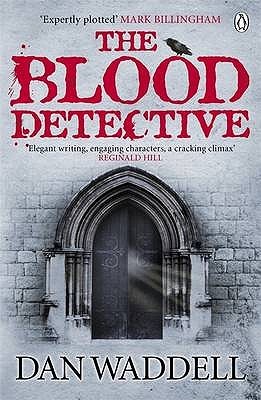
The Blood Detective (Nigel Barnes #1)

Also crime fiction – and also a bit grisly is The Legacy by Yrsa Sigurdardottir, the first in the Children’s House thriller series. I loved it and once I started reading I just didn’t want to put it down, even though there are some particularly dark and nasty murder scenes, which would normally guarantee that I’d stop reading. It’s dark, mysterious and very cleverly plotted, full of tension and nerve-wracking suspense about three children, two brothers and their little sister who were adopted.

And so to the last book in my chain, Digging to America by Anne Tyler, also about adopted children. It  captivated me right from the start, with the description of two contrasting families waiting at Baltimore Airport for the arrival of two Korean babies they have adopted. The story develops as the two girls, Jo-Hin and Susan (originally Sooki) are integrated into their families ‘“ one American, the Donaldsons, outgoing and confident and the other the Yazdans, American/Iranian, reserved and restrained.

Digging to AmericaI never know when I begin a chain where it will lead. This one has gone from 18th century England to 20th century America, via Iceland, and passing through biographies, a memoir, and crime fiction. ‘Family’ is a theme in all the books in one way or another and adopted children feature in three of them – in Jane Austen’s own family one of her brothers was ‘adopted’ by a wealthy relation and another went to live with another family because of his epilepsy.

Quite surprising, really. I wonder where other chains will go?
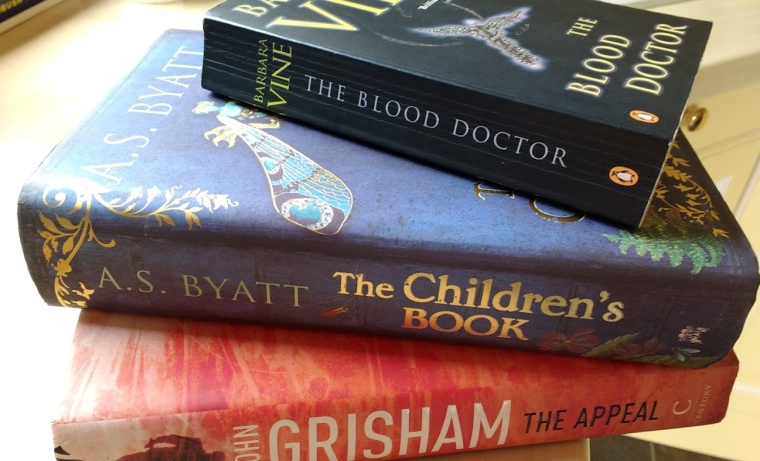
A-Z of TBRs: A, B and C

I thought a fresh look at some of my TBRs might inspire me to read more of them by the end of the year. So here is the first instalment of my A – Z of TBRs (I’m thinking of making this a regular post).

TBRs abc_edited

A is for The Appeal by John Grisham: a story of political and legal intrigue.  (On my TBR shelves since February 2008.)

People were hurrying from the courthouse from all directions when the Paytons parked on the street behind it. They stayed in the car for a moment, still holding hands For four months they had tried not to touch each other  anywhere near the courthouse. Someone was always watching. Maybe juror or reporter. It  was important to be as professional as possible. The novelty of a married legal team surprised people, and the Paytons tried to treat each other as attorneys and not as spouses.

B is for The Blood Doctor by Barbara Vine: a chilling tale of ambition, obsession and bad blood. (On my TBR shelves since July 2015.)

The Queen appointed him Physician Extraordinary in 1879. Most of her other doctors were in permanent residence but Henry, though sometimes staying a few days at Windsor, retained his professorship and his London home. Though he began on the lowest rung of the royal medical ladder, he enjoyed a special position. He was the Queen’s consultant on haemophilia.

C is for The Children’s Book by A S Byatt:  a saga about the years between the closing of the Victorian age and the dawn of the Edwardian, when a generation grew up unaware of the darkness ahead. (On my TBR shelves since August 2009.)

Everyone old and young, now gathered for a kind of sumptuous picnic. As happens in such gatherings, where those whose lives are shaped fortunately or unfortunately, are surrounded by those whose lives are almost entirely to come, the elders began asking the young what they meant to do with their lives, and to project futures for them.

If you’ve read any of these please let me know what you think?

Jane Austen, died 18 July 1817

Today is the 200th anniversary of Jane Austen’s death and there are many events to commemorate her death. Earlier this year I wrote about  The Spirituality of Jane Austen by Paula Hollingsworth, a combination of a biography and an analysis of Jane Austen’s works from the point of how they reveal her spirituality.

Currently I’m reading Jane Austen at Home by Lucy Worsley,

telling her life story through the places she lived, places like Steventon Parsonage, Godmersham Park, Chawton House and a small rented house in Winchester. Lucy Worsley examines the rooms, spaces and possessions which mattered to her, and the varying ways in which homes are used in her novels as both places of pleasure and as prisons. She shows readers a passionate Jane Austen who fought for her freedom, a Jane Austen very different from the one who famously lived a ‘life without incident’.

Jane Austen died in this house in Winchester

and is buried in Winchester  Cathedral’s north nave aisle.

My Friday Post

Book Beginnings Button

Every Friday Book Beginnings on Friday is hosted by Gillion at Rose City
Reader
 where you can share the first sentence (or so) of the book you are reading, along with your initial thoughts about the sentence, impressions of the book, or anything else the opener inspires.

I’ve recently finished reading Gallows View by Peter Robinson, the first Inspector Banks book and have decided to read the series in the order they were written. The second Inspector Banks book is A Dedicated Man. A Dedicated Man

When the sun rose high enough to clear the slate roofs on the other side of the street, it crept through a chink in Sally Lumb’s curtain and lit on a strand of gold blonde hair that curled over her cheek. She was dreaming.

This opening doesn’t tell me much about the book. If I didn’t know it’s an Inspector Banks book I’d probably not bother reading much further. But reading the blurb encourages me to read on:

Blurb:

Near the village of Helmthorpe, Swainsdale, the body of a well-liked local historian is found half-buried under a dry stone wall. Harry Steadman has been brutally murdered. But who would want to kill such a thoughtful, dedicated man?

Chief Inspector Alan Banks is called in to investigate and soon discovers that disturbing secrets lie behind the apparently bucolic facade. It is clear that young Sally Lumb, locked in her lover’s arms on the night of the murder, knows more than she is letting on. And her knowledge could lead to danger . . .

Also every Friday Freda at Freda’s Voice hosts The Friday 56

Friday 56

These are the rules:

  1. Grab a book, any book.
  2. Turn to page 56, or 56% on your eReader. (If you have to improvise, that’s ok.)
  3. Find any sentence (or a few, just don’t spoil it) that grabs you.
  4. Post it.
  5. Add the URL to your post in the link on Freda’s most recent Friday 56 post.

From Page 56:

‘He was a fine man, good-tempered, even-natured. He had a sharp mind – and a tongue to match when it came to it – but he was a good man; he never hurt a soul, and I can’t think why anyone would want to kill him.’

‘Somebody obviously felt differently,’ Banks said. ‘I hear he inherited a lot of money.’

I’m pleased that page 56 provides information about the man in the title and provides an answer to the question of why anyone would want to kill such a good man. I haven’t read much more of the book so I’m still in the dark about the motive – was the man really killed for his money?

What do you think? Would you continue reading?


The Unquiet Dead by Ausma Zehanat Khan

A powerful and thought provoking story

The Unquiet Dead by Ausma Zehanat Khan

I read The Unquiet Dead by Ausma Zehanat Khan in May. It’s due to be published by No Exit Press on 27 July 2017 (first published December 30th 2014).

Blurb:

One man is dead.

But thousands are his victims.

Can a single murder avenge that of many?

When Christopher Drayton’s body is found at the foot of the Scarborough Bluffs, Detectives Esa Khattak and Rachel Getty are called to investigate his death. But as the secrets of his role in the 1995 Srebrenica Massacre surface, the harrowing significance of the case makes it difficult to remain objective. In a community haunted by the atrocities of war, anyone could be a suspect. And when the victim is a man with far more deaths to his name, could it be that justice has at long last been served?

In this striking debut, Ausma Zehanat Khan has written a compelling and provocative mystery exploring the complexities of identity, loss, and redemption.

The harrowing account of the atrocities of Srebrenica in 1995 and the search for justice forms the basis of this intriguing novel. Extracts from statements and reports from survivors of the massacre head each chapter, giving voice to the ‘unquiet dead‘. These are immensely powerful and drive the novel. Alongside that is the investigation by detectives Esa Khattak and Rachel Getty into the death of Christopher Drayton who fell from the heights of the Scarborough Bluffs. Was it suicide, or an accident? Or was he pushed -and if so, who pushed him and why?

This is Ausma Zehanat Khan‘s debut novel but at times events in the past lives of the characters are referred to without much explanation and I felt I must have missed an earlier novel. For me, the investigation into Drayton’s death is the weaker part of the book. I think Rachel is the most convincing character, with Esa more of a shadowy personality, seemingly easily influenced by the women he meets. The other characters and there are a lot, aren’t particularly well-drawn and some are really just caricatures.

But these criticisms aside I think it is a powerful and thought provoking story that brought home to me the devastating and heart breaking horrors of the Srebrenica massacre of 8,000 Bosnian Muslims.

  • Paperback: 320 pages
  • Publisher: No Exit Press (27 July 2017)
  • Language: English
  • ISBN-10: 1843449447
  • ISBN-13: 978-1843449447
  • Source: Review copy via Lovereading
  • My rating: 3*