What a gloomy day outside. I knew it was wet when my cat rubbed round my legs first thing this morning. Looking out of the window I could seen a fine sprinkling of snow. That’s all gone now and the rain has set in. What better thing to do than read Les Misérables for a while and then tackle the problem of where to store more books than will fit onto our bookshelves.
I’ve made good progress this week with reading Hugo’s masterpiece. I’d put it on one side just after meeting Marius, the young aristocrat estranged from his grandfather. This week matters have progressed quite rapidly. Marius walking in the Luxembourg garden sees an elderly gentleman and a beautiful young girl. He falls in love with the girl (who is of course, Cosette). The following pages bring the sordid and wretched conditions of the poor so vividly to life as I read about the true “misérables” of this novel:
Certainly they appeared utterly depraved, corrupt, vile and odious; but it is rare for those who have sunk so low not to be degraded in the process, and there comes a point, moreover, where the unfortunate and the infamous are grouped together, merged in a single, fearful word. They are les misêrables – the outcasts, the underdogs.
I read with bated breath the account of Marius watching through a peephole the terrible happenings in the room next to his as ‘Monsieur Leblanc’ (Valjean) is ambushed, and I wondered how he was going to escape from both the gangsters and Inspector Javert. I have now finished Part Three, which ends with the introduction of a street urchin, another significant character I assume.
So for the rest of the day it’s more sorting and tidying. D has found a space for another bookcase and in his wonderfully resourceful way remembered he had the parts to make one. He has put them together and now it just needs fixing to the wall and then I can fill it up.
Share with us two (2) ‘œteaser’ sentences from that page, somewhere between lines 7 and 12.
You also need to share the title of the book that you’™re getting your ‘œteaser‘ from ‘¦ that way people can have some great book recommendations if they like the teaser you’™ve given!
Please avoid spoilers!
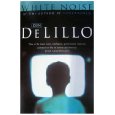
Today’s teaser is from page 73 of White Noise by Don DeLillo, which I am about to start reading.
They picked up pebbles where he’d walked and took them home as souvenirs. Crowds came to hear him speak, crowds erotically charged, the masses he once called his only bride.
The blurb on the back cover informs me that this book is an extraorinarily funny book on a serious subject. It’s the story of Jack Gladney and his wife Babette who are both afraid of death. Jack is the head of Hitler studies at the College-on-the Hill. His colleague Murray runs seminars on car crashes and he and Jack ponder the instances of celebrity death from Elvis to Marilyn to Hitler.
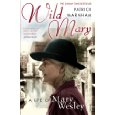
I’ve written before about the number of books I have on the go and today is no exception. Earlier this week I read Anita Shreve’s new novel Testimony, which I’ll write about in another post. Whenever I finish one book even though I’m in the middle of reading others an irrestible urge comes over me to start another. It was a bit difficult to decide but I settled on Wild Mary: the life of Mary Wesley by Patrick Marnham. I’d read and enjoyed Mary Wesley’s The Camomile Lawn many years ago and although I don’t think I’ve read anything else by her I thought this biography might be interesting. This morning’s reading took me nearly to the end of chapter 2. I stopped reading at an interesting point where Mary aged 6 refused to walk to the edge of a cliff with her mother to look down on the waves crashing over the rocks below – not because she was afraid of heights, but because she was frightened of her mother and didn’t trust her an inch. A real cliff-hanger!
Mary Wesley came from a privileged background with military connections on both sides of her family. The first chapter of the book is almost a history lesson informing me that Mary was descended from the Duke of Wellington’s older brother, Richard who became Governor-General of India and in 1797 when he was given an English barony chose the title ‘Baron Wellesley of Wellesley in Somerset’. A privileged background doesn’t always make a happy childhood and Mary, who had 16 governesses, was a “formidably obstructive child” who knew she was unwanted by her mother. From the acknowledgements and list of sources at the end of this book it promises to be a detailed and well researched biography.
In contrast I’m also reading today Mark Twain’s Adventures of Huckleberry Finn. I started it a few weeks ago and am enjoying it much more than ever I thought I would. I had no idea it was so amusing and I love the way Mark Twain interweaves commentary on racial and class prejudice with the mishaps and adventures of Huck and his companions as they make their way down the Mississippi. This morning’s reading included the wonderful mish-mash the ‘duke’ compiles of Hamlet’s soliloquy. His version mixes together quotes from Hamlet, Macbeth and Richard III and it becomes:
To be or not to be; that is the bare bodkin
That makes calamity of so long life;
For who would fardels bear, till Birnam Wood do come to Dunsinane,
But that the fear of something after death
Murders the innocent sleep,
Great nature’s second course,
And makes us rather sling the arrows of outrageous fortune
Than fly to others that we know not of.
I hope later on today to get back to Les Miserables as I haven’t made much progress with it for a while. The weather is helping me now as it’s so dark and dank outside with a steady drenching fine rain that looks as though it has settled in for the rest of the day. I was going to go outside and rake up some leaves but I think I’ll settle down with Les Miserables, maybe do some wii fit (I’m in danger of becoming a wii fit addict) and then watch the results show of Strictly Come Dancing – I can’t believe John Sergeant will survive another week, much as I like him!
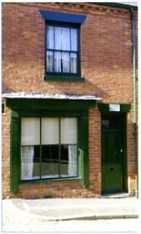
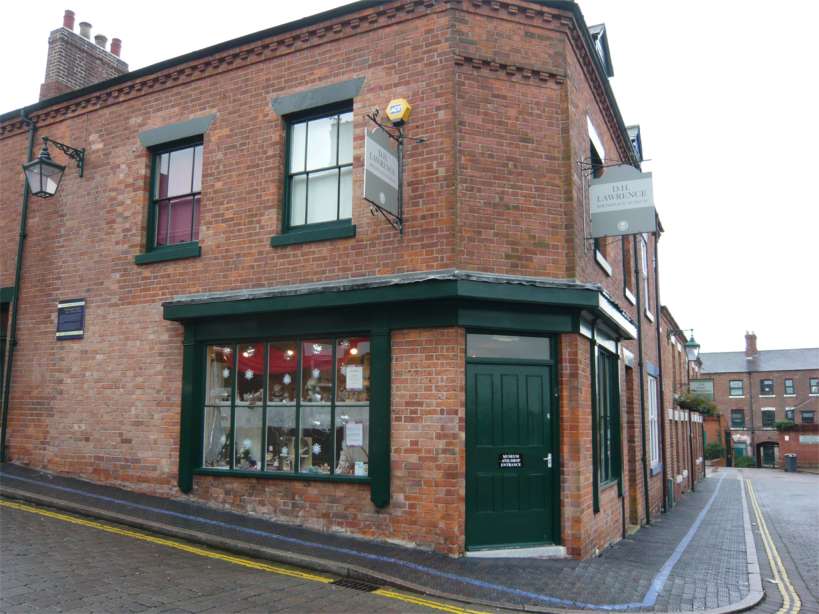
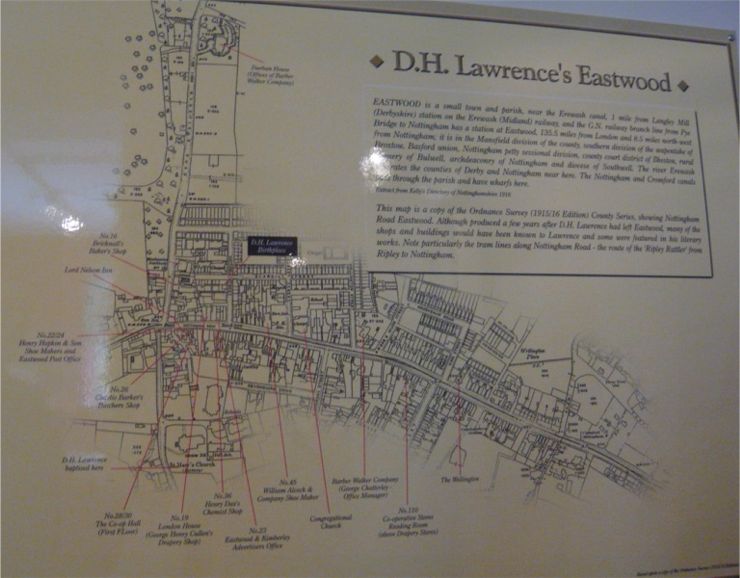
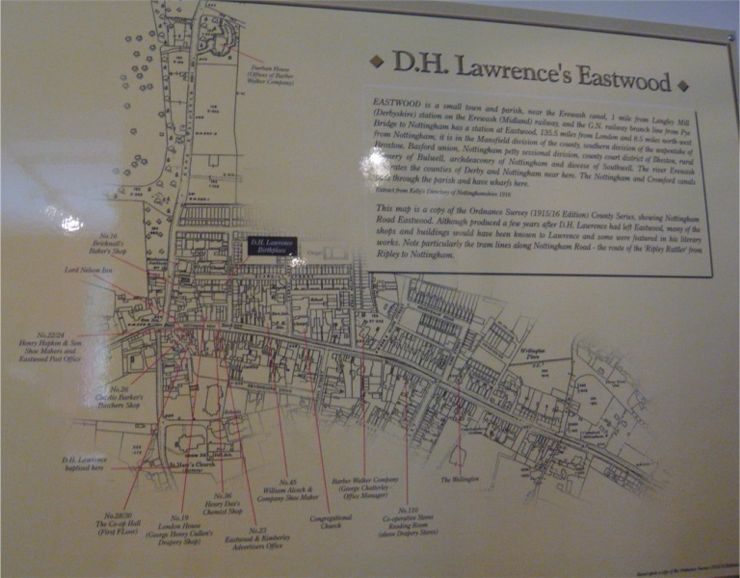
At the weekend D and I went to Nottingham and whilst there we visited D H Lawrence’s birthplace at Eastwood, 8 miles from Nottingham. 8A Victoria Street is the house where Lawrence was born on 11 September 1885 and I think it is a fascinating place. The house was newly built when the Lawrence family moved there in 1883, one of several rows of houses built for the miners by the local colliery company, Barber Walker and Co. It’s a redbrick two-up, two-down standing in a row of terraced houses. The adjoining end terrace house is now a museum and shop.
We were the only visitors and we had a most informative and interesting guided tour of the house – it was as though the family had just left, with the fire lit in the kitchen range and the table laid out with examples of everyday objects of a miner’s family. Although the furniture dates from Lawrence’s early childhood some of it, such as the chiffonier had actually belonged to the Lawrence family. We saw the parlour, the ‘best’ room, only used for visitors, such as the vicar. The parlour window was used as a shop window displaying clothing and lace made by Lydia, Mrs Lawrence, although the customers had to come to the back door to buy items. We also saw the kitchen – the heart of the house, and the bedrooms, one where Lawrence was born and the children’s bedroom where they all slept together in one bed. Outside is the washhouse, where children on school visits can experience a little of what it was like when water had to be drawn by pump and heated in a copper to do the weekly washing. There is no bathroom, of course, and baths were also taken weekly in a tin bath in front of the fire in the kitchen, with all the family using the same water.
Lydia’s family thought she had married beneath her, even though Arthur her husband was a “butty”, responsible for a team of miners working at the coalface. Lydia had been a non-certified teacher and having lived in Kent she didn’t have the same accent as her neighbours, who felt she was putting on airs and graces. D H Lawrence was known to his family as Bert. He was a sickly child who missed a lot of schooling but still went on to win a scholarship at the grammar school. Mrs Lawrence had ambitions for all her children, encouraging them in their education and careers; in contrast to Arthur who hated books, she loved to read, borrowing books from the Mechanics’ Institute library close by the house. Even though Lawrence only lived there for the first two years of his life I found it easy to picture him and his brothers and sisters living there.
In the museum next to the family house one room upstairs is full of his paintings and some of his personal belongings, such as his travelling trunk. I knew very little about Lawrence before and didn’t know that he painted. Some are landscapes and some are nudes. Nothing too shocking was on display but as with his book Lady Chatterley’s Lover, they were considered immoral and shocking at the time. You can also watch a short DVD on Lawrence outlining his life and works. Downstairs is a small shop with Lawrence’s books on sale and other gift items. My visit had made me more interested in Lawrence so I bought a biography of him by John Worthen, D H Lawrence: the Life of an Outsider. Worthen was the Professor of D H Lawrence Studies at the University of Nottingham where he is now Emeritus Professor.
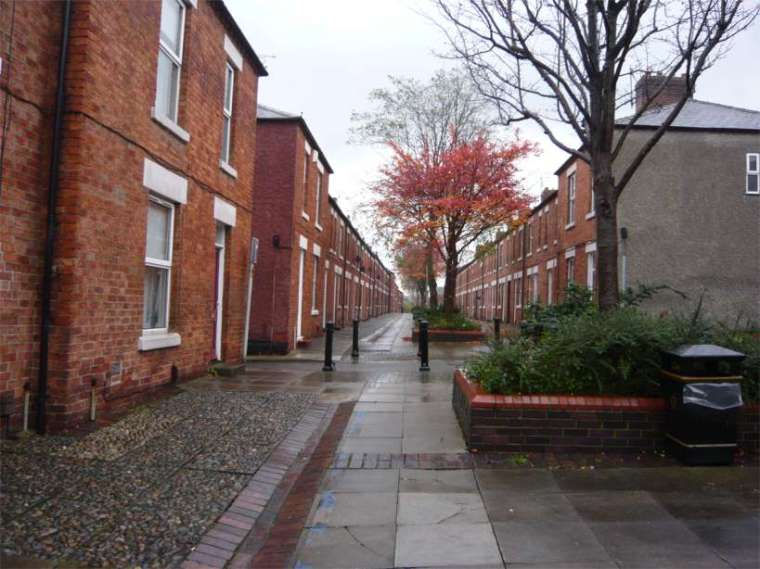
Eastwood, itself seems to be a museum of Lawrence, which is remarkable really as he himself felt out of place there, although he loved the countryside around, calling it “the country of my heart”. There is a Blue Line Trail around the roads leading to the houses he lived in and some of the places he used to visit. In the photo below of Princes Street you can just see the blue line on the paving slabs. Lawrence’s Uncle Walter and his family lived here close to Victoria Street (the bollards mark the junction with Victoria Street).
We also visited the D H Lawrence Heritage Centre, which is in Durban House where the colliery owners lived and where Lawrence used to go to collect his father’s wages. The exhibition shows the area as it was when Lawrence was a child – the farm where he used to visit the Chambers family, the school and the conditions of the coalmines.
Also on display is the copy of Lady Chatterley’s Lover, used by the prosecution at the trial in 1960 when Penguin Books were prosecuted under The Obscene Publications Act 1959, with all the passages and phrases considered as obscene underlined in red. The book had been published a number of times before Lawrence’s death in 1930 but it was the decision by Penguin Books in 1960 to publish the unexpurgated text and the extensive publicity this and the trial received that led to the widespread sale of the book.
I have started to read Worthen’s book. It’s very readable and detailed – as the quote from Claire Tomalin on the back cover indicates it is
The best and fullest portrait yet of this great English novelist and poet.
I’d like to think this would please Lawrence – it’s such a contrast to the criticism of one reviewer in 1928 of Lady Chatterley’s Lover to which Lawrence responded:
Nobody likes being called a cesspool.
It’s amazing that you can visit both the Birthplace Museum and the Heritage Centre for free on weekdays!
I’m currently reading All Quiet On The Western Front by Erich Maria Remarque. So it seems appropriate today on 90th anniversary of the end of World War 1, with the cease fire on the Western Front, to quote from this book:
The horror of the front fades away when you turn your back on it, so we can attack it with coarse or black humour. When someone is dead we say he’s ‘pushing up the daisies’, and we talk about everything the same way, to save ourselves from going mad; as long as we can take things like that we are actually fighting back.
But we do not forget. All that stuff in the war issues of the papers about the wonderful cheeriness of the troops, who start arranging little tea-dances the minute they get back from being under fire in the line, is complete rubbish. It isn’t because we are cheerful we make jokes, it’s just that we keep cheerful because if we didn’t, we’d be done for. All the same, it can’t hold all that much longer – the jokes get more bitter with ever month that passes. …
The days, the weeks, the years spent out here will come back to us again, and our dead comrades in arms will rise again and march with us, our heads will be clear and we will have an aim in life, and with our dead comrades beside us and the years we spent in the line behind us we shall march forward – but against whom, against whom?
Remarque’s story of German soldiers in the trenches vividly portrays the horror and futility of war.
This year I joined the What’s In a Name? Challenge, which has been very enjoyable. I’m currently reading After the Fine Weather by Michael Gilbert in the Weather category and that will complete this year’s challenge.
Next year the new Challenge is to read one book from each of 6 different categories between January 1, 2009 through December 31, 2009:
A book with a “profession” in its title.
Dear and Glorious Physician – Taylor Caldwell
The Vicar of Wakefield – Oliver Goldsmith
Doctor John Lee of Hartwell – Hugh Hanley
A book with a “time of day” in its title.
The Meaning of Night – Michael Cox,
The Friday Night Knitting Club – Kate Jacobs
A book with a “relative” in its title.
Sex Life of my Aunt – Mavis Cheek
the Sixth Wife – Suzannah Dunn, Daughters of Fire Barbara Erskine,
My Cousin Rachel – Daphne Du Maurier
A book with a “body part” in its title.
Needle in the Blood – Sarah Bower
A book with a “building” in its title.
Castle Dor – Daphne Du Maurier,
The Wasp Factory, Iain Banks,
The House of Spirits – Isabelle Allende,
The Mill on the Floss – George Eliot
A book with a “medical condition” in its title.
Love in the Time of Cholera – Gabriel Marcia Marquez
These books are all in my to-be-read list, so that should make it not too difficult. My choices in the “body parts” and “medical condition” categories are rather limited at present and of course, I may decide to add different books as time goes by.
 What a gloomy day outside. I knew it was wet when my cat rubbed round my legs first thing this morning. Looking out of the window I could seen a fine sprinkling of snow. That’s all gone now and the rain has set in. What better thing to do than read Les Misérables for a while and then tackle the problem of where to store more books than will fit onto our bookshelves.