Adding to My To-Be-Read Piles

wlwo

Some more books found their way to me last Saturday. In the  morning the postman delivered When the Lights Went Out: Britain in the Seventies by Andy Beckett sent to me courtesy of LibraryThing Early Reviewers Programme.  Actually, the postman  just left it propped up against the wall by the front door and I didn’t find it until about 11am, so anyone could have walked off with it!  This is a whopping book of over 500 pages and it’ll take me ages to read. The Seventies were times of strikes, the three-day week and the Winter of Discontent. My first impressions of this book are that it looks well researched from the number of sources Beckett has used and there’s a chronology that may be useful, but it does look as though it could be more of a political history than I would like.

I went to a booksale on Saturday afternoon. I debated with myself whether I should go or not, after all I don’t need any more books right now, especially considering I’d just got When the Lights Went Out.  But the booksale was in aid of Multiple Sclerosis and other local charities so I felt I ought to go, because if my reading helps other people that’s a plus.

There  were plenty of books to choose from both fiction and non-fiction and I came away with these:

  • The Country Life by Rachel Cusk, the winner of the Somerset Maugham Award 1998. I’d enjoyed her Arlington Park, so I thought this looked good. On the back cover it’s described as being a mixture of P G wodehouse and Jane Austen!
  • Mrs Jordan’s Profession: the story of a great actress and a future King by Claire Tomalin.  The biography of Dora Jordan, a comic actress and the mistress of William IV in late-eighteenth century England. My knowledge of this period is very slight and of the history of the theatre, practically non-existent. I am addicted it seems to Claire Tomalin’s biographies.
  • A Place of Greater Safety by Hilary Mantel. This is yet another massive book – it’s nearly 900 pages long. I do like historical fiction and Hilary Mantel’s writing. From the back cover:

Superbly readable … nothing less than a well-researched but richly idiosyncratic fictional history of the French Revolution …

  • Billy by Pamela Stephenson. This biography by Billy Connolly’s wife was my husband’s choice, but I’ve no doubt I’ll read it one day. Billy is a very funny comedian, although not everyone’s cup of tea. Recently we watched his TV series Journey to the Edge of the World when he travelled through the North West passage from the Atalantic to the Pacific, packed with laughter, information and stories of pioneers, colourful characters and wierd and wonderful scenery.

Library Loot

library-lootLibrary Loot is a weekly event co-hosted by Eva and Alessandra  that encourages bloggers to share the books they’ve checked out from the library.

I haven’t written about my Library Loot for a few weeks as I’ve been trying to catch up on reading my ever-growing piles of books. I have of course been visiting the library but not adding much to their issue figures. In fact I’ve returned more recently than I’ve borrowed.

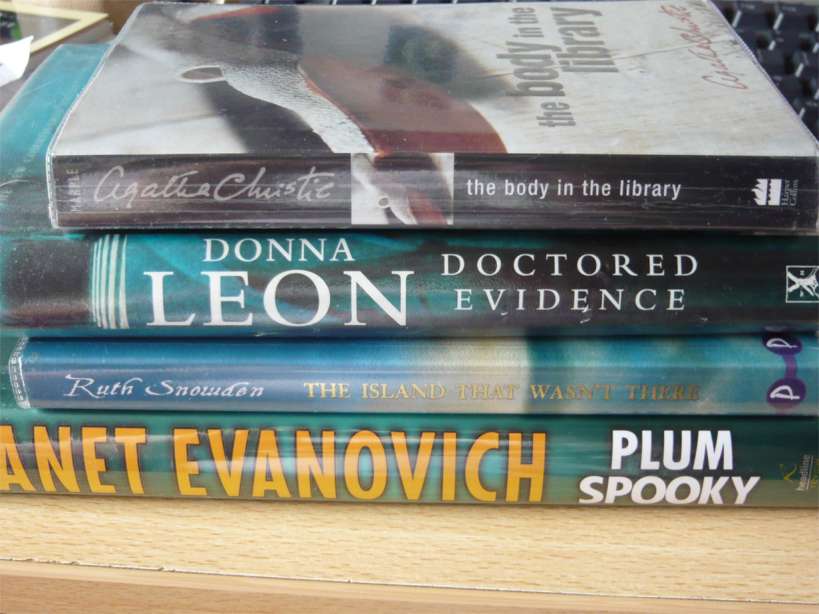
But here are four more library books I’ve acquired in the last few weeks, none of which I’ve started to read (descriptions from the library on-line catalogue):

library-loot-christie

  • The Island That Wasn’t There by Rita Snowden.  “One day, Rosie finds a mermaid, Anemone, tangled in the seaweed. The mermaid is too scared to swim back. But when Rosie tries to get help, no one believes her – except for an old man called Yan Eye.”  This children’s book  is Rita Snowden’s first novel.  So far I’ve only looked at a few pages but it is obviously drawn from folk-lore and myths.
  • Doctored Evidence by Donna Leon. When the body of a wealthy elderly woman is found, brutally murdered in her Venetian flat, Commissario Brunetti decides – unofficially – to take the case on himself. I keep reading about Donna Leon’s books – how good they are etc, but I’ve never read one. I like the  map of Venice on the inside covers of the book.
  • Plum Spooky by Janet Evanovitch. Stephanie Plum is back in town, along with her sidekick Lula, her Grandma Mazur, and an ever-widening cast of freaks, criminals, deranged felons, and lunatics looking for love. And just when Stephanie thinks her life can’t get any more complicated, in walks the mysterious Diesel. Janet Evanovich is another author I’ve never read, but seen reviews on some blogs. I thought I’d try this one.
  • The Body in the Library by Agatha Christie. No library description, but then the title says it all. From the back cover – “The Bantrys have awoken to find the body of a young woman in their library. … But who is she? How did she get there? And what’s the connection with another dead girl, whose charred remains are later discovered in an abandoned quarry?” I must have read this years ago, but as I’m taking part in the Agatha Christie Reading Challenge I decided to read it again. Have a look at the Agatha Christie Reading Challenge Carnival for reviews of Christie’s books.

Here are two more phtos of my library – the Children’s Section and the little reading area where my husband sits and reads the paper whilst waiting for me to choose books – he chooses his much more quickly than I do.

local-library-childrens-section


local-library-reading-area

Non-Fiction – Musing Mondays

monday-musingToday’s MUSING MONDAYS post is about reading non-fiction€¦

Do you read non-fiction regularly? Do you read it in a different way or place than you read fiction? (question courtesy of Diane).

I don’t read a lot of non-fiction, but I do read it regularly. I like to have at least one that I’m reading in between reading fiction. I read mainly biographies, books on history, religion, art, travel and cookery.

I don’t read them differently from fiction, apart from the travel and cookery books, which I use as reference books – dipping into sections rather than reading them straight through. I do like looking at cookery books for inspiration and at travel books to get an idea of what places look like. I suppose I read cookery books mainly in the kitchen, but really I read books wherever I am (including cookery books).

I think the one main difference when I’m reading non-fiction is that it’s usually for information and I don’t often make notes of what I’m reading as I do with fiction. The indexes help and sometimes I wish fiction had indexes too. 

Click on the graphic above to read more Monday Musings.


Sunday Salon

tssbadge1

It’s been a good week for reading. I finished:

It has taken me weeks to read Sue Roe’s book, as I took it slowly, savouring the detail. Whereas both Ferney and We Have Always Lived in the Castle  are the type of books that demand to be read and it was impossible to read them slowly.

I’ve started reading three very different books:

I’ve only just started each one, but in their different genres they all promise well. I won’t be finishing them all this week as Melvyn Bragg’s book is 551 pages and A N Wilson’s is 624 pages!

Ferney: Tuesday Teasers

teaser-tuesdayIt’s Tuesday again – the day for posting two or three sentences as teasers from a book you’re currently reading without giving away any spoilers, hosted by Mizb.

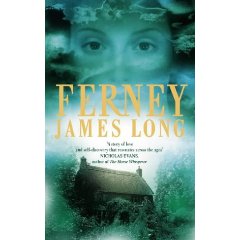
Today my teasers are from Ferney by James Long. I’m  not very far into it but so far I think it’s absolutely fascinating. It’s a bit historical, and a bit mysterious with characters who can see what the landscape looked like in centuries long gone.

He lifted his head from the ghost of the wrecked tree and let his gaze wander across the landscape, changing, turning. The pylons in the valley flicked out, the cluster of new houses beyond them melted like butter, the woods writhed, grew ragged and stretched their boundaries, the fields divided themselves back with old, forgotten walls, and a hard, brash metal barn shrivelled back into a thing of sagging tile and stone. (page 30)

ferneyIn addition it has a young couple who have bought their dream cottage in the country – one that is derelict and in need of some tender loving care. But this brings their relationship under strain and Ferney, the old countryman who seems to know everything about  the house and the countryside complicates matters.