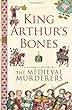
King Arthur’s Bones by The Medieval Murderers

King Arthur’s Bones is a historical mystery written by The Medieval Murderers, a group of five authors, all members of the Crime Writers’ Association. The book consists of five stories with a prologue and epilogue tracing the mystery of Arthur’s remains.

The legend is that King Arthur is not dead, but sleeping with his knights ready to return to defend his country in a time of great danger. So when monks at Glastonbury Abbey find what are thought to be his bones that causes great consternation. If these are his bones then Arthur really did die. The implications are too much for some and the bones mysteriously disappear from the Abbey.

The stories by Philip Gooden, Susanna Gregory, Bernard Knight, Michael Jecks and Ian Morson follow the bones from their discovery in 1191 at Glastonbury Abbey through to 2004 when archaeologists at Bermondsey Abbey discover a nineteenth century iron coffin containing an incomplete skeleton of what had been a large man who had probably died after a severe head injury.

Each story involves a murder, as the bones are passed down the centuries. They’re all colourful tales. I particularly liked the story (by Philip Gooden) set in the 17th century involving William Shakespeare’s brother Edmund who discovered a long thigh bone and murder in the Tower of London in one of the compartments of the Lion Tower where the king kept lions and tigers. 

Now that I was here, against my will, I could not see the beasts, but I could smell and hear them. I was in one of the compartments of the Lion Tower meant for animal use. More of a cave or a cell than a chamber it smelled rank. In the next-door cell was a body, not animal but human and supposedly murdered. (page 260)

These are entertaining tales, full of action and surprises. I liked the way the stories interlink around the central theme and the similarities and differences that contribute towards making this such an inventive story. I could believe that one day Arthur will return.

I’ll be looking out for the four earlier books The Medieval Murderers have published and for books by the individual authors as well.

Sunday Salon – Which Free* Book to Choose?

 Newbooks magazine arrived on Friday and as usual there are extracts from six books to read before deciding which one (if any) I’ll choose as my ‘free’ copy (*paying just for the post and packing). I haven’t read any of the extracts yet.

These are my initial thoughts on the books:

I have The Angel’s Game out on loan from the library so I probably won’t choose this one. It’s the second novel by Carlos Ruiz Zafon and like his first The Shadow of the Wind is set in Barcelona. It’s a stand-alone story about a writer of sensationalist novels in the 1920s; a tale about the magic of books. The author writes that it is a book to make you step into the storytelling process and become part of it.

This  is also a second novel, narrated by a sensitive thirteen-year old boy. It’s set in the 1960s in a small mining town in Australia and is a “coming-of-age” story. Silvey writes that he wanted to capture the thrill of that age, where everything seems bigger and the stakes seem higher. It’s a time of burned innocence. Infinite dangers. Fresh experiences that are never forgotten.

This was shortlisted for the 2009 Man Booker Prize and I borrowed it from the library last year. I read the beginning but it didn’t grab me then and I returned it unfinished. It’s based on the real-life story of the poet John Clare and the time he spent in an asylum in the 1840s. I was disappointed I couldn’t connect with this book, maybe it was just the wrong time for me to read it.

This one appeals to me. It’s Mari Strachan’s first novel and it’s about Gwenni, a Welsh girl growing up in the 1950s who is bookish, loves playing detective and can fly in her sleep. Mari Strachan writes about her contentment with quietude in the magazine and if her writing in the novel is anything like this I want to read her book. She writes

Quietude is a place in my mind that I travel towards on my own, a place that no one else is able to enter, a place far away from the babble of the world. It’s the place Yeats found in ‘The Lake Isle  of Innisfree’ where ‘peace comes dropping slow’, and the place Wordsworth described as his ‘inward eye that is the bliss of solitude’.

This book appeals to me too. I’ve read one of Andrea Camilleri’s Inspector Montalbano Mystery books and enjoyed it. This is his tenth one and like the others it’s set in Sicily. Montalbano investigates the murder of a young girl whose body is discovered in a trunk. There is an article in the magazine by Stephen Sartarelli on translating Camilleri’s books. He writes:

They are written in a language that is not ‘just’ Sicilian dialect, but a curious pastiche of that particular Sicilian of Camilleri’s native region (Agrigento province) combined with ‘normal’ Italian, contemporary slang, comic stage dialogue, lofty literary flourishes, and the sort of manglings of proper Italian made by provincials who have never learned it correctly.

This is a novel about the Brontes, which also appeals to me. I know nothing about Jude Morgan’s books but looking on Amazon I see he writes historical fiction. In the magazine he writes that he doesn’t ‘dislike contemporary fiction, but too much of  it is preoccupied with the earth-shaking problem of finding the right sexual partner in NW1.’  I like historical fiction, so maybe this would be the one to choose.

Today’s reading will be the extracts from these books which I hope will help me decide which one to pick.

More Books

We had to take a CD back to the library today, so I thought I’d just see what was on the shelves, not intending to borrow any more books as I already have more than I can read for months  ahead.

But when I saw The Breaking Point, short stories by Daphne du Maurier was on the “new in” stand I wanted to read it so I thought I might as well see if there were any more books I’d like to borrow. The blurb on the back cover tells me that The Breaking Point is a collection of “suspenseful tales in which fantasies, murderous dreams and half-forgotten worlds are exposed … often chilling, sometimes poignant, these stories display the full range of Daphne Du Maurier’s considerable talent.”

I felt it would be good to know more about the local area, so I looked in the Local History section and came away with 100 Days on Holy Island: a Writer’s Exile by Peter Mortimer. Holy Island, off the coast of north-east England is not far from where I now live. This book is an account of Peter Mortimer’s time on the island, cut off twice a day by the tides, exploring the landscape, people and myths. Peter Mortimer is a playwright and poet.

I’ve recently been reading King Arthur’s Bones by The Medieval Murderers and enjoyed the stories by Philip Gooden, one of the authors. So I looked to see if there were any of his Shakespearean Murder Mysteries, featuring Nick Revill. There was just one on the shelf – An Honourable Murderer. I see from Fantastic Fiction that this is his sixth Nick Revill book – ah well, maybe the library has his earlier books too. This one is set in 1604, with James I newly on the throne. Nick’s theatre company, the King’s Men, are part of the ceremonial celebrations. Nick investigates a number of suspicious deaths.

My Crime Fiction A – Z

Kerrie’s Crime Fiction Alphabet has come to the end. It’s been a most rewarding challenge. I’ve looked back at some books I read a while ago, read new books from favourite authors and discovered new authors.

The posts had to be related to either the first letter of a book’s title, the first letter of an author’s first name, or the first letter of the author’s surname. I did a mixture.

In the middle of the alphabet we moved house and I missed out the letter ‘L‘, so I’ve added in my review of Doctored Evidence by Donna Leon to complete the alphabet.

Here is my Crime Fiction A – Z:

They are all good reads in different ways.

I suppose it is inevitable that there are six books listed here by Ian Rankin and three by Agatha Christie as I’m reading steadily through their books. The series, though, has meant that I’ve sought out other authors, particularly to find those for the letters Q, X and Z and the books by the authors I found are probably the ones that most stand out in my mind now the series has come to an end.

Many thanks to Kerrie for thinking of this series. I hope she can come up with more ideas to stimulate my reading.

Wondrous Words Wednesday – King Arthur’s Bones

Wondrous Words Wednesday, run by Kathy (Bermudaonion),  is a weekly meme where we share new (to us) words that we’ve encountered in our reading.


This week I have a few words from King Arthur’s Bones by The Medieval Murderers, which I’m currently reading.

  • Calvarium – ‘Gingerly pulling that aside, they gazed down on a jumbled heap of mottled brown bones, some of which even their inexpert eyes recognised as human, especially as they glimpsed the rounded calvarium of a skull.’ (page 150)

I realised from the context what a calvarium is but didn’t know before that it is the upper domelike part of the skull without the jawbone or facial parts. From the Latin.

The next words all have a medieval origin as is to be expected in a book about medieval murder. No doubt I’ll come across more before I’ve finished this book. The meanings can all be surmised from the text but the dictionary definitions flesh out the words.

  • Cote-hardie – ‘A grey-haired man, dressed in a sombre but good-quality cote-hardie,  nodded his agreement.’ (page 157)

Obviously a garment of some sort – the dictionary defines it as a medieval close-fitting tight-sleeved body garment – from Old French.

  • Lymer – ‘ Before he got fifty paces, a dozen hounds broke cover, including several lymers and running dogs,  which hunted by scent rather than sight.’ (page 162)

Another word defined in the text, more specifically a lymer was  a forerunner of today’s bloodhound, used to find the lay of the game before the hunt even started, and it was therefore important that, in addition to a good nose, it remained quiet. Silence in the lymer was achieved through a combination of breeding and training. See this article on Medieval Hunting.

  • Mazer – ‘Peter lifted his eyebrows and gazed pensively at the jug as his bottler poured two mazers of wine.’ (page 201)

A mazer is a type of drinking bowl made originally of maple wood (Old French masere, of Germanic origin).

  • Murdrum – ‘ ” No need to worry about proving he was local, then. Just a murdrum fine and the usual amercements”, Sir Richard grunted.’ (page 210)

Again from the text I could understand that murdrum is a fine. Specifically as defined in the Norman Conquest Encyclopedia murdrum “derives from the Old French murdre from which the English word murder comes. The new law provided that if a Norman was killed and the killer was not apprehended within five days, the hundred within which the crime was committed should be liable for a collective penalty of whatever balance of the sum of forty-six marks of silver the lord of the hundred could not pay. The killing of a Saxon triggered no such penalty.”

  • Deodand – ‘I will say the weapon was worth at least a shilling, and that much is deodand.’ (page 219)

My Chambers Dictionary defines deodand as ‘ a personal chattel [property] which had been the immediate accidental cause of the death of a human being, forfeited to the crown for pious uses. (Latin deo to God, and dandum, that must be given from dare, to give).’

The online Free Dictionary gives additional information that it traces back to the 11th century and has been applied, on and off, until Parliament finally abolished it in 1846. In theory, deodands were forfeit to the crown, which was supposed to sell the chattel and then apply the profits to some pious use. In reality, the juries who decided that a particular animal or object was a deodand also appraised its value and the owners were expected to pay a fine equal to the value of the deodand. If the owner could not pay the deodand, his township was held responsible.

Teaser Tuesdays

Teaser Tuesdays is a weekly bookish meme, hosted by MizB of Should Be Reading.

Share a couple or more sentences from the book you’re currently reading. You also need to share the title of the book that you’re getting your ‘teaser’ from €¦ that way people can have some great book recommendations if they like the teaser you’ve given!

My teaser is from King Arthur’s Bones by The Medieval Murderers:

Each of the individuals who stared at these remains in the abbot’s parlour was lost for a time in his imagination, seeing a great and final battle in which a warrior-king had been fatally struck down. They put out their hands – even Michael and the other labourers – to touch the scullcap, the jaw-bone, the mighty shin-bone, the fragments of ribcage, as if some trace of Arthur’s spirit might be transmitted to their own blood and sinew. (page 22) 

This is a book of shortish interlinked stories tracing the whereabouts of King Arthur’s skeletal remains. It begins in 1191, when monks at Glastonbury Abbey discover an ancient cross and lying beneath in a hollowed out tree trunk are bones in the form of a body.

 Are these really King Arthur’s bones? As soon as the bones are found they are carried away by the ‘Guardians’ whose heritage is to protect them until the legend is fulfilled and Arthur returns to save his country. The story moves forward through the centuries and treachery, theft, blackmail  and murder follow the bones.