Weekly Geeks:Secret pasts and peculiar presents

Bernadette at Reactions to Reading asks these questions at Weekly Geeks :

A couple of incidents have prompted this week’s topic.

  1. I very much enjoyed the two Susan Hill novels that I’ve read and already have the next book in her series Simon Serrailler series on my audio book playlist. Then I discovered, via the author’s opinion column in a UK newspaper, that I don’t particularly like her personality (this piece is an example of what I found mean-spirited and inaccurate about her rants but there were other articles too). Suddenly her books did not seem so appealing any longer.
  2. Craig Sisterson’s excellent blog Crime Watch featured an article about historical mystery author Anne Perry who, as it happens, committed a particularly grim murder many years ago (at the ripe old age of 15). “Thank heavens I’m not a fan of hers” was my first thought.

So I have been pondering the issues of whether it is possible to separate an author’s non-writing life from the books they produce and thought I’d throw these questions over to you. Feel free to answer one or more of these and give examples if you have them.

Does an author’s politics matter to you? Do you have a favourite book or series written by someone you know to be your political opposite? Or have you stopped reading works by a particular author after discovering that their politics was radically different from your own?

What about their personality? Have you ever stopped reading an author’s work after seeing or hearing them talk because you didn’t like what you saw or heard?

And how about that secret past? How would you feel if you found out your favourite author was a murderer or some other kind of criminal? Are there some crimes that you would be OK about and others that would stop you following their work? Do you know about the pasts of ‘your’ authors? Do you want to?

I’d like to say that a writer’s personality and/or past life crimes don’t affect my reading their work and that I judge it on its own merits. But of course it does. It hasn’t actually stopped me reading their books but I find it means their books have to be sufficiently absorbing for me to disregard what I know about their authors. The only way to avoid that influence is not to read anything about an author.

With regard to Susan Hill, I like her books and had read those comments and articles she published, plus her blog. I don’t agree with everything she writes by any means, but I did find her blog entertaining, perhaps more so when I didn’t agree with her views, and I went to hear her talk at Abingdon. She is not an easy character, in my opinion, certainly not very comfortable speaking in public and she had some very sharp words to say about e-books and book bloggers. But I still enjoy her books and won’t stop reading them.

I’ve read one book by Anne Perry, which I didn’t think was very good and based on that book I decided not to bother reading any more of her books. I didn’t know anything at all about her, but when I saw other bloggers recommending her books I checked them online and read about her crime. I did wonder whether that would have affected my decision if I’d known about it when I chose her book to read but I suspect it wouldn’t have put me off. There are plenty of films and books about real-life crime and I have no qualms about watching/reading them.

Non-fiction is different. For example, I want to know that an author’s credentials are genuine when reading books on health, diet, exercise and so on. I used to go to a book group where one person always asked these question about an author – “Who is the person and why should we take any notice of what s/he writes? “.

Unfortunately I haven’t always asked myself those questions. I picked up Bad Science  by Ben Goldacre this morning, which my husband is currently reading. Ben Goldacre is a qualified doctor working for the NHS, so maybe I can trust his book. There is a chapter on “Dr. Gillian McKeith PhD”, which reveals that she is neither a medical doctor, nor is she qualified as a nutritionist. Her PhD was  bought from a non-accredited correspondence course college. I had watched her TV programmes, You Are What You Eat with interest and I even bought her book, which has since sat on the bookshelves unread, along with other books such as Carol Vorderman’s book Detox for Life – both of them totally useless books, Carol’s because, as my husband points out, I didn’t follow it, but then I didn’t want to spend loads of money on all the supplements she recommends, although some of her recipes are good. As my bookshelves are groaning under the weight of too many books I think it’s time to get rid of at least McKeith’s book.

April’s Best Books

I’ve been looking back at some of the best books I’ve read in the months of April beginning with April 2007. I’d left my job at the end of March 2007 and the amount of books I read that April was in reaction to being able to spend more time reading. I read 13 books that month. The highlights were many but these two stand out:

  • Hallucinating Foucault by Patricia Duncker, which I thought was excellent. This is both a love story and a story of obsession. It explores what it is to be ‘mad’ and the relationship between the reader and the writer. I’d hoped to read more by Duncker, but so far that’s just a wish.
  • The Secret of the Last Temple by Paul Sussman because of its intrigue and mystery. It’s a fast action book moving between time and location from Jersualem in AD70, Germany in 1944 to present day Egypt and Israel. I haven’t read any more of his books but have The Lost Army of Cambyses sitting here on the desk waiting to be read.

By April 2008 my reading rate had settled down and I read 7 books. Two of the best were:

  • Revelation by C J Sansom – historical crime fiction, the fourth in the series featuring lawyer Matthew Shardlake, set in the 16th century.
  • Giving Up the Ghost by Hilary Mantel – a remarkable memoir that came over to me as clear, honest and very moving. Now I must get reading her latest book, Wolf Hall.

In April 2009 I read 9 books and these two stand out:

  • Dead Man’s Folly by Agatha Christie – an Ariadne Oliver and Poirot mystery with such a misleading tangle of evidence that it kept me guessing to the end.
  • Star Gazing by Linda Gillard – a beautiful book, this is not just a love story, it’s also about how we ‘see’ the world, how we interact with other people and how we cope with our disabilities be they physical, emotional or otherwise.

And now this April’s best books, out of the 7 I read:

  • Take My Breath Away by Martin Edwards – a legal mystery, featuring Nic Gabriel, a lawyer turned writer. This is a complex book about good and evil, about power and manipulation, about secrets, lies and deception.
  • Faithful Unto Death by Caroline Graham – a Midsomer Murder mystery with more bite and more substance than the TV series.

Library Loot

I hadn’t intended to borrow any more library books for a while, at least until I’ve read at least half of the ones I’ve got out at present. But on Thursday I was watering the hanging basket at the front door and glancing down the road saw a mobile library van. We moved here in December and this was the first time I’d seen it. Needless to say I went across the road to have a look and came away with four books. It comes here every three weeks! So now I have three libraries locally that I can use – I’m spoilt for choice.

One of the books I borrowed is a great source of writers: Myers’ Literary Guide The North East. This includes not just writers born in the North East, which includes the counties of Northumberland, Tyne and Wear, Durham, and Cleveland, but also writers with important links to the area. These include such people as Wordsworth, Shakespeare, Coleridge, Auden and Larkin. This area of Britain boasts the first known writer of English prose – Bede (673 – 735) who was also known as ‘The Father of English History’ – and the first Christian English poet, Caedmon (fl. 670 – 680), a servant at the monastery in Whitby. The only drawback is that it concentrates on historical rather than modern writers.

I also borrowed:

  • Agatha Raisin and the Haunted House by M C Beaton. This was quite opportune because I’d read an article about Agatha in newbooks Crime Fiction Supplement the other day. The victim of the haunting is an old lady nobody likes. Then she is murdered. This looks as if it sits in the Cozy Mystery genre.
  • Indiscretion by Jude Morgan, who was also mentioned in the Supplement, so maybe that’s why one of his books stood out for me. This one is historical fiction set in Regency England.
  • The Cruellest Month: an Inspector Gamache Crime Novel by Louise Perry. I keep seeing her books mentioned on book blogs but haven’t read any of them yet. This is a Canadian whodunit about a seance in an old abandoned house that has gone wrong. Another Cozy Mystery?

Sunday Salon

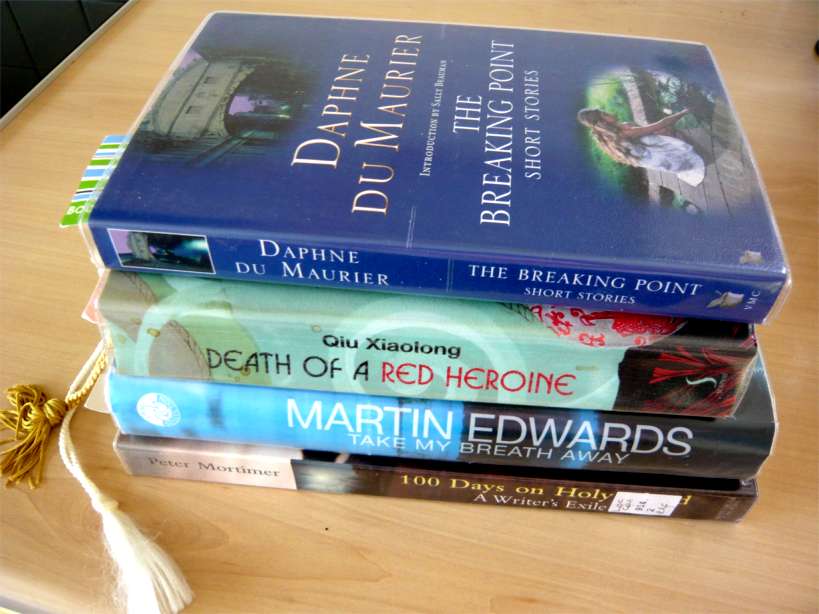
I’ve now started reading 100 Days on Holy Island: a Writer’s Exile by Peter Mortimer, a diary of the time he spent living on Lindesfarne, off the coast of north-east England, in a close-knit community of a 150 people. This is not a book about the history of the island but it is about what it was like for Mortimer to live there on his own away from his  family from January to April 2001.

It began badly as his father died just before Mortimer had planned to leave, and his nephew was very ill after an emergency operation. As it was winter there were few, if any, visitors to the island and the pubs and village store were closed for most of the time:

 It was silent in the way cities are never silent, silence not as a brief interruption from traffic, the humans, the incessant noise of civilisation, but silent as a way of being. What lay beneath the surface of this small settlement I had no idea. But on a bitter cold January night in 2001, it offered up silence as a totally natural state. (page12)

In preparation for his stay he had asked ten northern writers to select  a book (not written by themselves) that they thought might amuse,divert or challenge him during his stay. Nine of them gave him a book and I’m looking forward to discovering what they were. 

I can see already that I’m going to enjoy this memoir and hope the rest of the book lives up to the beginning.

I’ve dipped into The Breaking Point by Daphne du Maurier (short stories) this week and will continue reading that later on. Qiu Xiaolong’s Death of a Red Heroine has had to take a back seat for a while whilst I read these two books and I’m also tempted to start reading Martin Edward’s Take My Breath Away. I just wish I had more than one set of eyes and one brain to cope with reading multiple books – that would be excellent.

Agatha Christie – On Writing

Agatha Christie managed that most remarkable of achievements in publishing more than one book a year ever since the 1920s. How did she do it? Where did she get her inspiration I wondered?

I found some of the answers in the introduction to her spy thriller Passenger to Frankfurt, published in 1970.

Where did she get her ideas from?

Her immediate response:

‘I always go to Harrods’, or ‘I get them mostly at the Army and Navy Stores’, or, snappily, ‘Try Marks and Spencer.’

Her real answer is of course:

‘My own head.’

She did relent a little to add that if she had an attractive idea she would:

toss it around, play tricks with it, work it up, tone it down, and gradually get it into shape. Then, of course, you have to start writing it. That’s not nearly so much fun – it becomes hard work. Alternatively you can tuck it carefully away, in storage, for perhaps using in a year or two years’ time.

Do you take most of your characters from real life?

Her answer, indignantly:

No, I don’t. I invent them. They are mine. They’ve got to be my characters – doing what I want them to do, being what I want them to be – coming alive for me, having their own ideas sometimes, but only because I’ve made them real.

What about the settings?

She replied:

… it must be there – waiting – in existence already. You don’t invent that  – it’s there – it’s real.

… you don’t invent your settings. They are outside you, all around you, in existence – you have only to stretch out your hand and pick and choose.

Where do you get your information – apart from the evidence of your own eyes and ears?

Her answer:

It is what the Press brings to you every day, served up in your morning paper under the general heading of News. Collect it from the front page. What is going on in the world today? What is everyone saying, thinking, doing? Hold up a mirror to 1970 in England.

Look at that front page every day for a month, make notes, consider and classify.

Agatha Christie also wrote about her writing methods in her Autobiography:

Plots come to me at such odd moments: when I am walking along a street, or examining a hat-shop with particular interest, suddenly a splendid idea comes into my head, and I think, ‘Now that would be a neat way of covering up the crime so that nobody would see the point.’ Of course, all the practical details are still to be worked out, and the people have to creep slowly into my consciousness, but I jot down my splendid idea in an exercise book. (page 451)

Those exercise books she kept have now been published – Agatha Christie’s Secret Notebooks by John Curran and these too make fascinating reading. But here is what she herself wrote about her notebooks in her Autobiography:

… but what I invariably do is lose the exercise book. I usually have about half a dozen on hand, and I used to make notes in them of ideas that struck me, or about some poison or drug, or a clever little bit of swindling that I had read about in the paper. Of course, if I kept all these things neatly sorted and filed and labelled it would save me a lot of trouble. However, it is a pleasure sometimes, when looking vaguely through a pile of old note-books, to find something scribbled down, as: Possible plot – do it yourself – girl and not really sister – August – with a kind of sketch of a plot. What it’s all about I can’t remember now; but it often stimulates me, if not to write that identical plot, at least to write something else. (page 451)

What a fertile mind!

The Orange Prize for Fiction 2010 shortlist

The shortlist for the Orange Prize for Fiction includes one book I have but haven’t read yet – Wolf Hall and one book I haven’t got but would very much like to read – Lacuna.

The full list is:

Some wonderful titles there.

The two books on the longlist that I have read – Little Stranger and Hearts and Minds haven’t made the shortlist. Let’s hope the shortlisted ones are better than these two, which I did enjoy to a certain degree. My posts on Little Stranger and Hearts and Minds are here and here.

The prize will be awarded on 9 June.

Must get reading Wolf Hall and find a copy of Lacuna. I’m going to the library this afternoon, maybe some of the others will be there?