ABC Wednesday – H is for Hunt

William Henry Hunt (1790 – 1864) was an English watercolourist. This is one of my favourite paintings – Primroses and Bird’s Nest.


Hunt specialised in still life compositions, mainly fruit, flowers, nests and eggs – he was known as ‘Bird’s Nest’ Hunt. This is one of his bird’s nest paintings, measuring just 7½ inches by 10¾ inches. I saw a variation of this painting at the Royal Academy of Art ofThe Great Age of British Watercolours 1750 – 1880 exhibition several years ago. The catalogue describes Hunt as an outstanding technician. His work was admired by many, including John Ruskin who took lessons from him in 1854 and 1861.

There are a few details about Hunt in The Pre-Raphaelites by Timothy Hilton, including a reproduction of this painting. Amazingly, Hunt said:

I feel really frightened every time I sit down to paint a flower.

I think his paintings are just so beautiful. For more information on Hunt’s method of painting see Craig’s comment below.

See more ABC Wednesday posts.

Crime Fiction Alphabet – Letter I

Rebus’s Scotland: A Personal Journey by Ian Rankin is my choice to illustrate the letter I in Kerrie’s Crime Fiction Alphabet.

If you like the Rebus books, like me, then you’ll also like this book. It is fascinating to read, with insights into Ian Rankin’s own life and that of the character he has invented, along with his thoughts on Scotland and the Scottish character. It’s partly autobiographical, blending his own life with Rebus’s biography. It also describes many of the real life locations of the books, in particular Edinburgh, Rebus’s own territory.

I particularly enjoyed Ian Rankin’s views on writing – how writers mine their own experiences, reshaping their memories to create fiction and the similarities between novelists and detectives:

Both seek the truth, through creating a narrative from apparently chaotic or unconnected events. Both are interested in human nature and motivation. Both are voyeurs. (The Edinburgh-born Muriel Spark says that she and her fellow novelists ‘loiter with intent’ – playing on the idea of a criminal activity.) I certainly enjoy dipping into other people’s lives, giving fresh texture and tone to them, while Rebus has his own reasons for prying into everyone else’s secrets. (page 31)

He went on to quote from The Hanging Garden and then The Falls giving Rebus’s reasons – which were ‘to stop him examining his own frailties and failings.’

I’ve read all the Rebus books – links to my posts are in the Author Index (the tab at the top of the blog). Some of these are brief and last year I decided to make a page on each one to flesh them out a bit more. So far, that just remains an intention, although the parent page has a list of all the books. In preparing to write Rebus’s Scotland Ian Rankin re-read all his Rebus books. Here is his own analysis:

Authors seldom read their own work: by the time a book has been published, we’re busy with our next project. When a story is done, it’s done – reading it through would only make most authors want to tinker with it. Having said that, I enjoyed the majority of the Rebus novels. Knots & Crosses I thought wildly overwritten – definitely a young man’s book. Dead Souls possesses too many characters and story-lines: at points it confused even its author! But several books which had seemed real chores to write surprised me with their deftness – Set in Darkness and Let it Bleed especially. (I think they probably seemed chores because of the amount of political detail they had to embrace – it’s never easy to make politics seem exciting to the layman.) (page 125)

Throughout this book Ian Rankin quotes liberally from his books to illustrate the points he makes. He begins with a chapter on the place where he was born and grew up, which was in the same cul-de-sac as John Rebus – even in the same house. But really, of course, Rebus was not born there. He was created in a bed-sit in Edinburgh where Rankin was living and writing. He deals with Rebus’s ‘prodigious intake of alcohol‘, the Oxford Bar, his taste in music, the city of Edinburgh (Rebus’s territory) and Fife, where Rebus and Rankin have shared memories. I like the way he writes about Rebus as though he were a real person, sometimes admitting that he’s not sure what Rebus will do, but at the same time acknowledging that he is his creation.

An excellent book. My only criticism is that I would have loved it to have an index – maybe I’ll do one for myself

  • Paperback: 224 pages
  • Publisher: Orion; New Ed edition (1 Jun 2006)
  • Language English
  • ISBN-10: 0752877712
  • ISBN-13: 978-0752877716
  • Source: my own copy

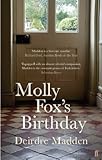
Molly Fox’s Birthday by Deirdre Madden: Book Review

I loved Molly Fox’s Birthday by Irish author, Deirdre Madden.

It takes place in one day, that day being Molly Fox’s birthday. Her friend, the unnamed narrator is staying in Molly’s house in Dublin whilst Molly is away and she reminisces about their friendship, wondering why Molly doesn’t like to celebrate her birthday. Molly is an actress and her friend a playwright, who has written plays in which Molly acted. Their friendship goes back a long way and during this one day she contemplates their past, how their relationship evolved and the relationships with their friends and families.

She thinks about their mutual friend Andrew, an art historian, Fergus, Molly’s disturbed brother, Tom, her own brother who is a priest and during the day both Andrew and Fergus turn up an announced on Molly’s doorstep. It’s written at a gentle pace, with vivid descriptions of the setting – the house and garden in Dublin

The big clock at the head of the stairs bonged softly for nine-thirty. I carried the mug out of the kitchen, into the hall and through to the sitting room. It looked this morning like some kind of jewelled casket, like a box of treasures. sunlight caught on copper and brass, was reflected in polished wood and mirrors. All this glitter and brightness was offset by the rich dark colours of the kilims on the floor. (page 44)

It’s a novel about identity as well as family and friendship, about how we see other people and how they see us. For example she had never really got to know Fergus but had heard of his problems from Molly. During her conversation on this day she realised that the Fergus she knew through Molly ‘timid, weak, a failure in life‘ had disappeared and the man she now knew for herself was a ‘man of wisdom and acute moral knowledge‘. It’s a novel about character and about the parts we play as well as the people we are, what we hide from others and what we reveal  to others. It’s the sort of book I could happily re-read and still find plenty to think about.

My first book towards the Ireland Reading Challenge.

Do the Write Thing! Charity Raffle


Do the Write Thing! is a charity raffle put together by Margot Kinberg at Confessions of a Mystery Novelist to raise funds for Christchurch, New Zealand earthquake relief.

Thanks to the generosity of 39 authors from around the world you’ve got a chance to win signed copies of some wonderful books for just about every taste. Each winner will get a package of 3-4 titles.

To enter the raffle click HERE.

Reading Challenges Update

I always find it difficult to keep track on where I am with the reading challenges I’ve joined, so as two months of the year have already gone I thought I’d check up on what I’ve read so far.

The Agatha Christie Reading Challenge open ended

The Daphne Du Maurier Challenge ‘“ May 13, 2010- April 19, 2011

The 2011 Global Challenge

Europe – I’ve read 2 books:

The Seventh Continent – History

The Victorian Reading Challenge

Currently reading The Moonstone by Wilkie Collins

Ireland Reading Challenge

  • Molly Fox’s Birthday by Deirdre Madden – review to follow

What’s in a Name 4

So far I’ve read 1 book from the category:

A book with travel or movement in the title

Booking Through Thursday – Cheating?

Today’s Booking Through Thursday question is:

Do you cheat and peek at the ends of books? (Come on, be honest.)

When I read this question I had a feeling that I’d answered it before and checking back in the blog I came across my answer back in June 2007. It was my very first Booking Through Thursday post. Here is what I wrote then:

I’m always tempted to look at the end of books and sometimes I do if the book is getting boring to see if it picks up. If the book is one that I can’t put down then I try to resist looking ahead ‘“ not always successfully though and then I wish I hadn’t!

Do I still think the same? Yes and no.

Yes, because now I don’t think of it as cheating at all – life is too short to continue reading a book that seems to be going nowhere, so I’ll look ahead to see if it looks as though it will pick up.

And no – now I don’t peek at the end of crime or mystery novels – that does spoil the experience.