The Classics Club Spin Result

Classics Club

The spin number in The Classics Club Spin was announced yesterday. It’s number …

5

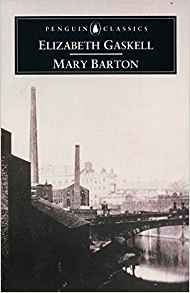
which for me is Mary Barton by Elizabeth Gaskell. The rules of the Spin are that this is the book for me to read by October 31, 2019.

Mary Barton


I’ve read some of Elizabeth Gaskell’s books and enjoyed them. This is her first book, set in Manchester between 1839 and 1842.

Here’s the blurb from Amazon:

Mary Barton, the daughter of disillusioned trade unionist, rejects her working-class lover Jem Wilson in the hope of marrying Henry Carson, the mill owner’s son, and making a better life for herself and her father. But when Henry is shot down in the street and Jem becomes the main suspect, Mary finds herself painfully torn between the two men. Through Mary’s dilemma, and the moving portrayal of her father, the embittered and courageous Chartist agitator John Barton, Mary Barton powerfully dramatizes the class divides of the ‘hungry forties’ as personal tragedy. In its social and political setting, it looks towards Elizabeth Gaskell’s great novels of the industrial revolution, in particular North and South.

Did you take part in the Classics Spin? What will you be reading?

First Chapter First Paragraph: The Vanished Bride by Bella Ellis

Every Tuesday First Chapter, First Paragraph/Intros is hosted by Vicky of I’d Rather Be at the Beach sharing the first paragraph or two of a book she’s reading or plans to read soon.

This week I’m featuring The Vanished Bride by Bella Ellis, one of the books I’m currently reading.

Vanished Bride

Haworth Parsonage, December 1851

Drawing her shawl a little closer around her, Charlotte adjusted her writing slope once more and dipped the nib of her pen into the ink, her head bent low, nose just above the paper. Yet, just as so many times before, her hand hovered over the blank page, and it seemed impossible to put pen to paper in a house so empty of anything but the ghosts of those she loved.

Blurb 

A young woman has gone missing from her home, Chester Grange, leaving no trace, save a large pool of blood in her bedroom and a slew of dark rumours about her marriage. A few miles away across the moors, the daughters of a humble parson, Charlotte, Emily, and Anne Brontë are horrified, yet intrigued.

Desperate to find out more, the sisters visit Chester Grange, where they notice several unsettling details about the crime scene: not least the absence of an investigation. Together, the young women realise that their resourcefulness, energy and boundless imaginations could help solve the mystery – and that if they don’t attempt to find out what happened to Elizabeth Chester, no one else will.

The path to the truth is not an easy one, especially in a society which believes a woman’s place to be in the home, not wandering the countryside looking for clues. But nothing will stop the sisters from discovering what happened to the vanished bride, even as they find their own lives are in great peril…

~~~

I’ve read nearly half the book so far and I’m really enjoying it. And it is making keen to get back to reading Juliet Barker’s biography, The Brontës, which I began reading last year!

What do you think – does The Vanished Bride appeal to you too?

Life After Life by Kate Atkinson

Life After Life 1

Transworld Digital|March 2013|Print length 477 pages| e-book|5*

I am delighted to say that I loved Life After Life. I wasn’t at all sure that I would as I began reading it soon after I bought it (in 2013) and didn’t get very far before I decided to put it to one side for a while. A ‘while’ became years – and then at the end of 2016 I read A God in Ruins about Ursula’s brother Teddy, and loved it and decided to try Life After Life again. But, even so it has taken me until this September to get round to reading it. I can’t imagine what my problem with it was in 2013, because this time round once I’d started it I just knew I had to read it and I was immediately engrossed in the story.

Ursula Todd was born on 11 February 1910 at Fox Corner during a wild snowstorm. In the first version she was born before the doctor and the midwife arrived and she died, strangled by the umbilical cord around her neck. But in the second version the doctor had got there in time and saved her life, using a pair of small surgical scissors to snip the cord

During the book Ursula dies many deaths and there are several different versions that her life takes over the course of the twentieth century – through both World Wars and beyond. Each time as she approaches death she experiences a vague unease, before the darkness falls. As she grows older she experiences different outcomes to the events that lead up to that feeling of unease, and finds that sometimes she can prevent the darkness from falling. By the end of the book I had a complete picture of a life lived to the full. I loved the way she experiences the same circumstances but because one little thing is changed it completely changes the whole sequence of events.

There is a constant thread throughout the book – the Todd family, Ursula’s mother, Sylvie, her father, Hugh, her aunt, Izzie, and her brothers and sisters, plus the family servants and friends. They all play more or less significant roles throughout Ursula’s life. It’s a large cast of characters but I had no difficulty in distinguishing them – they all felt ‘real’, partly I think because Atkinson is so good at depicting family life and relationships.

I would love to know more about several of the characters – Izzie, for one – Hugh’s wild bohemian sister, who Sylvie called a ‘cuckoo’ and Mrs Glover described as a ‘Flibbertigibbet’. Then there is Sylvie herself, who I found quite a mysterious character – in particular one of the chapters describing Ursula’s birth very near the end of the book set my imagination working overtime- what had Sylvie known and how? There is more about Ursula’s youngest brother, Teddy in A God In Ruins and I think I’ll have to re-read it soon to see what further light it throws on all the characters.

In some ways it is a tragic book – particularly the parts set during the war years. They are brilliantly written bringing the full of horror of war into focus; some of the standout scenes  are those in London during the Blitz. And it’s interesting to speculate how different the history of the twentieth century could have been if Hitler had been assassinated in 1930. The whole book is full of ‘what ifs’ – what if this character had behaved differently, what if that had not happened, what if you’d made a different choice of subject to study or a different career, or married a different person?  

In fact I think the whole book is excellent, well researched and with such a different structure so well done that it kept me glued to the pages. I wish I’d read it earlier – but it obviously wasn’t the right time for me to read it then.

Reading challenges: Mount TBR

Top Ten Tuesday: TBR Books That Keep Getting Left on the Shelves

top-ten-tuesday-new

Top Ten Tuesday is a weekly meme created by The Broke and the Bookish and now hosted by Jana at That Artsy Reader Girl. For the rules see her blog.

This week’s topic: Books On My TBR I’m Avoiding Reading and Why – (maybe you’re scared of it, worried it won’t live up to the hype, etc. I don’t have any books that I’m scared of reading or am worried about in any way.

So, this week I’ve adapted the topic to suit me and it is:

TBR books that I keep leaving on the shelves – including books on my Kindle. These books have not seen the light of day for ages as they’re from the back of my double shelved bookcases or from the depths of my Kindle, or I’ve not read them yet just because they are so long that I choose a shorter book to read in preference, or because I’m reading newer books or review books.

From the black hole that is my Kindle.

These are books I’ve forgotten I downloaded:

  • Flight Behaviour by Barbara Kingsolver – On the Appalachian Mountains above her home, a young mother discovers a beautiful and terrible marvel of nature: the monarch butterflies have not migrated south for the winter this year.
  • The Luminaries by Eleanor Catton – set in 1866, and Walter Moody has come to make his fortune upon the New Zealand goldfields. On arrival, he stumbles across a tense gathering of twelve local men, who have met in secret to discuss a series of unsolved crimes.
  • Sea of Poppies by Amitav Gosh – an epic saga, set just before the Opium Wars, an old slaving-ship, the Ibis is crossing the Indian Ocean, its crew a motley array of sailors and stowaways, coolies and convicts.
  • The One I Was by Eliza Graham – Rosamond Hunter is full of guilt about her involuntary role in her mother’s death. When her nursing job brings her back to Fairfleet, her childhood home, to care for an elderly refugee, she is forced to confront the ghosts that have haunted her for so long.

Forgotten books, some from the back of my bookshelves:

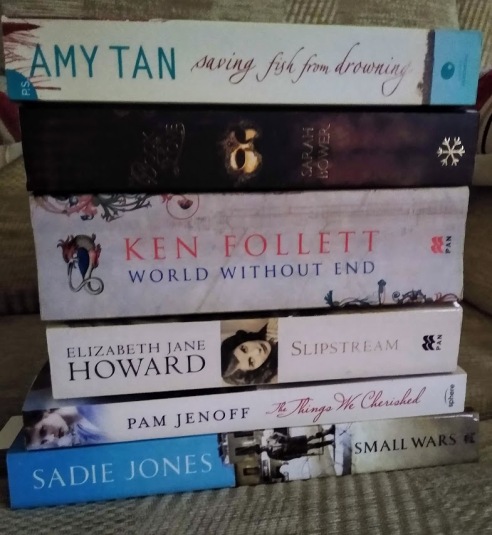
TBRs Sept 2019

  •  Saving Fish from Drowning by Amy Tan – On an ill-fated art expedition of the Southern Shan State in Burma, eleven Americans leave their Floating Island Resort for a Christmas morning tour – and disappear. (Hidden at the back of my bookshelves.)
  • The Book of Love by Sarah Bower, set in the late 15th/early 16th centuries historical fiction about the Borgias. (Hidden at the back of my bookshelves.)
  • World Without End by Ken Follett – Book 2 of 3 in the Kingsbridge series. I’ve read book 1, Pillars of the Earth. World Without End is set two centuries later  beginning in the year 1327. You can see in my photo above just how chunky this book is – 1237 pages in a very small font. Need I say more about why I haven’t read it yet!
  • Slipstream: a Memoir by Elizabeth Jane Howard – I love her Cazalet Chronicles, which is why I want to read this book. Why I haven’t yet is a mystery!
  • The Things We Cherished by Pam Jenoff – a WWII love story, part thriller and part romance. This book turned up in the post one day from the publishers, unsolicited by me, which is probably why I haven’t read it yet.
  • Small Wars by Sadie Jones – This is historical fiction set in Cyprus in the 1950s as the EOKA terrorists are fighting for independence from Britain and union with Greece. (Hidden at the back of my bookshelves.)


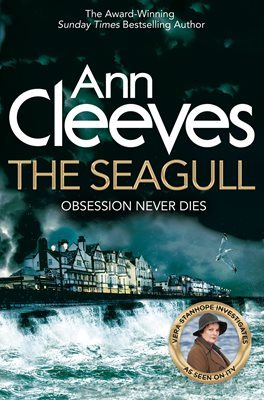
The Seagull by Ann Cleeves

Seagull

Macmillan| September 2017|print length 416 pages|e-book| 5*

The Seagull is Ann Cleeves’ eighth novel in her Vera Stanhope series, set in Northumberland. It begins as Vera visits the prison where ex-Superintendent John Brace is serving time for corruption and his involvement in the death of a gamekeeper. He had been one of the so-called ‘Gang of Four’ – Brace, Robbie Marshall, a man known simply as ‘The Prof’, and Vera’s father, Hector Stanhope. Brace tells Vera that Robbie, who had disappeared years ago, is dead and that he will tell her where his body is buried if she will visit his daughter Pattie, who has mental health problems.  She does so, but when the police investigate the location Brace gave her they find not one skeleton, but two. 

Opening up this cold case brings back memories for Vera of her past when she was living at home in a remote cottage in the Northumberland countryside, with Hector, after her mother had died.  The Gang of Four had met at Hector’s cottage when Vera was a teenager. They had traded in rare birds’ eggs and sold raptors from the wild for considerable sums. They were regulars at the (fictional) classy Seagull night club, a sleek Art Deco building built in the thirties in Whitley Bay,  during the town’s glory days. Brace and Marshall had also run a recruitment service providing muscle for hire. And Vera wonders just how much Hector had been involved in the Gang of Four’s illegal activities. 

And just as Vera and her team, Joe, Charlie and Holly – Vera’s own ‘gang of four’ – investigate Robbie’s murder they are faced with a present day murder that looks very much as though it links in with their cold case.

I enjoy watching Vera on TV, but I enjoy the books even more. Brenda Blethyn is very good in the role of Vera, but the Vera in the books is not the same as the TV Verashe is more down to earth, a large woman who wears tent-shaped dresses, has bare legs, wears size seven sandals with rubber soles and Velcro straps and she is none too fussy if her feet are dirty. She is a big woman with a big personality and she knows she is a brilliant detective:

‘Oh, I’m interested in everything, Joe. That’s why I’m a bloody brilliant detective’. She gave him her widest smile, ‘That’s why I’m in charge and you’re sitting there, doing as you’re told.’ (page 45)

She still lives in the cottage in the hills (not on Lindisfarne as in the TV series), which she had inherited from Hector along with a freezer full of animal corpses (Hector had done a bit of taxidermy), but most of the action takes place in Whitley Bay and at St Mary’s Island, a small rocky tidal island, linked to the mainland by a short, narrow causeway which is submerged at high tide.

I thoroughly enjoyed The Seagull and loved the way it reveals Vera’s past and her relationship with her father. At the same time the plot kept me guessing almost to the end and the location, well known to Ann Cleeves as it used to be her home town, is superbly described.

I see on Ann Cleeves’ website that ITV have confirmed that there will be a tenth series of VERA, based on Ann’s characters and settings and starring multi-award-winning Brenda Blethyn. The cast have been filming in the North East through the summer. Four new episodes will be broadcast in 2020.

And she has recently published a new  book, The Long Call, the first in a new series, Two Rivers. It is set in North Devon, where Ann grew up, and introduces the reserved and complex Detective Inspector Matthew Venn, estranged from the strict evangelical community in which he grew up, and from his own family, but drawn back by murder into the community he thought he had left behind.

The Long Call was published in Australia on 27th August, in the US on Tuesday 3rd September and in the UK on Thursday 5th September 2019.

Reading challenges: Mount TBR, Calendar of Crime

Six Degrees of Separation: from A Gentleman in Moscow to …

I love doing Six Degrees of Separation, a monthly link-up hosted by Kate at Books Are My Favourite and Best. Each month a book is chosen as a starting point and linked to six other books to form a chain. A book doesn’t need to be connected to all the other books on the list, only to the one next to it in the chain.

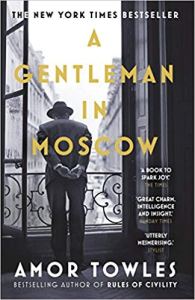
A Gentleman in Moscow

This month the chain begins with A Gentleman in Moscow by Amor Towles – a book I haven’t read, or even heard of before. It looks interesting from the description on Amazon:

On 21 June 1922, Count Alexander Rostov – recipient of the Order of Saint Andrew, member of the Jockey Club, Master of the Hunt – is escorted out of the Kremlin, across Red Square and through the elegant revolving doors of the Hotel Metropol.

Deemed an unrepentant aristocrat by a Bolshevik tribunal, the Count has been sentenced to house arrest indefinitely. But instead of his usual suite, he must now live in an attic room while Russia undergoes decades of tumultuous upheaval.

Can a life without luxury be the richest of all?

My first link is to another book set in Moscow Mrs Harris goes to Moscow by Paul Gallico This is a lovely little book. Mrs Harris is a London char lady who wins a trip to Moscow, where she wants to find her employer’s long-lost love. Mayhem ensues when she is thought to be Lady Char (the Russians not understanding what a ‘char lady’ is had converted it to ‘Lady Char’) and also a spy.

My second link is to a book about another visitor to Moscow: Archangel by Robert Harris. Set in present day Russia, it tells the story of Fluke Kelso, a former Oxford historian who is in Moscow for a conference on the newly opened Soviet archives. He learns of the existence of a secret notebook belonging to Josef Stalin and his search takes him to the vast forests near the White Sea port of Archangel.

Moving away from Moscow, but still in Russia my third link is Midnight in St Petersburg by Vanora Bennett. It begins in 1911 in pre-revolutionary Russia with Inna Feldman travelling by train to St Petersburg to escape the pogroms in Kiev. I liked the way Inna’s personal story is intermingled with the historical characters of the time, including Father Grigory (Rasputin), Prince Youssoupoff and Lenin.

The next book that came into my mind is another book set in St Petersburg and featuring Rasputin – Sashenka by Simon Sebag Montefiore. It begins in 1916 in St Petersburg. Sashenka’s mother parties with Rasputin whilst Sashenka is involved with conspiracy. It then moves forward to 1939 in Moscow under Stalin and ends in the 1990s when a young historian researches her life and discovers her fate. I haven’t read this book yet, even though I’ve had it for a long time.

My fifth link is a book I did read a long time ago, also set in Russia during the Russian Revolution – Doctor Zhivago by Boris Pasternak. At this distance in time my memories of it are a bit vague, but I remember more about the film of the book starring Julie Christie and Omar Sharif amongst others. I’d love to read it again sometime …

And so to the last link. It really should be to another book set in Russia to complete the chain with just one common theme. I wondered about a few – Anna Karenina, The Brothers Karamazov, or War and Peace, but eventually settled on a non fiction book, A People’s Tragedy: the Russian Revolution by Orlando Figes,  Unlike the other books in my chain I haven’t read this book, and it is not one of my TBRs – but it is now. It’s been described as the most vivid, moving and comprehensive history of the Russian Revolution available today. It’s long – 960 pages – and has won several awards.


My chain has one link throughout – Russia – passing from Moscow to St Petersburg and covering the modern day and the Russian Revolutionary period. Apart from the last book they are all fiction, beginning with the rather twee novel about Mrs Harris in Moscow. And for once I haven’t included any crime fiction!

Next month (October 5, 2019), we’ll begin with Three Women by Lisa Taddeo.