Book Beginnings

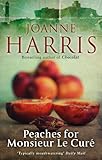
Peaches for Monsieur Le Curé: I really shouldn’t be reading this book yet as I’m still reading Joanne Harris’s The Lollipop Shoes, the book that precedes Peaches for Monsieur Le Curé, but I just had to see how it starts.

This is the beginning (and the whole of Chapter One):

Someone once told me that, in France alone, a quarter of a million letters are delivered every year to the dead.

What she didn’t tell me is that sometimes the dead write back.

Well, that seemed so familiar – and it is because here is the opening sentence of The Lollipop Shoes:

It is a relatively little-known fact that, over the course of a single year, about twenty million letters are delivered to the dead.

I’ve had The Lollipop Shoes for nearly five years and have only just got round to reading it. I bought it when it came out in hardback because I’d loved reading Chocolat and wanted to read more about Vianne Rocher – my post on Chocolat explains my love of this book. So far, though, it just doesn’t have the same enchantment as Chocolat and it’s giving me uneasy feelings. I don’t want to say too much just yet as I’ve only read half the book – but one of the characters is definitely not ‘nice’, she’s dangerous and devious, out to  change Vianne’s world.

In fact, when I first looked at The Lollipop Shoes I found I didn’t want to read it – it’s so different in mood from Chocolat. So it went back on the shelf until this week, when I read Christine’s review of Peaches for Monsieur Le Curé and I knew it was time to read Joanne Harris’s books. It sounds as though  Peaches for Monsieur Le Curé is just as enjoyable as Chocolat and maybe not quite so dark as The Lollipop Shoes, because she wrote: ‘it’s the kind of novel I’ll turn to on a grey day, when the world seems against me, and I want my spirits lifting without having to think too deeply about anything’.

For more Book Beginnings on Friday see Gilion’s blog Rose City Reader.
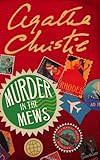
Murder in the Mews by Agatha Christie

I don’t usually find short stories as satisfying as novels, but the stories in Murder in the Mews are good, mainly, I think, because with one exception they are novellas, longer than the average short stories. The collection was first published in 1937.

There are four stories about crimes solved by Hercule Poirot:

  •  Murder in the Mews – at first it looks as though a young widow, Mrs Allen has committed suicide, but as the doctor pointed out the pistol is in her right hand and the wound was close to her head just above the left ear, so it’s obvious that someone else shot her and tried to make it look like suicide. The plot is tightly constructed, with a few red herrings to misguide Poirot and Inspector Japp and a moral question at the end. The book begins on Guy Fawkes Day and I like this conversation between Poirot and Inspector Japp:

(J): ‘Don’t suppose many of those kids really know who Guy Fawkes was.’

(P): ‘And soon, doubtless, there will be confusion of thought. Is it in honour or in execration that on the fifth of November the feux d’artifice are sent up? To blow up an English Parliament, was it a sin or a noble deed?’

Japp chuckled. ‘Some people would say undoubtedly the latter.’ (page 7)


  • The Incredible Theft – Poirot is called in to investigate the theft of top secret plans of a new bomber from the home of a Cabinet Minister, Lord Mayfield, where a number of guests are gathered for a house party: Mrs Vanderlyn is an American siren who had formed friendships with ‘a European party’ (this was written in 1936). Air Marshall Sir George Carrington  wonders why she is there. Lady Julia Carrington, Sir George’s wife is a keen bridge player, who has ‘the most frightful overdraft’ and their son Reggie, fancies the French maid. Also present are Mrs Macatta MP, and Mr Carlile, Lord Mayfield’s private secretary. This is perhaps the weakest story in the collection.
  • Dead Man’s Mirror – a conventional murder mystery. Sir Gervase Chevenix-Gore is found dead in his locked study, shot through the head. The bullet had shattered the mirror on the wall behind his desk. Again it looks like suicide, but the question is why he should kill himself. Poirot considers it’s all wrong psychologically – Sir Gervase was known as The Bold Bad Baronet, with a huge ego, much like Poirot, considering himself to be a man of great importance. This is another story, complicated by family relationships. Things of interest I noted are that Poirot studies the footprints in the garden outside the study, Mr Satterthwaite (seen in later stories) makes an appearance, and on a personal note I wondered if this was Agatha Christie’s cynical view of divorce?

 I can’t see it makes a ha’p’orth of difference who you marry nowadays. Divorce is so easy. If you’re not hitting it off, nothing is easier than to cut the tangle and start again. (page 115)


  • Triangle at Rhodes – although this is the shortest story, not my preferred length, I think this is the best one in the book. It’s similar to her later book Evil Under the Sun in that it is about a love triangle and a crime of passion. Poirot is on holiday in Rhodes and observes the jealousy and passion between two couples as he sits in the sun on the beach. He foresees trouble ahead and is worried as he traces a triangle in the sand. There aren’t many people on holiday there and he wonders if he is imagining things , reproaching himself for being ‘crime-minded‘. But he is not wrong and Valentine Chantry, a famous beauty, married to a commander in the navy, a strong, silent man, is murdered.

These stories demonstrate some of Agatha Christie’s plot elements and endings – the locked room murder, the murderer conceals the motive, Poirot foresees murder, the clues (often odd clues) are there hidden or in plain sight, there are red herrings and bluffs, chance remarks that have significance, and the final denouement, explaining the solution to the mystery.

The Classics Spin

The Classics ClubThe Classics Club Spin

  • Pick twenty unread books from your list. This could be five you are dreading/hesitant to read, five you can’t WAIT to read, five you are neutral about, and five free choice.
  • Number them from one to twenty.
  • On Monday a number will be drawn.
  • That’s the book to read by July 1.

I decided the simplest list way to do this was to choose books from different centuries, which gave me three sections and for the final five I’ve listed five really long books. These are all books I want to read but I am hesitant about some of them, especially some of the longer books – even some of the books not included in the ‘Long books’ section are long too! I’m really hoping for a shorter book.

The first five are 17th & 18th century, the second group are 19th century, the third 20th century and the last five are ‘Long books’.

  1. Don Quixote by Miguel de Cervantes Saavedra 1605 
  2. A Journal of the Plague Year by Daniel Defoe 1722
  3. Moll Flanders by Daniel Defoe 1722
  4. Gulliver’s Travels by Jonathan Swift 1726
  5. Lady Susan, The Watsons, Sanditon by Jane Austen poss 1794 first pub 1871
  6. Barnaby Rudge by Charles Dickens 1841
  7. Mary Barton by Elizabeth Gaskell 1848
  8. Barchester Towers (Barsetshire Chronicles, 2) by Anthony Trollope 1857
  9. The Mill on the Floss by George Eliot 1860
  10. Lorna Doone: A Romance of Exmoor by R D Blackmore 1869
  11. Ethan Frome by Edith Wharton 1911
  12. The Voyage Out by Virginia Woolf 1915
  13. Out of Africa €“ Isak Dinesen 1937 
  14. To Kill a Mockingbird by Harper Lee 1960
  15. Love in the Time of Cholera by Gabriel Garcia Marquez 1985
  16. Gone with the Wind by Margaret Mitchell 1936
  17. Of Human Bondage by W. Somerset Maugham 1915
  18. No Name by Wilkie Collins 1862
  19. The Count of Monte Cristo by Alexandre Dumas 1844
  20. Parade’s End by Ford Maddox Ford 1924 – 28

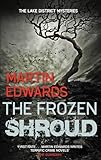
The Frozen Shroud by Martin Edwards

The Frozen Shroud is the sixth book in Martin Edwards’s Lake District Mystery series. I’ve enjoyed the previous five, featuring historian Daniel Kind and DCI Hannah Scarlett, head of the Cold Case Review Team and this one is no exception; it kept me guessing almost to the end.

The Frozen Shroud begins at Halloween in Ravenbank, an isolated community on the shores of Ullswater. At Ravenbank Hall, Miriam Park tells Shenagh Moss the ghost story of the Faceless Woman, Gertrude Smith who was murdered on Hallowe’en, just before the First World War. She was found, battered to death, her face reduced to a pulp and covered with a woollen blanket like a shroud. Her murderer wasn’t hanged and the story goes that her tormented spirit walks down Ravenbank Lane on Hallowe’en. Later that night Shenagh goes missing and is found, battered to death and with her face covered by a rough woollen blanket.

Five years later, Daniel Kind sets out to discover more about Gertrude Smith’s murder when a third murder occurs on Hallowe’en; another young woman with her face shrouded from view. This time it’s Hannah’s best friend Terri Poynton, who was at a Hallowe’en party at the Hall.  Is it the same killer or a copycat murder?  DCI Fern Larter investigates this latest murder and because it looks as though there are connections with Shenagh’s murder, Hannah reopens that case. She and Daniel work together once more to discover the truth.

In Martin Edward’s books, the characters are all so alive, the settings so vividly described and the plots so intricate and compelling. I love all the historical and literary references he uses, weaving them seamlessly into the books, and then there is the ongoing friendship between Daniel and Hannah – both Daniel’s sister and Hannah’s friends keep insisting they’re right for each other.

I think each book can be read on its own, but it helps to fully understand the characters’ relationships if you read them in order. The earlier books are as follows (linked to Fantastic Fiction):

1. The Coffin Trail (2004)
2. The Cipher Garden (2005)
3. The Arsenic Labyrinth (2007)
4. The Serpent Pool (2010)
5. The Hanging Wood (2011)
6. The Frozen Shroud (2013)

The Frozen Shroud is available in the USA in both hardback and paperback, published by Poisoned Pen Press. I received my copy from Maryglenn McCombs Book Publicity.
In the UK the hardback, published by Allison & Busby will be released in June this year.

crime_fiction_alphabetThis is my contribution to Kerrie’s Crime Fiction Alphabet 2013 for the letter F. To take part your post MUST be related to either the first letter of a book’s title, the first letter of an author’s first name, or the first letter of the author’s surname, or even maybe a crime fiction “topic”. But above all, it has to be crime fiction.

I’ve taken part in all of Kerrie’s previous Crime Fiction Alphabets but this is my first one for this series. I decided to contribute when the books I’ve read or am reading coincide with the letter of the week. Actually this book could equally as well be for the letter E too.

Book Notes: Daisy Dalrymple

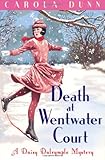
I’ve now read the first three books in Carola Dunn’s Daisy Dalrymple series – all borrowed from the Kindle Owners’ Lending Library. I wrote about the first book Death at Wentwater Court in this post. It’s a typical country house murder mystery.

I’ve recently read the second and third books, The Winter Garden Mystery, another country house murder mystery and Requiem for a Mezzo. These are quick, light, easy and enjoyable to read, not requiring much brain power to work out who did the murders. They provide an interesting glimpse of life in the 1920s..

Set in 1923 Daisy is visiting Occles Hall in Cheshire, the home of her school friend Bobbie, to write an article for the Town and Country magazine and discovers a corpse buried in the Winter Garden. It’s the body of Grace Moss, the blacksmith’s daughter and parlour maid at the Hall. She had gone missing three months earlier.The under-gardener is arrested. Daisy convinced of his innocence contacts Detective Inspector Alex Fletcher of Scotland Yard and their relationship develops as they set about discovering the murderer.
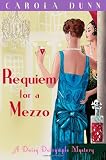
In this book Daisy and DI Alex Fletcher are at the Albert Hall watching a performance of Verdi’s Requiem in which her neighbour, Bettina Westlea is singing , until she drops dead, apparently from cyanide poisoning.  Alex reluctantly lets Daisy help with the investigation into her murder.

Bettina had made many enemies and it surfaces that there are several possible motives and suspects. Daisy has a knack of getting people to talk to her, but I did find this just a little repetitive as Alex tried to stop her involvement. However, this didn’t detract from their continuing relationship.

Lost in the Stacks

Books in hallway - photo 1

Danielle who writes one of my favourite book blogs, A Work in Progress, asked me to contribute to her  Lost in the Stacks: Home Edition‘ series this week. I love writing about books and looking at other people’s bookshelves so I was delighted to take part. Danielle’s post includes photos of my books and shelves along with my answers to her questions.

If you’d like to see more have a look at this post.