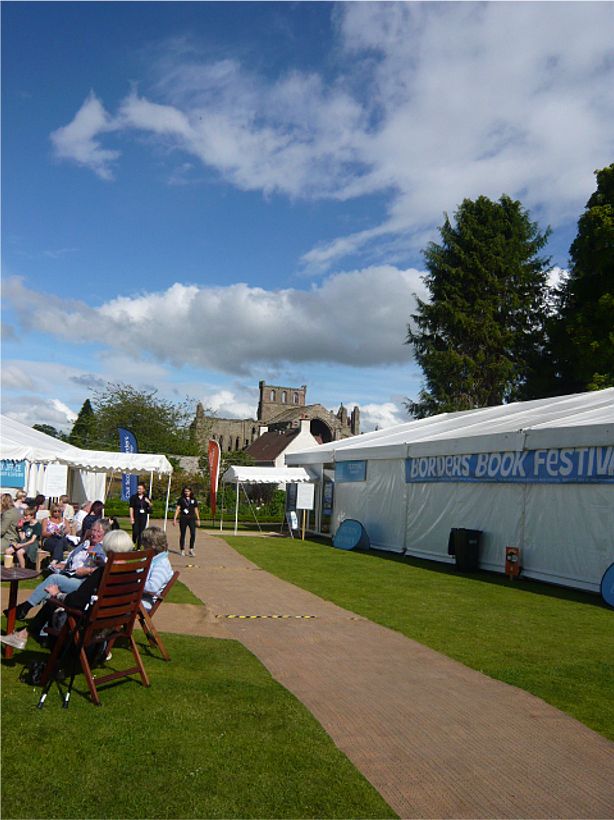
 I was looking forward to Hilary Mantel’s talk last night at the Borders Book Festival in Melrose. I was not disappointed – far from it. It was a memorable evening as we sat in the packed Festival Marquee as Hilary Mantel and Kirsty Wark carried on their conversation. It was brilliant, or as Kirsty said at the end thanking Hilary – ‘it was absolutely fantastic’!
Here are some of my impressions:
Hilary Mantel is not only a fantastic writer she is also an articulate speaker – she is so enthusiastic about her subject and spoke with fluency, clarity, conviction and with power. She began by reading a short extract from Bring Up the Bodies, describing Thomas Cromwell, his appearance and his view of the portrait Hans Holbein had painted.The passage came to life as she spoke the words she had written.
After that the conversation between the two women flowed effortlessly. I’ve seen both on TV and read many of Hilary Mantel’s book but they both have so much more presence in person. It was magnetic and mesmerising as they talked about the process of writing – does Hilary Mantel write her historical novels sequentially moving forward through history? No, she doesn’t. She researches, surrounds herself with her notes, her ideas and jots down descriptions, sections of dialogue and scenes, so that at no point can she answer where she is up to in the book – she cannot tell you the year, how many pages she has written, only that she needs another eighteen months before it will be finished.
She lives in a parallel world – in the present and in the world of Cromwell and Henry VIII, plus all the characters, at one and the same time. It is always with her. When she started to write about Cromwell it was just going to be one book, but that soon changed and at present she is writing about the third book (The Mirror and the Light), leading up to Cromwell’s death. She tries as far as possible to be historically accurate, for the dialogue to be correct, but as a lot of what happened was not recorded – eg there is no transcript of Anne Boleyn’s trial – what she writes is her offering, her interpretation as it were.
I was pleased Kirsty Wark asked her about writing in the present tense (something I often have difficulty reading, but didn’t in either Wolf Hall or Bring Up the Bodies). I can’t remember precisely but I think Hilary Mantel replied that she saw the people as though the scenes were being acted out before and wrote it as it happened. If that is not what she said that is the impression I came away with. I only know that for me in these books it all came to life as I read it with an immediacy that I don’t often find in novels – I was there, not just an observer.
What does Hilary Mantel do in her ‘down time’, what does she read when she is not writing. Well, she doesn’t really have ‘down time’ and she doesn’t read novels when she is writing, she is so immersed in the world she is writing about that she can’t enter anyone else’s world. She reads round the subject, history, sociology etc.
What will she write next – more historical fiction or a contemporary novel? She is not sure – she’s thinking about writing about writing historical fiction – I do hope she does. Maybe not historical fiction itself, as that’s a huge project taking several years to research and plan. When she was 22 she had dreamed of writing historical fiction and wrote her novel about the French Revolution. Then she hadn’t realised that most people this side of the Channel weren’t really interested in the Revolution. Well, actually, I was and I’ve read that novel – A Place of Greater Safety and that’s another epic novel that kept me intrigued, even though I knew the outcome before I read it.
Kirsty Wark even touched on the question of the criticism Hilary Mantel had had over her comments about Kate Middleton. Her reply was a master of diplomacy, but it had upset her that her words had been taken out of context and she expressed her amazement at being woken one morning to find the press camped outside her house two weeks after her speech.
There were a few questions from the audience – would she write a prequel about Thomas Cromwell’s life on the continent, before the events in Wolf Hall. She liked that question but answered that she probably wouldn’t – there was little documentary evidence about all the places he’d been to and what he did, but I’m guessing she would have liked to have attempted it.
There was so much more said – but I’ll stop here. It was a grand night out – an event I’m delighted to have experienced.
 Every Tuesday Diane at Bibliophile by the Sea hosts First Chapter First Paragraph Tuesday Intros, sharing the first paragraph or (a few) of a book she’s reading or thinking about reading soon.
 It begins with a Prologue:
 I read
  tonight on BBC1, maybe I should read it in tandem, or leave it for later? It’s the story of Elizabeth Woodville, the White Queen. A woman who won the love of a king and ascended to royalty by virtue of her beauty, Elizabeth fought tenaciously for the success of her family — her daughter who would one day unite the warring dynasties, and her two sons whose eventual fate has confounded historians for centuries: the Princes in the Tower.
 born Catalina, the Spanish Infanta, to parents who are both rulers and warriors. Aged four, she is betrothed to Arthur, Prince of Wales, and is raised to be Queen of England. She is never in doubt that it is her destiny to rule that far-off, wet, cold land.
 Queen Victoria’s death: two families visit neighbouring graves in a fashionable London cemetery. One is decorated with a sentimental angel, the other an elaborate urn. The Waterhouses revere the late Queen and cling to Victorian traditions; the Colemans look forward to a more modern society. To their mutual distaste, the families are inextricably linked when their daughters become friends behind the tombstones. And worse, befriend the gravedigger’s son.
 Thames Valley CID baffled. A year after the dreadful crime they are still no nearer to making an arrest. But one man has yet to tackle the case €“ and it is just the sort of puzzle at which Chief Inspector Morse excels. The final Morse book, which I bought after watching the TV version. I’ve just checked and this was way back in 2000! I decided at the time that I would read it later – I never meant it to be 12 years later!
  meaning to read them before now. I see from a bookmark that I did start
  double shelve books that I forget I’ve got them. If I thought 12 years was a long time to have owned and not read a book, then I was astonished when I checked this book to find that I’ve had it since 1992! No!! It’s another book I bought after watching the TV version, which was broadcast in November 1992. I did start it – there’s a bookmark at the start of Chapter 6. I see from Amazon that the book has been reprinted several times since I bought my copy. The blurb is: The fifteenth book to feature the classic crime-solving detective, Chief Inspector Wexford. The thirteenth of May is famously the unluckiest day of the year. Sergeant Caleb Martin of Kingsmarkham CID had no idea just how terminally unlucky it would prove, as he embarked upon his last day on earth… Ten months later, Wexford is confronted with a murder scene of horrific brutality. At first the bloodbath at Tancred House looks like the desperate work of a burglar panicked into murder. The sole survivor of the massacre, seventeen-year-old Daisy Flory, remembers the events imperfectly, and her confused account of the fatal night seems to confirm this theory. But more and more, Chief Inspector Wexford is convinced that the crime lies closer to home, and that it has sinister links to the murder of Sergeant Martin…