Crime Fiction Alphabet: Letter O

Kerrie’s Crime Fiction Alphabet has reached the letter O.

I was surprised quite recently to discover that Baroness Orczy had not only written books about the Scarlet Pimpernel, but had also written crime fiction.

Emmuska Orczy (1865 – 1947) was born in Hungary and she and her family moved to London in 1880, where she went to the West London School of Art and then Heatherley’s School of Fine Art.  Several of her paintings were exhibited at the Royal Academy. She married Montague MacLean Barstow in 1894 and encouraged by him, she began writing in 1900. As well as the Scarlet Pimpernel stories she wrote mysteries for the Royal Magazine and Cassell’s Magazine. She created one of the earliest female detectives in a collection of short stories about Molly Robertson-Kirk – Lady Molly of Scotland Yard in 1910.

The Old Man in the Corner
The Old Man in the Corner, Greening & Co. 1910, Design by H. M. Brock. From Flickr

Her book of short stories, The Old Man in the Corner features one of the earliest armchair detectives. It was first published in 1909, although she had written the stories before that and published them in magazines. The ‘Old Man’ sits in the corner of an A. B. C. (Aerated Bread Company) tearoom and relates the mysteries to Polly Burton of the Evening Observer. She was amused by his appearance:

Polly thought to herself that she had never seen anyone so pale  so thin, with such funny light-coloured hair, brushed very smoothly across the top of a very obviously bald crown. He looked so timid and nervous as he fidgeted incessantly with a piece of string; his long, lean and trembling fingers tying and untying it into knots of wonderful and complicated proportions. (Location 47 of 2760)

Tying knots in a piece of string seems to be essential to his deductive powers, for as he unravels the knots so he solves the mysteries. His philosophy is:

There is no such thing as a mystery in connection with any crime, provided intelligence is brought to bear upon its investigation.  (Location 29)

Very like Hercule Poirot, I thought, but the resemblance ends there. The Old Man’s sympathies are with the criminal rather than the police; he solves the mysteries just for the love of doing it, to discover the motive and method. He doesn’t pass his information onto the police and in most of the cases there is still an element of doubt.

The mysteries included in The Old Man in the Corner are:

The Fenchurch Street Mystery
The Robbery in Phillimore Terrace
The York Mystery
The Mysterious Death on the Underground Railway
The Liverpool Mystery
The Edinburgh Mystery
The Theft at the English Provident Bank
The Dublin Mystery
An Unparalleled Outrage (The Brighton Mystery)
The Regent’s Park Murder
The De Genneville Peerage (The Birmingham Mystery)
The Mysterious Death in Percy Street

They seem to be the most baffling cases that the police had been unable to solve, involving murder, blackmail, forgeries and puzzling crimes. I enjoyed reading them, although they don’t overtax the brain.

  • Format: Kindle Edition
  • File Size: 302 KB
  • Print Length: 186 pages
  • Sold by: Amazon Media EU S.à r.l.
  • Language: English
  • ASIN: B0084BMM6W
  • Source: my own copy
  • My Rating 3/5


Crime Fiction Alphabet: N is for …

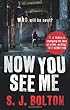
 … Now You See Me by S J Bolton

I’ve enjoyed S J Bolton’s earlier books, but I hesitated several times before deciding to read Now You See Me, because it begins with such a brutal killing. I’d read the opening pages on Amazon using the ‘Click to Look Inside‘ feature and didn’t like it. I usually steer clear of books with such graphic descriptions of murder, but I knew that I liked S J Bolton’s writing and that others had given it good reviews, so eventually I read further on.

I’m glad I did because, despite the brutal murders, it is compelling reading, with a complex plot and convincing characters.

Summary from S J Bolton’s website:

Despite her life-long fascination with Jack the Ripper, young detective constable Lacey Flint has never worked a murder case or seen a corpse up close. Until now ‘¦

As she arrives at her car one evening, Lacey is horrified to find a woman slumped over the door. She has been brutally stabbed, and dies in Lacey’s arms.

Thrown headlong into her first murder hunt, Lacey will stop at nothing to find this savage killer. But her big case will also be the start of a very personal nightmare.

When Lacey receives a familiar letter, written in blood, pre-fixed Dear Boss, and hand delivered, it is clear that a Ripper copycat is at large. And one who is fixated on Lacey herself. Can this inexperienced detective outwit a killer whose infamous role model has never been found?

I don’t have a fascination with Jack the Ripper and began to be a bit  weary about the copycat nature of the killings, but then the scenario changed and it became clear that there was more to the killings than just copying the Ripper. It’s narrated by Lacey, a strong character, one who thinks for herself, is a loner, and is not content to merely follow police procedure. But I didn’t warm to her until near the end of the book. She knows more than she is letting on to her fellow police officers and I was very suspicious of her motives and conscious that she was not a reliable narrator.

S J Bolton is very skilled in leading the reader up the garden path, providing plenty of hints that could be significant or be dead ends. This book (like her others) is fast-paced, full of suspense and tension, with a chilling and dramatic ending.

  • Paperback: 512 pages
  • Publisher: Corgi (26 April 2012)
  • Language: English
  • ISBN-10: 0552159816
  • ISBN-13: 978-0552159814
  • Source: My own copy
  • My Rating: 3.5/5

For more Crime Fiction Alphabet posts see Kerrie’s blog Mysteries in Paradise. The posts must be related to either the first letter of a book’s title, the first letter of an author’s first name, or the first letter of the author’s surname, or even maybe a crime fiction “topic”. But above all, it has to be crime fiction.

Crime Fiction Alphabet: M is for …

… M R Hall

Biography summarised from M R Hall’s website:

Matthew Hall was born in London in 1967, he was educated at Hereford Cathedral School and Worcester College, Oxford,where he graduated in law. He lives and works in the Wye valley in South Wales. He spends much of his spare time looking after his sixteen acres of woodland and working for the conservation of the countryside.

After working as a barrister, mostly in the field of criminal law he then went on to become a screen writer and producer, including writing episodes of such dramas as  Kavanagh QC starring John Thaw and Dalziel and Pascoe. His first season of writing the Channel 5 series, Wing And A Prayer earned him a BAFTA nomination in the best series category.

Novels:

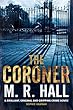
I’ve read his debut novel, The Coroner, which was published in 2009 and was nominated for the Crime Writer’s Association Gold Dagger in the best novel category. In this book Jenny Cooper, a newly appointed Coroner, divorced, and recovering from a nervous breakdown gets involved in investigating the deaths of several teenagers at local detention centres. Has her predecessor neglected some crucial information in this area? As Jenny digs deeper, she encounters a solid wall of bureaucratic resistance. But Jenny just won’t give in until she gets to the truth.

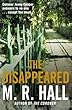
The second novel in the Jenny Cooper series, The Disappeared, was published in the USA by Simon and Schuster on December 1st 2009 and in the UK by Pan Macmillan in January 2010. I’ve yet to read this book in which Jenny investigates the disappearance of a British student, Nazim Jamal. She is beginning to settle into her role as Coroner for the Severn Valley. But as the inquest gets under way, a code of silence is imposed on the inquest and events begin to spiral out of all control, pushing Jenny to breaking point.

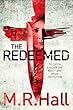
I thoroughly enjoyed the third novel in the same series, The Redeemed, which was published in April 2011 in the UK and May 2011 in the USA. With an accusation of murder hanging over Jenny’s head her lone quest for justice takes her to the heart of the fight between good and evil, sex and the supernatural, and on a dark inner journey to confront ghosts that have haunted her for a lifetime.

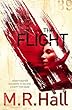
The fourth in the series, The Flight was published in the UK on 2 February 2012. I’ve recently read this one and have to say that I don’t think it’s as good as the other two I’ve read.

Flight 189 has plunged into the Severn Estuary, an area outside Jenny Cooper’s jurisdiction, but she is handling the cases of a sailor, washed up on her side of the river and that of a 10 year old girl, who was a passenger on the flight. Jenny is never one to back away from handling sensitive issues and when the authorities want her cases to be dealt with by Sir James Kendall, a recently retired High Court judge,the coroner for the inquest into the crash, she resists and insists she carries out her own investigations. Each time they try to halt her inquest she finds ways of carrying on.

My problem with this book wasn’t Jenny’s role.  I like the way Jenny perseveres, her sympathies for the bereaved parents, her own fragile psychological make-up and how she deals with her problems with her father. These elements are in the other books too, but in The Flight I thought they were overwhelmed by all the technical details of the aircraft and how it came to crash. I prefer the smaller scale inquests, rather than this ‘disaster film’ genre – but, I think, it would make a good disaster film.

If you’re nervous about flying, (which I’m not, although I did feel glad I’m not booked on a flight soon as I was reading it) it is definitely a scary book, even though M R Hall in his Author’s Note at the end of the book says this about the safety of flying:

Next time you fly – or perhaps you are in a plane right now? – remember that a short drive through town remains statistically far more dangerous than your flight by a factor of many thousands to one. The most perilous parts of your journey are the ones to and from the airport. I am reliably informed that you are precisely eighty-seven times more likely to choke on the ice cube in your gin and tonic than to perish in a crash. So sit back and enjoy the movie – the numbers say it’ll never happen to you.

Mmm – do I really find that comforting?

A Crime Fiction Alphabet post for the letter M. For more posts see Kerrie’s blog Mysteries in Paradise.

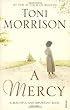
A Mercy by Toni Morrison

Toni Morrison is the author of ten novels, from The Bluest Eye(1970) to A Mercy (2008). She has received the National Book Critics Circle Award and the Pulitzer Prize. In 1993 she was awarded the Nobel Prize in Literature. She lives in New York.

I recently read A Mercy. I found it a difficult book, both to understand and to appreciate. In fact once I’d read it I went back to the beginning and read it again, almost straight away and then found myself turning back to the first page again.The narration moves between the characters and at times I wasn’t sure whose voice I was reading and had to backtrack several times. Even on the second reading, I was not sure, even though the characters have different ways of talking.

From the back cover:

On the day that Jacob, an Anglo-Dutch trader and adventurer, agrees to accept a slave in lieu of payment of a debt from a plantation owner, little Florens’ life changes. With her intelligence and passion for wearing the cast-off shoes of her mistress Florens has never blended into the background and now at the age of eight she is taken from her family to begin a new life. She ends up part of Jacob’s household, along with his wife Rebekka, Lina their Native American servant and the strange and melancholy Sorrow who was rescued from a shipwreck. Together these women face the trials of their harsh environment as Jacob attempts to carve out a place for himself in the brutal landscape of the north of America in the seventeenth century.

It’s definitely character-based, and the plot is hard to follow (at least I thought so), although on the second reading it was much clearer. It begins with a confession:

Don’t be afraid. My telling can’t hurt you in spite of what I have done and I promise to lie quietly in the dark – weeping perhaps or occasionally seeing the blood once more – but I will never unfold my limbs to rise up and bare teeth.

and it was only at the end that I could understand the beginning.The writing is lovely, the mood is melancholy and touching.The setting is America in the 1680s – 1690. It’s a land still largely unknown territory that regularly changed hands, a land where you couldn’t be sure who was friend or foe. The themes of this novel are slavery, racism and religion, with a mighty emphasis on motherhood and the position of women in that time and place.

A Mercy is not my favourite Toni Morrison book and I wouldn’t recommend it to anyone who hasn’t read any of her other books, but it is thought provoking and moving. I prefer Song of Solomon and Beloved.

  • Source: my own copy
  • Rating: 3/5

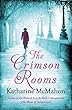
Crime Fiction Alphabet: K is for The Crimson Rooms by Katharine McMahon

Kerrie at Mysteries in Paradise hosts the Crime Fiction Alphabet each week. It has now reached the letter K and my choice is Katharine McMahon’s book The Crimson Rooms.

I bought The Crimson Rooms a couple of years ago because I’d enjoyed reading Katharine McMahon’s The Rose of Sebastopol, which I read in 2008. It’s been sitting with the other to-be-reads on my bookshelves since then and I hadn’t realised that this is not only historical fiction, but also historical crime fiction.

It’s set in London in 1924, with Britain still coming to terms with the aftermath of the First World War. Evelyn Gifford, one of the few pioneer female lawyers, lives at home with her mother, aunt and grandmother, still mourning the death of her brother James in the trenches. Evelyn is woken in the early hours one morning to find Meredith and her child, Edmund, aged 6 on the doorstep, claiming that Edmund is James’s son. Evelyn and the other women are thrown into confusion as Meredith upsets their memories of James.

Meanwhile Evelyn carries on with her work, taking on the case of Leah Marchant, who wants to get back her children who had been taken into care. She was accused of trying to kidnap her own baby. It’s early days for women to be accepted as lawyers and Evelyn struggles to defend Leah who distrusts her and wants Daniel Breen, Evelyn’s boss to defend her.

She is also involved in defending Stephen Wheeler, an old schoolfriend of Daniel’s. Stephen is accused of murdering Stella, his young wife of a fortnight. It’s obvious to Evelyn and Daniel that Stephen is innocent, but at first he refuses to talk and defend himself. After a humiliating experience in court, barrister Nicholas Thorne offers to help Evelyn much to her dislike. But she finds herself drawn to him and wonders how much she can trust him.

I was thoroughly engrossed in this book. It was not just the court cases, I was fascinated by the account of early women lawyers, represented by Evelyn, the central character. It clearly shows the prejudice these women had to overcome just to qualify as lawyers, never mind the difficulties of persuading law firms to employ them and clients to accept them. Katherine McMahon has included a Chronology of Women in Law from 1875 to 1950 at the back of the book and an analysis of why it took so long for women to be accepted. Evelyn is based on Carrie Morrison, who was the first British woman to be become a solicitor.

It’s not just about crime and the court cases, it’s also a novel about the way people’s lives were affected by the War, how men were unable to resume their old lives, some damaged by shell-shock and the horrors they had taken part in, or witnessed during the war. Women, too, had their lives completely changed, so many had their marriage prospects destroyed, and were replaced by work, becoming career women.

Katherine McMahon has done extensive research of the period but it all sits easily within the narrative. It’s beautifully written, full of imagery that creates a vivid picture of the setting and the characters. For example, she describes the moon:

… an extraordinary crescent moon which had, in the last few minutes, risen above the river, with the old moon burdening its lap like a fat round cushion.

and I like this description of one of the characters as she walked from the garden towards the house,

… the trailing hem of her robe a pool of ivory, her hair a swathe of black silk. (page 207)

Katharine McMahon’s other books are:

  • The Alchemist’s Daughter
  • A Way through the Woods
  • Footsteps
  • Confinement
  • After Mary
  • The Season of Light

More details are on her website.

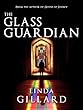
The Glass Guardian by Linda Gillard: a Book Review

The Glass Guardian, Linda Gillard’s latest book, kept me spellbound. It’s a ghost story and a love story, with a bit of a mystery thrown in too. Ruth Travers is in her early forties and has just had a difficult year with the deaths of her lover, father and most recently her beloved aunt, Janet. Janet had lived in a house on the Isle of Skye, Tigh-na-Linne, the house where she had been born, and where her mother had lived with her three brothers who had all been killed in the First World War; the house where Ruth spent many childhood summers and the house Janet left to her in her will. After Janet’s death Ruth goes to live in the house to grieve and decide what to do next.

Set in a beautiful location, Tigh-na-Linnne is in a sorry state:

 Rattling windows, water-stained ceilings and idiosyncratic plumbing paled into insignificance when one looked out of the big windows at the view over Loch Eishort, a sea loch, to the Black Cuillin mountains beyond and the distant islands of Canna and Rhum.

Ruth is in a very fragile state, having nightmares and is pleased to find that Tom, Janet’s gardener is her childhood friend, Tommy. But then she realises that everything in her childhood was not quite as she thought it was, or as she remembered it. As Ruth attempts to sort through her aunt’s belongings and decide whether to sell the house it becomes clear that there is more about her aunt and her family history than she ever knew before. And then she realises there is someone else in the house and there is a stained glass window behind a large wardrobe, which she never knew existed:

It’s a memorial window. There were three originally. One for each son who fell in the Great War. One of the windows was badly damaged in a storm and another got taken out when Janet had the conservatory built. But there’s one left. It’s behind that wardrobe.

From there on Ruth is unsure whether she is in her ‘Sane Mind’ or her ‘Insane Mind’, as she hears the wardrobe being dragged from its position in the dead of night.

I do like ghost stories and I had no trouble suspending my disbelief reading this book. The setting is so convincing, the characters so believable and even if I did see where the story was going to end that didn’t spoil it. This is a book that brought tears to my eyes and there aren’t many that do that! It deals so poignantly with death and the pain of loss, but it’s never sentimental and even though there are moments where you have to hold your breath, the supernatural element is not horrific.

N.B. I previously posted the opening paragraphs of this book.