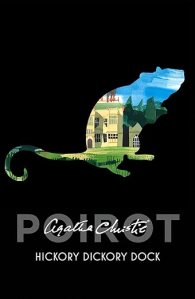
Hickory Dickory Dock by Agatha Christie

Hickory Dickory Dock is a Poirot mystery, first published in 1955. The nursery rhyme title actually bears no relevance to the plot, even though Poirot quotes the rhyme at the end when he hears a clock strike one. The only links I can see are that it’s about the residents of a students’ hostel at 26 Hickory Road and one of the suspects also parodies the rhyme.
Poirot is drawn into the plot through his secretary, Miss Lemon. This is her first appearance as Poirot’s secretary in a full length novel, although she had featured in some of Agatha Christie’s short stories. She had also appeared in Parker Pyne Investigates (1934) when she worked for Mr Parker Pyne. I’m used to Pauline Moran’s portrayal of Miss Lemon, in Agatha Christie’s Poirot TV series – efficient and smart but also attractive. So I was surprised to read this most unflattering description of her as ‘that hideous and efficient woman … she was not a woman at all. She was a machine – the perfect secretary’ , with ‘strong grizzled hair.’ Poirot just cannot believe that she has made three mistakes in one letter and discovers that she is worried about her sister who manages a student hostel where strange things have been happening.

Now this is not the usual setting for an Agatha Christie novel – no quintessential English village, no grand country houses, or quaint cottages, but a crowded London house, owned by Mrs Nicolstis, a Greek and full of a mixed group of young people from a variety of backgrounds and cultures – from America, West Africa and India as well as an assortment from the British Isles. Miss Lemon’s sister, Mrs Hubbard gives Poirot a list of items that have recently gone missing and.invites him to talk to the students about detection and some of his  celebrated criminal cases. At first it all seems to be quite low key, as some of the missing items are rather trivial – lipstick, and a box of chocolates, for example, but others are rather odd – such as one evening shoe, a rucksack, discovered cut up in pieces, and boracic powder. But then one of the students commits suicide – or is it murder? And more deaths follow.

I did enjoy this book, although the plot is somewhat far-fetched, but I liked the characterisation, particularly the way in which Agatha Christie reveals contemporary attitudes (1950s) to race and politics, as the characters’ prejudices come out in their discussions. There are plenty of suspects and red herrings and some interesting reflections on crime and the psychology of behaviour. And I also liked this insight into Miss Lemon’s mind. Poirot has quoted from one of Conan Doyle’s Adventures of Sherlock Holmes and she responds:

‘You mean these Baker Street societies and all that’, said Miss Lemon. ‘Grown men being so silly! But there, that’s men all over. Like the model railways they go on playing with. I can’t say I’ve ever had time to read any of the stories. When I do get time for reading, which isn’t very often, I prefer an improving book.’ (page 9)

It’s just as well we don’t all think like that.
Crime Fiction Alphabet: W is for Wycliffe …

… Wycliffe and the Cycle of Death by W J Burley.

From the back cover:

When Matthew Glynn, a respectable bookseller is found bludgeoned and strangled, Chief Superintendent Wycliffe is mystified. Why would anyone want to kill him, and in such a brutal manner?

But a look at Glynn’s background reveals tension within the family. Alfred Glynn, an eccentric recluse, has held a grudge against his brother for years and the older brother, Maurice, argued bitterly with Matthew over the sale of family land. Add to this a discontented son, valuable documents in the bookseller’s safe, and the mysterious, still unexplained disappearance of Matthew’s wife years earlier, and Wycliffe faces one of his most impenetrable cases yet.

Then another Glynn dies and the murderer’s identity seems obvious. But Wycliffe is not convinced – and soon uncovers some very murky secrets, and the possibility of another murder …

My view:

The story is set in Penzance and its immediate neighbourhood, so Burley, who knew the area well (he lived near Newquay), sets the scene well. The three Glynn brothers didn’t get on, with a long-standing quarrel between Matthew and Alfred, which was connected to their mother, and a more recent row between Matthew and his other brother, Maurice, who objected to Matthew’s proposal to build houses near to Maurice’s pottery. And as Trice, the local DI,  tells Wycliffe, the locals are suspicious of outsiders – he’s talking not just about Cornwall, but about the local area, Penwith, which in Cornish means ‘ … “the extreme end”. The people here feel different – they are different.’

And this is a murder mystery with a difference, because all is not clear by the end. There are plenty of suspects, not just the brothers but also their sister and grown-up children. The reader is left to work out the puzzle, indeed Wycliffe struggles to come to terms with his suspicions and his mind is in turmoil:

With something approaching desperation, Wycliffe was trying to see the events in perspective, to relate them one to another and to imagine the repressed tensions and accumulated bitterness which had finally surfaced. But what troubled him most was the thought that he was being pushed beyond his role as an investigating officer into decisions which were either moral or judicial or both. (page 185)

I liked the book very much, with its complex plot, convincing characters, and in particular the way Wycliffe’s humane and thoughtful character is portrayed. The ending certainly makes you think.

  • Paperback: 320 pages
  • Publisher: Orion; New Ed edition (2 Aug 2001)
  • Language: English
  • ISBN-10: 0752844458
  • ISBN-13: 978-0752844459
  • Source: I bought the book
  • My Rating: 4/5

A Crime Fiction Alphabet post for the letter W.

Crime Fiction Alphabet: V is for Vargas

This week’s letter in Kerrie’s Crime Fiction Alphabet is V.

My choice of book is The Chalk Circle Man by Fred Vargas, translated from the French by Siân Reynolds. This is the first of her Commissaire Jean-Baptiste Adamsberg novels.

From the back cover:

Jean-Baptiste Adamsberg is not like other policemen. He doesn’t search for clues; he ignores obvious suspects and arrests people with cast-iron alibis; he appears permanently distracted. In spite of this his colleagues are forced to admit that he is a born cop.

When strange blue chalk circles start appearing on the pavements of Paris, only Adamsberg takes them – and the increasingly bizarre objects fround within them – seriously. And when the body of a woman with her throat savagely cut is found in one, only Adamsberg realises that other murders will soon follow.

My view:

As soon as I began reading this book I was entertained – the writing is fluent (unlike the translation I read of her later book Seeking Whom He May Devour) and easily conveyed the quirky nature of Vargas’s plot and characters. As the book cover summary describes, Adamsberg just doesn’t fit the usual detective profile – well, he is a loner, so that’s pretty standard, but apart from that he stands out  – an outsider from the Pyrenees, newly appointed to Paris as Commissaire of police headquarters in the 5th arrondissement. His colleagues don’t understand him, especially Inspector Danglard, who likes a drink and isn’t too reliable after about four in the afternoon.

Vargas goes into some detail both about Adamsberg’s history, appearance and characteristics, and about Danglard. Adamsberg is a thinker – but a vague thinker – he works mainly on intuition, whereas Danglard doesn’t trust feelings and gut instincts. He prefers to follow procedure, looking for clues and proof. Adamsberg claims that some people just ooze cruelty:

And most premeditated murders require the murderer not only to feel exasperation or humiliation, or to have some neurosis, or whatever, but also cruelty, pleasure in inflicting suffering, pleasure in the victim’s agony and pleas for mercy, pleasure in tearing the victim apart. It’s true, it doesn’t always appear obvious in a person, but you feel at  least that there’s something wrong, that something else is gathering underneath, a kind of growth. And sometimes that turns out to be cruelty – do you see what I’m saying? A kind of growth. (pages 17-18)

The chalk circle man intrigues Adamsberg and it is his meditation on his character that leads him to solve the mystery – but before that two other murders have taken place. Is the chalk circle man the killer, or is the killer using the circles to his own advantage? And why does he leave a lingering smell of rotten apples?

Adamsberg and Danglard are not the only eccentric characters – the book is full of them, all delightfully different including Mathilde, the marine biologist who prefers fish to people. She lets rooms to Charles, the beautiful blind man with a chip on his shoulder and to Clemence, the old lady who lives on the top floor. Clemence at seventy is still looking for the love of her life. She has an unattractive appearance with a bony face and sharp little teeth like a shrew-mouse and wears far too much make-up. I thought the interactions and conversation between these people was fascinating.

This is a very cleverly constructed and quirky mystery, and I was pleased that I did half guess the solution; I only half-guessed because there is a twist at the end which took me totally by surprise. I’ll certainly look out for more of Fred Vargas’s books to read.

  • Paperback: 256 pages
  • Publisher: Vintage; First PB Edition edition (4 Feb 2010)
  • Language: English
  • ISBN-10: 0099488973
  • ISBN-13: 978-0099488972
  • Source: Library book
  • My Rating: 4.5/5

The Judgement of Strangers by Andrew Taylor

The Judgement of Strangers is the second in Andrew Taylor’s Roth Trilogy, an ideal choice for  R.I.P.VII. This second book fills in some of the back story of the first, The Four Last Things, which I wrote about earlier. It covers events that took place in 1970 and although there is an atmosphere of suspense and mystery it is by no means as chilling and scary as The Four Last Things.

It’s narrated in the first person by David Byfield, who is a sexually frustrated, widowed parish priest with a mysterious past. When he marries Vanessa, his beautiful teenage daughter, Rosie, seems to accept her. But, it’s obvious that David is unaware of Rosie’s psychological troubles and is beset with problems – his own passions, the attentions of the menopausal spinster churchwarden, Audrey Oliphant, as well as his obsession with Joanna, the new young owner of Roth Park.

And then the murders begin and it seems that the influence of Francis Youlgreave, a 19th century opium addict, poet and priest who committed suicide at Roth Park is still prevalent. Vanessa is fascinated by him. The sole surviving member of the family, Lady Youlgreave, now  senile lives in the Old Manor House with her equally senile dogs, Beauty and Beast. She allows Vanessa to study Francis Youlgreave’s journals. The pressure and suspense build, with the climax at the village fete, which ends in disaster. 

 In some ways this book is a bit like an Agatha Christie mystery – set in a village (there’s a helpful map), with a mix of characters, locals, gentry and newcomers. The plot is complex and although it can be read as a self-contained novel, it really is best to read the trilogy in order, because there are answers in this book to some of the questions posed in the first and I think it could spoil the suspense if you read them the out of order. There are also intriguing glimpses into the past. I’m keen to read the third book – The Office of the Dead – as soon as possible. And I’d like then to re-read them in reverse order, just to see the difference.

Crime Fiction Alphabet: U

This week’s letter in Kerrie’s Crime Fiction Alphabet is letter-u

I’ve chosen Nicola Upson’s Fear in the Sunlight, the fourth novel featuring Josephine Tey, which I read on Kindle.

Summary from Fantastic Fiction:

Summer, 1936. The writer, Josephine Tey, joins her friends in the holiday village of Portmeirion to celebrate her fortieth birthday. Alfred Hitchcock and his wife, Alma Reville, are there to sign a deal to film Josephine’s novel, A Shilling for Candles, and Hitchcock has one or two tricks up his sleeve to keep the holiday party entertained – and expose their deepest fears. But things get out of hand when one of Hollywood’s leading actresses is brutally slashed to death in a cemetery near the village. The following day, as fear and suspicion take over in a setting where nothing – and no one – is quite what it seems, Chief Inspector Archie Penrose becomes increasingly unsatisfied with the way the investigation is ultimately resolved. Several years later, another horrific murder, again linked to a Hitchcock movie, drives Penrose back to the scene of the original crime to uncover the shocking truth.

My thoughts:

I have mixed thoughts about this book, good and not so good. Overall I enjoyed it but I found it confusing with so many characters, introduced very quickly in the novel, and it was difficult to distinguish who they all were, with the exception, of course, of Josephine Tey and Alfred Hitchcock. So, not well-defined characters.

However, the setting in Portmeirion is very well done and if you like lots of description that’s a bonus. I do like description, up to a point, but in this book I thought it intruded too much and held up the action. (Portmeirion is Sir Clough Williams-Ellis’s Italianate creation in the Welsh countryside. It’s also the setting for the 1960s TV series, The Prisoner, if you remember that as I do.) Set in the thirties it does give a good sense of the period between the two world wars with the shadow of the Great War still lingering and the threat of another war getting ever nearer. There is a general air of unhappiness, as Alma, Hitchcock’s wife says:

Perhaps it’s the times we have lived through, but we seem very good at destroying each other and not just through wars. We wear each other down all the time through little acts of jealousy or cruelty or greed. (location 1731)

And there are many such acts in Fear in the Sunlight as the murders pile up. I didn’t really have much idea what was going on until about halfway into the book when the writing became sharper, more focussed on the plot and characters.

I was interested in Nicola Upson’s inclusion of a discussion about writing, about mixing fact and fiction and also about the difference between a book and the film of the book. Here Josephine and Marta are talking about mixing fact and fiction, which is exactly what Nicola Upson does in her books:

‘Mix fact and fiction?’ Josephine asked, and Marta had to laugh at the disapproval in her voice. ‘How would that help restore the reputation of a much aligned man? No one would know what was true and what wasn’t.’

‘Exactly. That’s the fun of it. And a biography would only be your interpretation. At least calling it fiction is honest.’ (location 3548)

Josephine is at Portmeirion to discuss making a film of her book, A Shilling for Candles, with Alfred and Alma Hitchcock. She’s sceptical about the process of using her book as the basis for a film, but Alma tells her:

‘A film can’t just be a visual record of a book or it will never have a life of its own,’ she said.  … ‘It’s like any marriage, I suppose. The two things can coexist if they’re both good in their own right, and it doesn’t have to be one at the expense of the other.’ (locations 1612-1620)

I’ll try to remember that next time I get irritated at the way a film or TV drama alters a book.

I think that Alfred Hitchcock is really the main character and I don’t know enough about him to be able to distinguish fact from fiction in Fear in the Sunlight, nor do I know that much about the thirties either to judge whether that’s an accurate picture, but I have no doubt that Nicola Upson has done her research. Hitchcock seems to have been a complicated and difficult character, a practical joker and a manipulator:

An experiment in fear and guilt, he had called it, but an exercise in control would have been more accurate. Staging a joke, like making a film, was a way of holding on to power, and Hitchcock had discovered long ago that the manipulation involved in both helped him to forget his own anxieties and doubts. (location 1088)

As you would expect he is a master of suspense:

‘Fear of the dark is natural, we all have it, but fear in the sunlight, perhaps fear in this very restaurant, where it is so unexpected – that is interesting’. (location 3465)

  • Format: Kindle Edition (also available in paperback)
  • File Size: 821 KB
  • Print Length: 432 pages
  • Publisher: Faber and Faber Crime (3 April 2012)
  • Sold by: Amazon Media EU S.à r.l.
  • Language: English
  • ASIN: B007JVF6U2
  • Source: My own copy
  • My Rating 3/5

September’s Books

September was a good month for reading. In total I read 10 books:

I read 4 crime fiction, 4 non fiction, 1 ghost story and 1 science fiction. Two of the books were library books, 3 borrowed from a friend and 4 books were from my to-be-read books (books I’ve owned before January 2012).

It’s not been such a productive month for writing about the books I’ve read – more reading means less writing. So I’ve not previously written about the book I’ve chosen as my Pick of the Month. For more ‘Picks of the Month’ see Kerrie’s blog Mysteries in Paradise.

It is, by a short margin, The Sixth Lamentation by William Brodrick, the first Father Anselm novel.

Synopsis from Fantastic Fiction:

What should you do if the world has turned against you? When Father Anselm is asked this question by an old man at Larkwood Priory, his response, to claim sanctuary, is to have greater resonance than he could ever have imagined. For that evening the old man returns, demanding the protection of the church. His name is Eduard Schwermann and he is wanted by the police as a suspected war criminal.

With her life running out, Agnes Aubret feels it is time to unburden to her granddaughter Lucy the secrets she has been carrying for so long. Fifty years earlier, Agnes had been living in Occupied Paris, a member of a small group risking their lives to smuggle Jewish children to safety – until they were exposed by a young SS Officer: Eduard Schwermann.

As Anselm attempts to uncover Schwermann’s past, and as Lucy’s search into her grandmother’s history continues, their investigations dovetail to reveal a remarkable story.

It’s my Pick of the Month because it is historical fiction and it’s also a mystery. It looks back  to the Second World War in occupied France, telling a dramatic tale of love and betrayal, full of suspense, and interwoven stories.William Brodrick explains in his Author’s Note that the novel weaves fact and fiction, with accurate details of life in Paris during the Occupation and the subsequent war trials. He gathered facts for his novel from a variety of sources, although he has taken ‘small liberties’ with some of them.

William Brodrick has also drawn on his own personal experience. He was formerly in religious life but left before his final vows. He has degrees in philosophy and theology and after studying law he became a barrister, specialising in personal injury. The idea of smuggling Jewish children out of the Nazis’ hands was prompted by the war time experience of his own mother, Margaretha Duyker. She was part of a smuggling ring and took a child out of Amsterdam by train to Arnhem. She was caught by the Gestapo and imprisoned and eventually released. She died of motor neurone disease (the disease that Agnes is suffering from) in 1989.

I’ve read one other book by William Brodrick – The Gardens of the Dead, also a Father Anselm book. There are two more:

The Sixth Lamentation also fits into the R.I.P.VII Challenge.