Sisters of Sinai by Janet Soskice

Sisters of Sinai

The full title of this book is Sisters of Sinai: How Two Lady Adventurers Found the Hidden Gospels. This is biography so well written that it almost reads like a novel. In fact, if this was a novel I would think it was a most unlikely story of twin sisters in the latter half of the nineteenth century, travelling to St Catherine’s Monastery at Mount Sinai where they discover one of the earliest copies of the Gospels written in ancient Syriac.

Janet Soskice has written a compelling account of two Scottish sisters – Agnes and Margaret Smith born in 1843 in Irvine, a town south-west of Glasgow. Their mother died two weeks after they were born and they were brought up by their father, John Smith. He was unusual in that he gave his daughters an unconventional education for that period. He approved of independence of mind and foreign travel. The girls had an aptitude for languages and mastered French, German, Spanish and Italian whilst they were still quite young – helped by visits to each country. Their taste for learning, travels and adventure was set for life with long hours of study and plenty of exercise. Add to this intensely-held Presbyterian beliefs and Bible study.

John Smith inherited a huge sum of money (today’s equivalent would be around £7 million) from a relative. He died when the twins were 23 leaving his fortune to them (which had built up considerably by then); they were very rich indeed. They decided to have a trip down the Nile. And that was just the beginning; their lives were transformed.

They learnt Greek, Arabic, Hebrew and Syriac and they returned to Egypt and Sinai many times, befriending the monks of St Catherine, despite their religious differences, and getting embroiled in disputes with Cambridge academics who were initially very reluctant to accept that these two middle-aged (by then) women with no university qualifications (women were not permitted to receive degrees from the university at that time), could possibly have found anything of value or interest to them.

What they discovered in a ‘dimly lit little room  below the prior’s quarters’ in the monastery was a dirty volume, its leaves nearly all stuck together, written in Syriac. It was a collection of lives of women saints, but written underneath that was something else that was clearly an earlier text – of the Gospels. This was a palimpsest – the earliest writing having been scraped off and overwritten at a later date, the old ink becoming visible at a later date through the effects of the atmosphere. This eventually proved that the Gospels had been written much earlier than had previously been thought, moving the date back to the late second century.

Not only is that remarkable in itself, but it is astonishing to me that these two middle-aged women travelled to Egypt, Sinai, Jerusalem and beyond at the latter half of the nineteenth century across the desert on camel or walking miles on foot. Their courage and resolve overcame all the difficulties they encountered, coping with physical discomfort and  dishonest dragomen abroad and the hostility and scepticism at home.

I would never have known of this enthralling book if it hadn’t been for Cath’s review of it on Read-Warbler. I was intrigued and looked for it in my library straight away and was delighted to find that there was a copy in another branch.  Biographies and historical books are probably my most favourite of non-fiction books and accounts of  the Bible and how it came to be compiled have long been of interest to me, but I hadn’t come across these two sisters before. Janet Soskine has thoroughly researched her subject and the book is complemented by a ‘select’ bibliography that runs to nearly 5 pages and an extensive index.

This is an excellent non-fiction book, just right for Peggy Ann’s Read Scotland 2014 Challenge.
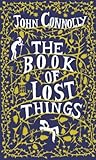
The Book of Lost Things by John Connolly

I like fantasy, so when I came across The Book of Lost Things, a modern version of traditional fairy tales that has glowing reviews from various sources, I was keen to read it. Fairy tales are full of bad things happening to people, wicked stepmothers, evil witches, wolves and trolls, fantasy characters, damsels in distress and magic and enchantments, but in the end good overcomes evil and they live happily ever after.

The Book of Lost Things begins at the start of World War Two, with David, a boy of twelve, who is mourning the death of his mother, resenting his father’s new wife, Rose and his new baby brother, George. Alone in his bedroom he hears the books on the shelves murmuring and whispering in the darkness, and his fantasy world becomes peopled with the characters from his books and he dreams of the Crooked Man, waiting for him out in the woods beyond the house.

One night his dreams and nightmares become reality as he sees through a fissure in his room into another realm beyond. He falls unconscious and coming to he hears his mother calling out him to save her, saying she is not dead but trapped in a strange place. He climbs out of his window and then as a bomber crashes in the garden David escapes through the sunken garden into a different world, a world peopled by the characters from the stories he has been reading. Told that the king has a ‘Book of Lost Things’ that will help him find the way back to his own world, he is met with the most terrible and gruesome opposition.

As well as stomach churning and excruciatingly toe-curling grisly detail there are some very dark episodes in this book with an element of moralising within the story from a number of ‘father figures’ David meets, for example the Woodsman and the knight Roland who tells him that life is filled with threats and dangers.

It is indeed filled with danger but the book becomes a sequence of ‘this happened and then that happened’, of showing rather than telling. The writing is flat; there is no sense of suspense, David is attacked and goes on to fight battle after battle as the characters helping him are killed off. There are his battles against the Loups, wolves who dress like men. He has to answer a riddle to choose the right bridge to cross a chasm thronged with harpies. He meets seven dwarves  dominated by an obese Snow White, her face caked with white make-up (this story is quite funny actually with its references to communism). He comes across a peasant village terrorised by a monstrous loathsome worm which gives birth in mid-battle. He eventually finds the castle of thorns where his mother may be imprisoned, and then finally the great castle of the ancient and now dying king, the guardian of the ‘book of lost things’. And behind it all is the sinister and evil Crooked Man.

I quite liked the concept of this book, it promised much, but I didn’t like its gruesomeness, the torture chambers, the animal and human experimentations, the sexual innuendos, nor did I like the ending, which I thought was weak. These details didn’t leave me with a chill down my spine, but just feeling rather sick.

Still, it seems an appropriate book to include in the Once Upon a Time Challenge, which ended yesterday and certainly for the Mount To Be Read Challenge as it has sat unread on my shelves for 7 years. Maybe fairy stories are no longer magical for me, this one wasn’t.

I can almost hear the rest of my books muttering, well thank goodness that one’s on its way out of the house.

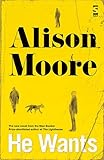
He Wants by Alison Moore

I received a proof copy of He Wants by Alison Moore from Lovereading for review. It will be published in August this year. I began reading with high expectations because I thought I’d like it from the publishers’ synopsis:

Lewis Sullivan, an RE teacher at a secondary school, is approaching retirement when he wonders for the first time whether he ought to have chosen a more dramatic career. He lives in a village in the Midlands, less than a mile from the house in which he grew up. He always imagined living by the sea. His grown-up daughter visits every day, bringing soup. He does not want soup. He frequents his second-favourite pub, where he can get half a shandy, a speciality sausage and a bit of company. When an old friend appears on the scene, Lewis finds his routine and comfortable life shaken up.

However, this synopsis is a bit misleading. Lewis is not approaching retirement – he has already retired. He is looking back over his life and thinking about all the things he had wanted/wants/ does not want.  It’s a book about ageing and unfulfilled expectations. It jumps around mirroring Lewis thought processes as he remembers his childhood, his parents, his wife, his daughter and his friend Sydney.

He Wants is a short book (180 pages in the proof copy). Written in the present tense, it’s a bleak tale of a man whose life did not turn out as he expected or wanted. I don’t have to like the characters to enjoy reading a book, but despite the quality of writing, which is taut and effective in creating an atmosphere of unease and emptiness, I couldn’t take to this book. Lewis’s dissatisfaction with his life compared to how had imagined it would be was just too drab and unrelenting.

Lewis had wanted all sorts of fantastic things. The chapter headings indicate the things he wanted but never got, or the things he did not want and did get: he did not want soup or the sausages, he did not want the boy to be spoiled, he wanted to go to the moon, to live in Australia, to be seen, a time machine and a cup of tea and so on.

Sadly, it was not my cup of tea.

Alison Moore was shortlisted for the Man Book Prize in 2012 with her debut novel The Lighthouse, a book I haven’t read and may check just to see if it’s in the same vein as He Wants.

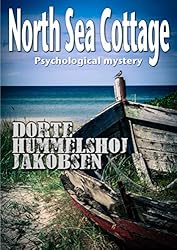
North Sea Cottage by Dorte Hummelshoj Jakobsen

Dorte Hummelshoj Jakobsen’s latest book, North Sea Cottage, is an e-book, a novella set in Denmark. It’s another dual time period book – it seems that each book I’ve read recently is one of these. This one is split between the present day and 1943/4 and it works very well.
I thoroughly enjoyed this book; the cottage in the title is owned by Tora’s aunt, Bergatora. As soon as I began reading I was immediately transported in place away to the other side of the North Sea to Denmark with Tora, and in time back to the Second World War, with her aunt, Bergatora. In just a few words Dorte Hummelshoj Jakobsen draws a vivid picture of the old fisherman’s cottage surrounded by dense sea fog.

Tora is struggling to overcome her own problems when she is faced with a new problem. The old stable next to the cottage catches fire during a thunder storm and in the aftermath of the fire Tora finds a skeleton in the potato cellar under the ruined stable. Who is it who had died in the cellar? Bergatora is reluctant to talk about the war years and her brother, Tora’s father, was too young at the time to help. It was a time when Denmark was under German occupation and a resistance movement was under way. Inspector Thomas Bilgren suspects the victim may have been related to the German occupation.

Tora, helped by Bilgren attempts to discover the truth, but is hampered by the strong character of her aunt and the silence surrounding what happened during the war. I loved this aspect of the book – the delving back into history, the way the narrative switches backwards and forwards, gradually revealing what had happened. North Sea Cottage is only about 90 pages but it has depth both in mystery and in characterisation and the setting is so atmospheric. I was fearful for Tora’s safety as she dug deeper into the mysteries from the past.

Thanks to Dorte Hummelshoj Jakobsen, who kindly sent me a copy of her book. She has a blog – Djskrimiblog and used to be a teacher. She writes both serious mysteries as well as humorous and cosy stories about the Gershwin family in Knavesborough, a fictional village in Yorkshire, publishing in Danish and English. I like her humorous stories but prefer the serious ones like North Sea Cottage and her previous novel, Anna Märklin’s Family Chronicles. She is currently at work on her next novel – Crystal Nights, to be published in 2014/5.

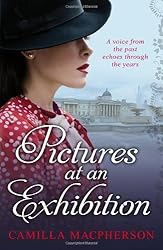
Pictures at an Exhibition by Camilla Macpherson

I enjoyed Pictures at an Exhibition by Camilla Macpherson very much. It’s a dual time period novel moving between the present day and the Second World War, a format I think that can be hard to do successfully. In this book, Camilla Macpherson’s first published novel, I think it is successful as I was equally keen to find out what happened next in both periods.

Pictures at an Exhibition is structured around Daisy’s letters to her cousin Elizabeth telling her about the paintings on display at London’s National Gallery during the war years – one a month. In the present day Claire reads the letters, left to her husband Rob, by his grandmother, Elizabeth. They are not just about the paintings but also about Daisy’s life and the man she meets and loves. Claire meanwhile, is struggling to recover from a tragedy that threatens to overwhelm her and wreck her marriage. She decides to read the letters, one a month, and visit the National Gallery to see the paintings and compare them with Daisy’s descriptions.

I found the characters thoroughly convincing, the settings and the time periods contrasting vividly and loved all the details about the paintings. I also liked the way the characters developed throughout the book. For example, at the beginning of the book, which I found so devastatingly sad, Claire is full of anger and grief, affecting her relationship with Rob:

It was the grief speaking. It could do strange things grief. She had not known that until now. She had never had to know. It had brought with it this desperate, physical need to blame someone, someone who would be right there when she had to lash out – Rob. The only person who was always there. (page 106)

She becomes obsessed with the letters, the paintings and with Daisy’s life. It’s a remarkable portrayal of a woman in crisis and how she managed to find herself again. Daisy’s story is just as convincing describing life in London during the Blitz and along with Claire I really wanted to know more about her and what happened to her.

I think it was the art that drew me to this book in the first place and I found those parts of the book absolutely fascinating. The National Gallery did display one painting a month after most of them had been transported away from London and the bombs for safe keeping. You can see the paintings described by scanning the QR codes at the beginning of each chapter and also see them on Camilla Macpherson’s website, and of course on the National Gallery’s site too. I knew of most of them before, but not all of them and as I was reading I printed copies to see what Daisy and Claire saw.

But by the end of the book it was the characters and the story that had captivated me too.  It’s about life and death, love and loss, grief and relationships and I found it compelling reading – when I wasn’t reading it I was thinking about it and keen to get back to it. It’s a book I want to re-read at some time – and there aren’t many of those.

My thanks go to Camilla Macpherson, who kindly sent me a copy of her book. I look forward to reading more of her work in the future.

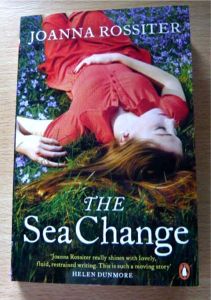
The Sea Change by Joanna Rossiter

Set in lost landscapes, The Sea Change is Joanna Rossiter’s debut novel revolving around a mother and daughter caught up in catastrophic events. The lost landscapes are the village of Imber, a Wiltshire village that was requisitioned by the army during World War Two, where Violet had grown up, and the coastal village of Kanyakumari in Southern India, where her daughter Alice was caught up in the tsunami that devastated the area in 1971.

It’s about lost lives too, wrecked relationships, the isolation of people through their inability to communicate with each other, about love, loss and grief and above all about the relationship between mothers and daughters and sisters.

I enjoyed reading this beautifully written book; I could easily visualise the different landscapes as I read. It begins with drama in the ‘present’ (1971) as the tsunami sweeps through Kanyakumari, separating Alice from her new husband, James and she is in danger of drowning. The story is a dual time novel told alternately by Alice and Violet. After the dramatic opening scenes it then moves immediately to Imber in 1971 as Violet returns to Imber and recalls how they were forced to leave, clinging to Imber ‘as if it were a lost soul.

There are parallels between their stories, both caught up in events outside their control. I was more interested in Violet’s story as she and her mother and sister try to carry on with their lives during the war, mourning the death of her father. And yet Alice’s story is also moving as she desperately searches for James.  Alice and Violet had not parted on good terms when Alice had left home to go on the hippy trail and I liked the way the two stories gradually came together and details of their lives became clearer.

I wrote about the opening paragraphs of this book in this earlier post.

Thanks to Penguin for providing a review copy of this book. I’m sorry to say that it has sat unread apart from the opening pages on my bookshelves since last year when I received it. This is one reason I’m reluctant sometimes to accept review copies – there are so many books clamouring to be read!

Joanna Rossiter has her own website where you can see a YouTube video of her reading from the beginning of the book and talking about her book. I hope she writes more books!