The One I Was by Eliza Graham

Rating: 5 out of 5.

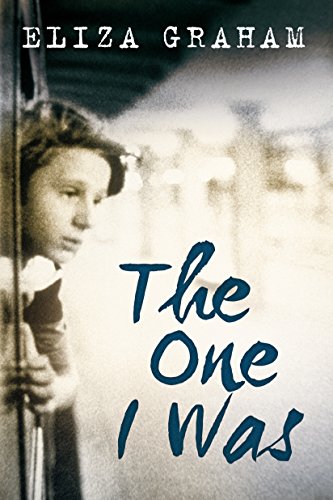
I downloaded The One I Was by Eliza Graham soon after it was published in May 2015 and I’ve just got round to reading it. It was worth waiting for as I really enjoyed it and think it is one of the best books I’ve read recently. It’s historical fiction split between the present and the past following the lives of Benny Gault and Rosamund Hunter.

It begins in the present as Rosamund goes to Fairfleet, her childhood home, to nurse Benny Gault, who first came to Fairfleet in 1939, having fled Nazi Germany on a Kindertransport train. As an adult he bought the house and now he is dying of cancer. It’s a difficult time for Rosamund as she has painful memories of her life at Fairfleet and she is wary about returning – so much so that she doesn’t tell Benny of her connection to the house.

Throughout the book events from both their pasts are revealed, and gradually they discover the connections between them and they come to terms with the traumas that have haunted them. This is a novel about friendship, palliative care, redemption and forgiveness across generations. I was totally engrossed in both their life stories as the various strands of the story eventually combined. Although it was Benny’s story that appealed to me the most – particularly his early life in Germany and the story of how he came to live at Fairfleet – I was also fascinated by the story of Rosamund’s grandmother, one of the few women pilots who flew Spitfires for the Air Transport Auxiliary.

This is obviously a well researched book and Eliza Graham has listed the books she had found invaluable whilst writing The One I Was.

Amazon UK link

I’ve read just two of Eliza Graham’s books, Playing With the Moon and Another Day Gone (linked to my reviews). I hope to read more of her books this year:

Playing with the Moon (2007)
Restitution (2008)
Jubilee (2010)
The History Room (2012)
The One I Was (2014)
Another Day Gone (2016)
The Lines We Leave Behind (2018)
The Truth in Our Lies (2019)
You Let Me Go (2021) – publication date 25 March 2021

Exit by Belinda Bauer

Random House UK, Cornerstone| 21 January 2021| 336 pages| Kindle review copy| 4*

I wasn’t at all sure about Exit by Belinda Bauer when I first started to read it a few months ago, so put it to one side and only picked it up again a few days ago. What initially put me off was the opening chapter, which sets the scene for the work of the Exiteers, a group of people who provide support for people with a terminal illness to end their lives. Their role is ostensibly passive, just to be there to keep the dying company as they take their final breaths. But they do provide the means! And one assignment for John (real name Felix Pink) and Amanda goes wrong when they discover they have ‘helped’ the wrong man.

But I read on and what at first looks like a novel considering the ethics of assisted suicide turns into crime fiction as Felix and Amanda realise they have become murder suspects. It’s all mayhem after that as Felix, overcome with remorse, tries to put things right and to discover how and why the wrong man had died.

Far from being a ‘thriller’ it becomes a borderline ‘cosy’ murder mystery, verging on farce in places and I was amused by the wry humour and surreal scenes. It’s a comedy of errors, interspersed with poignant scenes as we learn about Felix’s grief over the deaths of his wife, Margaret and son James. His thoughts always end up with wondering what Margaret would do in the same situation.

It gets off to a slow start, the pace only gradually picking up in the later chapters, when the multiple twists kept me engaged and keen to know how it would end. There are quite a lot of characters in the book, which I found a bit confusing at first, although the main characters, Felix and Acting DC Calvin Bridges are clearly defined and distinctive characters. Some of the minor characters, such as old Greybeard and other clients in the betting shop, are clearly quirky and their actions absurd. And I particularly liked old Skipper, Albert’s father. But underneath the comedy there is a tragedy, as Felix discovers how he has been deceived all along. And the ending is bitter sweet. I began not sure I really wanted to read Exit and ended it feeling I’m glad I did. It’s unlike anything else I’ve read!

Thanks to the publishers and NetGalley for my proof copy.

Measure of Malice: Scientific Detection Stories edited by Martin Edwards

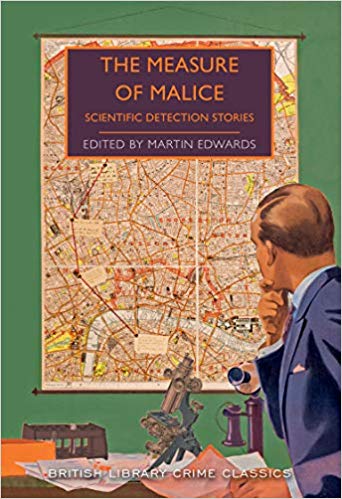
The Measure of Malice edited by Martin Edwards is one of the more enjoyable short story collections that I’ve read. It contains 14 stories in which scientific/technological methods are used in the detection of crime. There is an excellent introduction by Martin Edwards with information about the authors, five of whom were doctors, two were engineers and one was an academic chemist.

As always with short story collections some stories are better than others. I’m highlighting a few of the better ones here:

The Boscombe Valley Mystery by A Conan Doyle was originally published in the Strand Magazine in October 1891, and is the first short story to feature Inspector Lestrade. It’s a solid story, solved by Sherlock Holmes by inspecting and analysing the footprints and signs at the scene of the crime.

The Horror of Studley Grange by L T Meade and Clifford Halifax (1894), from Stories for the Diary of a Doctor, originally published in the Strand Magazine. I enjoyed this one although it was pretty easy to predict. Ostensibly a ghost story, the solution involves the use of a laryngoscope.

After Death the Doctor by J J Connington, a Scottish professor of chemistry. This one was first published in 1934, involving a contemporary scientific gadget. The doctor in question is Doctor Shefford who together with Sergeant Longridge, investigate the murder of old Barnaby Leadburn, found dead with his throat cut.

The next two are the ones I enjoyed the most:

The Broken Toad by H C Bailey, first published in 1934, featuring the surgeon and Home Office Consultant, Reggie Fortune as he considers the death of a police constable from poisoning. I enjoyed all the detailed complications and Bailey’s literary mannered style of storytelling.

In the Teeth of the Evidence by Dorothy L Sayers, first published in 1939, about forensic dentistry, which starts as Lord Peter Wimsey is sitting in his dentist’s chair. The police had just visited the surgery, wanting to see his predecessor’s records to identify the victim of a burnt out garage. An upper right incisor crown and the filling in a molar provided the clues to his death. Gory if you actually visualise what is involved!

  • Publisher : Poisoned Pen Press (4 Feb. 2020)
  • Language: : English
  • Paperback : 336 pages
  • ISBN-10 : 1492699624
  • ISBN-13 : 978-1492699620
  • Source: The Poisoned Pen Press via NetGalley
  • My Rating: 3.5*

V2 by Robert Harris

Random House UK, Cornerstone| 17 September 2020| 314 pages| Kindle review copy| 5*

Description

Victory is close. Vengeance is closer.

On the brink of defeat, Hitler commissioned 10,000 V2s – ballistic rockets that carried a one-ton warhead at three times the speed of sound, which he believed would win the war.

Dr Rudi Graf who, along with his friend Werner von Braun, had once dreamt of sending a rocket to the moon, now finds himself in November 1944 in a bleak seaside town in Occupied Holland, launching V2s against London. No one understands the volatile, deadly machine better than Graf, but his disillusionment with the war leads to him being investigated for sabotage.

Kay Caton-Walsh, an officer in the WAAF, has experienced first-hand the horror of a V2 strike. When 160 Londoners, mostly women and children, are killed by a single missile, the government decides to send a team of WAAFs to newly-liberated Belgium in the hope of discovering the location of the launch sites. But not all the Germans have left and Kay finds herself in mortal danger.

As the war reaches its desperate end, their twin stories play out, interlocked and separate, until their destinies are finally forced together.

My thoughts:

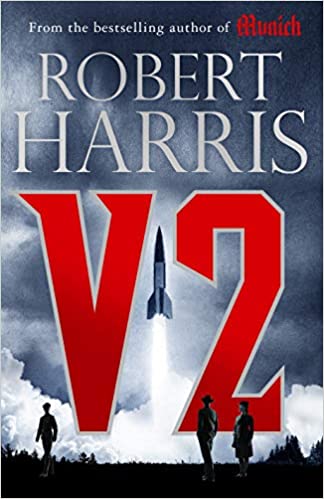
V2 is historical fiction with a solid factual framework. I like to know when I’m reading historical fiction how much is history and how much is fact. So, I was pleased to find that at the end of the book Harris has included a list of the sources he consulted on the history of the V2 and how it worked, including the work of the photographic reconnaissance interpreters, before writing V2. In particular he acknowledges Eileen Younghusband’s two volumes of memoirs – Not an Ordinary Life and One Woman’s War. She had worked as a WAAF officer on the Mechelen operation, working on detecting the location of the V2 launch sites, and her memoirs had provided him with a vivid insight into her wartime life. Without them he would not have written V2.

It’s set over five days at the end of November 1944 as the Germans fired V2 missiles on London from the woods around Scheveningen on the Dutch coast. The British response was a counter-operation, including a team of WAAFs. The cast includes some historical figures such as Werner von Braun, the real-life head of the Nazi rocket programme, and SS-General Hans Kammler. It’s told in alternating chapters from two of the fictional characters’ perspectives – Dr Rudi Graf, a rocket engineer on the V2 team and Kay Caton-Walsh of the Women’s Auxiliary Air Force. Kay was part of the team based at Mechelen using radar to try to locate the V2 firing sites. Harris emphasises that his fictional character, Kay, bore no resemblance to Mrs Younghusband, apart from the fact that she worked on the Mechelen project.

I thoroughly enjoyed reading this novel, learning a lot about that period of the Second World War and about the V2. It is detailed and tense, and very readable, describing the intricate details of the launching of the V2s and Kay’s work, which became increasingly dangerous as their location became known to the Germans.

Many thanks to the publishers and NetGalley for my digital proof copy.

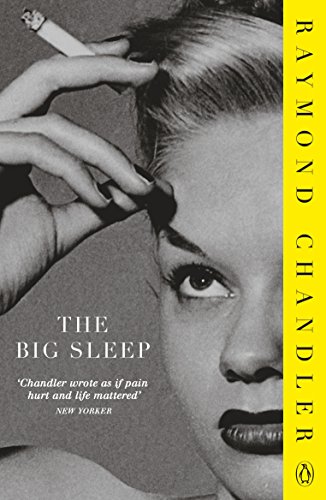
The Big Sleep by Raymond Chandler

In December I read 12 books, most of them short ones, and because I was reading them one after the other I hardly paused to write about them. Before they slip out of my memory I want to write about some of them at least. –

I particularly want to write about The Big Sleep by Raymond Chandler as it is one of those books that I’ve always heard about but have never read. It’s been on my Kindle for the last three years. It was first published in 1939 and is an excellent example of what is known as ‘hardboiled’ crime fiction, which generally featured a private eye with a whisky bottle in a filing cabinet, a femme fatale, and rich and usually corrupt clients. Female sexuality is a snare in a dangerous society where manipulative politicians and corrupt police thrive.

About the book:

Best-known as the creator of the original private eye, Philip Marlowe, Raymond Chandler was born in Chicago in 1888 and died in 1959. Many of his books have been adapted for the screen, and he is widely regarded as one of the very greatest writers of detective fiction. His books include The Big SleepThe Little SisterFarewell, My LovelyThe Long Good-byeThe Lady in the LakePlaybackKiller in the RainThe High Window and Trouble is My Business.

The Big Sleep has been adapted for film twice, in 1946 with Humphrey Bogart, Lauren Bacall, John Ridgely, Martha Vickers, and again in 1978, with Robert Mitchum, Sarah Miles, Richard Boone, Candy Clark.

My thoughts:

The novel is narrated by Philip Marlow, who describes himself as a ‘lone wolf, unmarried, getting middle-aged, and not rich.’ He’s been in jail more than once, likes liqour and women and the cops don’t like him much, although he does get on with a couple of them.

It’s not really the type of crime fiction that I like, but I did enjoy it. There are damsels in distress, gangsters, corrupt officials, and plenty of dark, violent and bloody situations. And of course there are murders – the ‘big sleep’ is death, after all. It’s fast-paced, violent, complicated and in times I found it a bit difficult to follow.

Reading the book took me back in time and place to Los Angeles in the late 1930s, a baking hot LA in which Private Investigator Marlow is hired by the paralysed millionaire General Stallwood, who is being blackmailed. His investigations are hampered by the General’s two daughters, one of whom proves to be a femme fatale, out to entrap Marlow and vindictive when her efforts fail. Chandler’s writing is sharp, snappy and richly descriptive with witty one-liners.

The Secret Garden – Book and Film

Recently I watched the 2020 film of The Secret Garden. The first thing so say it is that it is not like Frances Hodgson Burnett’s book. The basic premise is the same – Mary Lennox is an orphaned child who goes to live with her uncle in Yorkshire where she discovers a secret garden. I’m not going to describe the differences between the book and the film – there are so many – but the main difference is the garden itself. And that is what disappointed me the most about the film.

The ‘garden’ is not a garden – it is a huge version of maybe the Amazon rain forest, a digital fantasy, nothing like the garden in the book. And Misselthwaite Manor has been morphed into Misselthwaite Hall, a huge palatial building dominating the Yorkshire skyline. And what has become of Ben Weatherstaff, the gardener and Mrs Sowerby, Dickon and Martha’s mother? They are just not in the film!

If you don’t like modern versions of old favourites, then steer clear of this film – it is nothing like the book. It’s CGI ‘magic’ is simply not the real Magic of the natural world.

This is what I wrote about the book when I last re-read it 8 years ago. I’m tempted to read it again to obliterate the film from my imagination.

I read The Secret Garden several times as a child and the story has stayed with me ever since. For years my picture of the ideal garden has been a walled garden, just like the secret garden. The story can be read on different levels. As a child it seemed to me to be a straight forward story of Mary Lennox, orphaned after her parents died of cholera in India. Up until the age of nine she had lived a cosseted life looked after by servants, in particular her Ayah, ignored by her parents. After their death she was sent to live at Misselthwaite Manor, on the bleak Yorkshire moors, with her uncle, who was a hunchback recluse, who took little interest in her. Soon after Mary’s arrival, her uncle went abroad leaving her again in the care of servants. These were very different from the servants in India and Mary struggled to adjust.

Soon after she discovers she is not the only child in the house, when she finds Colin, her cousin, a hypochondriac, unable to walk, who believes he won’t live to grow up. Both Mary and Colin are selfish children, hating both themselves and the adults in their lives. Both also hate the outdoors, but encouraged by Martha, her maid, Mary wanders in the gardens of the Manor house and comes across a walled garden, which apparently has no door. There seems no way to get inside it – until guided by a robin, she finds an old key buried in the earth. I loved the descriptions of the Yorkshire countryside, the garden and how under the influence of Martha and her younger brother Dickon and even the grumpy gardener, Ben Weatherstaff, Mary blossomed as the year progressed along with the garden.

Reading it now I can see it is full of symbolism using nature, the Bible and myths, that I never noticed as a child. The image of the garden is used as both paradise lost and paradise regained. As the garden is nurtured and begins to blossom so do Mary and Colin, through springtime and into summer, culminating in the autumn when both are brought to full health. Dickon is accompanied by a young fox, a lamb, a crow and tame squirrels, reminiscent of St. Francis of Assisi and plays his pipe to charm the animals, like Pan. His mother, Mrs. Sowerby, is a plain-speaking down-to-earth Yorkshire woman, full of common sense and wisdom, who through Dickon and Martha helps the children, feeding Mary and Colin with both her words and wholesome food. At times I thought the language becomes over sentimental and a bit syrupy (I never thought that as a child). But there are descriptions that still appeal to me, such as this description of the roses in the garden:

And the roses – the roses! Rising out of the grass, tangled round the sundial, wreathing the tree trunks, and hanging from their branches, climbing up the walls and spreading over them with long garlands falling in cascades – they came alive day by day, hour by hour. Fair, fresh leaves and buds – and buds – tiny at first, but swelling and working Magic until they burst and uncurled into cups of scent delicately spilling themselves over their brims and filling the garden air. (page 210 in my copy)

Above all it is the power of Magic that is invoked in this book. The magic of nature, that makes plants and people grow and develop, the magic of the power of positive thinking and prayer, of the healing power of the mind, and of laughter and love. Sometimes it seemed too simplistic and yet at the same time I was swept along with the sentiments and enjoying the experience of re-reading this book.