Whose Body? by Dorothy L Sayers

I’ve read some of Dorothy L Sayers’s Lord Peter Wimsey Mystery series and enjoyed them immensely. But up until now have not read the first book in the series, Whose Body?, first published in 1923. It’s an amusing Golden Age mystery that kept me entertained throughout. Lord Peter is a wealthy amateur detective, a friend of Inspector Charles Parker, a Scotland Yard detective. He called ‘Lord’ as he is the younger son of a duke.

When the naked body of a man, wearing only a pair of pince-nez is found in Mr Alfred Thipp’s Battersea bathroom, Lord Peter is asked by his mother, the Dowager Duchess of Denver, to help solve the mystery of whose body had found its way into the bath. The police investigation is being led by Inspector Sugg, who doesn’t welcome what he calls Lord Peter’s ‘interference’ in the case. He thinks the dead body might be that of Sir Reuben Levy, a wealthy London financier who had vanished from his bedroom, leaving no trace. Meanwhile Charles is investigating Sir Reuben’s disappearance himself. Although the body in the bath at first appears to be Sir Reuben it soon becomes clear that it is not and that the two cases are not connected. But are they?

As I began reading I was a bit put off by the dialogue between Lord Peter and his valet Bunter, who used to be his batman in the army. The dialogue is supposed to be witty banter between the two of them but to my mind it was irritating and superficial, definitely dated, and reminded me a just a tiny bit of the Jeeves and Wooster stories. But that was just at the start – it’s not at all like Jeeves and Wooster! I enjoyed watching the mystery unfold, which put Lord Peter’s life into grave danger. There are many complications and twists and turns that did stretch my credulity. It has a serious side too as events trigger traumatic memories for Lord Peter of his time in the trenches of the First World War

My rating: 4*

There are 15 books in the series (linked to my reviews when I’ve read the book):


   1. Whose Body? (1923)
   2. Clouds of Witness (1926)
   3. Unnatural Death (1927)
   4. Lord Peter Views the Body (1928)
   5. The Unpleasantness at the Bellona Club (1928)
   6. Strong Poison (1930)
   7.  Five Red Herrings (1931)
   8. Have His Carcase (1932)
   9. Hangman’s Holiday (1933)
   10. Murder Must Advertise (1933)
   11. The Nine Tailors (1934)
   12. Gaudy Night (1935)
   13. Busman’s Honeymoon (1937)
   14. In the Teeth of the Evidence (1939)
   15. Striding Folly (1972)

A Corruption of Blood by Ambrose Parry

Canongate Books| 19th August 2021| 405 pages| Review Copy| 5*

This is the third book in Ambrose Parry’s historical series starring Will Raven & Sarah Fisher, set in 19th century Edinburgh. I loved the other books, The Way of All Flesh and The Art of Dying and A Corruption of Blood is equally as good, if not better.

Description

Edinburgh. This city will bleed you dry.

Dr Will Raven is a man seldom shocked by human remains, but even he is disturbed by the contents of a package washed up at the Port of Leith. Stranger still, a man Raven has long detested is pleading for his help to escape the hangman.

Back at 52 Queen Street, Sarah Fisher has set her sights on learning to practise medicine. Almost everyone seems intent on dissuading her from this ambition, but when word reaches her that a woman has recently obtained a medical degree despite her gender, Sarah decides to seek her out.

Raven’s efforts to prove his erstwhile adversary’s innocence are failing and he desperately needs Sarah’s help. Putting their feelings for one another aside, their investigations will take them to both extremes of Edinburgh’s social divide, where they discover that wealth and status cannot alter a fate written in the blood.

Ambrose Parry is the pseudonym of crime fiction author, Chris Brookmyre and Marisa Haetzman, a consultant anaesthetist. Will is a doctor working with Doctor James Young Simpson, a professor of midwifery, who discovered the anaesthetic properties of chloroform (a real historical character), and Sarah, is the Simpsons’ housemaid, but she now assists Professor Simpson and is studying medicine. The two of them have a complicated and somewhat spiky relationship, which continues in this novel.

The combination of a crime fiction writer and an anaesthetist works excellently in Ambrose Parry’s novels. The research into the history of medicine is extensive, making this book a combination of historical fact and fiction, a tale of murder and medical matters, with the social scene, historical and medical facts slotting perfectly into an intricate murder mystery. 

The mystery begins when the body of a baby wrapped in a parcel, is found floating in the Forth. The child had been strangled with a length of white tape. Sarah meanwhile is involved in finding a missing child. When Sir Ainsley Douglas, a prominent and wealthy member of Edinburgh society is found dead from arsenic poisoning, Will reluctantly gets involved in the murder investigation. How the mysteries interlink gradually becomes clear and although I soon realised how Sir Ainsley had been murdered, I was puzzled about who did it and was completely taken by surprise when the culprit was revealed.

Like all good historical fiction, this book weaves together fact and fiction. The Historical Note at the end of the book sorts out what was real and what was invented. The subjects covered include details about infectious diseases, the difficulties women experienced in obtaining a medical degree, and crimes children suffered in the 19th century. I think A Corruption of Blood is an exceptionally excellent murder mystery and an informative historical novel, with great period detail and convincing characters. I look forward to reading more books by Ambrose Parry.

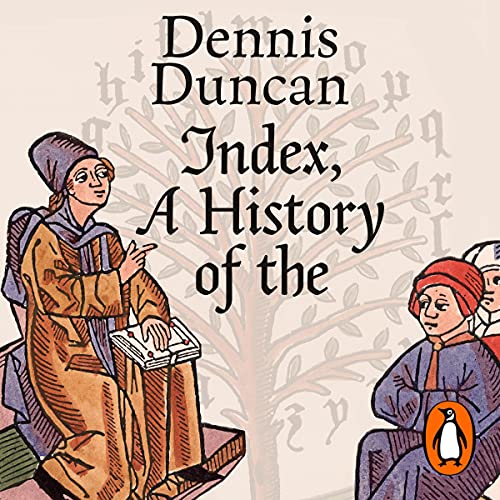
Index, A History of the by Dennis Duncan

Penguin| 19 August 2021| 339 pages| Review copy| 4*

Synopsis:

Most of us give little thought to the back of the book – it’s just where you go to look things up. But here, hiding in plain sight, is an unlikely realm of ambition and obsession, sparring and politicking, pleasure and play. Here we might find Butchers, to be avoided, or Cows that sh-te Fire, or even catch Calvin in his chamberwithaNonne. This is the secret world of the index: an unsung but extraordinary everyday tool, with an illustrious but little-known past. Here, for the first time, its story is told.

Charting its curious path from the monasteries and universities of thirteenth-century Europe to Silicon Valley in the twenty-first, Dennis Duncan reveals how the index has saved heretics from the stake, kept politicians from high office and made us all into the readers we are today. We follow it through German print shops and Enlightenment coffee houses, novelists’ living rooms and university laboratories, encountering emperors and popes, philosophers and prime ministers, poets, librarians and – of course – indexers along the way. Revealing its vast role in our evolving literary and intellectual culture, Duncan shows that, for all our anxieties about the Age of Search, we are all index-rakers at heart, and we have been for eight hundred years.

My thoughts:

This book is not just about the history of the index, but also about the history of reading and the evolution of the book from the scrolls, manuscripts and the codex before the the invention of printing – how they were produced and used. I was interested in reading it as I’m an ex-librarian and cataloguer, later an assistant in a county record office where a large part of my job involved indexing. If you think like me that an index is an indispensable part of a non fiction book then you’ll enjoy this book, which is both informative and entertaining. And I often wish fiction books were indexed too – one of the advantages of an e-book is that you can search the text, even better if it has the X-Ray feature.

It explains the difference between the index and the table of contents, goes into the evolution of page numbers and the problems of alphabetisation. This is not a dry, factual account it is written with humour and insights into the past, using examples from historical texts, and from indexes complied as satirical attacks on their authors. I never knew indexes had been used as weapons! Nor did I know that some works of fiction had been indexed in the past – full details in Chapter 6 ‘Indexing Fictions: Naming was Always a Difficult Art’, quoting from Lewis Carroll’s works. Carroll was fascinated with indexes, leaning particularly towards the whimsical, using his logician’s wit.

Neither is it stuck in the far distant past, Duncan brings it up to date in the digital age and the ubiquity of the search engine with the rise of anxiety that this is changing our brains, shortening our attention spans and eroding our capacity for memory. But this, Duncan explains is nothing new as the history of the index shows that there have always been fears that nobody will read properly any more when they could just use an index to replace the ways of close reading. The ways we read have changed over the generations.

The Index, a History of the is simply fascinating.

About the Author

Dennis Duncan is a writer, translator and lecturer in English at University College London. He has published numerous academic books, including Book Parts and The Oulipo and Modern Thought, as well as translations of Michel Foucault, Boris Vian, and Alfred Jarry. His writing has appeared in the Guardian, the Times Literary Supplement, and the London Review of Books, and recent articles have considered Mallarmé and jugs, James Joyce and pornography, and the history of Times New Roman. 

The Dressmaker by Beryl Bainbridge

This is another ‘catching-up’ post about a book I read a while ago. It’s one of my TBRs and also one of my 20 Books of Summer. It’s a novel with an under current of psychological suspense.

Description

Wartime Liverpool is a place of ration books and jobs in munitions factories. Rita, living with her two aunts Nellie and Margo, is emotionally naïve and withdrawn. When she meets Ira, a GI, at a neighbour’s party she falls in love as much with the idea of life as a GI bride as with the man himself. But Nellie and Margo are not so blind …

My thoughts:

I read The Dressmaker because I’ve enjoyed other books by Beryl Bainbridge. It’s a novella, really, as it’s only 160 pages. I love her style, clear, concise prose, with fully realised characters and descriptive settings. It was first published in 1973 – my copy is a Fontana edition published in 1985.

The Dressmaker was runner up for the 1973 Booker Prize and also for the Guardian Fiction Prize. The Sunday Times, is quoted on the back cover: ‘ Like the better Hitchcock films Miss Bainbridge suggests a claustrophobic horror … An impressive, haunting book.’

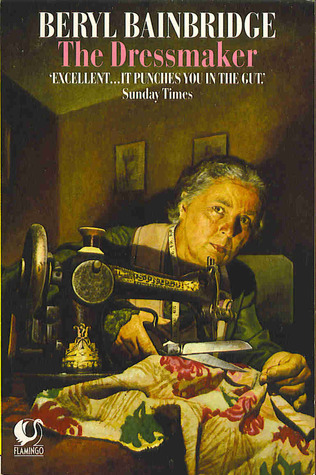
It’s a wartime story of life in Liverpool in 1944, where Rita, aged 17, is living with her two middle-aged aunts, Nellie (shown on the cover of my 1985 copy) and Margo, also called Marge. Her mother had died in childbirth, and she had lived with them as her father, their brother Jack, was unable to bring her up whilst single-handedly running his butcher’s shop. Rita, although she knows he is her father, calls him ‘Uncle Jack’. She is naive and innocent, and after meeting Ira she fantasises about being a GI bride, but her aunts are not taken in by him and view him in a very different light. She dreams about life in America as Ira’s wife:

After the war he would take her to the States, and they’d have a long black car and a grand piano with a bowl of flowers on the table. There’d be a house with a verandah and wooden steps, and she would run down them in a dress with lots of folds in the skirt and peep-toed shoes. Auntie Nellie would tell Mrs Mander how well-off they were, how Ira cared for her, the promotion he kept getting at work. (page 59)

The opening chapter signals with the word ‘afterwards‘ that something significant had happened, but with no indication of what it was. It left me wondering where this book was going. At first it seemed a rather mundane story of everyday life, but as the story played out I began to feel it was leading up to a tragedy – something terrible was coming towards this working class family.

And indeed it was – and it was shocking, particularly given the domestic setting. It’s only with the final denouement that the mystery hinted at in the opening chapter is revealed in a savage and violent climax. Even though I was expecting a tragedy the actual nature of it took me totally by surprise.

A Town Called Solace by Mary Lawson

Chatto & Windus| 18 February 2021| 294 pages| Review copy| 5*

It was a complete pleasure to read A Town Called Solace by Mary Lawson. I loved the clarity of the narrative, focused on three main characters, each perfectly distinct and finely described and the sense of location in a small town is excellent.

It’s set in North Ontario in 1972, but looks back to events thirty years earlier when Elizabeth Orchard first met Liam who was then a small boy of 3 when he and his family lived in the house next door. The last time she saw him he was still only 4 years old. It was not a happy time for either of them, and thirty years later, when she is dying she wants to make amends and gives him her house.

Clara lives next door to Elizabeth, who she loves, and she is alarmed when she sees Liam moving into Elizabeth’s house. Elizabeth had given her a key and she goes in every day to feed Moses, Elizabeth’s cat. She has no idea that Elizabeth is dying and is furious when she discovers that Liam is moving Elizabeth’s things and packing them in boxes. Her life is in turmoil in any case as she is devastated that Rose, her 16 year old sister has gone missing.

The narration moves between these three people, seeing events through their eyes. Elizabeth, in hospital looks back over her life, remembering her despair at not having a child of her own, and her love for little Liam that ended badly, despite her good intentions. Clara spends the time before and after school at the window looking out for Rose’s return and Liam, whilst remembering his sad childhood, is trying to rebuild his life after his marriage ended in divorce.

I loved this book. It’s about families, the things that go wrong, about memories and about friendships and the care that people have for each other. It’s moving and sad, but also filled with hope. And it’s beautifully written.

Many thanks to the publishers and NetGalley for my review copy.

Murder in Mesopotamia by Agatha Christie

I first read Agatha Christie’s Murder in Mesopotamia in 2012 but never got round to writing about it. It was a good choice to re-read for the 1936 Club as I didn’t remember much about it. It’s a Poirot mystery, but he doesn’t appear until about halfway. As the title tells you it is set in Mesopotamia, the area in the Middle East between the two rivers, Tigris and Euphrates (the area of present-day Iraq, Kuwait, and parts of Iran, Syria, and Turkey).

An archaeologist’s wife is murdered on the shores of the River Tigris in Iraq…

It was clear to Amy Leatheran that something sinister was going on at the Hassanieh dig in Iraq; something associated with the presence of ‘Lovely Louise’, wife of celebrated archaeologist Dr Leidner.

In a few days’ time Hercule Poirot was due to drop in at the excavation site. But with Louise suffering from terrifying hallucinations, and tension within the group becoming almost unbearable, Poirot might just be too late…

Agatha Christie had first visited the Middle East in 1929 travelling on the Orient Express to Istanbul and then on to Damascus and Baghdad. She visited the excavations at Ur and returned there the following spring where she met archaeologist Max Mallowan – by the end of the summer they had decided to marry, which they did on 11 September 1930. So, by 1936 when she wrote Murder in Mesopotamia she had frequently accompanied Max on his archaeological digs and her books set in the Middle East are based on the everyday life that she experienced on a dig and on the people she met.

The murder victim is Louise Leidner, the wife of the leader of the expedition. The novel is narrated by Nurse Amy Leatheran, who had been asked by Dr Leidner to care for Louise, although he is vague about what is wrong with her. It seems she is scared and has nervous terrors. She has fearful visions and the other members of the expedition blame her for the oppressive atmosphere on the dig.

It’s a seemingly impossible murder – she is found in her room, dead from a blow on her head, and suspicion falls on Louise’s first husband who had been sending her threatening letters, or so she had claimed. But no strangers had been seen on or near the expedition house and it is down to Poirot to discover what had actually happened. Fortunately Poirot was in the area, having sorted out a military scandal in Syria (referred to at the beginning of Murder on the Orient Express) and was passing through the expedition site on his way to Baghdad before returning to London.

I thoroughly enjoyed this book, although I think the details of how the murder was committed are rather far-fetched. I was hoping that Agatha Christie had mentioned writing it in her Autobiography, but I couldn’t find any reference to it, although she wrote extensively about her time in the Middle East with Max, and in her fascinating memoir, Come, Tell Me How You Live she wrote about how much she loved the country and its people.