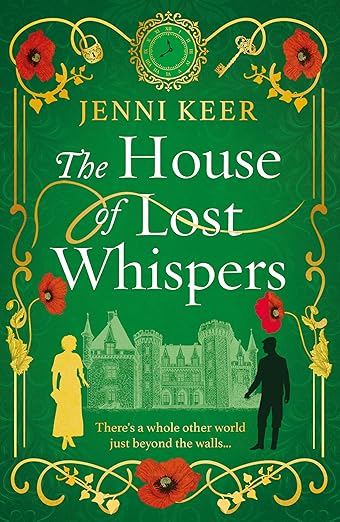
Boldwood Books|25 April 2025| 378 pages| e-book|Review book| 3*
Summary:
What if another world existed… where the Titanic had never sunk?
When the ill-fated maiden voyage of the Titanic leaves Olivia Davenport orphaned, she’s sent to live with her guardians, the Fairchilds, in their huge Jacobean mansion. But the Fairchilds have more to worry about than a grieving young girl – with war in Europe imminent and four sons to protect.
Olivia feels alone and friendless. Until she hears a voice from behind the wall in her tower bedroom. A voice from a man called Seth. Convinced he’s merely a product of her grieving imagination, it’s not until after the heartbreak of war that Olivia discovers that he exists in an overlapping world, just a shudder in time away from her own. A world where the Titanic never sank… Where everything since has been just slightly… different.
All Olivia wants is to find a way into his reality. And not just to see the faces of her beloved parents once again. But also to meet Seth. Who might just be the love of her life…
I enjoyed reading Jenni Keer’s debut novel, The Hopes and Dreams of Lucy Baker several years ago and thought I’d like to read more of her books. This one is her eighth book, so I missed the books in between. I don’t often read romance or fantasy novels but The House of Lost Whispers has both elements and it’s also historical fiction set before, during and after the First World War. I preferred the historical element, especially the middle section about the War. But I also enjoyed reading the fantasy element about the anomaly in the magnetic field surrounding the earth causing vibrations, disrupting the fabric of space and time. This resulted in the formation of a duplicate earth, one parallel with our world, in which the Titanic did not sink on 12th April 1912.
I think this is a very interesting and possibly original idea, exploring what life would have been like for Olivia and her family if the Titanic had not been sunk. The book also explores loss and grief, family life, friendship and romantic relationships, as well as the devastating and horrific events of the First World War. As described in the blurb Olivia in the ‘real’ world and Seth in the parallel world can hear each other through the wall in her tower bedroom (the whispers), but despite their efforts they cannot break through to meet.
It’s beautifully descriptive, bringing the settings to life and there is also a murder mystery to solve. My only criticisms are that at times I did get a bit confused about Seth’s character and his parallel in the ‘real’ world, and I could have done without the love scenes (too descriptive in places). As I read on I was wondering how it would end and maybe Jenni Keer wondered too because the conclusion seemed rushed and rather neatly sown up. I was a bit disappointed, although I can’t imagine how else it could have ended. But overall it kept me reading, wanting to know what would happen next.
Many thanks to the publishers for a review copy via NetGalley.
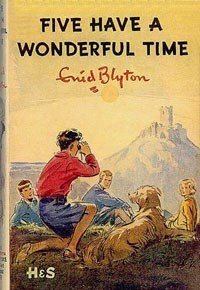
The Famous Five are having a brilliant time – on holiday in horse-drawn caravans – and they’ve discovered a ruined castle nearby! The castle looked deserted from a distance – but is that a face at the window? Or is it a trick of the light? The Famous Five just have to find out! Just who is hiding in the castle?
I had a wonderful time as a child reading Enid Blyton’s books. Her books gave me so much pleasure as a child going right back to her Noddy and the Magic Faraway Tree books. Her Malory Towers books were my favourites, but I also enjoyed the Favourite Five, The Secret Seven and the Adventure and Mystery series too.
The Five are Julian, Dick and Anne, their cousin, George (real name Georgina, but not call her that), and Timmy, George’s dog. Their ages aren’t mentioned in this book but according to Enid Blyton.net, Julian was twelve in Five on a Treasure Island, the first in the series, Dick and George were eleven, and Anne was ten. In the next book, Five Run Away Together, they were all a year older since their last adventure on Kirrin Island, a year before. After that in the later books, it seems that their ages were frozen in time (like Agatha Christie’s Poirot) — otherwise they would have been well into their twenties before the end of the series.
It’s the summer holidays and George is waiting impatiently at home recovering from a cold, whilst the rest of the Five are staying in a couple of old-fashioned gypsy caravans in a field near the village of Faynights, opposite the ruins of Faynights Castle. There’s news that two famous scientists have disappeared, with plans to go abroad and sell their secrets to another country. Julian is worried one of them might be his Uncle Quentin, George’s father. He isn’t and knows the two men, and insists that Derek Terry-Kane, in particular, would never be a traitor.
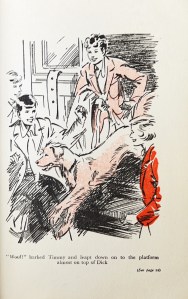
When George arrives they all go to the village shop to buy ice creams and the shop woman tells them some ‘fair folk’ are coming who usually camp in the field where the children are staying. She says it’s not a fair nor a circus, but a sort of mixed-up show with a fire-eater, a man with snakes, an India-Rubber man, and a man who can get himself free, no matter how tightly he’s tied up with ropes. When they arrive they insist the children have to leave the field, saying ‘No kids are allowed in our field’ and make life very unpleasant for them. Then their caravans disappeared whilst the children were out – the fair people had towed them into the next field. This is only resolved when Jo, a gypsy girl turns up, whose uncle is the fire-eater. She insists that they are her best friends and makes them bring the caravans back.
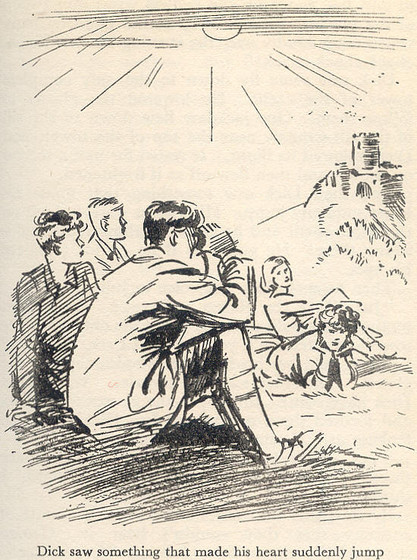
Julian though, isn’t happy and wants them to leave. But he changes his mind when Dick spots a face in a window-slot at the top of the only complete tower at the top of the castle. He thinks it’s a man’s face with bushy eyebrows. George remembers that Terry-Kane has thick black eyebrows. They decide they can’t leave without exploring the castle and find an explanation for the face – is Terry-Kane in the castle? So the next day they do just that and find themselves in the middle of a very dangerous mystery. It’s only with Jo’s help and the fairground entertainers with their amazing skills that it all ends well.
This really is a book that reflects the lives and attitudes of the 1950s. The children go exploring on their own much more so than they are allowed to do today, playing outdoors, exploring where they lived in the woods and fields, riding bikes with friends, and going swimming. And as a child of the 1950s that’s what my childhood was like, but not to the same extent as the Famous Five! Boys were encouraged to be strong and independent, whilst girls tended to be domesticated. Anne, for example, does the shopping, tidies the caravans and does the cooking, whereas the boys get the water and collect wood for the camp fire. George, a tomboy is the exception – she has short hair, scorns skirts and dresses in shorts and wants to do what the boys do.
Yesterday’s Britain, published by the Reader’s Digest describes the period 1950 – 1959 as a ‘golden age for some people‘, with ‘Britons better off as material prosperity swept away the last vestiges of austerity. “Most of our people have never had it so good,” declared Harold Macmillan.
Public figures were automatically respected, authority was deferred to inside as well as outside the home, and children grew up with an unquestioning sense of security.
It’s a pity that we can’t say the same for today!
About Enid Blyton
She wrote around 760 books during her fifty-year writing career! The 1950s was her most productive period, often publishing more than fifty books a year. However, her books have been criticised over the years, saying they are mediocre material, formulaic books with fantastical plots, xenophobic and ‘reflected negative stereotypes regarding gender, race, and class.’ Her books are very much of their time – she was born in 1897 and died in 1968. She began writing in the 1920s, with most of her series dating from the 1940s, when lives and attitudes were very different from those of today. I think they are books that provided comfort reading during and after the Second World War. Some of Blyton’s books have been ‘updated’ over recent years to remove or alter potentially offensive language and imagery, in an attempt to make them appeal more to modern children.
I thoroughly enjoyed them, finding them fun to read and completely unaware at the time that there was so much criticism when I read her books. She wrote about children whose lives were very different from mine and that was one reason I liked them. I loved the fact that her books took me to magical places, places of adventure where children could solve mysteries, thwart criminals, be independent of adults and have great fun, a world of mysterious castles and islands, exploring secret passages and hidden chambers and finding buried treasure.
It’s nearly the end of March when the Reading Ireland Month 2025 hosted by Cathy at 746 Books ends. I had a list of books to choose from and I read one of my TBRs, The Likeness by Tana French, a book I’ve had for eight years. It’s the second book in the Dublin Murder Squad Mysteries. I read the first book, In the Woods, in 2014.
Hodder and Stoughton| 2008| 574 pages| 4*
Description:
Still traumatised by her brush with a psychopath, Detective Cassie Maddox transfers out of the Murder squad and starts a relationship with fellow detective Sam O’Neill. When he calls her to the scene of his new case, she is shocked to find that the murdered girl is her double. What’s more, her ID shows she is Lexie Madison – the identity Cassie used, years ago, as an undercover detective. With no leads, no suspects and no clues to Lexie’s real identity, Cassie’s old boss spots the opportunity of a lifetime: send Cassie undercover in her place, to tempt the killer out of hiding to finish the job.
I loved this book. I couldn’t remember very much about In the Woods, but I had no difficulty in following The Likeness, so I think it’s a good standalone mystery. It’s a gripping fast paced book, set in Ireland, with well drawn characters, including a group of five friends living in a large house in the countryside. French portrays each of these friends in detail, and as the story progresses their backgrounds and relationships are revealed. The book begins as one of the friends, Lexie Madison is murdered.
Astonished by the fact that Lexie is her double, Detective Cassie Maddox, who played a small role in In the Woods, is persuaded to go undercover at the house, and assume the dead women’s identity, the police having told her friends she wasn’t killed, but was merely wounded. Far-fetched, yes, but it didn’t take me long before I found myself accepting this was feasible. If you find that impossible then this book is not for you, which would be a shame as it is well written, outstanding in its depiction of the Irish countryside and the interaction of the characters. It explores their feelings and emotions, their motivations and desires to such an extent that I was totally engrossed in the book, hoping, irrationally, that Lexie was not dead but had survived and all would be well. Of course, that was not possible and the ending was inevitable.
Now I am just as eager to read the next book in the series, Faithful Place, which features one of the other characters in the Murder Squad, Undercover cop Frank Mackay.
It would be an excellent match for he was rich, and she was handsome” Sense & Sensibility, 1811
When Elinor and Marianne Dashwood’s father dies, they with their mother and younger sister are forced to leave their family home Norland Park and take up residence in a small rented cottage. There they experience love, romance, and heartbreak. Marianne falling madly in love with the dashing Mr. Willoughby while Elinor silently hides her own broken heart from those nearest to her. A story of very mixed fortunes in love.
Jane Austen is one of my favourite authors and I’ve read all of her novels, beginning with Pride and Prejudice, which I’ve reread over the years many times, and watched TV and film adaptations. This year is the 250th anniversary of Jane Austen’s birth, so this is an ideal time to reread some of her books and I’m joining Brona at This Reading Life in her Austen 2025 project to reread her books, along with the Classics Club’s Sync Read (or readalong).
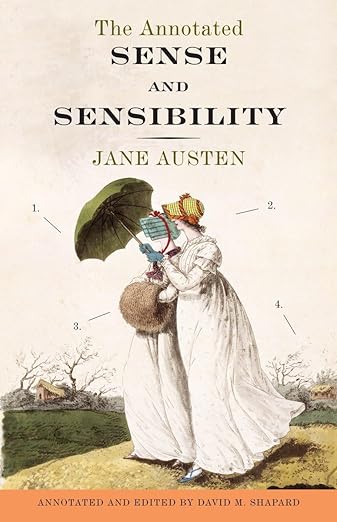
I first read Sense and Sensibility when I was at school but have never reread it. This time I read the annotated edition, edited by David M Shapard that gives explanations of historical context, citations from Austen’s life, letters, and other writings, definitions and clarifications, literary comments and analysis. There are multiple maps of England and London, an introduction, a bibliography, and a detailed chronology of events with more than 100 informative illustrations. I found I already knew some of the information given in some of these notes but others enhanced my understanding of the period. I particularly liked all the illustrations and the details about the cultural context, the social customs and conventions of the period.
Sense and Sensibility was Jane Austen’s first published novel. There was an earlier version, called Elinor and Marianne, that Jane Austen wrote in the form of letters probably in 1795 when she was nineteen. She returned to it after she began First Impressions, which later became Pride and Prejudice. Towards the end of 1797 she returned to Elinor and Marianne, modifying it and changing its name to Sense and Sensibility. It wasn’t until 1810 that she finished the book and it was published in 1811.
It focuses on the two Dashwood sisters, Elinor (aged 19) and Marianne (aged 16), who have contrasting temperaments. On the surface Elinor, the older sister represents sense or reason while Marianne represents sensibility or emotion. However as the story develops they both exhibit varying aspects of each characteristic. Marianne comes over at first as a rather silly teenager, emotional and passionate, who openly expresses her likes and dislikes, letting everyone know how much she is grieving for her father and how much she loves her new friend she met whilst living at Barton Cottage, John Willoughby. Elinor, however, is more restrained and discrete, controlling her emotions and reactions, even though she has strong feelings for her sister-in-law’s brother, Edward. Later in the book, however, both sisters display both ‘sense’ and ‘sensibility’, which I think makes them more believable as characters.
I’m not going into any more detail about the plot. A lot happens, there are misunderstandings and many secrets are exposed. I liked the way the story moves between the two sisters switching from one to another. At first I did feel more sympathetic towards Elinor, but Marianne did grow on me by the end of the book. They both grew in complexity as Jane Austen developed their characters. There are many other characters, some foolish or absurd providing comic relief and others who are nasty and selfish and cause both Elinor and Marianne much anguish and heartache.
I thoroughly enjoyed the book!
And now I’m looking forward to re-reading Pride and Prejudice.
When Benet was about fourteen, she and her mother had been alone in a train carriage – and Mopsa had tried to stab her with a carving knife. It has been some time since Benet had seen her psychologically disturbed mother. So when Mopsa arrives at the airport looking drab and colourless in a dowdy grey suit, Benet tries not to hate her. But when the tragic death of a child begins a chain of deception, kidnap and murder in which three women are pushed to psychological extremes, family ties are strained to the absolute limit…
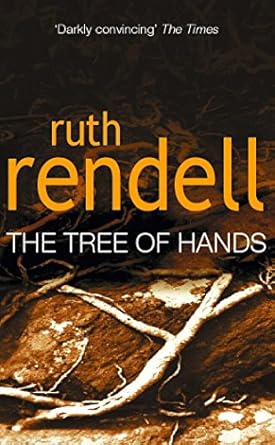
The Tree of Hands by Ruth Rendell is one of my TBRs. It’s a book I bought nine years ago from Barter Books in Alnwick. I don’t know why I haven’t read it before now as it is really good – one of the best books I’ve read this year, and one of her best standalone books. I read it this year as one of my 20 Books of Summer.
Why I enjoyed it so much is that it thoroughly gripped me and made me want to read on and on. It’s a psychological thriller, full of suspense, with several twists and turns that made me unsure how it would end. I was delighted by the final twist!
Benet’s son, James aged four dies from croup whilst in hospital soon after Mopsa, her mother with a history of mental illness, comes to visit. Meanwhile Carol, a young widow with three kids, two of them in care, is living nearby with Barry, her younger boyfriend. He adores her but she doesn’t want to marry him, content for him to do all the housework and look after Jason her two year old son when he is not being looked after by babysitters. The trouble starts when Mopsa kidnaps Jason and brings him back to Benet as a replacement for James.
The tree of hands in the title is taken from the collage on the hospital playroom wall:
On the white paper base sheet had been drawn a tree with a straight brown trunk and branches and twigs, and all over the tree, on the branches, nestling among the twigs, protruding like fungus from the trunk, were paper hands. All were exactly the same shape, presumably cut out by individual children using a template of an open hand with the fingers spread slightly apart. (page 46)
Benet found them horrible, as though the hands were begging for relief, or freedom, or oblivion. She thought there was a mad quality about them, ‘all the hands upraised, supplicating, praying.’ And she fell forward in a faint when the doctor told her James had died.
This is a dark and disturbing book about what happens to Jason, Benet, Carol and Barry. It’s well written and I could easily visualise the characters and the setting. It’s emotionally challenging and it both fascinated and horrified me in equal measure. It won the CWA Silver Dagger Award in 1984, an award given annually by the Crime Writers’ Association of the United Kingdom since 1960 for the best crime novel of the year.
NB I’m currently reading Rendell’s The Girl Next Door because I enjoyed The Tree of Hands so much.
‘No sign of foul play,’ says Dr Carr after the post-mortem on Agatha Dawson. The case is closed. But Lord Peter Wimsey is not satisfied.
With no clues to work on, he begins is own investigation. No clues, that is, until the sudden, senseless murder of Agatha’s maid.
What is going on in the mysterious Mrs Forrest’s Mayfair flat? And can Wimsey catch a desperate murderer before he himself becomes one of the victims?
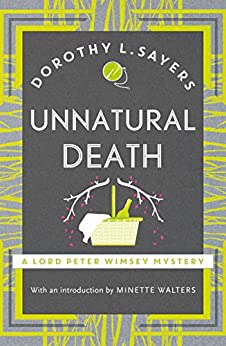
This is the third book in the LordPeter Wimsey series by Dorothy L Sayers, first published in 1927. My copy was reprinted in 2016 and I bought it secondhand five years ago. I’ve been reading this series totally out of order – I’ve already read the first two and several of the later books too. I think they each read well on their own.
Miss Climpson makes her first appearance in Unnatural Death, helping Lord Peter, working undercover. She is an elderly spinster, who runs what Wimsey calls ‘My Cattery’, ostensibly a typing bureau, but actually an amateur detective/enquiry agency. As in the first two books he works with his friend, Inspector Charles Parker, who is a Scotland Yard detective. Bunter, his manservant, only has a very minor role in this book. I think it’s an interesting mystery, not so much about discovering who killed Agatha Dawson and her maid, Bertha, but more about how the murders were committed.
Uncertain Death is most definitely a book of its time – that is the early 20th century. There is much banter, wit and humour, and plenty of snobbery of all types, clearly showing the class distinctions between the working and upper classes. Racism is prevalent and also lesbianism, although that is not directly stated. It is a clever story, well told, with colourful characters. There is a biographical note at the end of the book that reveals much about Lord Peter’s background, about his early years, school and university, and his experiences during the First World War.


 BooksPlease