Tales of Terror

The Body Snatcher and Olalla are two short stories by Robert Louis Stevenson included in my copy of The Strange Case of Dr Jekyll and Mr Hyde, a Penguin Classic. Both stories were written for the Christmas “crawler” tradition in 1884 and 1885. Christmas was a season traditionally associated with supernatural and creepy tales. In the introduction to the book, the editor, Robert Mighall explains that a “crawler” was a ‘sensational tale of a supernatural incident designed to produce a pleasurable thrill in its readers.’

The Body Snatcher is very much a traditional Christmas ghost story, beginning with four men gathered in an inn on a dark winter’s night telling tales round the fireside of grisly deeds. On this particular night Fettes, the local drunk, is roused from his stupor  as if “arisen from the dead” when he hears the name ‘Dr Macfalane’. What follows is the tale of their relationship in the past when they were both medical students. The title of this story of course gives the game away and it is based on the activities of Burke and Hare in Edinburgh in the 1820s, body snatchers who turned out to be murderers selling bodies that had never been buried. I didn’t find this story to be very chilling or thrilling, although I didn’t predict the slight twist at the end. The interest for me is in the two personalities of Fettes and Macfarlane and how the turn of events affected their lives. Macfaarlane had gone on to be a successful and wealthy doctor, untroubled by his conscience, and

richly dressed in the finest of broadcloth and whitest of linen, with a great gold watch chain and studs and spectacles of the same precious metal; he wore a broad folded tie , white and speckled with lilac, and he carried on his arm a comfortable driving coat of fur.

Whereas Fettes overcome by his conscience had lived in idleness, pursuing

“crapulous, disreputable vices”. Permanently in a “state of melancholy, alcoholic saturation”, a “parlour sot, bald, dirty, pimpled and robed in his old camlet cloak”.

Olalla is a longer story and to my mind is the better of the two. When does a short story cease to be considered short, I wonder? It is definitely written as a Gothic tale, set in an ancient Spanish castle surrounded by deep woodland, about a young man recovering from his war wounds and to “renew his blood”, who finds himself living with a strange family. The castle is as much a character in this story as the people, fallen into disrepair as much as the family has degenerated from its noble ancestors who fell prey to evil.

The young man, naturally, falls in love with Olalla, the beautiful daughter, with a strange mad mother and a simpleton brother.  She fears she has inherited the evil of her ancestors and the hint of vampirism in her mother. There is almost a fairytale feel to this story with references to Sleeping Beauty locked by magic within the castle, and also a chill factor which Bram Stoker later developed in Dracula.

This completes my reading for the RIP Challenge, although I have several more books that I would like to read such as The Turn of the Screw. Thanks to Carl for hosting the Challenge.

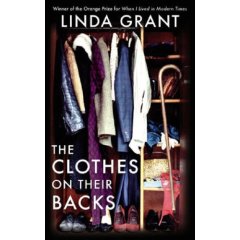
The Clothes On Their Backs by Linda Grant

Vivian, the only child of refugee parents, grows up at Benson Court in London during the 1960s and 1970s. Her parents are quiet, timid people, and they live a sheltered life, wanting to be inconspicuous. Vivian describes herself as 

the child of old parents, a pair of cranky odd Europeans with wierd opinions. Oppressive ideas formed in the stale gloom.

As a child she is fascinated by her glamorous and notorious Uncle Sandor, the infamous slum landlord, much to her parents’ distress who want to deny any relationship to him. She leaves home briefly going to York University where she  hides her identity by wearing vintage clothes. She arrived wearing a”crepe de Chine cocktail dress and created an instant, sensational impression.” She met Alexander, a “tall, blond Englishman with his mutton chop whiskers which were all the rage in the early seveties and the long narrow feet in their suede desert boots” – a vicar’s son from Hereford. They marry but he dies on their honeymoon and she returns to live with her parents at Benson Court.

Vivian’s problem is that her parents are silent about their lives before coming to England and refuse to tell her about her uncle. This intrigues her and she feels she doesn’t know who she is. Much of the book is about her efforts to find out. So when she meets Sandor on a park bench she pretends she is “Miranda” and takes the job of writing his life story. There is much in this that I found implausible, including the climax of the story.

The clothes the characters wear are described in detail and are symbolic of their identities and lives. Vivian ponders on the power of clothes to create or disguise our personalities:

A new dress. Is this all it takes to make a new beginning, this shred of dyed cloth, shaped into the form of a woman’s body? The crowd hurried past, their faces lit with anxiety and excitement. Our vulnerability suddenly touched me, all our terrible, moving weaknesses contained in a jacket, a skirt, a pair of shoes.

Well, I know Trinny and Susannah are always going on about the importance of wearing the right clothes and the impact that has on our lives, but I’m not so sure that clothes have the power to change one’s personality. For a new beginning surely you need more than a new dress?

The Clothes On Their Backs is shortlisted for the Man Booker Prize, the winner is to be announced on 14 October. I’ve started The Secret Scripture by Sebastian Barry, but I haven’t read the rest of the shortlisted book. I doubt this one will win, but who knows?

A Real or An Imaginary Friend?

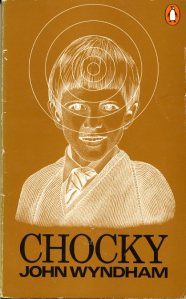
Chocky by John Wyndham qualifies for the RIP Challenge in the Supernatural category. It seems at first as though Matthew has an invisible friend, just like his little sister’s Piff, who appeared when Polly was about five. Matthew at eleven seemed a little bit old for such a friend, and when his father overhears him having what seems like a one-sided conversation he becomes worried. It all becomes more puzzling when Matthew starts asking unusual questions about physics and maths and starts to do things he couldn’t do before.  When Matthew becomes ill he can’t keep his secret any longer and running a high temperature he asks his mother to tell Chocky to go away and stop asking him questions. Just who Chocky is and where is he/she from, and indeed what gender  Chocky is, is all most mysterious.

Matthew who can’t swim, saves his sister from drowning, much to everyone’s astonishment. Does he have a “Guardian Angel”? He suddenly starts painting in a most unusual style and it appears that he is “possessed”.  On the face of it this is a simple story and told in an innocent, almost facile style. But every now and then philosophical questions are thrown into the story as Matthew’s parents discuss the problem. Mary, his mother reflects on reality:

Reality is relative. Devils, evil spirits, witches and so on become real enough to the people who believed in them. Just as God is to people who believe in him. When people live their lives by their beliefs objective reality is almost irrelevant.

 She wonders if they dealing with the problem in the right way. Is Matthew mentally ill? Eventually they get professional help from Landis who specialises in mental disorders. Landis is baffled and says it has him beat:

More than anything I’ve come across it resembles what our unscientific ancestors used to consider a case of “possession”. They would have claimed quite simply that this Chocky is a wandering, if not a wanton, spirit which has invaded Matthew.”

But Chocky is not malevolent. It appears sometimes as though John Wyndham, writing in 1968, is using this book as a means of stating his criticsm of the state of technology and the use that was being made of scientific advances, such as atomic power. Chocky tells Matthew’s father:

You have not done badly with electricity in a hundred years. And you did quite well with steam in quite a short time. But all that is so cumbersome, so inefficient. And your oil engines are just a deplorable perversion – dirty, noisy, poisonous, and the cars you drive with them are barbarous, dangerous …

Chocky is convinced that resources are being squandered. At the end of the book it does come over as a lecture for finding and developing new sources of energy, of gaining access to an infinite power supply.

Chocky advocates that she/he contacted Matthew because young minds are disposed to accepting the improbable because

they have absorbed so much that is unlikely and inexplicable from myths, legends, fairy-stories, and religion, that they are disposed to accept the improbable with little question, providing it is not alarming. Older minds, on the other hand, have formed rigid conceptions of probability, and are very frightened by any attempt at contact: they usually think they must be going mad, which interferes with rapport.

I liked this strange little book, although it is now a bit dated, and I had little difficulty in accepting its reality ( after all, I have read many myths, legends and fairy tales). One other topic I found interesting is the view put forward that women have “a compulsion” to “produce a baby as soon as possible after marriage” and that this is not just a biological urge but also a response to pressure to conform with other people’s expectations and the

“desire to prove that one is normal, the belief that it will establish status, a sense of personal achievement, the symbol of one’s maturity, a feeling of solidarity, the obligation of holding one’s own in competition with the neighbours. … It is not the least use pointing out that some of the world’s most influential women, Elizabeth the First, Florence Nightingale, for instance, would actually have lost status, had they become mums, in fact it is much wiser not to try. Babies, in a world that already has far too many, remain desirable.”

On one hand it seems as though John Wyndham was being rather condescending but on the other as though he was advocating feminism. Matthew is adopted and Mary’s sisters do think of her as inferior until Polly is born.  So there are also some reflections on the difficulties of adoption and its effect on children. Until Polly was born Mary felt that she was not a real mother – she had the impression that “some babies confer a little more equality than other babies”. 

I liked this mixture of story with its gentle sci-fi theme and its social and philosophical reflections. All of which was different from Chocky, a children’s TV series of the 1980s which I remembered watching. I found this great site – Little Gems – which contains lots of information on children’s TV shows and films of years gone by, including Chocky. If you have time on your hands and fancy enjoying a bit of nostalgia I can recommend Little Gems

The Sunday Salon on a cold wet Sunday

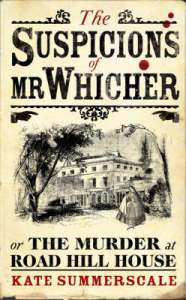
It’s raining and cold here for today’s Sunday Salon post. Summer wasn’t very long this year but then it often isn’t. It wasn’t in England in 1860 according to my reading today in Kate Summerscale’s remarkable book The Suspicions of Mr Whicher or The Murder at Road Hill House, when summer was brought to an end on the evening of 19 July by a tremendous downpour over Somersetshire and Wiltshire. Ditto this year.

This book is the winner of the Samuel Johnson Prize for Non-Fiction and it is terrific (Ian Rankin also thinks so). I’ve read nearly half the book and I only started it yesterday. It’s compelling reading but I do have a growing feeling of discomfort because I’m beginning to feel a bit of a voyeur. There is so much detail, not just of the brutal murder of Saville Kent, aged three, but of everything in the lives of the Kent family and the investigations of Detective Inspector Jonathan Whicher of Scotland Yard.

It’s the most amazing book with all the suspects of a classic murder mystery – the original country house murder. Kate Summerscale has thoroughly researched the case using the National Archives, Family Records Centre, and many libraries and museums, including the London Metropolitan Archives and the Metropolitan Police Historical Collection.

Her sources include not just books, pamphlets, essays and newspaper articles but also maps, railway timetables, and so on and so forth – even the weather details are accurate being taken from press reports and the dialogue is from testimony given in court. Did you know that a defendant was not allowed to give evidence at his or her own trial until 1898? I didn’t.

Then there are also the fascinating descriptions of how writers like Dickens and Wilkie Collins used real life police detectives as models in their novels – for example Bleak House, The Moonstone, and The Woman in White. It makes me want to rush and read those books again. Interspersed with the story of the investigation into the murder are details of the role and status of detective, the origin of the word clue, the comparison of a detective with a “sleuthhound” by Charlotte Bronte and the conduct of newspaper reporters. The word “detect” stems from the Latin “de-tegere” meaning “unroof” and the original figure of the detective was the lame devil Asmodeus who took the roofs off houses to spy on the lives inside! That’s exactly what it feels like reading this book, peering right down to the private lives of the Kent family.

It’s just the most wonderful book, no wonder it won the Samuel Johnson Prize.

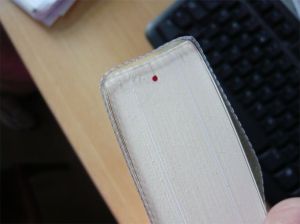
I’m just wondering if all the copies of this book have the small red blob on the head of the pages that is on the one I’m reading? A nice touch I think continuing the splashes of blood on the front and back covers.

Final Thoughts about The Gravedigger’s Daughter

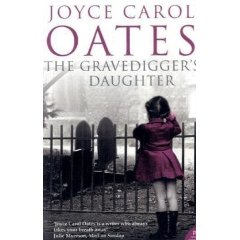
Gravedigger's DaughterI finished The Gravedigger’s Daughter by Joyce Carol Oates last week and parts of it have remained in my mind. Mainly I think it’s the general atmosphere of its world. It’s a grim, dark world, a violent and pessimistic world, gothic and grotesque. In some ways it reminds me of Hardy’s novels – you know something terrible will happen whatever the characters do to try to avert tragedy.

The main character is Rebecca Schwart, born in New York Harbor, the daughter of Jacob and Anna escaping from Nazi Germany in 1936. They live a life of abject poverty whilst Jacob can only find work as a caretaker of Milburn Cemetery, a non-demoninational cemetery at the edge of the town. A rent-free “cottage”, which is a stone hovel of four cramped rooms,  goes with the job. Jacob, once a maths teacher is reduced to a troll-like figure, harassed and tormented by schoolboys and young men: “Gravedigger! Kraut! Nazi! Jew!”.

It’s this first section of the book recounting Rebecca’s childhood that has stayed with me; the effect of the suppressed anger, prejudice and resentment on the whole family. Her mother Anna, retreats into a world of her own, hiding away from other people “the outsiders”. It’s only through through listening to music on Jacob’s radio when he is out of the house that she can communicate with Rebecca. Briefly the family have their hopes raised with the news that Anna’s sister and family are fleeing Germany and will come to live with them. Rebecca is excited and entranced by thoughts of her cousin Freyda and imagines playing with her, whilst Anna does her best to ‘fix-up’ the cottage. Alas, they never arrive. Jacob is sickened by his inability to protect his daughter and exhorts her to hide her weakness:

He told her solemnly as if she were of a age to understand such words, “Humanity is fearful of death, you see. So they make jokes about it. In me, they see a servant of death. In you, the daughter of such a one. But they do not know us Rebecca. Not you, and not me. Hide your weakness from them and one day we will repay them! Our enemies who mock us.”

Eventually, Jacob’s rage at his desperate life erupts into violence and life is never the same for Rebecca and her brothers.

More violence and despair follow as Rebecca falls in love with Niles Tigor, a man whose moods alternate wildly, one moment tender and passionate towards Rebecca and then cruelly indifferent and brutally agressive. Rebecca has a miscarriage, brought by Niles’s violent attack. She stays with him until she can no longer bear his cruelty and in fear of her life and that of her son Niley she turns on him and flees thinking she may have killed him.

The third section of the book follows her life with Chet, his desire to marry her and her increasing anxiety and fear that Niles will discover where she is. Chet is a musician and helps Niles to become a pianist. Chet is from a wealthy family in contrast to Rebecca, now Hazel and she lives a life of luxury, still haunted by the fear of Niles. Music is a motif that runs through the book. Niley has inherited his musical talent from Anna, who used to play in the ‘old country’ and stifled by Jacob she still listened secretly to music on the radio and introduced Rebecca to Beethoven’s Appassionata; a memory that Rebecca cherished throughout her life, culminating in Niley’s triumphant performance of the sonata. I read the account of his performance with increasing tension as Hazel (Rebecca) can hardly breathe in her dread of a catastrophe.

History and how we perceive it is a thread running through the book. Here are two quotes that struck me:

History has no existence. All that exists are individuals, and of these, only individual moments as broken off from one another as shattered vetebrae.

and

History is an invention of books. In biological anthropology we note that the wish to perceive “meaning” is one trait of our species among many. But that does not posit “meaning” in the world. If history did exist it is a great river/cesspool into which countless small streams and tributaries flow. In one direction. Unlike sewage it cannot back up. It cannot be “tested” – “demonstrated”. It simply is. If the river dries up, the river disappears. There is no “river-destiny”. There are merely accidents in time.

But it’s the final section for me that stands up to the story of Rebecca’s childhood and in some ways completes the story. And yet …

I don’t want to spoil it for anyone, so I’ll just say the ending did surprise me and touched me enormously. It made a great ending for this melodramatic and memorable book. There is an interview with Joyce Carol Oates at the back of the book and I was not surprised to read that this part of the book had the power to bring tears to her eyes, even though she had written it herself. It brought tears to my eyes too. The favourite parts of the book for her included the scenes in the gravedigger’s house and the exchanges between the father and his children, which I think are very powerful.

I’ve also written about this book here and here. It qualifies for my second book for the RIP III Challenge.

The Sunday Salon – This Week’s Books

This last week has been yet another week away from home and reading has had to be slotted in. I read late at night when I nodded off with a book in my hand or early in the mornings when the time speeds up at an alarming rate so I hardly felt I’d read much at all. However, this week I finished reading Joyce Carol Oates The Gravedigger’s Daughter and yesterday I finished reading Daphne du Maurier’s The House On The Strand. I also started Linda Grant’s The Clothes On Their Backs (short listed for the Booker Prize).

This morning I read the introduction to The House On The Strand and dipped into Margaret Forster’s biography of Daphne Du Maurier to see what she had to say about it too. This was my first reading of The House On The Strand and I was drawn into its world immediately. I read it quickly and without taking notes, so this is just a brief summary of the book. It’s a story of time-travel as Dick Young moves between the present day and the 14th century set in Cornwall – around Par Sands and the Manor of Tywardreath. Dick is staying at Kilmarth (the house where Du Maurier lived after she was forced to leave Menabilly), the guest of his friend Magnus, a scientist researching the effect of a psychedelic drug. The drug produces hallucinations of time travel and as Dick moves in his mind to the 14th century he physically moves across the present day landscape crossed by roads and railway lines that he cannot see. The difference in the landscape plays a central part in the story.

Life in the 14th century is more to Dick’s liking than his own, where he is married not too happily to Vita, an American with two sons from an previous marriage. The 14th century world is full of danger, intrigue, adultery and murder and he falls in love (from afar, of course) with Isolda, a beautiful young woman married to a scoundrel, Sir Oliver Carminowe and in love with Sir Otto Bodrugan. Du Maurier had researched the history of Kilmarth and the local families and she was so exhilarated by the story that she actually  “woke up one day with nausea and dizziness” and could hardly bear to leave it for more than a few hours. Dick is a rather pathetic figure disllusioned with his marriage, unable to relate to his step-sons and alienated from his own times.

The combination of historical fact and psychological study moves into fantasy with the effect of the mind-expanding drug Dick takes. Du Maurier was writing in 1967 when LSD was well established, and in this book she has elaborated on its effects in describing Dick’s experiences as though on each trip a chemical time machine enabled him to continue the narrative of events with the same characters.  I did have to suspend my disbelief at times whilst reading but was carried along by Dick’s increasing obssession and addiction to the 14th century. It reminded me a bit of The Scapegoat by Du Maurier, a book I read many years ago – time for a re-read of that soon.

I alternated my reading between Linda Grant’s The Clothes On Their Backs and The House On The Strand. Grant’s book is narrated by Vivian as she looks back on her life, growing up in London in the 1960s and 1970s, the only child of refugee parents, fascinated by her glamorous and notorious Uncle Sandor. In the acknowledgements Grant states that the character of Sandor was inspired by that of the Notting Hill landlord Peter Rachman. I’m only about half way through this book which includes, as you would expect from its title, many descriptions of clothes and how they define us; how we use them to create or disguise our personalities.

I particularly liked the description of how Vivian reads:”Somehow I would climb inside the books I read, feeling and tasting them – I became the characters themselves.” It reminded me of Du Maurier’s immersion in the characters in her novels. Both books look at identity and how personalities influence and are influenced by others and both have entertained me thoughout this week.

The House On The Strand is the first book I’ve read for the RIP III Challenge.