The Music Room by William Fiennes

The Music Room must have been a difficult book to write and in parts it’s a difficult book to read.  It’s lyrical and strong in setting the scene – the castle with its battlements, secret rooms and spiral staircases where William grew up and the landscape, the moat, the fields and birds all came vividly to life as I read it. And yet as I read more and more of it I almost began to tire of it. There was little variation and it felt detached and over-stylised and impassive. But on reflection, I think that maybe that’s the only way Fiennes could write this book.

I never felt I really got to know William himself or most of his family, certainly not his mother, father, or his twin brother and sister. Most of the book is about his brother Richard, who was epileptic, and about the brain – the discovery of how it worked and the causes and treatment of epilepsy. William’s reactions to Richard are there – how as a small child, eleven years younger than Richard, he just accepted that that was how Richard was and how as he got older he became fascinated with the anger and aggression that could dominate Richard, how William almost tested him to see how far he would go. His love for Richard is also evident and Richard himself is a strong presence, with his violent outbursts and his passion for football, his mood swings and  his tenderness and remorse for what he has done.

William and the rest of the family almost faded into the background and I wanted to know more about them. There were glimpses of them such as the passages where  his father finds strength from the castle itself:

One afternoon I saw Dad standing next to the house, his right arm stretched out, palm pressed flat against a buttress, his head dropped. He didn’t move.

‘What are you doing?’ I asked.

He said he was asking the house for some of its strength. (page 131)

William describes hearing his mother playing the viola in the music room. The music room is a place of refuge – his mother

… didn’t want to leave the music; she wanted longer in that private room, away from everything, playing each piece as if she were trying to say how much she loved it. (page 48)

Music played its part in Richard’s life too. He had a ‘clear, soft baritone voice’ and liked to sing songs from Gilbert and Sullivan and Welsh hymns such as ‘Guide Me, O Thou Great Redeemer’.

He sang in the music room. Often he started too low or too high, and when the melody got away from his range he’d change key like someone shifting gear in a car so he could keep a grip on the tune. Sometimes in the evening, inspired, he’d dress up in suit, waistcoat and bow tie, and stand in the music room with the score held out in front of his chest just as a professional would, the Anglepoise at full extension over his shoulder. (page 210)

A disturbing book that has stayed with me over the last week or so, the idyllic setting, an extraordinary childhood and an outstanding portrait of his brother.
Crime Fiction Alphabet: P is for …

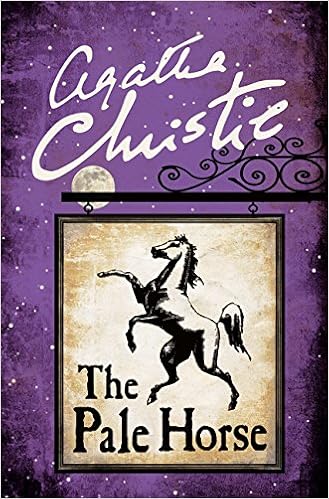
The Pale Horse by Agatha Christie. My copy is a hardback published in 1961 for The Crime Club.

Neither Hercule Poirot, nor Miss Marple feature in this novel and Mrs Ariadne Oliver has only a small part. Detective Inspector Lejeune is in charge of the investigation into the murder of Father Gorman who was killed one night on his way home. A list of names is found on Father Gorman’s body, seemingly unconnected in any way. The title,  a reference from the Book of Revelation  to a pale horse ridden by Death suggested to me from the beginning that what they had in common was death.

Mark Easterbrook, an historian and friend of Mrs Oliver, is drawn into the mystery when he meets an old friend Dr Corrigan, a police doctor, who shows him the list. Mark recognises two of the named people, both of whom are now dead. His cousin Rhoda lives in Much Deeping where he meets Ginger, a young red-haired woman and a friend of Rhoda. They visit The Pale Horse, an old house  which was formerly an inn in the village and is now the home of three weird women, thought by the locals to be witches. The Pale Horse is also the name of a sinister organisation that arranges murders based on black magic. Together, Mark and Ginger set out to unravel the mystery of the Pale Horse, but it is down to Inspector Lejeune to find the killer.

The book is a study of evil. Some of the characters are together discussing witchcraft and the nature of evil. Venables, a man crippled with polio says:

‘I can’t really go along with this modern playing down of evil as something that doesn’t really exist. There is evil. And evil is powerful. Sometimes more powerful than good. It’s there. It has to be recognised – and fought. Otherwise -‘ he spread out his hands.’We go down to darkness.’ (page 70)

It’s a fascinating book conveying a feeling of real menace. As usual with Agatha Christie’s books there are several suspects and various red herrings. However, I began to suspect who the culprit was quite early on in the book and this time I was right. This did not detract at all from my enjoyment and I hadn’t worked out the method until right at the end. I liked the various references to previous crimes that Agatha Christie dropped into the narrative, and also the portrait of Mrs Oliver as an author who liked her own privacy and disliked the embarrassing questions, always the same, that people asked her every time:

What made you first think of taking up writing? How many books have you written? How much money do you make? (page 17)

Reading about The Pale Horse in John Curran’s book Agatha Christie’s Secret Notebooks I discovered that this novel was mentioned during the trial in 1972 when Graham Young was convicted of murder, using the same method as detailed in the book, although he denied having read The Pale Horse. Still, it’s a disturbing thought, one that often occured to me when I used to watch TV programmes such as Wire in the Blood (I can’t watch it any more, it’s far too gory for me).

Crime Fiction Alphabet: O is for …

letter OThis week my choice for the Crime Fiction Alphabet meme is Oscar Wilde and the Candlelight Murders by Gyles Brandreth (published in the USA as Oscar Wilde and a Death of No Importance), John Murray Publishers Ltd, 2008, 355 pages). I read this in April 2008 and these were my thoughts about it at the time.

This is an ‘historical whodunit’ set in 1889 €“ 1890, fin-de-siècle London and Paris. The mystery begins with Oscar Wilde finding the naked body of Billy Wood, a 16 year old boy in the candle-lit room in a small terraced house in Westminster, close to the Houses of Parliament. Billy’s throat has been cut and he is laid out as though on a funeral bier, surrounded by candles, with the smell of incense still in the air. It’s a combination of fiction and fact, with both real and imaginary characters. Wilde with the help of his friends Arthur Conan Doyle and Robert Sherard sets out to solve the crime. Sherard (the great grandson of William Wordsworth) who wrote poems, novels, biographies (including five of Oscar Wilde) and social studies is the narrator.
The story reads quickly and is full of colourful characters such as Gerard Bellotti, who runs an ‘informal luncheon club for gentlemen’. Bellotti is

‘grossly corpulent’ giving the impression of ‘a toad that sits and blinks, yet never moves’ wearing ‘an orange checked suit that would have done credit to the first comedian at Collins’ Music Hall and on the top of his onion-shaped head of oily hair, which was tightly curled and dyed the colour of henna, he sported a battered straw boater.’

Wilde is a fan of Conan Doyle’s Sherlock Holmes stories so much so that as the mystery is unravelled he picks up clues in the manner of Holmes, observing and deducing, exclaiming when questioned by Conan Doyle ‘Come, Arthur, this is elementary stuff €¦ Holmes is where my heart is.’ I think it is this combination of fact and fiction that I enjoyed most in reading the book. I knew little about Wilde or Doyle and nothing about Sherard before reading it, but I think I learned a lot about all three people, about their characters, their views on life and love, and their works, as well as about the society in which they lived.

According to The Oscar Wilde Murder Mysteries website the book is peppered through with quotes from Wilde, or Brandreth’s versions of Wilde’s words, together with Brandreth’s own inventions. I couldn’t tell which was which, as I’ve only read Wilde’s The Picture of Dorian Gray and seen a TV production of The Importance of Being Ernest, but it all seemed perfectly in character to me. I found the details of Wilde’s love for his wife Constance particularly interesting in contrast to his trial for gross indecency in 1895. In fact I came away from the book really liking Wilde and wanting to read more about him and by him. Fortunately the biographical notes at the end of the book give more details of works by and about Wilde, Conan Doyle and Sherard.

I didn’t find the mystery too difficult to work out, with lots of clues throughout the book, but that didn’t detract from my enjoyment. On the contrary it made it all the more pleasurable. There are two more books in the series Oscar Wilde and the Ring of Death and Oscar Wilde and the Dead Man’s Smile.

Crime Fiction Alphabet: M is for Mortal Causes

crime_fiction_alphabetThis week’s letter in the Crime Fiction Alphabet series is M and I’ve chosen Ian Rankin’s Mortal Causes, which is the one book I finished reading in December.

Mortal Causes is the sixth book in the Inspector Rebus series. In his introduction Ian Rankin explains that ‘mortal’ in the Scots vernacular means ‘drunk’ so Mortal Causes

 evoked, in his mind, the demon drink, just as surely as it did any darker and more violent imagery. (page xii)

And there is a fair amount of violence in this dark book, starting with the discovery of a brutally tortured body in Mary King’s Close, an ancient Edinburgh street now buried beneath the High Street. It’s August in Edinburgh during the Festival.

Next time I visit Edinburgh I’d like to see Mary King’s Close. It’s open to the public and according to this website you can “experience the sights, sounds and maybe even smells of an amazing street that time forgot.  Where everyday people went about their day to day lives and where you can now walk in their footsteps.” Just the place for a murder, away from the busy streets, undisturbed by the festival goers and soundproofed so no one would hear any gunshots or screams.

There are links to the Northern Ireland ‘troubles’, the IRA, the Catholic/Protestant conflict, the Secret Service and organised crime. Rebus works his way through this mix, seconded to the SCS (the Scottish Crime Squad) because he’d been in the Army and had served in Ulster in the 1960s. The relationship between Rebus and Big Ger Caffety, Edinburgh’s gangster boss, develops in this book as the victim is none other than Big Ger’s son and he insists Rebus finds his killer. He tells Rebus he wants revenge. His men

… are out there hunting, understood? And they’ll be keeping an eye on you. I want a result Strawman. … Revenge, Strawman, I’ll have it one way or the other. I’ll have it on somebody. (page 74)

Rebus’s personal life is no better, his relationship with Dr Patience Aitken is  difficult. They quarrel, she tries to civilise him, giving him poetry books and tickets for ballet and modern dance:

Rebus had been there before, other times, other women. Asking for something more, for commitment beyond the commitment.

He didn’t like it. (page 81)

Their relationship is also threatened by Rebus’s involvement with Caroline Rattray, from the Procurator Fiscal’s office, who ‘is mad about him’.

This book, like the other Rebus books I’ve read, is more than crime fiction. It’s a complex story exploring the psychology of guilt, revenge and fear.

Drood by Dan Simmons

Drood was the first book I finished reading this year and I do hope I’m going to read better books than this, this year. My complaints about it are:

  • It’s too long
  • It’s too wordy
  • It’s too full of facts described in great length
  • It’s too full of Wilkie Collins
  • It’s too full of hallucinatory nightmares, involving in particular a black beetle scarab.

I  began to dislike all the characters, in particular Wilkie Collins, but then I realised this is fiction, not biography and I disliked it even more for initially lulling me into thinking this is what Collins and Dickens were like. But perhaps that’s a good point  – I began to believe what I was reading. I began to believe Dickens and Collins were involved in trying to find Drood, that Drood really existed, that he wasn’t just a figment of Dickens’s imagination, or Collins’s opium induced nightmares and that Collins actually planned to kill Dickens.

Wilkie comes over as a bombastic hypocrite full of his own self-importance and with a chip on his shoulder as far as Dickens is concerned. He’s not a well man, riddled with rheumatic gout, living with a woman he refuses to marry and with a mistress who has three children by him. He sees a green- skinned woman with teeth like long, yellow curved tusks who wants to fling him down the stairs and he is haunted by the ‘Other Wilkie’. He takes laudanum by the jugful, but insists the Other Wilkie has been with him all his life and is not a laudanum-induced dream. The Other Wilkie sits and watches him, lunging for the pen as Wilkie writes and eventually writing his novels for him.

Drood as portrayed in this book is horrific, a half-Egyptian fiend, who, according to Inspector Field is a serial killer. I suspect that this bears little relationship to Dickens’s Drood. I haven’t read The Mystery of Edwin Drood, but having read Drood, I feel I really should.

The plus points for Drood are that it does contain some vivid descriptions bringing the period to life for me – the slums of London, the train accident at Staplehurst and the fantastical “Undertown” with its miles of tunnels, catacombs, caverns and sewers are good examples. It has also made me keen to read more books by Dickens and Collins and biographies of them. There is a list of biographical and other sources in the Acknowledgements at the end of the book, so I’m adding some to my wishlist such as Dickens by Peter Ackroyd.

Alphabet in Crime Fiction: J and K

Whilst I’ve been busy moving house Kerrie’s A-Z Crime Fiction meme has featured the letters J and K. Now that I have the computer up and working (well D actually did that for me) I’m having a little break from unpacking boxes to add to the series. I’ve written about the following books earlier in this blog and have adapted my reviews for this post.

the letter JJ is for A Judgment in Stone by Ruth Rendell.

This portrays Eunice, an illiterate woman and a psychopath who does anything to stop anyone from finding out that she can’t read or write.  Her ingenuity and resourcefulness is amazing. She blackmails people and killed her father. I found the whole premise of such a damaged person apparently functioning normally in society scary.

She is employed by the Coverdales as their housekeeper and in the interests of having their house kept clean and tidy they tried to make her comfortable. But part of the problem was that they looked on her as little more than a machine, not as a person. They meant well, wanting to make other people happy, but they were interferers and things went from bad to worse. Then Eunice met Joan, who was completely unstable, in fact she was insane. Joan is a religious fanatic, a sinner who delights in telling people of her past sins and wanting them to seek God’s forgiveness.  Their friendship ends in tragedy.

I felt helpless whilst reading this, desperately wanting the Coverdales to realise Eunice’s problems, but they were blind to the fact that Eunice was illiterate and although they tried to prevent her meeting Joan they were unaware of the danger they were in.  This inflamed Eunice and pushed her into taking the actions she did.

Although Eunice’s crime is known right from the start, that does not detract from the suspense. It actually makes it worse – you know that the murder is going to happen and as  the reasons why it happens become clear, the tension builds relentlessly.

letter Kis for King of the Streets by John Baker.

I read this over two years ago. It depicts violent murder in graphic detail, which I found hard to stomach and the subject matter of the abuse and murder of children is neither easy nor pleasant to contemplate, but it’s a quick read. This was the third book I’d read by Baker, all set in York and featuring the private detective, Sam Turner and his assistant Geordie (naive, but street-wise). Sam is investigating the murder of a blackmailer and the death of a teenage runaway, hampered by a gangster and his “minders”.

It’s well written, giving insight into the minds of both the detective and the criminal characters. I particularly liked the nickname ‘Gog’ for one of the ‘minders’, who trashes Sam’s office. Gog is, as the name suggests, a huge giant of a man, with little reasoning power, but plenty of brawn, looked after (not very successfully) by his brother, Ben. Baker also refers to Gulliver’s Travels in describing Gog as ‘Brobdingnagian’. At times I even felt sorry for Gog.

I enjoyed this book immensely, despite the violence it portrays.