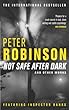
Not Safe After Dark by Peter Robinson

Not Safe After Dark and Other Works is a collection of twenty short stories by Peter Robinson. There are three Inspector Banks stories, one of which Going Back is a novella that had not been published before. The other stories are varied in length, technique and style.

 Of them all I prefer the Inspector Banks stories, in particular Going Back. There isn’t much mystery in this story, but a lot about Banks himself, his youth, relationships with his parents and brother Roy and about his old girlfriend, Kay. It’s his parents’ golden wedding anniversary and Banks goes home for the weekend for the party. He sleeps in his old bedroom with its old glass-fronted bookscase containing a cross-section of his early years’ reading, finds old records he’d forgotten he had, his old school reports, photos and his books of adolescent poetry. His mother treats him like she did as a child, prefering his younger brother Roy and his visit is spoilt by the presence of a new neighbour, the ever-helpful and charming Geoff Salisbury. He is suspicious of Geoff from the start – and with good reason.

Some are historical –In Flanders Field, Missing in Action and The Two Ladies of Rose Cottage. The latterwas inspired by Robinson’s visit to Brockhampton in Dorset where Thomas Hardy was born and also by his interest in Hardy. In 1939 the narrator of the story as a young man first met Miss Eunice and Miss Teresa, who had known Thomas Hardy – was she really the Tess on which he based Tess of the D’Urbervilles? She denied it but then it turned out that Miss Teresa was charged with murder, although  nothing was proved. Years later Miss Eunice had a shocking tale to tell.  This reminded me I still haven’t finished reading Claire Tomalin’s biography of Hardy – The Time-Torn Man.

Of  the other stories I also liked Some Land in Florida, in which Santa ends up in the pool with his electric piano thrown in after him – still plugged in. A private eye, there on holiday isn’t convinced it is an accident. April in Paris is a poignantly sad love story about happened when love turned to hatred.

Some of the stories were written when Robinson was asked for stories on a specific topic – Gone the the Dawgs, about American Football and The Duke’s Wife, a modern telling of Shakespeare’s Measure for Measure.

I enjoyed some of these stories more than others – mainly the longer ones. I do prefer novels where characters and plots are more developed than is possible in a short story. I wrote more about this book here.

The Hollow by Agatha Christie: Book Review

The Hollow by Agatha Christie is a country house mystery in which Hercule Poirot comes across what he decribes as “A set scene. A stage scene”; a murder scene specifically staged, he thinks at first, to deceive him.

Gerda and her husband John Christow, a Harley Street doctor were visiting Sir Henry and Lucy, Lady Angkatell at their house, The Hollow. John is an agressive dominant personality. Also down for the weekend were Lucy’s cousins Midge, who works in a London dress shop, Henrietta, a sculptress, Edward, a rather pale character and David, a student.

Lucy is sure it will be a difficult weekend – Gerda always appears vacant and lost, completely dominated by John, who is having an affair with Henrietta. Edward is in love with Henrietta and Midge is in turn in love with Edward. David is too intellectual  and Lucy herself is vague, charming and completely eccentric. As a distraction she has invited the “Crime man“, Poirot, whose weekend cottage is next door, to lunch on the Sunday. She describes Poirot’s house disparagingly as

… one of those funny new cottages – you know, beams that bump your head and a lot of new plumbing and quite the wrong kind of garden. London people like that sort of thing. (page 13)

As Poirot arrives and is taken through the garden to the swimming pool all the characters are there, with Gerda, revolver in hand, standing over the dying body of her husband, as his blood drips gently over the edge of the concrete into the pool. Poirot hears his final word “Henrietta”.

I found Lucy’s reaction amusing. It’s typical of her vague, almost detached nature. She says:

Of course, say what you like, a murder is an awkward thing – it upsets the servants and puts the general routine out – we were having ducks for lunch – fortunately they are quite nice eaten cold. (page 102)

Later she observes:

There would be something very gross, just after the death of a friend, in eating one’s favourite pudding. But caramel custard is so easy – slippery if you know what I mean – and then one leaves a little on one’s plate. (page 113)

This is now one of my favourite Agatha Christie books. She herself described it in her autobiography as “in some ways rather more of a novel than a detective story.” I agree, the characters are well drawn and the setting of both The Hollow and Ainswick, the larger country house Edward has inherited from his uncle, Lucy’s father are described with nostalgia. Agatha Christie also revealed that she thought she had ruined the book by the introduction of Poirot:

I had got used to having Poirot in my books and so naturally he had to come into this one, but he was all wrong there. He did his stuff all right, but how much better, I kept thinking, would the book have been without him. So when I came to sketch out the play, out went Poirot.(page 489-490)

Poirot has a small role, the investigation into John’s death is headed by Inspector Grange and it is a comment he makes that leads Poirot to discover the culprit. I’m used to having Poirot in her books too, so I didn’t find too much wrong with him being there.

It seems that everyone could have committed the murder and I swung from one to the other as I read, no doubt as Agatha Christie intended, but I did work it out before Poirot unveiled the killer.  As Poirot  says:

That is why every clue looked promising and then petered out and ended in nothing. (page 249)

Crime Fiction Alphabet: R is for Ian Rankin

letter_RThis week the letter in the Crime Fiction Alphabet Community Meme is R, so of course it just had to be Ian Rankin, who is fast becoming my favourite crime writer.

I’ve previously written a bit about Ian Rankin after I went to a talk he gave in January – see here.

R is also for Rebus. There are 17 Inspector Rebus books (a a book of short stories) and I’m reading them in sequence starting with the first one Knots and Crosses. Currently I’m reading the tenth book, Dead Souls. As well as the Rebus books Rankin has written a few others, the latest being The Complaints, featuring a new cop Inspector Malcom Fox. The complete list of Rebus books is on Ian Rankin’s website and on Wikipedia. Both places give more information about the man and his books. Just as a taster the author details on the latest book I read  The Hanging Garden reveal that after graduating from the University of Edinburgh he  had been employed as

a grape picker, swine-herd, taxman, alcohol researcher, hi-fi journalist and punk musician.

The Hanging Garden is full of characters, sub-plots and plenty of crime from the local gang leader Tommy Telford, vying for supremacy over crime boss, Big Ger Cafferty, currently imprisoned in Barlinnie but still in control of his empire through his second in command, the Weasel, to Chechian and Yakuza villains. Then there is Mr Pink-Eyes, a Newcastle gangleader to contend with. It’s a mix of prostitutes, drug running, money laundering and attacks on Cafferty’s territory and associates, with retaliations on Telford’s strongholds.

Rebus is struggling to keep off the alcohol, aided by his friend Jack Morton, when his daughter, Sammy is the victim of a hit and run. Who is trying to warn off Rebus and is he in the pay of Big Ger?  At the same time he is investigating a suspected Nazi War Criminal and helping a Bosnian prostitute, Candice who looks so like his own daughter and who pleads with him for safety. Added to all this his ex-wife Rhona and his lover Patience meet over Sammy’s hospital bed.

It’s grim and tough and as Rebus involves Jack in an undercover operation it all goes wrong – dramatic and tense right to the end.

Catching Up with Reviews

Some of January’s books – two quick reviews:

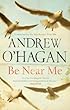
Be Near Me by Andrew O’Hagan is a beautifully written and moving book about David, a parish priest in a small Scottish parish and as I read it I gradually became aware of just how naive he is. The prologue foreshadows the problems he encounters when his mother comments that he has been through such a lot and that in her experience “nothing is ever behind anyone.” He tells her that he is looking forward to

Just working in an ordinary parish and greeting the faith of ordinary people.

What follows is a troubling story of what happened and what he did in that ordinary parish full of ordinary people. It’s a very sad and nasty tale, about prejudice, religious bigotry and it’s full of regret and despair.

Information about Andrew O’Hagan is here. I would like to read his earlier books, maybe The Missing, which is part autobiography and part looking at what happens to communities when people go missing.

That, quite coincidentally brings me on to another book I read in January:

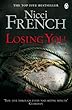
Losing You by Nicci French is a fast paced, take-your-breath-away book about Nina whose teenage daughter, Charlie goes missing. I read it a break-neck speed, switching between being completely engrossed and desperate for her to find her daughter before it’s too late and being annoyed by her attitude to the police.

It’s set on Sandling Island, off the east coast of England and the feelings of isolation and oppression fill the book. Nina is a newcomer to the island and is not really accepted as “one of us”. She struggles to get people, friends, neighbours and the police to take Charlie’s disappearance as anything serious. It’s the portrayal of the police as inept, inefficient and casual that bugged me – would that really be the case? Anyway, even if some of it was barely believable it is a real page-turner and I will be reading more of Nikki French’s books.

‘Nicci French’ is the pseudonym of wife and husband Nicci Gerard and Sean French. More information is on this website and they have a blog.

Crime Fiction Alphabet: Q is for Quintin Jardine

letter QThis week in the Crime Fiction Alphabet meme hosted by Kerrie at Mysteries in Paradise we’re up to the letter Q. My contribution is:

Quintin Jardine. I found his books in my local library – the one in Scotland, which is most appropriate as Quintin Jardine is Scottish. He was born in Motherwell, Lanarkshire and has homes in both Gullane, East Lothian and Trattoria La Clota, L’Escala, Spain. He has been a journalist, government information officer, political spin-doctor and media relations consultant before becoming a crime fiction writer with two  series of detective novels – the Bob Skinner novels set in Edinburgh where Skinner is a Deputy Chief Constable and the Oz Blackstone mysteries, in which Oz is a movie actor trying to forget that he was ever a “private inquiry agent”.

For more biographical details and list of books see his website.

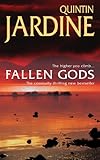
Fallen Gods is the 13th in the Bob Skinner books. It’s set in both Scotland and  America. The beginning of this book is quite confusing, which is down to me and not the author as I’ve jumped into the Bob Skinner books mid-stream as it were. It’s confusing because at the beginning of the book it appears that Bob is dead, ‘dropping in his tracks’ at his wife’s parents’ funeral. Sarah, his wife, says

His heart stopped, just like that. Makes you think, doesn’t it. There is no Superman; there is no Planet Krypton. Not even the great Deputy Chief Constable Bob Skinner was invulnerable. (page 6)

I had to double check.  I’d  read  the blurb before I started to read Fallen Gods and that stated that Bob’s career is ‘hanging by a thread’; that his brother’s body has been found in the detritus of a flood – a brother whose existence he has kept a secret for many years;  and that a valuable painting was burnt in the Royal Scottish Academy in Edinburgh. Whilst he and his team are investigating these events, his wife, Sarah is left in America with their children, recovering from the death of her parents. She finds comfort in the arms of an old college lover and then is faced with ‘a seemingly inevitable murder conviction’.

So how could Bob Skinner be dead? All was revealed as I read on and what a tangled web Quintin Jardine has woven (as Sir Walter Scott would say).

So, I have found another detective series to read. This is a complex book, with believable characters and it switches seemlessly between the crimes in  Scotland and America with ease. I was never unsure where I was or who I was with and there are a lot of characters to get your head round. It kept me guessing throughout as to the culprits and is really more about the characters and their personal lives than about the crimes.

I enjoyed this book and will be reading more of Bob Skinner in the future – there are 19 in total so far.

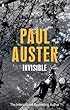
Invisible by Paul Auster

I read Invisible by Paul Auster in January and wasn’t quite sure what to make of it. I feel  may understand it more if I reread it, but I have little inclination to do so.

The story opens in New York City in 1967 when student Adam Walker meets a Swiss professor, Rudolf Born and his girlfriend Margot. Born is a visiting lecturer at Columbia University, where Adam is studying literature. He is drawn into their offbeat world, then caught in a triangle that soon descends into violence that shocks and disturbs Adam.

There are three different narrators and the story moves both in time and place, between 1967 and 2007, in New York, Paris and the Caribbean. It also moves between writing in the first person to the second and third person. Like other Auster books, it is multilayered containing stories within stories, which I always enjoy.

From the book jacket:

It is a book of youthful rage, unbridled sexual hunger and a relentless quest for justice. With uncompromising insight, Auster takes us into the shadowy borderland between truth and memory, between authorship and identity, to produce a work of unforgettable power that confirms his reputation as ‘one of America’s most spectacularly inventive writers’.

It’s about writers and writing, how they deal with expressing themselves, and overcoming their writer’s block. One of the narrators comments on a problem he had when writing a memoir:

By writing about myself in the first person, I had smothered myself and made myself invisible, had made it impossible for me to find the thing I was looking for. I needed to separate myself from myself, to step back and carve out some space between myself and my subject (which was myself) and therefore I returned to the beginning of Part Two and began writing it in the third person. I became He, and the distance created by that shift allowed me to finish the book. (page 89)

It started well, but as I read on it became dreary and cringe-making. But strangely I found it  compelling reading and had to read on to the end.  After the first part, it became harder to distiguish who was narrating.   None of the characters are very likeable, some are downright unlikeable (Born for example) and the book slips between truth and  fantasy so you don’t know whether to believe anything the narrators say. It’s a puzzle and a tiresome one.  Overall I didn’t like it. If I hadn’t read any of Auster’s books before I wouldn’t bother reading one again after this one.

Not everyone agrees with me  – both Gaskella and Reading Matters loved this book and recommend it highly.