Gillespie and I by Jane Harris: a Book Review

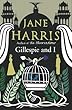
Gillespie and I by Jane Harris is a cleverly told story, narrated by Harriet Baxter, alternating between events in 1888-90 (in Glasgow) and those in 1933 (in London). In 1888 Harriet moved to Glasgow where she got to know the painter, Ned Gillespie and his family. At first I liked Harriet but as I read on I became increasingly doubtful about her character, even though she comes across as an honest, reliable person. But, as she relates what her life is like in 1933 my impression of her began to change.

All is well at first but than a tragedy occurs which forms the major part of the book. It’s signalled in advance, when Harriet refers to the ‘horrible events’ that lay in the future. To say any more would be too much of a spoiler.

The setting of the book in Glasgow of the late 19th century is well described, helped by plans in the front of the book. The characters are also convincing, even some of the minor ones and her portrayal of Ned’s disturbed daughter, Sybil is quite chilling. This is a very detailed book, both about the place, artists and, through the account of a trial, the Scottish legal system of that period. It’s a book that lingered in my mind after I finished reading and if it wasn’t so long I’d like to re-read it in the light of what I now know.

  • Hardcover: 528 pages
  • Publisher: Faber and Faber (5 May 2011)
  • Language English
  • ISBN-10: 0571275168
  • ISBN-13: 978-0571275168
  • Source:an uncorrected proof from the publishers (via LibraryThing Early Reviewers)
  • My rating 3.5/5

I haven’t read Jane Harris first book, The Observations, although I’ve owned it for a while. It’s probably time I read that one too.

They Came to Baghdad by Agatha Christie: a Book Review

They came to Baghdad

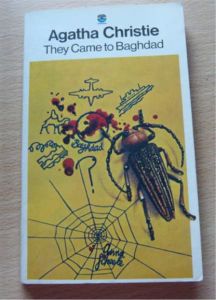
I made copious notes as I read Agatha Christie’s They Came to Baghdad because it’s such a complex plot and there seemed to be so many significant events and people that I wanted to clarify what was happening. This is not one of Agatha Christie’s detective novels – no Miss Marple or Hercule Poirot,-  just Victoria Jones, a short-hand typist, a courageous girl with a ‘natural leaning towards adventure’ and a tendency to tell lies. Set in 1950 this is a story about international espionage and conspiracy. The heads of the ‘great powers‘ are secretly meeting in Baghdad, where if it all goes wrong ‘the balloon will go up with a vengeance.’ And an underground criminal organisation is out to make sure it does go wrong, aiming at ‘total war – total destruction. And then – the new Heaven and the new Earth.’

Victoria gets involved after one meeting with a young man, Edward, who is going out to Baghdad the following day to join an archaeological dig. She thinks he’s an incredibly good-looking man and considering herself an excellent judge of character is immediately attracted to him. As she has just been fired from her job, impulsively she decides to follow him to Baghdad, claiming to be the niece of Dr Pauncefoot Jones, Richard’s boss .

At the same time a British secret agent, Carmichael, is trying to get to Baghdad with important information, and is his life is in great danger. Will he get there? Anna Scheele, a mysterious character is also on her way to Baghdad and there are hints that she is at the centre of things. Just who is she and what side is she on?

Alongside the mystery, Agatha Christie’s descriptions of the locations, local people and of the archaeological dig are superb, no doubt taken from her experience of her own visits to Baghdad and Iraq. I enjoyed it for its entertaining plot, the authenticity of the background and its great characters, in particular I grew very fond of the amazing Victoria Jones.

  • First published in 1951 by William Collins & Co Ltd
  • My copy a secondhand paperback Fontana Books, 1980
  • My Rating: 4/5

The Impossible Dead by Ian Rankin: a Book Review

The Impossible Dead, Ian Rankin’s second book featuring Inspector Malcolm Fox is very readable, with a nicely complicated plot, and good characterisation. Fox is still in the Complaints, now officially called Professional Ethics and Standards, but it soon becomes apparent that really he wants to be in CID. I’m not sure what to make of Fox. He’s:

… diligent and scrupulous, never a shirker. He had put in the hours, been commended for his error-free paperwork and ability to lead a team: no egos and no heroes. He hadn’t been unhappy. He had learned much and kept out of trouble. If a problem  arose, he either dealt with it or ensured it was moved elsewhere. (page 105)

And yet, he’s another loner, working best on his own, not letting on to his boss what he is working on, disregarding procedure and getting involved in cases outside his remit. He doesn’t drink because he’s an alcoholic, his marriage failed and his relationship with his sister leaves a lot to be desired (although it does improve in this book). Fox’s family life intrudes into his work and gives insight into his background and his relationship with his father and sister. He’s a complex character and I began to think that maybe he’s turning into Rebus.

Detective Constable Paul Carter has been found guilty of misconduct and Fox and his team are called to investigate whether his colleagues have covered up for him. When Paul’s uncle, Alan, a retired policeman, is found dead Fox is convinced it was murder and not suicide and begins his own independent investigations, despite being told it’s a CID case. He oversteps his remit too by investigating a cold case. When his investigations reveal links back to 1985, a time of turmoil when Scottish militants were intent on a split between Scotland and the rest of the UK, he discovers new evidence concerning the unsolved murder of one of the activists at that time.

In the second half of the book the pace and tension increase as Fox delves deeper and puts his own life in danger. I found it quite easy to see who the culprits were because their identity was signalled, but nevertheless it was a satisfying conclusion to the book.

  • Hardcover: 384 pages
  • Publisher: Orion (13 Oct 2011)
  • Language English
  • ISBN-10: 0752889532
  • ISBN-13: 978-0752889535
  • Source: I bought it
  • My Rating 3.5/5

Operation Mincemeat by Ben Macintyre: a Book Review

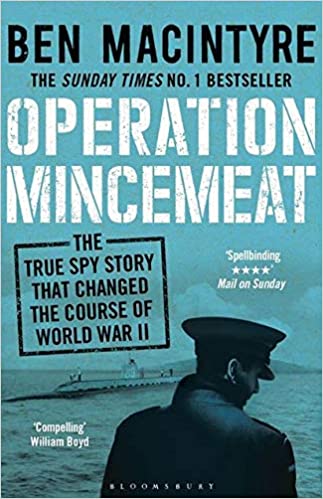
Subtitled The True Spy Story that Changed the Course of World War II, Operation Mincemeat is about the Allies’ deception plan codenamed Operation Mincemeat in 1943, which underpinned the invasion of Sicily. It was framed around a man who never was.

The success of the Sicilian invasion depended on overwhelming strength, logistics, secrecy and surprise. But it also relied on a wide web of deception, and one deceit in particular: a spectacular con trick dreamed up by a team of spies led by an English lawyer. (page xi)

At first I found this book a little confusing and far too detailed, but as I read on I became absolutely fascinated and amazed at what had actually happened. The plan was to take a dead body, equipped with false documents, deposit it on a beach in Spain, so that it would be passed over to the Germans and divert them from the real target into believing that the preparations to invade Sicily were a bluff.

Operation Mincemeat would feed them both a false real plan, and a false cover plan – which would actually be the real plan (page 58)

The corpse was a Welsh tramp who had committed suicide. His body was clothed in the uniform of an Royal Marine with documents identifying him as Major William Martin and letters about the top-secret Allied invasion plans. This involved creating a fictional character, a whole host of imaginary agents and sub-agents all with their own characteristics and imaginary lives – just as in a novel. The details of the deception were dreamt up by Ewan Montagu, a barrister and Charles Cholmondeley (pronounced Chumley), a flight-lieutenant in the RAF seconded to MI5, the Security Service. Both were enthusiastic readers, which stood them in good stead:

For the task of the spy is not so very different from that of the novellist: to create an imaginary credible world, and then to lure others into it, by words and artifice. (page 62)

The plan was not without its faults and and indeed it contained some potentially fatal flaws, but incredibly it succeeded.

Operation Mincemeat was pure make-believe; and it made Hitler believe something that changed the course of history. (page 307)

This is a book, totally outside my usual range of reading. I wasn’t expecting to enjoy it as much as I did and I think I did enjoy it because it was so far-fetched to be almost like reading a fictional spy story. I marvelled at the ingenuity of the minds of the plans’ originators and the daring it took to carry it out.

Wherever You Go by Joan Leegant: a Book Review

I really enjoyed reading Wherever You Go by Joan Leegant. When Joan emailed me to ask if I would like a review copy I nearly said no thank you, because I have so many books to read and I couldn’t say when I’d get round to reading it. I’m glad I didn’t because when it arrived I soon found myself reading it and then I couldn’t stop. It’s a dramatic (but not melodramatic) and thought provoking book.

It’s about three people, and the narrative moves between them beginning with Yona Stern, an American visiting her sister Dena, a settler living in the territories near Hebron on the West Bank. Yona has come to make peace with Dena, after being estranged for ten years. It then moves on to Mark Greenglass, a Talmud teacher in Jerusalem, now visiting his parents in New York, before returning to Jerusalem. He’s come to a crisis point in his life where he is questioning his faith, his life and his career. The third person is Aaron Blinder, a young American and a somewhat pathetic individual who gets involved in an unofficial commune just outside Jerusalem. Events gradually connect the three, changing all three lives.

Wherever You Go is convincing, with a strong sense of location, believable characters and a fast-paced plot. I’m neither Jewish or American but I thought this was an interesting view of life in Israel, and of the relationship between Israel and America and of Jewish Americans living in both countries. It also conveys the conflicts and tensions of Israeli life, emphasising the dangers of religious and political extremism. But it’s not just a commentary on the political and religious issues, as it explores each of the characters’ personal issues – seeking forgiveness, looking for the truth in religious beliefs, and reconciling family relationships. All in all, a well-rounded novel, which captivated me.

  • Paperback: 253 pages
  • Publisher: W. W. Norton & Co.; Reprint edition (9 Sep 2011)
  • Language English
  • ISBN-10: 0393339890
  • ISBN-13: 978-0393339895
  • Source: review copy from the author
  • My rating 4.5/5

Fair Exchange by Michèle Roberts: a Book Review

Fair Exchange by Michèle Roberts is from my to-be-read pile. I’ve had it for years and had started to read it once (it still had a book mark in it, but I had to begin again as I’d completely forgotten it) and stopped. I can’t remember why, because this time round I found it very readable. It’s historical fiction set in England and France in the late 1700s/early 1800s during the French Revolutionary period.

The Author’s Note at the beginning of the book explains that although she began with the idea of writing a novel about William Wordsworth’s love affair at the beginning of the French Revolution, with Annette Vallon, but as she wrote it, it turned into a novel about William Saygood a fictional friend of Wordsworth’s. Mary Wollstonecraft appears in the novel but Roberts has ‘plundered various aspects of her life’  for the character, Jemima Boote.  I like the fact that upfront you know that some of the events, places and people are fictional and that she hopes readers will forgive her ‘for the liberties’ she has taken. Well, I do.

It begins in France in 1792, thus:

In her youth Louise Daudry, née Geuze, had committed a wicked and unusual crime. At that time, autumn 1792, she wanted money very badly, so she put aside her knowledge that what she was doing was wrong and would hurt others. She told herself that virtue was a luxury the poor could not afford. She let herself be persuaded that no one would ever find out. (page 3)

Then it goes back in time and place to England years earlier when Jemima Boote met Mary Wollstonecraft. As you would expect there is a fair bit in this book about women’s rights and their place in society, and about the question of nurture versus nature in bringing up children. Jemima is a strong character, a free spirit but her life doesn’t turn out how she expected, affected not only by the Revolution but also by events in her personal life.

Intertwined with Jemima’s life are those of Louise, who works for the Vallons,  Annette Vallon, who falls in love with an English poet, and William Saygood, and Polly his sister (based on William and Dorothy Wordsworth?). When Annette discovers she is pregnant, Louise takes her to live in her mother’s house in the countryside and it is there that Annette and Jemima (also pregnant) meet, thus setting in motion the events that change both their lives.

I liked the ambiguity in this book, the uncertainty of what exactly was the crime that Louise had committed. It’s well written and kept me guessing almost to the end of the book. It’s one I’d like to re-read (if only I had the time!) to see if I could pick up the hints about what happened.

  • Paperback: 256 pages
  • Publisher: Virago Press Ltd; New edition edition (3 Feb 2000)
  • Language English
  • ISBN-10: 1860497640
  • ISBN-13: 978-1860497643
  • Source: my own copy (a Christmas/Birthday present)
  • Rating: 3/5