The Boy With No Shoes: a Memoir by William Horwood

Headline Book Publishing| 2004| Hardback edition| 440 pages| 5*

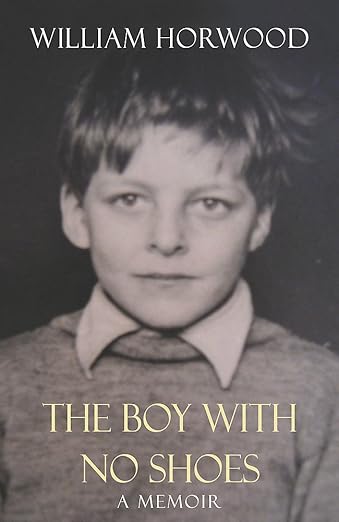
Five-year-old Jimmy Rova is the unwanted child of a mother who rejects him, and whose other children bully him. The one thing he can call his own is a pair of shoes, a present from the only person he feels has ever loved him. When they are cruelly taken away, Jimmy spirals down into a state of loneliness and terrible loss from which there seems no recovery.

This triumphant story of a boy’s struggle with early trauma and his remarkable journey into adulthood is based on William Horwood’s own remarkable childhood in south-east England after the Second World War. Using all the skills that went into the creation of his modern classics, Horwood has written an inspiring story of a journey from a past too painful to imagine to the future every child deserves. (Amazon)

William Horwood is an English novelist. He grew up on the East Kent coast, primarily in Deal. His first novel, Duncton Wood, an allegorical tale about a community of moles, was published in 1980. It was followed by two sequels, forming The Duncton Chronicles, and also a second trilogy, The Book of Silence. William Horwood has also written two stand-alone novels intertwining the lives of humans and of eagles, The Stonor Eagles and Callanish , and The Wolves of Time duology. Skallagrigg, his 1987 novel about disability, love, and trust, was made into a BBC film in 1994. In addition, he has written a number of sequels to The Wind in the Willows by Kenneth Grahame.

When I saw The Boy With No Shoes on the secondhand bookshelves in my local village hall I thought I’d like to read it. It was a great choice as I think it’s one of the best books I’ve read this year. It’s important to read the Author’s Note carefully before you read the book, and not dive straight into it. I had to re-read it after I’d read a few chapters as I was beginning to wonder if this was really fictional. I also wasted time searching on maps to find where he lived growing up.

In his Author’s Note at the front of the book he explained why he wrote about himself as Jimmy Rova:

When I was thirty-four and had been iller than I knew for two long years, my recovery began in the strangest and most magical dream of ways. |I woke one day from dreaming and saw myself when very young, as clearly as in a black and white Kodak photograph. I saw how desperately the little boy I once was had needed someone to talk to in a world where no one wanted to listen. I decided there and then to travel back in time and let myself as adult be listener to the child. This book and my final healing is the result of that imaginative listening, over very many years.

Because the boy seemed other than himself he gave him a different name and changed the name of his home town. By so doing he was able to fill in gaps, paper over the cracks and visit distant places of emotion that he would never have reached.

It is a long and detailed book that took me nearly a month to read. It is beautifully written and as he tells the story of his very early life there are many times when it moved me to tears. His writing is so clear that the places and people he describes spring to life as you read. All the characters have depth and are believable as people.

He is just as good at portraying Jimmy’s feelings and emotions. I could feel his depth of despair, fear and confusion as he describes his first memory about the man in a time long ago who bought him a pair of shoes. That day entered his heart and stayed there forever. He called him The Man Who Was, the man who left him standing in the rain, holding his Ma’s hand, full of fear that he would not be there to keep him safe from Ma, who treated him appallingly, and he would be all alone. All that was left to him were the shoes. So, imagine how awful it was when the shoes disappeared, cruelly taken from him.

But life for Jimmy did eventually get better, especially when Granny came to live with them, but even she could not protect completely from his abusive Ma. I loved all the details of Granny’s time in Africa with ‘The African Gentleman’, who wore a funny hat on his grey and grizzled hair, and his clothes were striped black and yellow. In his hand he carried a wand like a magician. Also unforgettable is his first love, Harriet, and how his mother ended their affair.

There were others too who were kind to him. I loved his description of a new English teacher at the Grammar School, who in contrast to the Head and other teachers believed in the boys. He inspired Jimmy and transformed his life by showing him how to believe he could succeed and how to prepare for his O levels.

There were others too, His Uncle Max who took him hiking in Snowdonia. Moel Saibod was the first mountain he climbed and then others, including Snowdon, the tallest mountain in Wales and England. Then, Mr Boys who taught him to read, Mr Bubbles, a fisherman and his wife, who lived along the shore and taught him all about fishing. I could go on and on, but really if this interests you the best thing is to read the book for yourself. It is a wonderful book, that captures what life was like in the 1950s and even though my childhood was nothing like his, it brought back memories of growing up. I too, as a young woman) climbed Snowdon – Welsh name, Yr Wyddfa (I did not take the Snowdon Mountain Railway either up or down) and also Moel Saibod.

The Seeker of Lost Paintings by Sarah Freethy

Simon & Schuster UK| 11 September 2025| 400 pages| e-book| Review copy| 5*

Blurb:

Rome 1939
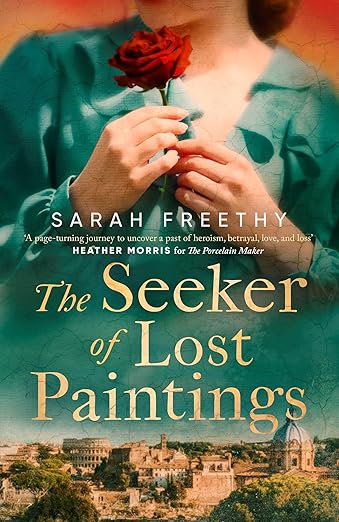
Arriving in Rome to work for the wealthy Montefalco family, Maddalena is homesick and alone. She finds solace – and love – in the beauty of the city, but as the war in Nazi-occupied Italy rages, she must make a devastating choice.

London, 1997
After her mother Maddalena’s death, Beatrice Fremont discovers a fragment of a painting and a letter that sends her on a hunt to Rome. Helping her is art dealer Jude Adler, who’s convinced they are looking for a lost Caravaggio. For Jude, this could be the find of a lifetime; but for Beatrice their search uncovers a shocking secret and the answer to a mystery kept hidden for years.

I’ve not read Sarah Freethy’s first novel, so I wasn’t sure what to expect from her latest book, The Seeker of Lost Paintings. I am delighted to say I loved it. It’s historical fiction set in two timelines, one in the 1940s in Italy and the other in 1997 in London and Italy. It appealed to me because of the mystery surrounding a lost Carravagio and I really enjoyed that aspect. I’ve read quite a lot of historical fiction set during the Second World War, but I don’t think I’ve read any set in Italy during the Nazi occupation before and it was this part of the story that I enjoyed the most.

The book begins with a Prologue set in Naples in 1610 with an unnamed artist as he starts a painting. Who he is and what he is painting only becomes clear later in the book. The narrative then flies forward to July 1997 and a hot day in London when Beatrice Fremont, yearning to be in Italy where both of her parents were born, is waiting for Jude Adler to arrive to value her late father’s art and photography collections. Her mother, Maddalena is seriously ill and they need to sell his collections to secure the family home.

When Jude spots a small painting, hanging on Maddalena’s bedroom wall, he is convinced he’d seen the image somewhere before. It reminds him of Caravaggio’s painting of St John the Baptist in Youth with a Ram. Caravaggio’s followers had made many copies of that painting and Jude is convinced that if it is one of those it could be worth tens of thousands. But Maddalena wants Beatrice to reunite the painting with its rightful owner. And so after Maddalena’s death, the search to find out more about the painting begins, taking Beatrice and Jude to Italy.

Back in 1939, Maddalena was working as a cook at the home of Conte Luca Montefalco, at the Villa Velare in Rome. Luca’s older brother Roberto had renounced his title and taken up Holy Orders, and is working at the Vatican where he is responsible for an art collection that must be preserved and removed from the Vatican in preparation for the impending war. It was a remarkably tense and difficult time in Italy, under Mussolini and the Fascists, and the local people suffered immensely under the Nazi occupation.

Sarah Freethy’s beautiful descriptive writing and characterisation transported me back to that period, almost as though I was there witnessing what life was like for the ordinary Italians during the war years – the dangers and privations they faced. It really is a remarkable book, drawing together the two strands of the story, both in the past and the present and ending in a satisfying conclusion.

Many thanks to the publishers, via Netgalley for my review copy and I’d love to read more of Sarah Freethy’s books.

The Spy in the Archive by Gordon Corera

William Collins| 5 Jun 2025| 298 pages| e-book| Review copy| 4*

Description:

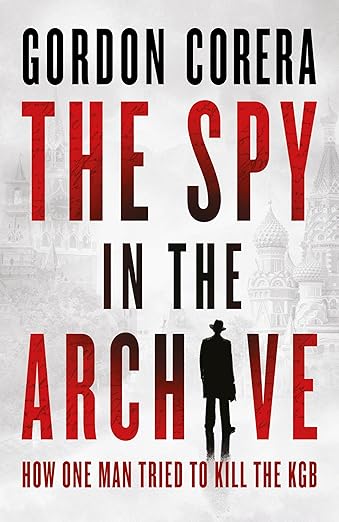
The Spy in the Archive tells the remarkable story of how Vasili Mitrokhin – an introverted archivist who loved nothing more than dusty files – ended up changing the world. As the in-house archivist for the KGB, the secrets he was exposed to inside its walls turned him first into a dissident and then a spy, a traitor to his country but a man determined to expose the truth about the dark forces that had subverted Russia, forces still at work in the country today.

Bestselling writer and historian Gordon Corera tells of the operation to extract this prized asset from Russia for the first time. It is an edge-of-the-seat thriller, with vivid flashbacks to Mitrokhin’s earlier time as a KGB idealist prepared to do what it took to serve the Soviet Union and his growing realisation that the communist state was imprisoning its own people. It is the story of what it was like to live in the Soviet Union, to raise a family and then of one man’s journey from the heart of the Soviet state to disillusion, betrayal freand defection. At its heart is Mitrokhin’s determination to take on the most powerful institution in the world by revealing its darkest secrets. This is narrative non-fiction at its absolute best.

I was intrigued by the title of The Spy in the Archive: How One Man Tried to Kill the KGB by Gordon Corera, a former BBC correspondent. It’s about Vasili Mitrokhin, a KGB archivist who defected to Britain in 1992. Mitrokhin, a quiet, introverted and determined man, was a reluctant defector, because whilst he loved Russia he came to hate the KGB and the Soviet system.

Working in the archives gave him access to top-secret documents and he decided to copy the files on slips of paper written in his own personal code, a type of shorthand. He wasn’t searched when he left work, although his bags were, so he hid the slips of paper in his clothing and typed them up in full at home. They included details about the Soviet secret service and the ‘illegals’, deep-cover operatives who penetrated Western society. These ‘illegals’ had been used to recruit and run the Cambridge spies, including Kim Philby in MI6 as well as atomic spies in America who had stolen the secrets of the Manhattan project and the bomb, and spies in other countries. He also noted the names of hundreds of agents in the west who had collaborated with the KGB. He wanted the documents he had copied to be made public, not just to the world but to open the Russians’ eyes to the corruption, torture and terror that was prevalent.

So, in 1992 he decided to take a sample of his notes first to the US embassy in Riga and Vilnius, but he was not taken seriously, He then went to the British embassy in Vilnius, where he was believed and eventually and handed over his secret archive.

It is a remarkable book about a remarkable man. It’s an in-depth account, that took me weeks to read as it’s not a book to read quickly. It’s fascinating and informative, as I know very little about Russian history post the 1917 Revolution (and not much before that either). It includes a glimpse of a young Vladimir Putin, aged sixteen, who already walked with a swagger as he announced to a KGB official that he wanted to get a job, on his way to becoming a Chekist. I think it’s worthy of note that in 2000 he was the first President to attend the Chekist day celebrations personally. Corera wrote that ‘only a few could understand what his [Putin’s] rise really signified. Mitrokhin, in his exile, was one of those. He understood the Chekist roots from which Putin had sprung and he understood what his rise meant.’

I’d never heard of Chekism before so that was particularly interesting for me. The word derives from Lenin’s creation in 1917 of the ‘All Russian Extraordinary Committee to combat Counter-Revolution and Sabotage’, known by its initials as the Cheka. It was more than a secret police force, it was ‘a revolutionary terrorist organisation’. The Lubyanka building in Moscow was its headquarters. It was formally dissolved in 1922 (the year Mitrokhin was born). But it was renamed several times and eventually emerged as the KGB. As Corera explains ‘the Cheka never died. It simply passed from the land of the living to the land of the dead, an otherworldly beast whose outward form would change but whose dark heart kept beating. … those who served the beast would always refer to themselves as the same thing: Chekists.’ Mitrokhin became a Chekist and that was what he came to hate and want to defeat by exposing to the Russian people and the world. He made it a condition of his defection that the documents he had copied should be made public

The final section concerning his exfiltration from Russia via Lithuania and Sweden reads like fiction. It was hard to believe that it is all true, as I began to wonder whether Mitrokhin and his family would make it to London, even though I knew that he did. Sadly, despite his determination that his work would reach the Russian people, that has not proved possible. He died from pneumonia in January 2004.

Many thanks to the publishers for a review copy via NetGalley. I enjoyed this fascinating and enlightening book.

CC Spin #41 Book Review: Brighton Rock by Graham Greene

The latest Classic Club Spin challenged you to read book 11 on your CC Spin #41 list by 24th August. That was Brighton Rock by Graham Greene for me.

Vintage Digital| 2 October 2010| 258 pages| e-book| 4*

Description on Amazon:

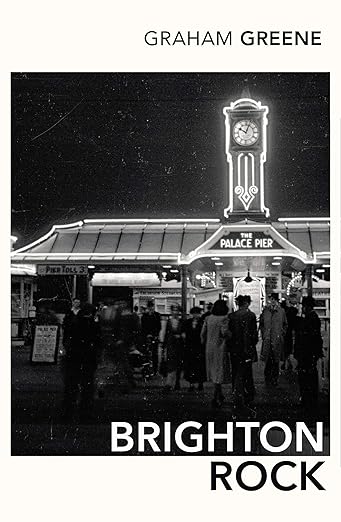
A gang war is raging through the dark underworld of Brighton. Seventeen-year-old Pinkie, malign and ruthless, has killed a man. Believing he can escape retribution, he is unprepared for the courageous, life-embracing Ida Arnold. Greene’s gripping thriller exposes a world of loneliness and fear, of life lived on the ‘dangerous edge of things.

In this gripping, terrifying, and unputdownable read, discover Greene’s iconic tale of the razor-wielding Pinkie.

I’ve enjoyed some of Greene’s books, so I’ve been meaning to get round to reading Brighton Rock for some years and I was pleased it came up as my Spin book. It was his ninth book, first published in 1938, and one of his Catholic Novels (the others being The End of the AffairThe Power and the Glory and The Heart of the Matter). In his Introduction J M Coetzee writes that it was his first serious novel, serious in the sense of working with serious ideas. Brighton in the 1930s had two faces, one the attractive seaside resort, and the other a nest of criminal activity in the desolate industrial suburbs.

The opening line sets the scene for a murder – “Hale knew, before he had been in Brighton three hours, that they meant to murder him.’ Later he is found dead, apparently from a heart attack. Ida Arnold, who had met Fred as he tried to evade the gang, had left him alone for a few minutes and when she returned he was nowhere to be seen. She is determined to find out what really had happened to him as the official account of his death doesn’t match up with what she knew. So when the police ignore what she says she carries out her own investigation. She believes in Right and Wrong – to Ida death was the end of everything, she didn’t believe in heaven or hell, and she wants justice for Fred.

To say that Pinkie Brown, the teenage gangleader, is a complex character is an understatement. He is desperately trying to cover up his involvement with Fred. Rose is a young innocent girl who could reveal his guilt although she doesn’t realise it. Pinkie believes that if he marries her she wouldn’t be able to give evidence against him. Both of them are Roman Catholics. Rose believes in Good and Evil and salvation, whereas Pinkie believes in Hell fire and damnation, but is unsure about the existence of Heaven. He becomes increasingly paranoiac, more desperate and violent.

This novel is bleak, full of violence, menace and suspense, not a book I could enjoy. I struggled at first to understand what was going on and who all the characters were. It’s an odd mixture really – a crime is committed and the amount of violence is shocking, but it is also a psychological character study and an in-depth consideration of the questions of life and death. It’s a tough book to read and to review without giving away any spoilers, which is why I haven’t gone into much detail about the plot. Whilst it is not my favourite book by Graham Greene, it is well written with memorable characters and brilliantly described which brings it all vividly and terrifyingly to life.

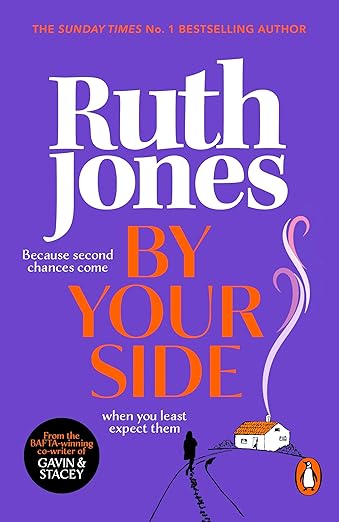
By Your Side by Ruth Jones

Transworld Digital |22 May 2025| 362 pages| e-book| Review book| 5*

Description

Linda Standish has been a friend to the friendless for the past thirty-three years, in her role at the council’s Unclaimed Heirs Unit. And now she’s looking forward to the joys of an early retirement.

But before she hangs up her lanyard, Linda takes on one last case – that of Levi Norman – a Welshman who made his home on a remote Scottish island for the five years before he died. Linda must visit Storrich to track down Levi’s remaining relatives . . .

What brought Levi here? And who did he leave behind? Obliged to travel (by hearse!) with her arch nemesis, and helped (and hindered…) by the local residents, Linda searches for clues to a life now lost. And in the process unexpectedly makes new friends, and discovers things about herself she never knew.

Bursting with all the heart and humour that has made Ruth’s name as a screenwriter and author, By Your Side is a joyful celebration of friendship, love and community.

I loved the TV series Gavin and Stacey which Ruth Jones co-wrote with James Corden and I loved By Your Side too. It’s the first one of her books that I’ve read but I’ll definitely look out for more to read. It’s an emotionally charged book as Linda Standish takes on her last case for the Council’s Unclaimed Heirs Unit, tracking down Levi Norman’s next of kin.

The story is told mainly from two perspectives, those of Linda and Levi. It’s told with gentle humour and laced with sadness as the details of both Levi’s and Linda’s lives are revealed. I really liked Linda, such a kind, compassionate character, who hides her vulnerability behind a confident exterior. She was looking forward to retirement and had made plans, most of which involved her four-year-old grandson, Zander, who lives with her and his father Struan. So she is devastated when she learns they will be moving to live near his ex-wife and her parents. All this just before Christmas and Linda has to travel to Storrich, the island where Levi died.

All she knows is that for the last five years seventy-five year old Levi had lived alone in Storrich, twenty miles off the mainland of Scotland. He had kept himself to himself and none of the local people knew anything about him. The story moves between their lives as Linda gradually discovers more about Levi, a Welshman, and the circumstances of his life and death.

It’s a well paced story, with wonderful characters, all well defined and believable. As I read it I could so easily hear Ruth Jones’ Welsh accent in Levi’s words. It’s a heartbreaking and poignant story, and at the same time an uplifting story, beautifully written bringing it all to life. It was a joy to read.

Many thanks to the publishers for a review copy via NetGalley.

The House of Lost Whispers by Jenni Keer

Boldwood Books|25 April 2025| 378 pages| e-book| Review book| 3*

Summary:

What if another world existed… where the Titanic had never sunk?

When the ill-fated maiden voyage of the Titanic leaves Olivia Davenport orphaned, she’s sent to live with her guardians, the Fairchilds, in their huge Jacobean mansion. But the Fairchilds have more to worry about than a grieving young girl – with war in Europe imminent and four sons to protect.

Olivia feels alone and friendless. Until she hears a voice from behind the wall in her tower bedroom. A voice from a man called Seth. Convinced he’s merely a product of her grieving imagination, it’s not until after the heartbreak of war that Olivia discovers that he exists in an overlapping world, just a shudder in time away from her own. A world where the Titanic never sank… Where everything since has been just slightly… different.

All Olivia wants is to find a way into his reality. And not just to see the faces of her beloved parents once again. But also to meet Seth. Who might just be the love of her life…

I enjoyed reading Jenni Keer’s debut novel, The Hopes and Dreams of Lucy Baker several years ago and thought I’d like to read more of her books. This one is her eighth book, so I missed the books in between. I don’t often read romance or fantasy novels but The House of Lost Whispers has both elements and it’s also historical fiction set before, during and after the First World War. I preferred the historical element, especially the middle section about the War. But I also enjoyed reading the fantasy element about the anomaly in the magnetic field surrounding the earth causing vibrations, disrupting the fabric of space and time. This resulted in the formation of a duplicate earth, one parallel with our world, in which the Titanic did not sink on 12th April 1912.

I think this is a very interesting and possibly original idea, exploring what life would have been like for Olivia and her family if the Titanic had not been sunk. The book also explores loss and grief, family life, friendship and romantic relationships, as well as the devastating and horrific events of the First World War. As described in the blurb Olivia in the ‘real’ world and Seth in the parallel world can hear each other through the wall in her tower bedroom (the whispers), but despite their efforts they cannot break through to meet.

It’s beautifully descriptive, bringing the settings to life and there is also a murder mystery to solve. My only criticisms are that at times I did get a bit confused about Seth’s character and his parallel in the ‘real’ world, and I could have done without the love scenes (too descriptive in places). As I read on I was wondering how it would end and maybe Jenni Keer wondered too because the conclusion seemed rushed and rather neatly sown up. I was a bit disappointed, although I can’t imagine how else it could have ended. But overall it kept me reading, wanting to know what would happen next.

Many thanks to the publishers for a review copy via NetGalley.