On the Black Hill by Bruce Chatwin

On The Black Hill (Vintage classics) by€¦

Synopsis (from the Vintage Books website):

On the Black Hill is an elegantly written tale of identical twin brothers who grow up on a farm in rural Wales and never leave home. They till the rough soil and sleep in the same bed, touched only occasionally by the advances of the 20th century. In depicting the lives of Benjamin and Lewis and their interactions with their small local community Chatwin comments movingly on the larger questions of human experience. 

The book was awarded the 1982 James Tait Black Memorial Prize and Whitbread First Novel of the Year Award.

I quoted the opening paragraphs in a Book Beginnings post back in 2011, when I first bought this book, but I think it’s worth repeating them here as they are typical of the style of the book:

For forty-two years, Lewis and Benjamin Jones slept side by side, in their parents’ bed, at their farm which was known as -˜The Vision’.

The bedstead, an oak four-poster, came from their mother’s home at Bryn-Draenog when she married in 1899. Its faded cretonne hangings, printed with a design of larkspur and roses shut out the mosquitoes of summer, and the draughts in winter. Calloused heels had worn holes in the linen sheets, and parts of the patchwork quilt had frayed. Under the goose-feather mattress, there was a second mattress, of horsehair, and this had sunk into two troughs, leaving a ridge between the sleepers. (page (9)

I love this book with its rich descriptions of both the landscape and the characters on the border between England and Wales. It follows the lives of identical twins, Lewis and Benjamin Jones on a farm, barely touched by the 20th century, a period of over 80 years. They are inseparable, Benjamin in particular suffering whenever they are apart. Their lives are hard, lonely, brutal at times, but full of love for their mother and the land they farm.

Most of all I love they way Chatwin brings the characters to life, not just Lewis and Benjamin, but all the other personalities, some eccentric, some comic and some tragic. His attention to detail is remarkable – at no time does it seem excessive, or intrusive but all the little minutiae of daily life are essential to the book. At the same time Chatwin highlights questions of love, religion, death and above all relationships. It is most definitely not a book to race through to find out what happens, although I did want to know, but one to savour – and one to re-read.

The Rendezvous and Other Stories by Daphne du Maurier

When I finished reading The Rendezvous and Other Stories I had absolutely no hesitation in giving it 5 stars – I loved it. This is most unusual for me as generally I’m not too keen on short stories because they often leave me feeling dissatisfied, thinking they are lacking in substance or characterisation. Not so with this book, even though some of the endings were predictable and some of the stories are very short I think they all worked well!

Daphne du Maurier wrote some of these stories before she wrote her first novel (The Loving Spirit, 1931), when she under 23, and the rest between 1937 and 1947, when she was a well established writer. The earlier stories are shorter than the later ones as they were written for magazines

There are 14 stories:

  • No Motive ~ this begins with the suicide of an apparently happy woman expecting her first child. Her husband desperate to discover what could have caused her to take her own life and that of their unborn child employs a private detective to investigate. What he discovers is just so sad and tragic.
  • Panic ~ This is one of the shorter stories about a casual love affair that ends in death and the panic that ensued.
  • The Supreme Artist ~ Another shorter story of an aging actor trying to fight off the years.
  • Adieu Sagesse ~ I loved this one about a hen-pecked husband who plans to escape his tedious life and have an adventure.
  • Fairy Tale ~ A gambler and his long-suffering wife face destitution – unless he wins the lottery!
  • The Rendezvous ~ Now this story really caught my imagination. It’s the story of an ageing writer, who meets a fan of his books whilst on a trip to Switzerland to lecture about his work. As in some of Du Maurier’s books this is about an unequal relationship and the exploitation of one of the partners. It is vividly written, the sense of disappointment, the misunderstandings and subsequent let down is brilliant.
  • La Sainte-Vierge ~ A very short and predictable story about a naive young wife.
  • Leading Lady ~ a beautiful actress manipulates the men around her.
  • Escort ~ Another of the really good stories, full of atmosphere set in set in World War II on board a merchant ship as it sails across the North Sea. Just what is the ship that offers to escort it as a submarine threatens  – and who is its captain?
  • The Lover ~ More sexual manipulation, this time by a young man.
  • The Closing Door ~ A young man is told of his terminal illness and the devastating effect it will have on his life.
  • Indiscretion ~ An amusing tale of what happens when you say something without knowing the consequences – a bit signalled but still enjoyable.
  • Angels and Archangels ~ A bitter and cynical look at religion and hypocrisy.
  • Split Second ~ A brilliant story to finish the book – about a woman who leaves her highly organised house for a walk and finds everything has changed when she returns.

This is one of a set of Du Maurier’s books that I bought at least seven years ago. It was well worth the wait! I still have one more of the set to read – I’ll Never Be Young Again, her second novel.  And there are more that I don’t own to enjoy in the future too.

St Mawr by D H Lawrence

I liked  St Mawr even though there is so much philosophising and repetition (why use a word just once when you can repeat it three times) that the story is rather swamped. It’s a short novel (147 pages in my copy), first published in 1925, set in the English countryside and then in America, on a ranch in the Rocky Mountains.

This is the story of Mrs Witt, an American, Lou her daughter and Rico, her daughter’s artist husband and the influence of the stallion St Mawr on their lives. Initially desperately in love with each other Lou and Rico react badly on each other and being together makes them ill – they sap each other’s vitality.

As soon as Lou sees St Mawr she knows she just has to buy him:

She laid her hand on his side and gently stroked him. Then she stroked his shoulder, and then the hard, tense arch of his neck. And she was startled to feel the vivid heat of his life come through to her, through the lacquer of red-gold gloss. So slippery with vivid hot life.

In St Mawr Lou finds the vitality that is lacking in Rico. St Mawr represents to her freedom, and wildness as well as masculinity. He cannot be tamed. Bored with life Lou goes to America with her mother, Phoenix, her mother’s Mexican-Indian servant, St Mawr and his groom Lewis. There too she is bored; she leaves St Mawr and Lewis behind and travels to the Rocky Mountains of New Mexico with her mother and Phoenix. Here she comes across a tumbledown ranch, Las Chivas, that she immediately loves, aligning herself to the wild spirit that she says wants her. (The ranch is based on Lawrence’ s Lobo Ranch (later called Kiowa) at Questa, seventeen miles fro Taos, where Lawrence wrote the novel.)

This a richly written story, with beautiful descriptions of the landscape and the characters, full of symbolism and Lawrence’s views on male/female relationships, life and death, and the power of nature. I think I may need to re-read it to understand it better.

Books Read in October

October was a good reading month for me. I read 11 books, which were a mixed bag of different genres, but all fiction this month, with two books from my to-be-read shelves. I’ve already written about some of the books (the links are to my posts):

1.The Shining by Stephen King (Kindle)

2.Ten Little Niggers by Agatha Christie

3. Over My Dead Body by Hazel McHaffie

4. The Year of Miracle and Grief by Leonid Borodin

5. The Idea of Perfection by Kate Grenville (library book)

6. A Murder is Announced by Agatha Christie (a book from my to-be-read shelves)

When I started this blog I wanted to write something about each book I read. I’ve never managed to do that and now I’ve decided that there are some books I don’t want to write about at all and for some I just want to write a few words. That’s not because I didn’t enjoy the books but simply because sometimes I just want to read and then go on to another book.

These are the books without posts (with links to Amazon UK):

6.Once Upon a Castle by Alan S Blood (Kindle, LibraryThing Early Reviewers) – a story about children evacuated to Northumberland during World War II, this had so much potential and it just wasn’t achieved. It is basically a series of short stories and I thought there were too many episodes packed into it. It needs more detail and development to be convincing. It’s unevenly paced, as though the author didn’t know how to finish it and rushed the ending. The supernatural elements come across as confusing rather than mysterious or spooky.

5. The Shooting Party by Isabel Colegate – I liked this novel, which chronicles the events of one day at a shooting party on an Oxfordshire country estate. There is a great sense of foreboding right from the start with the statement: ‘It was an error of judgment which resulted in a death. It took place in the autumn before the outbreak of what used to be known as the Great War.’ Although I could see how this was foreshadowing the slaughter of the First World War, for me it was the knowledge that a death was going to take place, right from the opening paragraphs, that was uppermost. I kept wondering who was going to die, what was the error of judgment, who was going to do the killing. I was surprised.

I did think it was rather too slow, too drawn out in parts but that maybe because I’m used to much faster paced books. I also had to keep reminding myself of the characters – their relationships to each other and at times I got confused and had to back track.

But its main attraction for me was the focus on a society that was soon to be destroyed by the devastation wrought by the First World War. Isabel Colegate writes beautifully depicting the class structure of the times, the rich aristocrats and their servants, ‘the stranglehold of the rich on the life-blood of the working man‘, ideas about manliness, the realization that civilisation as they knew it was coming to an end, contrasting it to a vision of England that had not existed even then for many years:

Doesn’t England mean a village green, and smoke rising from cottage chimneys, and the rooks cawing in the elms, and the squire and the vicar and the schoolmaster and the jolly villagers and their rosy-cheeked children? (page 100)

7. The Great Gatsby by F Scott Fitzgerald (a re-read). I really like this book – a portrait of the Jazz Age in all of its decadence and excess.

8. Dying Fall by Elly Griffiths (library book) – This is the fifth of her Ruth Galloway books. Ruth travels from her home in Norfolk up to the north of England €“ Lancashire, to be precise Blackpool, Lytham, Pendle, Preston and Fleetwood €“ because Dan Golding a friend from university has died in a house fire. He had written to her just before his death with news of an amazing find. It turns out that Dan was murdered and Ruth and Inspector Harry Nelson are instrumental in discovering the truth. It’s yet another book I’ve read about the whereabouts of King Arthur’s Bones €“ this time it seems he’s the Raven King. A satisfying if undemanding read.

11. Mrs Harris goes to Moscow by Paul Gallico (a book from my to-be-read shelves). This is a lovely little book. Mrs Harris is a London char lady who wins a trip to Moscow, where she wants to find her employer’s long-lost love. Mayhem ensues when she is thought to be Lady Char (the Russians not understanding what a ‘char lady’ is had converted it to ‘Lady Char’) and also a spy.

I sometimes borrow books and after reading the first few pages return them without reading any more, with no qualms. But it is very rare that I return a book unfinished after reading just over a quarter of it. That is just what I did with The Assassin’s Prayer by Ariana Franklin. I thought it was repeating much the same sort of scenarios (albeit in different locations) than her earlier books and I got fed up – so back it went.

Saturday Snapshot – Flodden

It’s the 500th anniversary of the Battle of Flodden this year – it was on 9th September 1513 that the armies of England and Scotland met at Flodden Field, near Branxton in Northumberland. There have been events this year to commemorate the battle and the men from both nations who died in this last medieval battle between England and Scotland.

Living not far from the site of the battle this week we went to see what had changed as a result of the anniversary. There’s now a surfaced path leading up to the Monument.

(Click on the photos to see them enlarged)

500th anniversary P1010826

There are some more information boards and signs to guide you round the Battlefield Trail:

Battlefield trail signpost P1010837The monument isn’t actually on the site of the battle but stands on Piper’s Hill.

Flodden MonumentFrom the monument you can look towards the north down on the village of Branxton:

Branxton P1010831The two armies lined up south of the monument with a marshy dip between them. The Scots advanced first, unaware of the of the ground conditions below them. Now it’s a ditch but in 1513 there was a brook surrounded by a reeded quagmire downhill – where the Scots were bogged down, the rear ranks pushing forward into the front ranks, crushing the fallen bodies and causing chaos. They were then easy prey for the deadly English billhooks.

It looks like this now – the ditch between the hedge and fence is now nearly dry, after weeks of rain in 1513 it was a quagmire:

Boggy Ground P1010835

 and the two armies came face to face:

Tthe Killing Fields P1010858

Flodden 1513: Scotland’s Greatest Defeat by John Sadler is an excellent account of the strategies and tactics of both armies, with maps and plans showing how the battle began and a time timeline of the various conflicts giving a detailed account of events.

Having read this book and the information boards around the trail I was able to visualise the battle, even on a peaceful weekday afternoon 500 years later. The Scottish troops had moved from their original position on Flodden Edge as the English approached the battlefield, putting them at a disadvantage. The outcome could have been different if they had seen the dip below them as they charged down the hill – or even if the English had attacked first.

But then, the battle needn’t have taken place at all if James IV of Scotland had not invaded England in an attempt to divert English troops from their fight against the French. Indeed he had entered into a Treaty of Perpetual Peace with England in 1502. But in 1512 he had also renewed the Auld Alliance with the French, putting him in the position of either declaring for France against Henry VIII (James’s brother-in-law) or remaining neutral, which would make him vulnerable to any further English expansion, as Henry had revived his claim to the Scottish throne.

Despite pressure from senior members of his council to avoid an outright breach with England, when Henry arrived in Calais preparing to wage war against the French, James decided to go to war against the English. Prior to the battle at Flodden he had crossed the River Tweed into England where he then attacked and captured Norham Castle, and then destroyed both Etal and Ford Castles whilst the English were still mustering their troops. But the outcome was a disaster for Scotland and James was killed on Flodden Field:

The king’s was but one of many hundreds of bodies, sprawled and piled on the bloodied turf. The whole hillside from the brook northwards was a killing ground, the dead, maimed and horribly injured competing for space, severed limbs and streaming entrails spilling fresh gore. The din would have been terrific, with hoarse shouts and the screams of the dying men, the crash of spears, a crescendo rising and spilling like breakers against the shore. (page 82, Flodden 1513 by John Sadler)

Each time I go to Branxton, or see the monument as we drive south along the A697, I think about the battle and all those who died there in 1513.

For more Saturday Snapshots see Melinda’s blog West Metro Mommy Reads.

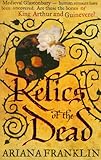
Relics of the Dead by Ariana Franklin

As soon as I’d finished reading The Death Maze I began Ariana Franklin’s third book in her Mistress of the Art of Death series, Relics of the Dead. Now this one was more to my liking and I enjoyed it very much.

The date is 1176, the setting is Glastonbury where the monks, after a fire had destroyed their monastery, discovered two skeletons buried in their graveyard. The question is  – are these the remains of King Arthur and Queen Guinevere? The problem is that Henry II needs evidence that they are not – that the legendary Arthur is indeed dead and not the ‘Once and Future King’, sleeping but waiting for the right time to lead the belligerent Welsh against him. Henry’s solution is to send Adelia Aguilar, the anatomist, to examine the bones for evidence, preferably to establish that no one can say that the bones are not that of Arthur and his queen. Given that this is the 12th century and the technology wasn’t there to prove the age and identity of the bones, Adelia assisted by Mansur, does a pretty good job in her investigation, despite attempts on her life.

Where Relics of the Dead stands out is in the depiction of Glastonbury, a mysterious, spiritual place, ‘one of the world’s sacred centres, a place where the division between man and God was thinner than anywhere else‘, a place where ‘there was a special magnetism that pulled people to worship a presence her long before Christ had set foot on his native heath.’ But Adelia, that down-to-earth, practical woman couldn’t feel it – for her all mysteries had to have an explanation. And she was determined to find it.

I’ve always liked the stories about King Arthur and the beliefs about his life and death, about Excalibur (which does feature in this book), about Guinevere’s affair with Lancelot,  and the Holy Grail (which do not). As well as a strong sense of place and atmosphere the characters are well-drawn and believable, even if some aspects of the plot required quite a hefty suspension of disbelief (which I managed easily enough).

Similarly I wasn’t bothered by Franklin’s use of modern language – in her Author’s Note, she had noted that she was sometimes criticised for making her characters use modern language and explained that ‘in 12th century England the common people spoke a form of English even less comprehensible than Chaucer’s in the 14th, the nobility spoke Norman French and the clergy Latin. Since people then sounded contemporary to each other, and since I hate the use of what I call ‘Gadzooks’ in historical novels to denote a past age, I insist on making them sound contemporary to us.’ If she had used such ‘gadzooks’ language I don’t think I’d have got very far into the book. And, it didn’t occur to me that her dialogue was anachronistic.

Franklin also used a lot of terms common to the age, such as ‘Mort d’Ancestor’, which she did explain within the text, so that that too did not bother me. In fact I liked it, I think it added to the atmosphere and I did enjoy looking up such terms for more information in a book I used to use a lot when I worked in a local archive repository – The Local Historian’s Encyclopedia by John Richardson, a fascinating book.

Ariana Franklin was the pseudonym of Diana Norman. She died in 2011. The last book in the series is The Assassin’s Prayer (published as Murderous Procession in the US), continuing Adelia’s story.