Book Beginnings: Dracula by Bram Stoker

JONATHAN HARKER’S JOURNAL

(Kept in shorthand)

3 May. Bistritz. – Left Munich at 8.35 pm on 1st May, arriving at Vienna early next morning; should have arrived at 6.46, but the train was an hour late. Buda-Pesth seems a wonderful place, from the glimpse which I got of it from the train and the little I could walk through the streets. I feared to go very far from the station, as we had arrived late and would start as near the correct time as possible. The impression I got was that we were leaving the West and entering the East; the most Western part of splendid bridges over the Danube, which is here of noble width and depth, took us among the traditions of Turkish rule.

With such an ordinary straight forward paragraph Bram Stoker begins his Gothic novel of the tale of Count Dracula and the Un-Dead.

I have no interest whatsoever in the modern vampire books, but for a while now I have been thinking about reading Dracula and now in the middle of Carl’s RIP Challenge I decided the time had come.

The opening surprised me a little, so matter-of-fact and such attention to detail. So I knew from the start that this was going to be a meticulously detailed book and that the character of Jonathan Harker was going to be that of a reliable narrator. I also guessed that after such a factual start Jonathan’s Journal would reveal more startling and scary events – well, this is Dracula! And it’s not long before he is on his way to Castle Dracula, his journey accompanied by queer dreams and warnings to go no further. As he approaches the castle he ‘felt a sort of paralysis of fear.’

I’m reading a hard-back copy of Dracula. There are many editions available and the link above is to the Kindle original and unabridged version.

Book Beginnings on Friday is hosted by Katy at A Few More Pages.
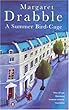
Book Beginnings: A Summer Bird-Cage by Margaret Drabble

Last Friday I quoted the opening sentences of Life Support by Tess Gerritsen, which was going to be the next book I read. I did read on for a couple of chapters but had to stop as I was just not in the mood for reading a medical thriller set in a hospital – too close to the bone! I fancied reading something less disturbing, so I took A Summer Bird-Cage by Margaret Drabble down from the bookcase and began to read that:

I had to come home for my sister’s wedding. Home is a house in Warwickshire, and where I was coming from was Paris. I was keen on Paris, but will refrain from launching into a description of the Seine. I would if I could, but I can’t. (page 7)

A Summer Bird-Cage was Margaret Drabble’s first novel. It was first published in 1963 and is set at the in the early 1960s, about the lives of two sisters – Sarah, the narrator who has just graduated from Oxford University and is wondering what to do with her life, and her beautiful sister Louise who at the start of the book is about to marry, Stephen, a rich novelist. From what I’ve read so far, neither of them seem happy and there is definitely tension between them.

Interesting I think, and I’m wondering if it maybe a bit autobiographical – Margaret Drabble is the younger sister of A S Byatt. Maybe this sentence was personal, comparing the two sisters, when Sarah says – ‘As far as tags go she is grande dame where I am jeune fille, and she leads all her life to match it.’ Or maybe I’m reading too much into that.

Book Beginnings on Friday is hosted by Katy at A Few MorePages.

Book Beginnings: Life Support

Life Support by Tess Gerritsen is the fourth book I’ll be reading in the RIP IV Challenge. According to the back cover this is ‘a quick, delightfully scary read‘, which fits in well with the RIP challenge criteria.

It begins:

A scalpel is a beautiful thing.

Dr Stanley Mackie had never noticed this before, but as he stood with head bowed beneath the OR lamps, he suddenly found himself marveling at how the light reflected with diamondlike brilliance off the blade. It was a work of art, that razor sharp lunula of stainless steel. So beautiful in fact, that he scarcely dared to pick it up for fear he would somehow tarnish its magic. In its surface he saw a rainbow of colors, light fractured to its purest elements. (Page 13)

This will be the first book by Tess Gerritsen that I’ve read. It’s been on my bookshelves for quite a while now and I have been wary of reading it in case it’s too gory for me. I didn’t buy it, it was a free book with the magazine Woman and Home, which I buy now and then. When I read the Introduction I was even less sure this book was for me as Tess Gerritsen wrote that she got the idea for the book whilst at medical school (she is a doctor), when she heard the professor say the words ‘human cannibalism’ in his lecture on Creutzfeld-Jakob disease, a viral infection of the brain.

So I put this book way down on my to-be-read books, but since then I’ve read several favourable reviews of other books by Gerritsen so I thought I’d try this one. I like the style of writing in this first paragraph and it does make me want to read on, so when I’ve finished one of my current reads I’m going to start Life Support. Let me know what you think if you’ve read it?

Book Beginnings on Friday is hosted by Katy at A Few More Pages.

Book Beginnings

Today I finished reading Blonde by Joyce Carol Oates. It has taken me several weeks to read it and I fancy a complete change and a shorter book!

So, I’m thinking of reading No Longer at Ease by Chinua Achebe, which begins:

For three or four weeks Obi Okonkwo had been steeling himself against this moment. And when he walked into the dock that morning he thought he was fully prepared. He wore a smart palm-beach suit and appeared unruffled and indifferent. The proceeding seemed to be of little interest to him. Except for one brief moment at the very beginning when one of the counsel had got into trouble with the judge. (page 1)

This is my copy which I bought several years ago from a second-hand bookshop somewhere, after reading its predecessor Things Fall Apart, whose hero was Obi’s grandfather. I thought Things Fall Apart was an amazing book and one that had made a great impression on me, so why haven’t I read No Longer at Ease before now?

From the blurb on the back cover I see that Obi has returned to Nigeria from studying in England. He is a civil servant with a respectable job and a fiancée, but despite the expectations of his family and tribe he falls victim to the corruption of Lagos. It promises to be a study of the cultural change in Nigeria during the 1950s.

Book Beginnings on Friday is hosted by Katy, at ‘˜A Few More Pages’.

Book Beginnings

I’ve been reading books recently and not writing about them. I didn’t have the impetus at the time (too many other things going on in my life right now to distract me), but I hope to write about them quite soon:

  • The Hanging Wood by Martin Edwards – excellent
  • Evil Under the Sun by Agatha Christie  – very good
  • Murder on the Eiffel Tower by Claude Izner – a bit disappointing

I’m about to start reading S J Bolton’s second book Awakening. Here are the opening sentences from the Prologue:

The darkest hour I’ve ever known began last Thursday, a heartbeat before the sun came up.

It was going to be a beautiful morning, I remember thinking, as I left the house; soft and close, bursting with whispered promises, as only a daybreak in early summer can be. The air was still cool but an iridescence on the horizon warned of baking heat to come. Birds were singing as though every note might be their last and event the insects had risen early.

This opening is full of threat. Even though it is a beautiful morning it foreshadows some dreadful event coming soon, in contrast to the fine day.

I decided to read Awakening after finishing Sacrifice, which I wrote about in my last post, especially as several people commented that her later books are better.

Book Beginnings on Friday is hosted by Katy at A Few More Pages.

Book Beginnings

Miss Arundell died on May 1st. Though her illness was short her death did not occasion much surprise in the little country town of Market Basing where she had lived since she was a girl of sixteen. For Emily Arundell was well over seventy, the last of a family of five, and she had been known to be in delicate health for many years and had indeed nearly died of a similar attack to the one that killed her some eighteen months before.

But though Miss Arundell’s death surprised no one, something else did. The provisions of her will gave rise to varying emotions, astonishment, pleasurable excitement, deep condemnation, fury, despair, anger and general gossip.

These are the opening lines of Agatha Christie’s Dumb Witness. And because it is an Agatha Christie book, it is obvious that Miss Arundell’s death should be cause for suspicion and that it was most unlikely to have been a natural death.

From the fact that the date of her death is specified in the first sentence makes me think that must be significant. And the surprising contents of her will also indicate that Miss Arundell had perhaps changed her it – why was that?

I’m still reading Dumb Witness and as the title indicates and the cover picture on my copy shows, a dog has an important part in the mystery – one which Hercule Poirot has to solve, with very little to go on.

Book Beginnings on Friday is hosted by Katy, at  A Few More Pages.