This Week’s Library Books

I don’t need to borrow any more books, but I had to go to the library to return The Gargoyle (see here) and of course then I couldn’t leave without at least looking at the books. This  week I concentrated on non-fiction as I already have a few novels on the go. I  read non-fiction much more slowly than fiction, so I don’t read many.

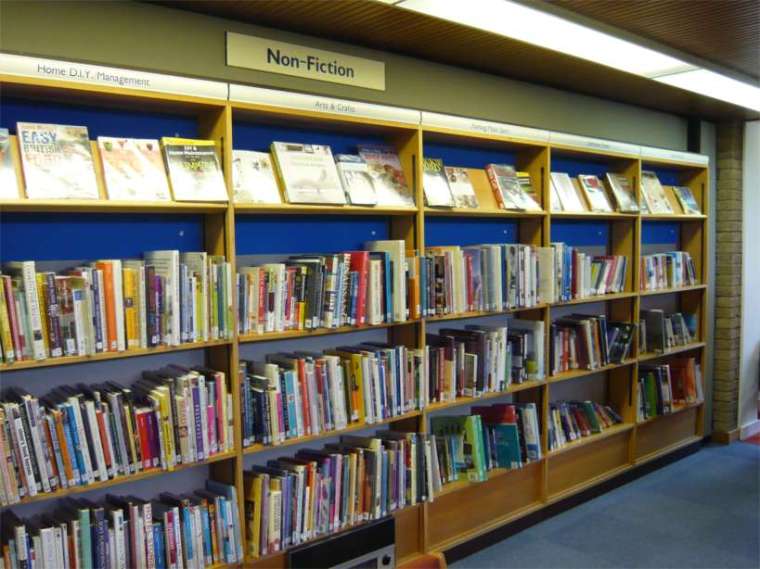
The photo below shows part of my local library’s non-fiction section. It’s not large but it has a good selection of books and I always find something of interest there.
non-fiction
Non Fiction Books

I came home with three books (I was very restrained remembering all my unread books):
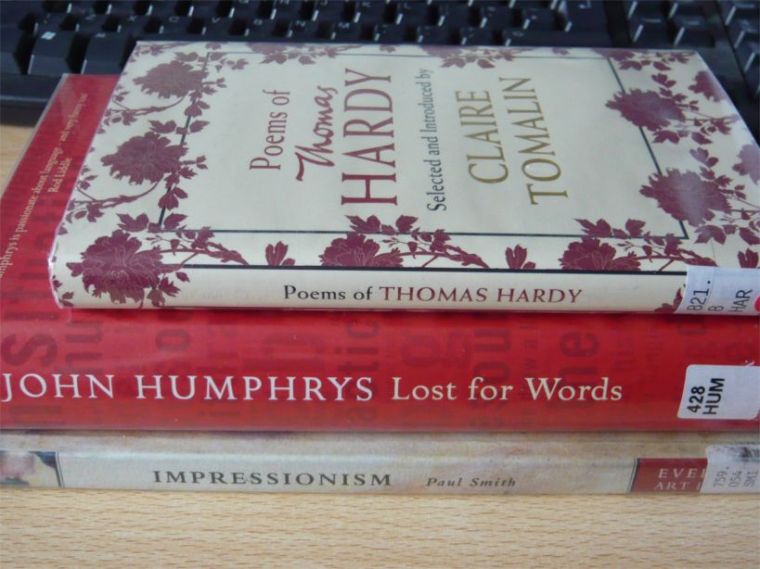
library-loot-non-fiction

  • I don’t read much poetry but The Poems of Thomas Hardy, selected and introduced by Claire Tomalin caught my attention as I’ve read several of Hardy’s novels, but none of his poetry. Hardy wrote over a thousand poems and this selection traces his experiences of life and love. This reminded me that over a year ago I started to read her biography of Hardy, which I’d put down for a while to read more of Hardy’s own works before finishing it. Time to get back to it soon.
  • Impressionism by Paul Smith. I’ve become very interested in the Impressionists since taking a short course recently. The course concentrated on the sites they painted rather than their lives. To supplement that I’m already reading Sue Roe’s The Private Lives of the Impressionists. This book looks at the social, political and intellectual contexts in which Impressionism came about. Plus it has many colour illustrations of their paintings.
  • Lost For Words by John Humphrys. I like John Humphry’s style – this book is about the “mangling and manipulation of the English Language”. He thinks language should be “simple, clear and honest” and provides examples of cliches, meaningless jargon and evasive language (which I detest).

Tuesday – Where Am I? & Today’s Teaser

tuesdaywhereareyouToday I’m in Dante’s Inferno, an invisible spectator following Dante and Virgil as they make their way down into Hell. Charon, the boatman  ferries the dead across the river Acheron to the Hall of Death with the dread words “Lay down all hope, you that go in by me” has let us enter from a word of power from Virgil. And so we descend …


teaser-tuesday(Click the button for more teasers)

My teaser is from pages 30 & 31 of Dante The Descent Into Hell translated byDorothy L Sayers. This in the 2nd Circle of Hell where the souls of the sexually promiscuous are being punished tossed eternally in a howling wind:

The blast of Hell that never rests from whirling

Harries the spirits along the weep of its swath ,

And vexes them, for ever beating and hurling.


When they are borne to the rim of the ruinous path

With cry and wail and shriek they are caught by the gust,

Railing and cursing the power of the Lord’s wrath.

Dante is so overcome with pity that he swoons: “And, as a dead man falling, down I fell.”

William Blake’s painting captures the scene:

blake_dante_hell_v


It’s Tuesday – Where Are You?/Teaser Tuesday

tuesdaywhereareyou

Today I’m in Paris in the 1860s with the Impressionists. Paris is overrun with art students  wanting to exhibit their paintings in the annual exhibition in the Salon des Beaux Arts. Today it’s 17 May 1863 and everyone is crowded into the exhibition of rejected works called the Salon des Refuses, where people are shocked by the paintings, jeering and hooting with laughter. But the painting that has completely stolen the show is Edouart Manet’s Le Dejeuner sur l’herbe.

It’s Tuesday – where are you? is hosted by raidergirl3.

Now the teaser (tteaser-tuesdayo see more teasers click on the button). The ‘official rules’ are to select a page at random in the book you’re currently reading and pick two sentences between lines 7 and 12. My teaser is a bit longer than two sentences, not random and not from lines 7 – 12. It’s from page 28 of Sue Roe’s The Private Lives of the Impressionists. 

Edouard Manet, who had exhibited at the Salon before, was this year exhibiting a monstrosity. Everyone stared in horror at Le Dejeuner sur l’herbe, an outrageous depiction of a naked woman, brazen and unashamed, staring straight out at the viewer and seated on a riverbank between two clothed men. Behind her, a second, lightly draped woman, up to her ankles in water, stoops in the distance. This bold display was shocking enough in itself, but what really astounded the public was the modernity of the scene. The men were grouped casually, in modern dress: the painting seemed to be about the present day.

It wasn’t the nudity that was shocking, but the casual style and the fact that the painting looks so real. It was seen as “an obscene, provacative taunt, doubly shocking by virtue of its ordinariness.” The critics complained that Manet appeared to have no sense of harmony, light or shade and thought that the colours were brash and harsh – garish and jarring!

I don’t think so – what do you think?

le-dejeuner-sur-lherbe-manet

Library Loot

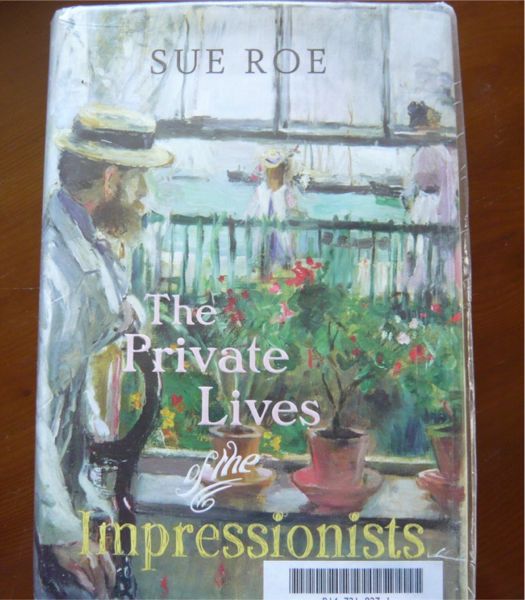
I went to the library yesterday to pick up a reservation, The Private Lives of the Impressionists by Sue Roe. I’d written about the short course on the Impressionists I’m doing and Litlove recommended this book. It has a lovely front cover showing part of Eugene Manet on the Isle of Wight by Berthe Morisot. I’d love to see the original which is in the Musee Marmottan in Paris.

The course I’m doing is focussing on the sites the painters used and not much about their lives and as I know very little (nothing really) about them this book promises to enlighten me. It covers Manet, Monet (I get those two mixed up in my head), Pisarro, Cezanne, Renoir, Degas, Sisley, Berthe Morisot and Mary Cassatt, going into their homes, their studios, describing their love affairs and arguments, as well as their canvases and theories. It has some illustrations.

library-loot-impressroe

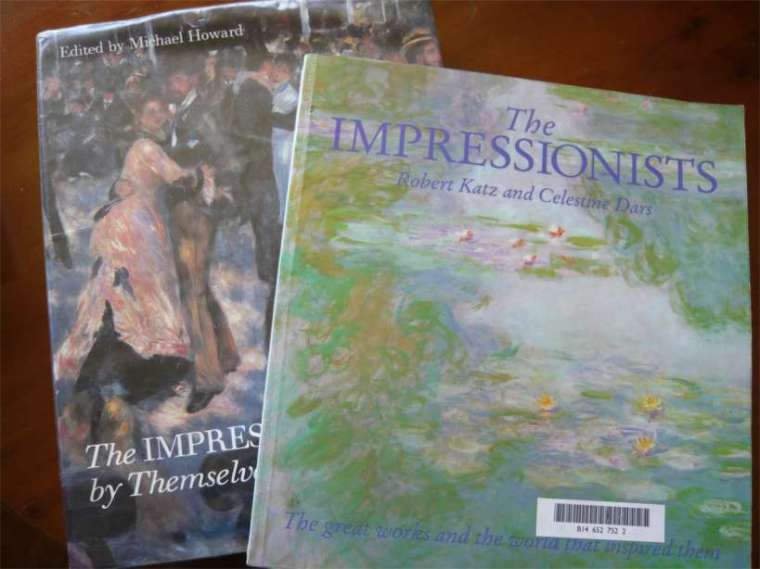
Whilst I was in the library I looked for other books on the Impressionists focussing on their actual works. There was plenty of choice and I came home with two large heavy books:

library-loot-impress

  • The Impressionists by Robert Katz and Celestine Dars. This is full of colour illustrations in two sections, one on the history of Impressionism and one on the life and works of  the artists in Sue Roe’s book plus Frederic Bazille.
  • The Impressionists by Themselves, edited by Michael Howard. This is a massively heavy book containing a selection of their paintings, drawings and sketches with extracts from their writing. It’s arranged chronologically covering the years 1856 – 1924

I don’t think the three week loan period will be long enough for me to absorb these books but at least I’ll find out if I want to buy any of them for future reference.

Sunday Salon – Reading By Inclination

A man ought to read just as inclination leads him; for what he reads as a task will do him little good.

Samuel Johnson 1709-84

This week I’ve been reading where my inclination took me. I’ve been tempted to re-read old favourites through thinking and writing about the books I read five years ago, particularly the Iris Murdoch books and then looking at books on my bookshelves set me off again.

But in the end I concentrated on my current reading  and finished The Hidden by Tobias Hill. I need to think about it more before writing about it. I also read a bit more of both Suite Francaise and The Various Flavours of Coffee, and also started Tartan Tragedy by Antonia Fraser, although I’ve not read much of it yet. This is set on a remote island in the Scottish Highlands. There is a forbidding stone house, a family feud, Scottish nationalism and a couple of suspicious deaths. Jemima Shore, on holiday is drawn into the mystery.

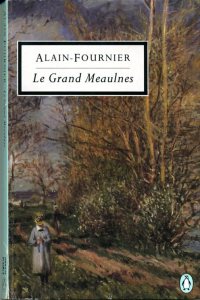
From Scotland I moved to France, reading the opening pages of Le Grand Meaulnes by Henri Alain-Fournier in preparation for the discussion on 14th February over at Cornflower’s book group. I haven’t managed to get the same edition as Cornflower’s as I’ve borrowed the book from the library. There were several copies held in the County Reserve stock (kept in the basement of the building next door to the library), one in French. My copy is a Penguin Twentieth Century Classic, published in 1966 with no introduction. From the back cover:

A classic of immaturity and adolescence … told with lucidity, grace and even magic.

The only novel by a brilliant young man who was killed in action in 1914 at the age of twenty-seven, it is a masterly exploration of the twilight world between boyhood and manhood, with its mixture of idealism, realism and sheer caprice.

I was wondering about “Meaulines”, not sure what it means or how to pronounce it.  “Le Grand Meaulines” is what the boys called Augustin Meaulines. Fortunately there is a footnote on page 18 by the Translator (Frank Davison), explaining that he has not translated the title because no English adjective conveys all the shades of meaning of “grand” which takes on overtones as the story progresses. It could mean the tall, the big, the protective, the almost grown up – even the great Meaulines, or “good old Meaulines” and it is pronounced like the English word “moan”.

le-grand-m001

Here’s a coincidence: the front cover of this book shows a detail from Small Meadows in Spring by Alfred Sisley, who I had never heard of until last Thursday at the first of a five week WEA course on the Impressionists. Sisley was influenced by the Barbizon School of painters. He moved to Moret-sur-Loing next to the Forest of Fontainebleau in 1880 and painted Small Meadows in 1881. It’s now in the Tate.  Sisley, a French landscape painter born in Paris of English parents was one of the founders of the Impressionist School of painting. A definite French trend seems to be going on here – first Suite Francaise, then Le Grand Meaulnes and now the Impressionists. This could be a distraction from my current reading as I want to know more about the Impressionists now.

I’m wondering where my inclination will take me next week – my intention is to read more of Suite Francaise and Le Grand Meaulines and to finish Tartan Tragedy, but maybe I’ll be tempted into starting something completely new, looking at the lives and works of the Impressionists, or I’ll be drawn back into reading an old favourite.

The Pre-Raphaelites

The Pre-Raphaelite Brotherhood was first formed in the summer of 1848. From the start their work had no common denominator – the painters called “Pre-Raphaelites” were all individual and their paintings show great contrasts. Pre-Raphaelitism cannot be defined; there are as many differences between the paintings as there are similarities. The original members of the Brotherhood were James Collinson, William Holman Hunt, John Everett Millais, Dante Gabriel Rossetti, William Michael Rossetti, Frederick Stephens and Thomas Woolner. Other artists became more or less loosely associated with the movement.

This isn’t a post about art history or about individual artists. I just wanted to record some of my favourite paintings that can be defined, somewhat loosely in some cases, as Pre-Raphaelite.  I love looking at these, mainly for the colour and style of the paintings. In no particular order of preference they are as follows.

Millais Ophelia blog

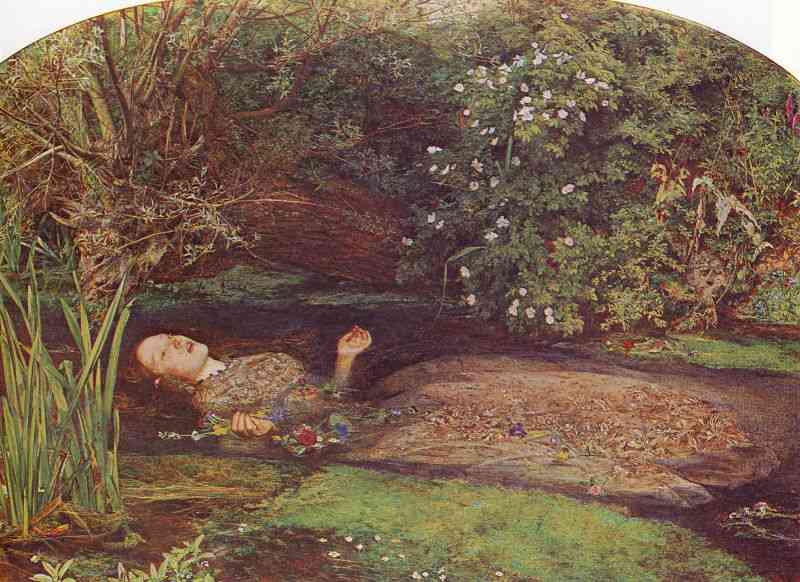
Ophelia by John Everett Millais 1851 – 1852, showing the drowned Ophelia from Hamlet. This reproduction doesn’t do justice to the original, which is held by the Tate Britain, currently part of the Millais Exhibition on display in Japan -in the Kitakyushu Municipal Museum of Art from 7 June to 17 August 2008, and The Bunkamura Museum of Art, 30 August to 26 October 2008. For more infomation click here. I particularly like the detail in Ophelia’s dress and flowers which are all symbolic.

William Dyce blog
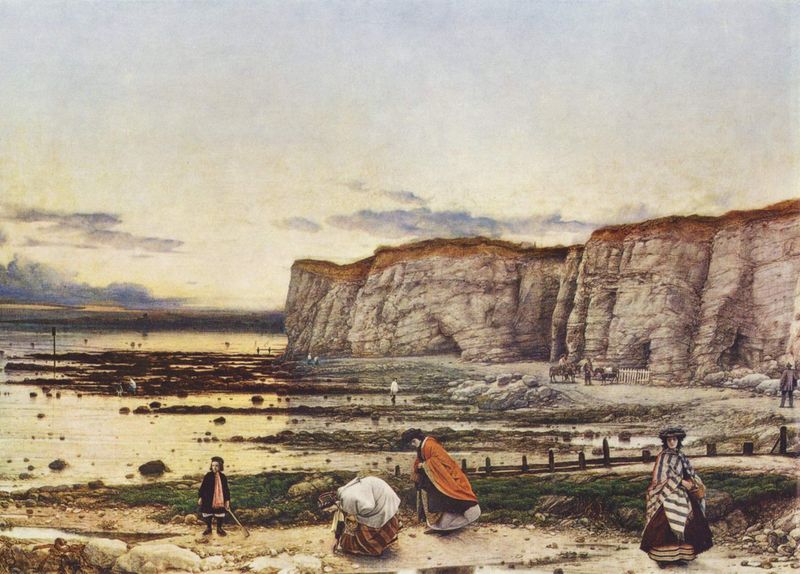
Pegwell Bay, Kent, a Recollection of October 5th, 1858 by William Dyce 1859 – 1860, (Tate Britain). The figures in the foreground are members of Dyce’s family, dwarfed by the chalk cliffs behind. Again it’s the detail and colour that I love in this painting. It doesn’t show in the reproduction below but in the sky is the trail of Donati’s comet.
Rossetti_beata beatrix

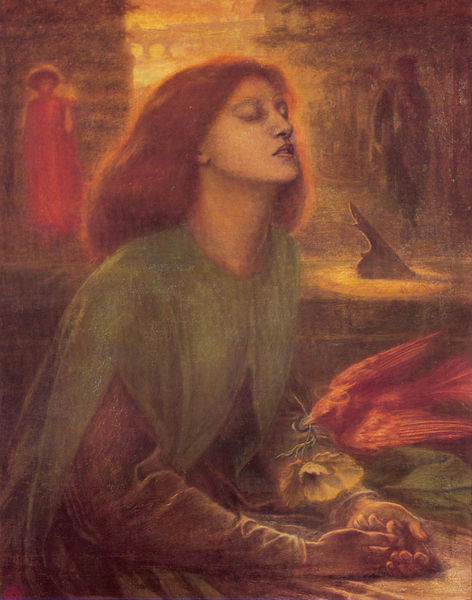
Then an absolute favourite  – Beata Beatrix by Dante Gabriel Rossetti c. 1863, (Tate Britain). This was inspired by Dante’s poem La Vita Nuova about his love for Beatrice. This is Rossetti’s portrait mourning the death of Lizzie Siddell in a trance-like state. The white poppy because she was thought to have been poisoned with opium and the sundial pointing to 9 relating to the meeting of Dante and Beatrice when he was 9 years old. I think this is such a beautiful, powerful painting – Rossetti described it saying Lizzy was ‘rapt from earth to heaven’.

Ford_Madox_Brown_-_Work

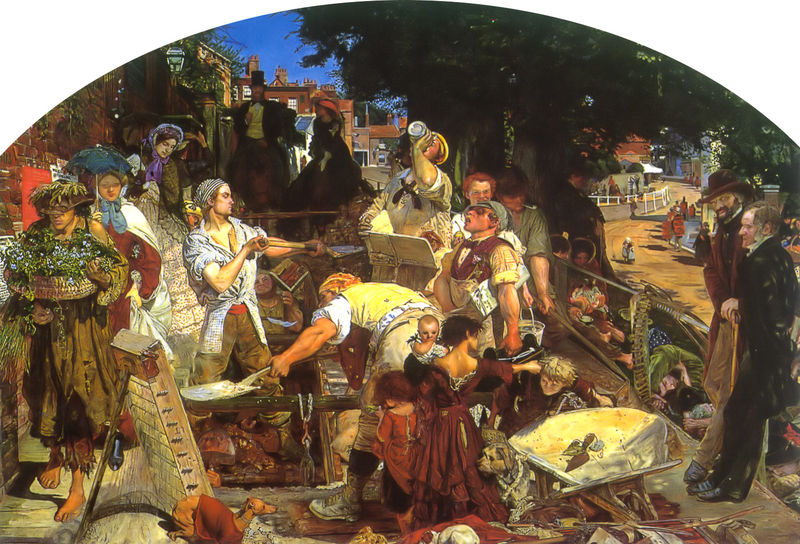
Work by Ford Madox Brown, 1852 – 1865 (Birmingham Museum and Art Gallery). It’s the movement and gestures of the figures that I like in this painting and the contrasts in the characters. There are the workmen digging and drinking as they work, a beggar, the figures of Carlyle and F D Maurice (the ‘brain workers’), the rich, dogs and children. There is so much to see in this painting.

Little is known about Henry Wallis, who painted Chatterton, 1856 (Tate Britain). I like the pathos in this painting and the contrast between the illuminated figure of Chatterton as the dawn light strikes the dark background of the attic room where he had killed himself. Peter Ackoyd’s novel Chatterton tells the story of the artist’s suicide.

The paintings are copied from Wikipedia where there is a list of paintings by Pre-Raphaelite artists and artists associated with the Pre-Raphaelite style. The Pre-Raphaelites by Timothy Hilton is a very good source of information, with many reproductions of the paintings mainly in black and white, but with a few in colour. I haven’t included all my favourites – more to come in another post, maybe.