Agatha Christie Reading Challenge: My Progress

The Agatha Christie Reading Challenge is an open-ended challenge to read all of Agatha Christie’s books and short stories, run by Kerrie at Mysteries in Paradise. I first read some of Christie’s books when I was a teenager and hadn’t read any for years until I borrowed a copy of The Crooked House from my local library three years ago. This reminded me of how much I had enjoyed her books and set me off reading them again. Over the years I must have read a good number of them but had never kept any records of what I read at the time.

So when I saw that Kerrie was running this challenge I decided to join in. It’s one of the best challenges out, for me at least, because all you have to do is read Agatha Christie’s books at your own pace and link to the Agatha Christie Carnival once a month. There’s no pressure to meet any deadlines – if you haven’t read any Christie books for the Carnival that’s OK and you just carry on reading when you like.

I’m not even trying to read them in the order they were published, even though Kerrie and some others are, because I’m reading books I already own or books that I find in librarys and/or bookshops. So far I’ve read 17 and 2 collections of her short stories – I’ve listed them on a separate page.

My latest find is 4.50 from Paddington, which I received from Juxtabook as part of my prize in her recent competition. Catherine described this book as a ‘rather aged paperback’ and it is, but then it is 50 years old, published in 1960 for just 2/6 (in old money). It may be old and faded, but because it was published soon after Agatha Christie wrote it, it has a contemporary feel about it. I’ve watched so many TV and film versions, with different actors playing the part of Miss Marple, some more successfully than others that it’s interesting to see this book. I’m not sure who the woman on the front cover is meant to portray – surely not Miss Marple?
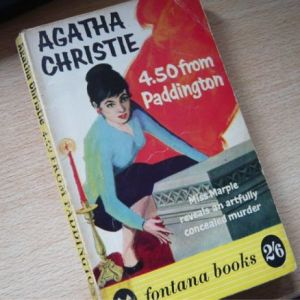
And this is the back cover – really that’s all the blurb you need to capture your interest.

This will be my next Agatha Christie book to read.

Death on the Nile by Agatha Christie: Book Review

Death on the Nile is a pre-Second World War novel, first published in 1937. It shows Agatha Christie’s interest in Egypt and archaeology and also reflects much of the flavour and social nuances of the pre-war period. In it she sets a puzzle to solve –  who shot Linnet Doyle, the wealthy American heiress? Although the novel is set in Egypt, an exotic location, it is essentially a ‘locked room mystery’, as the characters are passengers on the river-steamer SS Karnak, cruising on the Nile. Amongst them is the famous Hercule Poirot, a short man dressed in a white silk suit, a panama hat and carrying a highly ornamental fly whisk with a sham amber handle ‘a funny little man (pages 37 – 38). Linnet is the girl who has everything, good looks and wealth:

A girl with golden hair and straight autocratic features ‘a girl with a lovely shape’ (page 3). She was used to being looked at, being admired, to being the centre of the stage wherever she went. (page 41)

Linnet has recently married Simon Doyle, who was previously engaged to her friend, Jacqueline. This sets in motion a series of events that results in Linnet’s death. When Jacqueline follows them on their trip down the Nile she is the obvious suspect, driven by her jealousy of Linnet. Also on board are an imperious American, Miss Van Schuyler, her niece Cornelia Robson and Miss Bowers, her companion; a novelist Mrs Salome Otterbourne and her daughter, Rosalie; Mrs Allerton and her son, Tim; Linnet’s American solicitor, an excitable Italian archaeologist, a radical English socialist and a young English solicitor.

Poirot is on holiday, but he finds himself discussing the nature of criminals and motives for murder with Mrs Allerton. He says the most frequent motive is money:

that is to say gain in its various ramifications. Then there is revenge, and love, and fear ‘and pure hate, and benefice’. (page 83)

The motive in this case seems straightforward, looking at who gains from Linnet’s death, but this is a complicated plot (when is one of Christie’s books not complicated?) and following on from Linnet’s murder, her maid is also found dead, Linnet’s pearls are missing, several characters are not what them seem and with the arrival of Colonel Race, a member of the British Secret Service, it seems there is also an international murderer and agitator on board. Poirot knew

that Race was a man of unadvertised goings and comings. He was usually to be found in one of the out-posts of Empire where trouble was brewing. (page 120)

It does seem a very unlikely plot, dependent on precise timing, but Poirot works his way through the significant facts and arrives at the truth. He tells Race that

This is a crime that need audacity, swift and faultless execution, courage, indifference to danger and a resourceful, calculating brain. This crime wasn’t safe! It hung on a razor edge, It needed boldness. (page 272)

All in all, an enjoyable puzzle to solve, most of which I’d worked out along with Poirot.

The Mystery of the Blue Train by Agatha Christie: Book Review

Agatha Christie didn’t enjoy writing The Mystery of the Blue Train (first published in 1928). In her autobiography she wrote that it had not been easy writing it and that she had always “hated” it:

To begin with I had no joy in writing, no élan. I had worked out the plot – a conventional plot, partly adapted from one of my other stories. I knew, as one might say, where I was going, but I could not see the scene in my mind’s eye, and the people would not come alive. I was driven on by the desire, indeed the necessity, to write another book and make some money.

That was the moment when I changed from being an amateur to a professional. I assumed the burden of a profession, which is to write even when you don’t want to, don’t much like what you are writing and aren’t writing particularly well. (pages 368-9)

As she was writing this book at the time of her disappearance and divorce from her first husband, Archibald Christie it’s hardly surprising. It may not be her best book, but it’s still a good read. Ruth Kettering, the daughter of millionaire Rufus Van Aldin, is married to Derek, against her father’s advice. Agatha’s views on divorce are clear when Van Aldin tells Ruth she should divorce Derek, who he thinks is no good, rotten through and through and had only married her for her money, saying:
Have you got the grit to admit to all the world that you’ve made a mistake. There’s only one way out of this mess, Ruthie. Cut your losses and start afresh. (page 20)

Later Ruth is found strangled in her compartment in the Paris-Nice train, known as the train bleu, on its arrival in Nice and the fabulous ruby, the Heart of Fire that Van Aldin had given her, has been stolen. Fortunately Hercule Poirot is also travelling on the train and he of course unravels the mystery. There are a number of suspects ranging from Derek and his mistress, the dancer Mirelle, who had both the motive and the opportunity, to Ruth’s lover, the Comte de la Roche, suspected of stealing the jewels.

I liked the reflections on detective novels through a conversation Poirot has with another passenger on the train, Katherine Grey, from St Mary Mead who has inherited money from her employer. She is reading a roman policier when they meet at dinner and Poirot comments that they always sell well. She replies that may be because they give ‘the illusion of living an exciting life’ and that ‘nothing of that kind ever happens to me.‘ From then on however, she is drawn into the mystery along with Poirot, that

 small man, distinctly foreign in appearance, with a rigidly waxed moustache and an egg-shaped head which he carried rather on one side. (page 80)

It may be that Poirot is a bit of a caricature in this book, but the characters are in the main believable and the book certainly has a 1920s feel to it.

Agatha Christie Reading Challenge Update

Years ago I read as many of Agatha Christie’s books that I could find. Now I’m taking part in the Agatha Christie Reading Challenge and reading (or re-reading) her books. Listed below are the books I’ve read so far. I’ve reviewed them all except for A Pocketful of Rye and The Seven Dials Mystery

  1. The Mysterious Affair at Styles €“ 1920
  2. The Seven Dials Mystery €“ 1929
  3. Peril at End House €“ 1932
  4. Why Didn’t They Ask Evans? €“ 1934
  5. Hercule Poirot’s Christmas – 1938
  6. The Body in the Library €“ 1942
  7. The Hollow – 1946
  8. Crooked House €“ 1949
  9. A Pocketful of Rye €“ 1953
  10. Dead Man’s Folly €“ 1956
  11. The Pale Horse – 1961
  12. The Mirror Crack’d from Side to Side– 1962
  13. By the Pricking of My Thumbs – 1968
  14. Passenger to Frankfurt – 1970
  15. Elephants Can Remember – 1972

I’ve also read two books of her short stories:

  1. The Thirteen Problems (short stories) – 1933
  2. The Hound of Death (short stories) – 1934

I’m currently reading Agatha Christie and the Eleven Missing Days by Jared Cade and planning to read some of her earlier books next:

  • Murder on the Orient Express – 1934
  • The ABC Murders – 1936
  • Death on the Nile – 1937
  • Appointment with Death – 1938

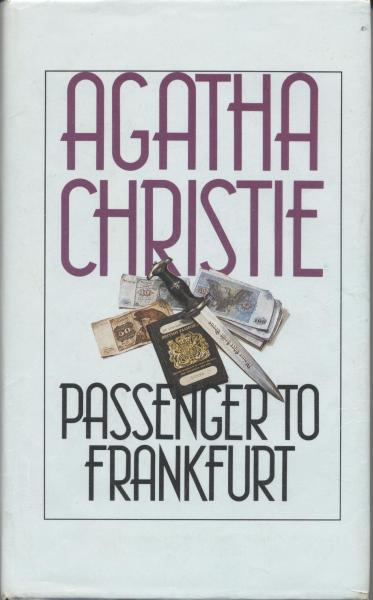
Passenger to Frankfurt by Agatha Christie: Book Review

Passenger to Frankfurt 001

Passenger to Frankfurt is unlike any other Agatha Christie book I’ve read. It was first published in 1970, the year she was 80, as her “eightieth” title, although she had written more than that.

It rambles on a lot, has many characters, and at times I wondered what it was all about. I decided that it was best not to think of it as an Agatha Christie crime novel, but rather as a collection of her thoughts about life and the society she had lived through, with a bit of intrigue thrown into the mix.

It begins well, with Sir Stafford Nye, a diplomat on his way back to London, sitting in an airport lounge in Frankfurt. He was thinking that “life and journeys by air were really excessively boring” when he met a dark haired woman whose life was in danger and his own life changed for ever. The woman wanted his passport to get her safely to London, disguised by his dark purply-blue cloak with its scarlet lining and hood.  He agreed.

So far, so good. From then on Sir Stafford is dragged along, somewhat unwillingly at first into a world of espionage, and world-wide organisations dedicated to anarchy and violence, all mixed with strains from Wagner – with the Young Siegfried – and Nazism. It’s a bleak picture of the world with money and the power of money perverting young people world wide, following blindly like the children beguiled by the Pied Piper of Hamelin.

I never really got the impression that many of the characters were real, apart from Sir Stafford his Great-Aunt Matilda and the young lady known as either Daphne Theodofanous, or Mary Ann or Countess Zenata Zerkowski. Great-Aunt Matilda is a very verbose lady who tells him that things are in a very bad mess  and “once people learn to love destruction for its own sake, evil leadership gets its chance.” Cynically she also comments that politicians are not to be trusted:

And one can’t help coming to the conclusion that politicians have a feeling that they have a kind of divine right to tell lies in a good cause. (page 80)

Sir Stafford doesn’t really know who he can trust, or who is playing a double game. It’s his sense of humour that is in the way of his career that makes him useful in discovering what is going on – he’s not a hero-worshipper and can see through humbug. The power some people wield through their personality is vital in enthusing people with their vision but it’s also dangerous:

It’s the magnetic power that a few men have of starting something, of producing and creating a vision. By their personal magnetism perhaps, a tone of voice, perhaps some emanation that comes forth straight from the flesh. …

Such people have power. The great religious teachers had this power, and so has an evil spirit power also. (pages 106 -7)

I find myself rambling as I think and write about this book. It does get rather repetitive with it’s pessimistic emphasis on a

growing organisation of youth everywhere against their mode of government; against their parental customs, against very often the religions in which they have been brought up. There is the insidious cult of permissiveness, there is the increasing cult of violence. Violence not as a means of gaining money but violence for the love of violence. (page 113)

It certainly is not representative of Agatha Christie’s books and not one I’d recommend to anyone who hasn’t read any of her books. Although there is a degree of pessimism and cynicism running through it there is also a strain of humour, a sense that you shouldn’t take it all too seriously and I did enjoy it. Sir Stafford is the best portrayed character and as Agatha Christie has him say:

One cannot go entirely through life taking oneself and other people seriously. (page 43)

Crime Fiction Alphabet W is for Why Didn’t They Ask Evans?

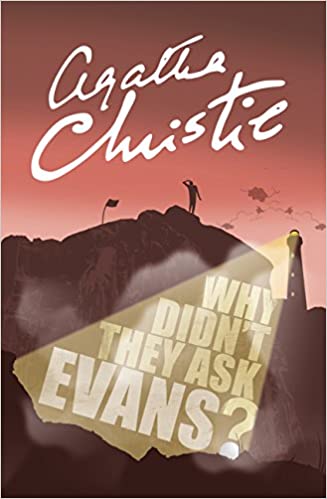
I’m returning to Agatha Christie to illustrate the letter W in Kerrie’s Crime Fiction Alphabet series, with Why Didn’t They Ask Evans? The copy I read is one of the Collected Works series with the original illustrations by Patrick Couratin and Sylvia Dausset. Why Didn’t They Ask Evans? was first published in 1934.

Why didn't they ask evans

The book begins with Bobby Jones playing golf with Dr Thomas on a golf course on a misty day by the sea. They find a dying man, who had fallen off a cliff. He has no identification on him, just a photo of a young woman that Bobby finds in his pocket. At the inquest Mrs Cayman said it was a photograph of her and that she was the dead man’s sister.

Bobby tells Mr and Mrs Cayman her brother’s last words, which apparently are meaningless and of no importance.Then Bobby is drugged with enough morphia to kill him (he survives) and he realises that the photo in the dead man’s pocket was not Mrs Cayman.  Frankie, (aka Lady Frances Derwent), his aristocratic friend decides that the dead man must have been pushed over the cliff and the killer is determined to kill Bobby too. She and Bobby then set out to discover the dead man’s true identity.

Neither Poirot, nor Miss Marple feature in this book. Bobby and Frankie solve the mystery with a little help from the police in the form of Inspector Williams. The novel as a whole is light-hearted with staged accidents, as Bobby and Frankie, a self-confident and rather bossy young woman relish the adventure of it all, despite being bound and gagged by the villain. There are disguises and subterfuges throughout, drug addicts, an American heiress, a sinister doctor with a questionable sanitorium, suicides and a charming  “ne’er-do-weel”. Bobby says:

You can’t mix up too many different sorts of crimes. (page 59)

But Agatha Christie manages it admirably.