ABC Wednesday – C is for …

Thumbnail for version as of 06:51, 12 November 2010… Susan Coolidge, the American author of some of my favourite books when I was a child.

Susan Coolidge was her pen name – her real name was Sarah Chauncey Woolsey (1835 – 1905). She is best known for her classic children’s book – What Katy Did, featuring Katy Carr and her family. Along with Little Women this must be the book that I’ve the most number of times, together with What Katy Did at School and What Katy Did Next.

Looking at her entry in Wikipedia I realise now that she wrote many other books, short stories and poems, some of which are available from Project Gutenberg, including two more ‘Katy’ books, which I haven’t read – Clover and In the High Valley. There is a brief biography at the 19th-Century Girls’ Series.

I loved Katy. She was a tomboy, always getting into scrapes, playing rough games and getting into trouble. But there is another side to the story of Katy and her little brothers and sisters (based roughly on her own family) because Katy has an accident, falling off a swing and becomes bedridden, eventually with the help of Cousin Helen learning patience and cheerfulness. I haven’t read the book for years and I suspect I could find it a little too moralising now. I hope not I enjoyed it so much.

Katy’s hair was always untidy; her frocks were always catching on nails and ‘tearing themselves’; and in spite of her age and size, she was as heedless and innocent as a child of six. Katy was the longest girl that was ever seen. What she did to make herself grow so, nobody could tell; but there she was – up above papa’s ear and half a head taller than poor Aunt Izzie. …

She had fits of responsibility about the other children, and longed to set them a good example, but when the chance came, she generally forgot to do so. Katy’s days flew like the wind; for when she wasn’t studying lessons or sewing or darning with Aunt Izzie, which she hated extremely, there were always so many delightful schemes rioting in her brains, that all she wished for was ten pairs of hands to carry them out. These same active brains got her into perpetual scrapes.

These are my well-worn ‘Katy’ books:
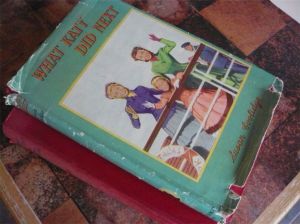
Katy books

So far my entries for ABC Wednesday have had a literary connection and I hope to continue with them as long as possible. I also post non-literary entries on my other blog Margaret’s Miscellany – this week it’s C for Corfe Castle.

The Victorian Literature Reading Challenge

Completed – see end of post.

Following on from my decision to take part in more reading challenges in an attempt to reduce my tbr list I’ll also be taking part in the Victorian Literature Challenge in 2011. This is hosted by Bethany at words, words, words.

Bethany writes: Queen Victoria reigned from 1837-1901. If your book wasn’t published during those particular years, but is by an author considered ‘Victorian’ then go for it. We’re here for reading, not historical facts! Also, this can include works by authors from other countries, so long as they are from this period.

Choose from one of four levels:

Sense and Sensibility: 1-4 books.
Great Expectations: 5-9 books.
Hard Times: 10-14 books.
Desperate Remedies: 15+ books.

Again, I’m choosing my books from my tbr list. All these were written in the Victorian period. I’m aiming for the Sense and Sensibility level and if I complete that I’ll go for the next level and so on.

  • An Autobiography by Anthony Trollope
  • Barchester Towers by Anthony Trollope
  • Black Beauty by Anna Sewell
  • The Coral Island by R M Ballantyne
  • David Copperfield by Charles Dickens
  • East Lynne by Mrs Henry Wood
  • The Hunchback of Notre Dame by Victor Hugo
  • Lorna Doone by R D Blackmore
  • Mary Barton by Elizabeth Gaskell
  • The Mill on the Floss by George Eliot
  • News from Nowhere by William Morris
  • The Pickwick Papers by Charles Dickens
  • Scenes of Clerical Life by George Eliot
  • Sylvia’s Lovers by Elizabeth Gaskell
  • The Tower of London by W H Ainsworth

That’s a lot of books, but I’ll be happy if I read just four of them during the year.

Update:

U is for …

… Unfinished …

My first entry for ABC Wednesday was J and I chose Jigsaw. I’d just got the pieces out ready to do it:

It’s a beautiful picture of Little Langdale in the Lake District. It’s also a very difficult puzzle partly because so many of the pieces are so similar in colour. Often a puzzle like this has to be done by matching the shapes of the pieces but what is so frustrating in this puzzle is that so many of them will fit together but they aren’t quite right and I end up with pieces that just won’t fit anywhere. The grass was bad enough and I know I’ve not got the pieces all in the right places because I have one green piece left and it won’t fit into the one remaining space. The sky is even worse.

It is UNFINISHED.

Also UNFINISHED is another U – namely Ulysses by James Joyce. Back in January I was full of determination to read this book, but so far I’ve only managed a few pages. It will certainly remain unfinished this year – maybe next year will be my Ulysses year, maybe not. It’s a daunting book because of its sheer length and reputation as a difficult book. It would probably help if I read it alongside Declan Kiberd’s book Ulysses and Us. I love the cover of this book, showing Marilyn Monroe reading Ulysses.

More variations on the letter U can be found on the ABC Wednesday site

T is for … Teddy Bears

I am a teddy bear collector – an arctophile – and here are some of my little teddy bears. I have a collection of miniature bears (and one or two bigger ones too). Shown below is a selection of some of them.

Seated above are some little Steiff bears, which are smaller versions of the originals, Hermann bears, Boyds bears, Chad Valley bears and Merrythought bears amongst others and they all have names. Some are ‘One of a kind’, like Tyler Major, who is very heavy as he is weighted with lead shot. Then there is Edmund Bear from St Edmund Hall, Oxford University – he is wearing a navy blue jumper and a brown bow. The little dark brown bear at the front wearing a black hat and pink ribbons is Simone.

I began collecting them several years ago, beginning with Little Big Ted, who was taken by his maker to meet the Queen:

He is my favourite, as sadly I no longer have my childhood teddy bear.

To go with my bears I have a small selection of teddy bear books:

From top to bottom they are:

  • The Treasury of Teddy Bear Tales – a collection of twelve tales , from comic to nostalgic.
  • Make Your Own Classic Bears – 14 Heirloom Designs by Julia Jones. This defines a ‘classic’ bear as one with lightly curved paws, feet that are long in proportion to its height, a small head with a long, pointed muzzle, black boot button eyes and a nose and mouth either embroidered with black thread or made with an oval of black leather, and pads on its paws and either no claws or one stitched in black.
  • The Teddy Bear Book: a Voyage of Discovery into the Origins of Our Favourite Toy by Maureen Stanford and Amanda O’Neill – over 700 photos of teddy bears from all over the world. This is a mine of information on teddy bears from their history to their design, care and repair.
  • The Ultimate Teddy Bear Book by Pauline Cockrill – more photos of historical bears as well as modern teddy bear personalities, such as Winnie the Pooh and Rupert Bear, complete with a data panel of Bear Essentials to help distinguish between the different types of bear.

Some Teddy Bear History

In America: Morris Michtom (a Russian immigrant) had the idea of making a cuddly bear after seeing a cartoon of President Roosevelt refusing to shoot a tethered bear cub. His wife made the bears and sent one to the President asking  to call it ‘Teddy’ after his first name, Theodore.

In Germany: A seamstress called Marguerite Steiff made soft toys and her nephew wanted an alternative to a doll and he thought of a bear. The first one was ‘Friend Petz’ in 1903, shown at the Leipzig Toy Fair, where it was seen by Hermann Berg, an American buyer for a New York company. By the 1920s bears were being made in Britain as well as in Germany and the US.

This is an  ABC Wednesday post.

S is for …

… Secondhand books

Yesterday I went to Barter Books in Alnwick, a superb secondhand bookshop where you can not only buy books but exchange books. I took a pile along and came back with some more and am still in credit for more books for my next visit. It’s a great way to recycle books.

I have written about Barter Books before, but not posted any photos of what it’s like inside. It is in a huge old railway station, built in 1887 and closed to passengers in 1968.

(Click on the photos to see more detail)

There is a cafe in what used to be the station waiting room where we refreshed ourselves with coffee and toasted teacakes in front of a roaring fire. The painting on the wall above the fireplace shows the station as it was in 1908 when the future King George V and Queen Mary visited Alnwick.

We then browsed the shelves. There are all sorts of books, fiction, non fiction, first editions, valuable antiquarian books, signed copies, maps, dvds, pamphlets and so on.

In one section there is a miniature overhead railway line with trains passing every few minutes.

It’s a very special bookshop.

This is an an entry in ABC Wednesday for the letter S.