 I’ve been reading some of Hans Christian Andersen’s Fairy Tales as part of Carl’s Once Upon A Time event, specifically in the Short Story Quest. So far I’ve written about The Rose Elf, The Shepherdess and the Sweep, and The Snow Queen.
I’ve been disappointed in some of the other stories, some are gruesome and moralistic. I don’t remember feeling that about them when I first read them as a child, which shows, I suppose, the different approach children have to such tales, or maybe it’s just me.
In my descriptions of today’s stories I have not concealed the endings. It’s difficult to write meaningfully without doing so or to decide what should not be revealed in these stories and anyway they are well known and have been told or retold in one form or another. But if you don’t want to know how they end please be aware that there are spoilers in what follows.
First, The Red Shoes, in which a little girl, Karen, longs to have a pair of shiny red shoes, even though the old lady who had adopted her told her that the shoes were very wrong and unbecoming. Karen disobeys her and wears the red shoes to go to church. But they are magic shoes and they compel her to dance, won’t come off her feet and take her dancing where she doesn’t want to go. The result is just awful.
An angel tells her she must dance until she dies, so that children will see the consequence of pride and vanity. In desperation she begs the executioner to cut off her feet along with the shoes, which then go dancing away by themselves and she is left a cripple with wooden feet. She begs for God’s mercy, is taken into service by a clergyman and eventually dies, ‘her heart was so filled with sunshine, peace and joy that it broke. Her soul took its flight up to heaven.’
The strange thing is that I didn’t remember what happened at the end! So I either stopped reading when the horrible bit began, or have blanked it out of my memory. The moral of the story is to point out the consequences of pride and disobedience.
The next one I read is The Brave Tin Soldier, a bitter-sweet tale that also ends in disaster. I suppose this one is about the dangers of pride too. He is one of twenty five tin soldiers, but he has only one leg as he had been cast last when there was not enough tin left to complete him. He wants to marry the cardboard ballet dancer, standing in the middle of a looking glass lake as it appears that she too has only one leg as she balances with one leg lifted raised so high the soldier can’t see it.
At midnight the Jack-in-a-box opens and the little black imp inside warns the soldier to keep his eyes to himself. The soldier ignores his warning and the imp tells him to just wait until the morning. Morning comes and a draught from the window (or is it the imp’s doing) knocks the soldier off the window and down into the street. He is too proud to call attention to himself when the little by who owns him looks for him and he is swept away down the gutter and ends up in a canal, threatened by a large water rat and is then eaten by a fish. The fish is caught and cooked, whereupon the soldier is saved. But that is not the end as one of the little boys throws him into the fire, a door is opened and the draught carries away the little dancer also into the fire. She blazes up and the tin soldier is melted down, leaving only a tin heart.
It’s true he was brave, but he was also too passive or too proud and so fails to save himself. But I do remember liking this story as a child, but maybe that was because I just accepted his fate.
Much more encouraging is the tale of The Ugly Duckling – a famous story about the duckling who was different from the other ducklings, mocked and picked on by the other birds. I remember seeing this story in the film with Danny Kaye as Hans Christian Andersen and the song: There Once Was an Ugly Duckling – quack, get out, get out of town. Of course the ugly duckling is not a duck at all! I thought of this story whilst watching Springwatch this week when the poor bedraggled blue tit was worn to a frazzle feeding her babies that were actually great tits, not blue tits!
And another story that has a happy ending is The Nightingale -one of my favourites as a child, so I’m pleased I still like it. It’s about a nightingale whose beautiful singing captivates all who hear her, including the Chinese Emperor. She agrees to come to his palace and sing for him, living in a cage but still allowed to fly twice a day. The Japanese Emperor sends him a mechanical bird, decked in rich jewels, which when wound up imitates the nightingale’s song. Everyone loves the artificial bird and the real nightingale flies away.
But eventually the artificial bird’s mechanism became worn out and it could no longer sing. The Emperor was heart broken when the real bird cannot be found and he collapsed close to death. But the live nightingale comes to his rescue and sings to give him hope and consolation and his death is averted. He wants her to return to the palace but she refuses as she can’t live inside, but agrees to come and sing for him in his garden.
It is a beautiful story contrasting art, technology and nature and one that is full of optimism about the joys of life.
I think this will probably be my last post for the Short Story Quest, which I have enjoyed even though some of the stories failed to live up to my memories.
 Every Friday Book Beginnings on Friday is hosted by Gillion at Rose City Reader where you can share the first sentence (or so) of the book you are reading, along with your initial thoughts about the sentence, impressions of the book, or anything else the opener inspires.

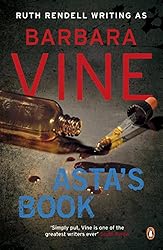
 What an amazing book is Asta’s Book by Barbara Vine*. It was published as Anna’s Book in the USA. I loved
  I think DC Fiona Griffiths must be one of the most original fictional detectives I’ve come across. She is the creation of Harry Bingham in


 I’m still reading Andrew Marr’s
  The last book I read was
  Blurb:
 BooksPlease