I read 4 books in January, half the number I used to read. My reading has slowed down considerably over the last 2 years and I no longer write in much detail about them. But this year I’m hoping to get back to something more like normal and I’m aiming to write at least a paragraph or more about each of the books I’ve read each month.
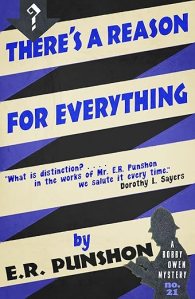
There’s a Reason for Everything (my review) by E R Punshon 4* – I began this book in December and finished reading it in early January. It was first published in 1945 and I read the e-book published by Dean Street Press. It’s the 21st in the Bobby Owen mystery series, in which Bobby has recently been promoted from Inspector to Deputy Chief Constable of Wychshire, a complicated novel with murders, a missing painting allegedly by Vermeer, dodgy fine art dealers and an abandoned country mansion called Nonpareil.
I was perplexed for quite some time until I began to see what was behind the bewildering confusion in Punshon’s narrative. I think this is a cleverly constructed plot, with ingenious puzzles to piece together before all the answers are revealed. I was quite pleased to find out at the end that I’d worked out one of the clues correctly.

Sense and Sensibility by Jane Austen 5* – It’s about the three Dashwood sisters and their widowed mother as they leave their family estate at Norland Park after their father’s death when their half-brother John inherited the estate. This year is the 250th anniversary of Jane Austen’s birth, so this is an ideal time to reread some of her books and I’m joining Brona at This Reading Life in her Austen 2025 project to reread her books, along with the Classics Club’s Sync Read (or readalong).
I read the annotated edition, edited by David M Shapard that gives Explanations of historical context, Citations from Austen’s life, letters, and other writings, Definitions and clarifications, Literary comments and analysis, Multiple maps of England and London, An introduction, bibliography, and detailed chronology of events and More than 100 informative illustrations.
I’ll write more about this book in a later post.

Signal Moon by Kate Quinn 5* – a short story. I’m not a big fan of short stories, often finding them too short and wanting to know more. But this one is good and it fascinated me. It’s sci-fi involving a type of time-travelling, a mix of historical fiction, links to the code breakers at Bletchley Park and WW2. I loved it. It is, of course, impossible, set in two time periods, 1943 during World War 2 and 2023, but I didn’t have to work hard to believe in it. Kate Quinn’s narrative just drew me in. In 1943, Lily Baines is a Wren working for a “Y” station, picking up signals from German intelligence that were then sent to Bletchley Park for translation. Then she picks up a signal apparently from 2023 – it’s a cry for help from Matt Jackson a young US officer. It’s about an American ship that is taking heavy fire in the North Atlantic. Together Lily and Matt have to work out how to help each other: Matt to convince her that the war she’s fighting can still be won, and Lily to help him stave off the war to come.
Kate Quinn wrote this story to feature the information about the Y stations that she had discovered whilst researching Bletchley Park and hadn’t included in The Rose Code.

Keir Starmer: the Biography by Tom Baldwin 3.5* A Times Book of the Year; A Telegraph Book of the Year; A Daily Mail Book of the Year; A Waterstones Book of the Year
Dsecription from Amazon:
This authoritative – but not authorised – biography by Tom Baldwin provides answers by drawing deeply on many hours of interviews with Prime Minister himself, as well as unprecedented access to members of his family, his oldest friends and closest colleagues.Together, they tell an unexpectedly intimate story filled with feelings of grief and love that has driven him on more than any rigid ideology or loyalty to a particular faction.
The book tracks Starmer’s emergence from a troubled small town background and rebellious youth, through a storied legal career as a human rights barrister and the country’s chief prosecutor, to becoming an MP relatively late in life.Baldwin provides a vivid and compelling account of how this untypical politician then rose to be leader of his party in succession to Jeremy Corbyn, then transformed it with a ruthless rapidity that has enraged opponents from the left just as much as it has bewildered those on the right.
Above all, this is a book that should be read by anyone who wants to understand how someone who has too often been underestimated or dismissed as dull, now intends to change Britain.
My thoughts
This book was published in February 2024, five months before the General Election. I decided to watch the televised debates between him and Rishi Sunak, the then Prime Minister, and thought Starmer looked uncomfortable in most of them. All I knew about him was that he was the former Director of Public Prosecutions, and, as he often said in interviews, that growing up he lived in a pebble-dashed semi , that his ‘dad was a toolmaker‘ and his ‘mother was a nurse.’ So I hoped that Baldwin’s book would tell me more. Baldwin writes:
Starmer is a private man who has chosen to place himself in the white light of public scrutiny, while showing a determination that is itself exceptional to maintain a semblance of normality … often appearing uncomfortable at being a politician at all. (page xi)
He also describes him as ‘someone who is both extraordinary and very ordinary‘ (page xii). The biography is divided into five parts :
each of which begins by sketching a moment since he became a politician when this tension is most apparent. All of them also include descriptions of sometimes traumatic episodes that have wrenched him back to real life and away from the febrile – often fake – world of Westminster politics. (page xii).
In the first three parts he covers Starmer’s childhood and schooldays, his time as a student at Leeds University, where he was awarded a first-class law degree, and then at St Edmund Hall at Oxford University where he gained a postgraduate Bachelor of Civil Law degree. He then worked as a trainee barrister in London, eventually transitioning from a human rights lawyer into the country’s chief prosecutor. The fourth part describes how he became an MP, a member of the shadow cabinet and Leader of the Labour Party. The fifth part examines the leadership, before assessing what kind of prime minister he would make.
One friend said:
He’ll just turn up at the pub and be a totally normal and genuinely good bloke. But his public persona is very different, I almost don’t recognise him when I see him on TV.
And another said:
There is this enormous gap between Keir the human being and Keir the politician. At Jonny [Cooper]’s funeral, I saw the real one letting himself go – in the best way – to share his grief with his friends. But, when I watched him on TV at the party conference, he had seemed to be almost a different person, holding back and distant, almost wooden compared to the generous, humorous and empathetic man I’ve known for twenty years. (page 323)
It seems to me that he is a conscientious person who believes in working hard and playing hard. He is resilient and driven. He believes in fairness and social justice, putting the country before the party, a serious, clever man, who wants to get things done and change the country for the better.





 BooksPlease