
Spell the Month in Books is a linkup hosted by Jana on Reviews From the Stacks on the first Saturday of each month. The goal is to spell the current month with the first letter of book titles, excluding articles such as ‘the’ and ‘a’ as needed. That’s all there is to it! Some months there are optional theme challenges, such as “books with an orange cover” or books of a particular genre, but for the most part, any book you want to use is fair game!
This month I’m not taking the option, which is Valentine’s Day/something sweet on the cover, but instead I’m featuring books from my blog, some from the early days of the blog.
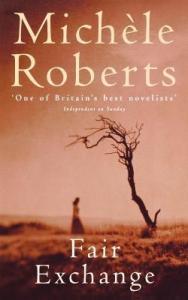
F is for Fair Exchange by Michele Roberts – historical fiction set in England and France in the late 1700s/early 1800s during the French Revolutionary period. While drawing hints and facts from the lives and secret affairs of two of the most famous and passionate figures of the late 18th century – Mary Wollstonecraft and William Wordworth – the intriguing mystery surrounding these two women, is Michèle Roberts own fascinating creation. It’s about William Saygood a fictional friend of Wordsworth’s. Mary Wollstonecraft appears in the novel but Roberts has ‘plundered various aspects of her life’ for the character, Jemima Boote. There is a fair bit in this book about women’s rights and their place in society, and about the question of nurture versus nature in bringing up children.
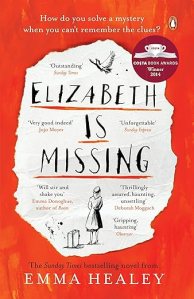
E is for Elizabeth is Missing by Emma Healey – Maud has dementia – but she knows her friend Elizabeth is missing. I enjoyed the TV adaption with Glenda Jackson as Maud much more than the book. Emma Healey’s depiction of dementia is convincing showing the confusion and bewilderment that Maud must have felt. It’s heart-rending. As Maud continues her search for Elizabeth, she also recalls the search for her sister, Sukey, who disappeared in 1946. And no matter who tells her to stop going on about it, to leave it alone, to shut up, Maud will get to the bottom of it. Because somewhere in Maud’s damaged mind lies the answer to an unsolved seventy-year-old mystery. One everyone has forgotten about.
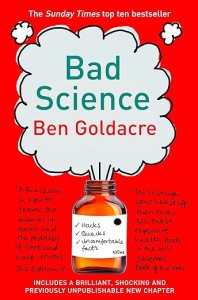
B is for Bad Science by Ben Goldacre – a splendid rant against the lack of education and knowledge about health with the inevitable result that we are unable to understand and judge for ourselves the effectiveness of the various treatments on offer. He describes how placebos work, just what homeopathy is, the misunderstandings about food and nutrition, and above all how to decide what works and what is quackery, scaremongering or downright dangerous. I found this easy to understand, apart from the statistics, which cause my eyes to glaze over at the mere sight of a graph, tables or columns of figures. Fortunately there’s not a lot of that in this book.
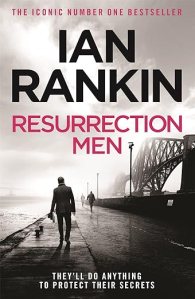
R is for Resurrection Men by Ian Rankin, an Inspector Rebus book. Resurrection Men isn’t about body-snatchers (as I wondered it might be), but about the cops who need re-training, including Rebus. They’re at Tullialian, the Scottish Police College and they are a tough bunch indeed, ‘the lowest of the low‘ as one of them, DI Gray tells a witness he is interrogating. To help them become team players – fat chance of that I thought – they’ve been given on old, unsolved case to work on. But Rebus was involved in the case at the time and begins to get paranoid about why is on the course. It’s a tough, gritty story and as with other Rebus books, there’s more than one investigation on the go, several, in fact, needing concentration to keep tabs on each one. I thought it was excellent.
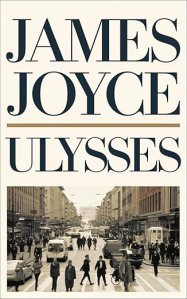
U is for Ulysses by James Joyce – I have started this book and given up several times. I’d love to say I’ve finished it, but I haven’t. It deals with the events of one day in Dublin, 16th June 1904, now known as “Bloomsday”. The principal characters are Stephen Dedalus, Leopold Bloom and his wife Molly. Loosely modelled on the wanderings of Homer’s Ulysses as he travelled homewards to Ithaca, Joyce’s novel follows the interwoven paths of Stephen, estranged from his father and Leopold, grieving for his dead infant son. Written over a seven-year period, from 1914 to 1921, Ulysses has survived bowderlization, legal action and bitter controversy.
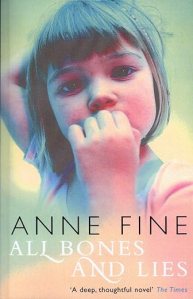
A is for All Bones and Lies by Anne Fine. I had high hopes I would like this book and that it would be a funny book – Anne Fine has won Awards for her children’s books and the film, Mrs Doubtfire, starring Robin Williams, is based on her book Madame Doubtfire. Although I didn’t enjoy the story, I did find it an indictment of how old age is looked upon by some people – an angry, unsettling and cruel look at our society.
Colin, works for the council and visits his aged mother, Norah. Norah is a grumbler, completely self-absorbed and constantly belittling Colin who can never please her. At times I found it confusing, just what was real and what was in his imagination and how the book hung together. Of course, everything goes wrong as events spiral out of Colin’s control.

R is for The Return of the Native by Thomas Hardy, one of my favourite authors and I thoroughly enjoyed this book. It’s a dramatic and tragic love story. It has a large cast of characters, with lovers who change their affections throughout the novel and it’s full of intrigue with striking moonlit scenes, disputes, heated quarrels and misunderstandings, along with rustic characters and traditional celebrations, for example Guy Fawkes night, May Day and a Mummers’ play at Christmas. It’s not a book to read quickly and it transported me back to a time that ceased to exist before I was born, where time moved more slowly, ruled by the seasons and the weather, and with a clearly defined social hierarchy. And yet, I was surprised to find that youngsters were scribbling graffiti on ‘every gatepost and barn’s doors’, writing ‘some bad word or other’ so that a woman can hardly pass for shame some time.’

Y is for You Talkin’ To Me?: Rhetoric from Aristotle to Obama by Sam Leith a TBR. Sam Leith traces the art of argument from ancient Greece down to its many modern mutations. He introduces verbal villains from Hitler to Donald Trump – and the three musketeers: ethos, pathos and logos. He explains how rhetoric works in speeches from Cicero to Richard Nixon, and pays tribute to the rhetorical brilliance of AC/DC’s “Back In Black”. Before you know it, you’ll be confident in chiasmus and proud of your panegyrics – because rhetoric is useful, relevant and absolutely nothing to be afraid of.
The next link up will be on March 1, 2025 when the theme be Science Fiction


Well done, Margaret! I really like the choices you’ve made, and you remind me that I want to read Elizabeth is Missing, and I should read more James Joyce. And of course, in my opinion, you can’t go very far wrong with Ian Rankin…
LikeLiked by 1 person
Thanks, Margot. Doing posts like this often makes me remember books I wanted to read years ago – and never actually got round to reading them. There are just so many books …
LikeLike
You have an interesting mix of books here!
LikeLike