Every Friday Book Beginnings on Friday is hosted by Gillion at Rose City Readerwhere you can share the first sentence (or so) of the book you are reading. You can also share from a book you want to highlight just because it caught your fancy.
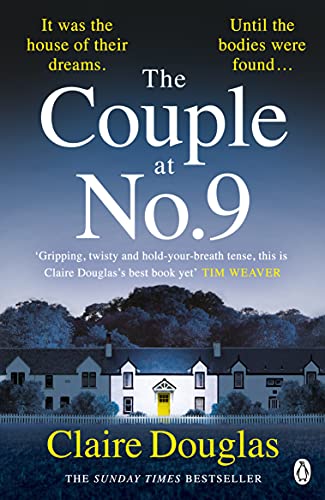
This week I’m featuring The Couple at No. 9 by Claire Douglas. I’ve read three of Claire Douglas’s books before and loved each one, so I have high hopes for this one. They are dramatic, tense, and full of atmosphere and suspense.
The Book Begins:
I’m in the front garden pulling at weeds that spill out from the borders of the driveway, like gigantic spiders, when I hear yells. Deep and gutteral.
Also every Friday there is The Friday 56, hosted by Freda at Freda’s Voice. *Grab a book, any book. *Turn to Page 56 or 56% on your ereader . If you have to improvise, that is okay. *Find a snippet, short and sweet, but no spoilers!
These are the rules:
Grab a book, any book.
Turn to page 56, or 56% on your eReader. If you have to improvise, that is okay.
Find any sentence (or a few, just don’t spoil it) that grabs you.
Post it.
Add the URL to your post in the link on Freda’s most recent Friday 56 post.
Page 56:
Lorna had envisaged the day she’d become a grandmother. She knew she wouldn’t be old, because she’d been such a young mother. But she’d expected to be older than forty-sodding-one. What will Alberto think?
Summary::
When Saffron Cutler and boyfriend Tom move into 9 Skelton Place, they didn’t expect to find this.
Two bodies, buried under the patio over thirty years ago.
When the police launch a murder investigation, they ask to speak to the cottage’s former owner – Saffy’s grandmother, Rose, whose Alzheimer’s clouds her memory.
But it is clear she remembers something . . .
What happened thirty years ago? What part did her grandmother play? And is Saffy now in danger? . . .
~~~
What do you think – does this book appeal to you too?
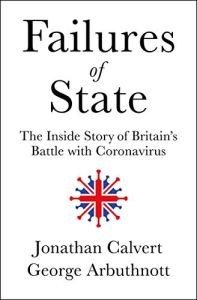
The inside story of the UK’s response to the pandemic from the Insight investigations unit at The Sunday Times
Mudlark, Harper Collins| 18 March 2021| 422 pages| My own copy| 4*
I don’t read a lot of nonfiction, but this year I have been reading more than usual. This book caught my eye in August and although I’ve watched countless TV programmes and interviews and read numerous articles about the coronavirus pandemic I just had to read it.
Meticulously researched and corroborated by hundreds of inside sources, politicians, emergency planners, scientists, doctors, paramedics and bereaved families, along with leaked data and documents, this is the insider’s account of how the government sleepwalked into disaster and tried to cover up its role in the tragedy – and it exposes one of the most scandalous failures of political leadership in British history.
In the eye of the storm was Boris Johnson, a Prime Minister who idolised Winston Churchill and had the chance to become a hero of his own making as the crisis engulfed the nation. Instead he was fixated on Brexit, his own political destiny and a myriad of personal issues, all while presiding over the UK government’s botched response to the global coronavirus pandemic. After missing key Cobra meetings, embracing and abandoning herd immunity and dithering over lockdown, Johnson left the NHS facing an unmanageable deluge of patients. His inaction resulted in the deaths of many thousands of British people and his own hospitalisation at the hands of the pandemic, yet further reckless decisions allowed a deadly second wave to sweep across the country in the autumn months with the economy on the brink of collapse.
With access to key figures at the top of government during the most tumultuous year of modern British history, Failures of State is an exhaustive and thrillingly told story – and one of the most essential pieces of investigative reporting for a generation.
My thoughts:
The book covers the period from 24 January 2020 – 23 January 2021, with a Prologue covering the period from 24 April 2012 – 23 January 2020. Since it was written time has moved on and further information has become available, but this book is a reminder of how it started and described what subsequently happened. So, much of it was what I already knew, especially about the steps that were taken in the UK to cope with the situation.
In considering the two phrases ‘we were following the science’ and ‘we have taken the right steps at the right time’ they ask was this in fact what happened? They used many sources as described in the blurb and their research gave them the answer ‘no’.
In particular, they question why the government failed to act more swiftly, what the scientists told ministers, whether Britain was equipped to fight a pandemic and what were the consequences. I’m a cautious person and I remember being anxious that not enough was being done at the time and thought that we should have locked down earlier than we did. Reading this book makes me think that I wasn’t being over-cautious. I am also a bit cynical about what I read in the papers and what I hear and see being reported, so I viewed this book with caution too. Many of the sources are named in the book, but many are not.
I am appalled at what this book reveals. I am appalled by the corruption, outright lies, obfuscations, misinformation and incompetence they report – worse than I had thought at the time.
But most of all I am utterly appalled by what is revealed about the NHS and the restrictions that were imposed on reporting what was taking place in hospitals. The NHS had limited capacity to deal with the pandemic and the public were not made aware of the selection process that was used in deciding who could be given intensive care. If it had been reported there would have been widespread panic, terror and outrage. It is appalling that so many people were not given intensive care, and that so many had died who could otherwise have survived.
It is a shocking account of a terrible year – words fail me.
Faber and Faber| 4 May 2021| 208 pages| My own copy| 4*
Second Place by Rachel Cusk was longlisted for the Booker Prize 2021.
Synopsis – A woman invites a famed artist to visit the remote coastal region where she lives, in the belief that his vision will penetrate the mystery of her life and landscape. Over the course of one hot summer, his provocative presence provides the frame for a study of female fate and male privilege, of the geometries of human relationships, and of the struggle to live morally between our internal and external worlds. With its examination of the possibility that art can both save and destroy us, Second Place is deeply affirming of the human soul, while grappling with its darkest demons.
My thoughts: I enjoyed Second Place, but not as much as I had hoped. The narrator is a writer, a woman known only as ‘M’. The book is a series of letters she writes to Jeffers, a friend and also a writer, in which M pours out her thoughts and perceptions in a stream of consciousness .The location, near a coast, is extremely well defined and I had a clear picture of where ‘M’ lived and its setting, although there is no indication of where it is in the world. But the time period is not specified and you only know that some event has taken place that has disrupted the economy and that travel is difficult – maybe climate change, or a pandemic, although these events are not mentioned.
The ‘second place’ of the title is a cottage that M and her husband, Tony, have renovated and furnished, where their visitors stay. It’s also the relationship that develops between her and ‘L’, a well-known artist, she invites to stay at the cottage. He upsets her when he arrives, unexpectedly bringing with him Brett, a beautiful young woman. And then he continues to disrupt her life. In addition, M’s daughter Justine is also visiting, along with her Kurt, her German partner, expecting to stay in the cottage. She is most upset at having to give it up for L and Brett. It all makes for a bit of a nightmare situation.
I found it a puzzling book. It raises several unanswered questions and it is not a novel you read for its plot, as that is secondary to the fluctuating relationships and interactions, between the characters. Having read D. H. Lawrence: the Life of an Outsider by John Worthen, I’d had an inkling that L was based on D H Lawrence and indeed in her Acknowledgement at the end of the book Cusk refers to Mabel Dodge Luhan’s 1932 memoir of the time D H Lawrence stayed with her in Taos, New Mexico. She acknowledges that her version of that event is intended as a tribute to her spirit. I think I’d have a clearer picture of it if I reread it, because knowing what comes later, the earlier scenes would be more meaningful.
It’s time again for Six Degrees of Separation, a monthly link-up hosted by Kate atBooks Are My Favourite and Best. Each month a book is chosen as a starting point and linked to six other books to form a chain. A book doesn’t need to be connected to all the other books on the list, only to the one next to it in the chain.
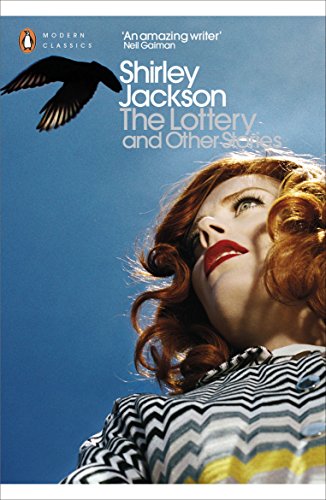
The chain this month begins with a (frightening) short story, The Lottery by Shirley Jackson.
The Lottery is a short story written by Shirley Jackson, first published in the June 25, 1948, issue of The New Yorker, (the link takes you to the story.) The lottery is an annual rite, in which a member of a small farming village is selected by chance. This is a creepy story of casual cruelty, which I first read several years ago. The shocking consequence of being selected in the lottery is revealed only at the end.
Once again I found it difficult starting my chain, and after several attempts I finally settled on an obvious choice of another one of Shirley Jackson’s stories for the first link.
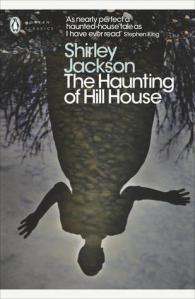
First link: The Haunting of Hill House. Dr. Montague, a doctor of philosophy with a keen interest in the supernatural and psychic manifestations had been looking for a ‘haunted’ house to investigate all his life. So, when he heard the stories about the strange goings on at Hill House he decided he would spend three months living there and see what happened, and he set about finding other people to stay there with him. The house is connected with a number of tragedies – scandal, madness and a suicide. But nothing is what it first appears to be and I felt as if I was sinking into the story in a most unpleasant way.
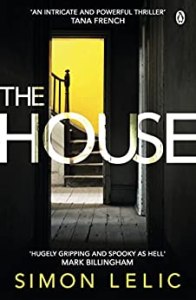
The Second link: is to another house, in The House by Simon Lelic. It is set in a creepy house, full of junk, with an overgrown garden and with hints of the supernatural. Jack and Syd move in and then Jack found something nasty in the attic. There’s been a murder and this is a story about despair, domestic violence, dark secrets and the effects of the past on the present.
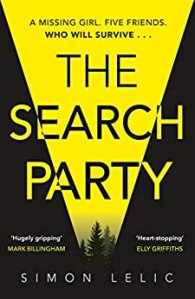
The third link: Simon Lelic also wrote The Search Party in which 16-year-old Sadie Saunders goes missing and five of her friends set out into the woods to find her. At the same time the police’s investigation, led by Detective Robin Fleet and Detective Sergeant Nicola Collins, is underway. When the friends get lost in the woods they make an incoherent phone call to the emergency services. The caller doesn’t know their location other than it is ‘somewhere in the woods‘ near an abandoned building.
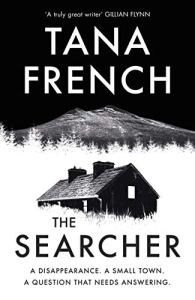
The fourth link: Cal Hooper is also searching for a teenager in The Searcher by Tana French. Cal and thirteen-year old Trey Reddy live in Ardnakelty, a remote Irish village. Cal has recently moved to the village, wanting to build a new life after his divorce. He is a loner and wants a quiet life in which nothing much happens. But he finds himself getting involved in the search for Brendan, Trey’s older brother who had gone missing from home.
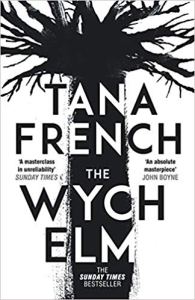
Thefifth link: The Wych Elm also by Tana French Toby Hennessy, the narrator, is twenty eight. He is brutally attacked by burglars in his flat, leaving him in a terrible state, physically and psychologically damaged. He seeks refuge at the family’s ancestral home, the Ivy House. But not long after his arrival, a skull is discovered, tucked neatly inside the old wych elm in the garden. As detectives begin to close in, Toby is forced to examine everything he thought he knew about his family, his past, and himself. This is a psychological thriller, a standalone book, about a family in crisis, as dark family secrets gradually came to light.
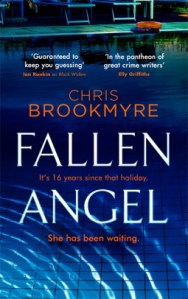
The sixth link: The Temple family in Chris Bookmyre’s Fallen Angel is another family in crisis. The family is spending the summer at its seaside villa in Portugal for a reunion after the death of the head of the family, Max Temple, who was a psychologist. The last time they were all there together was in 2002 when one of the children had disappeared from the villa, and was presumed drowned. None of the family members are very likeable and there’s plenty of tension as they don’t get on well with each other! It’s a novel about a family in crisis, about toxic relationships and about the psychology of conspiracy theories.
From a short and scary story my chain links two novels about scary houses, or rather the occupants of scary houses, two books about searches, and two about families in crisis.
I’ve read some of Dorothy L Sayers’s Lord Peter Wimsey Mystery series and enjoyed them immensely. But up until now have not read the first book in the series, Whose Body?, first published in 1923. It’s an amusing Golden Age mystery that kept me entertained throughout. Lord Peter is a wealthy amateur detective, a friend of Inspector Charles Parker, a Scotland Yard detective. He called ‘Lord’ as he is the younger son of a duke.
When the naked body of a man, wearing only a pair of pince-nez is found in Mr Alfred Thipp’s Battersea bathroom, Lord Peter is asked by his mother, the Dowager Duchess of Denver, to help solve the mystery of whose body had found its way into the bath. The police investigation is being led by Inspector Sugg, who doesn’t welcome what he calls Lord Peter’s ‘interference’ in the case. He thinks the dead body might be that of Sir Reuben Levy, a wealthy London financier who had vanished from his bedroom, leaving no trace. Meanwhile Charles is investigating Sir Reuben’s disappearance himself. Although the body in the bath at first appears to be Sir Reuben it soon becomes clear that it is not and that the two cases are not connected. But are they?
As I began reading I was a bit put off by the dialogue between Lord Peter and his valet Bunter, who used to be his batman in the army. The dialogue is supposed to be witty banter between the two of them but to my mind it was irritating and superficial, definitely dated, and reminded me a just a tiny bit of the Jeeves and Wooster stories. But that was just at the start – it’s not at all like Jeeves and Wooster! I enjoyed watching the mystery unfold, which put Lord Peter’s life into grave danger. There are many complications and twists and turns that did stretch my credulity. It has a serious side too as events trigger traumatic memories for Lord Peter of his time in the trenches of the First World War
My rating: 4*
There are 15 books in the series (linked to my reviews when I’ve read the book):
1. Whose Body? (1923) 2. Clouds of Witness (1926) 3. Unnatural Death (1927) 4. Lord Peter Views the Body (1928) 5. The Unpleasantness at the Bellona Club (1928) 6. Strong Poison (1930) 7. Five Red Herrings (1931) 8. Have His Carcase (1932) 9. Hangman’s Holiday (1933) 10. Murder Must Advertise (1933) 11. The Nine Tailors (1934) 12. Gaudy Night (1935) 13. Busman’s Honeymoon (1937) 14. In the Teeth of the Evidence (1939) 15. Striding Folly (1972)


 BooksPlease