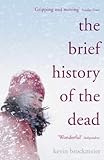
The Brief History of the Dead by Kevin Brockmeier

The Brief History of the Dead by Kevin Brockmeier, has been sitting on my bookshelves for 7 years (and moved house with me). It’s one of those books that I kept taking down off the shelf, flicking through it and putting it back.

As we’re in the middle of the R.I.P. IX Challenge it seemed this could be a good book to read as it’s fantasy fiction set some time in the future, about a place between heaven and earth, and the people who end up there after they’ve died and what happens to them. Amazingly they eat, sleep, fall in love and go to work in a city that looks like any on Earth with trees, houses, roads, businesses, shops, cafés and so on. It seems they are kept there as long as there is someone alive who remembers them. Parallel with this is the story of Laura, trapped in the Antarctic.  She is one of an expedition exploring methods of converting polar ice to use in manufacturing soft drinks. When their communication system fails two of the team go for help leaving Laura on her own. Eventually she too ventures out across the snow towards the Ross Sea, where there is a station studying emperor penguins.

I’m glad I read this book even if it didn’t quite live up to my expectations. The idea is good, and the two stories are dealt with in alternate chapters. It’s soon obvious that there has been some sort of worldwide disaster or epidemic and at first I was caught up with both stories, but the link between them is so obvious that the element of surprise or suspense just frittered away very quickly.

There is plenty of description; rather too much though and I got tired of reading about Laura’s struggle to cross the Antarctic, and the numerous descriptions of her battles to get in and out of her frozen sleeping bag, and hauling the sledge across the snow. There are plenty of flashbacks and digressions that promised to be interesting but were left undeveloped. It’s as though Brockmeier compiled the book from a series of short stories and scenic descriptions. By the end I really didn’t care what happened to any of the characters as they all waited for whatever came next. It’s a shame because I thought the idea had so much promise – what does happen when we die?

Reading Challenges

September's Books & Pick of the Month

September was a good month – we had a holiday in the Lake District, the sun shone and it’s been a dry September, according to the Met Office it was the driest September since records began in 1911!

And I read a fair number of books (the links are to my posts on the books), which brings my total for the year so far to 83. Four of the books are TBRs (to-be-reads) and six are crime fiction (marked with *):

  1. The Sunrise by Victoria Hislop – my review will be on the next issue of Shiny New Books (I think!) Set 40+ years ago in Cyprus, I liked this very much – a story of human tragedy in the face of war.
  2. The Goldfinch by Donna Tartt – review to follow.
  3. Wycliffe and the House of Fear* by W J Burley – Wycliffe investigates the disappearance of Roger Kemp’s second wife.  A complex story with sinister undercurrents.
  4. Testament of a Witchby Douglas Watt –MacKenzie investigates the death of Grissell Hay, Lady Lammersheugh accused of witchcraft in a village overwhelmed by superstition, resentment and puritanical religion.
  5. The Moving Finger* by Agatha Christie – anonymous poison-pen letters, an apparent suicide and a murder in a peaceful country backwater in this Miss Marple mystery.
  6. The Yellow Wallpaper by Charlotte Perkins Gilmore – a suspense story of a young woman slowly but surely losing her mind – or is it a case of a woman suffering from post-natal depression. 
  7. Entry Island* by Peter May- set in present day Magdalen Islands, part of the province of Quebec, in the Gulf of St Lawrence, and in the nineteenth century on the Isle of Lewis at the time of the Highland Clearances.  It mixes together two stories and two genres, crime fiction and historical fiction.
  8. The Brimstone Weddingby Barbara Vine €“ one of the best of Barbara Vine’s books that I’ve read. Stella gradually confides in Jenny, telling her things she has never said to her son and daughter €“ things about her life she doesn’t want them to know. Barbara Vine, writes beautifully and powerfully yet in a controlled manner, and the subtle horror of what I was reading gripped me. 
  9. The Shroud Maker* by Kate Ellis €“ a complex, historical mystery intertwined with a modern day murder mystery for D I Wesley Peterson to solve with plenty of characters, red-herrings, twists and turns, and sub-plots.

Pick of the monthI enjoyed all of them. It was a good month for reading crime fiction and my Book of the Month is also my Crime Fiction Pick of the Month. It’s …

Brimstone wedding

The Brimstone Wedding by Barbara Vine.

For more Crime Fiction Pick of the Month books see Kerrie’s Crime Fiction Pick of the Month over at Mysteries in Paradise.

Mount TBR: Checkpoint #3

It’s time for the third quarterly checkpoint in the Mount TBR Reading Challenge 2014
Bev asks 2 questions:
 
1. Tell us how many miles you’ve made it up your mountain (# of books read).  

I have read 40 books. The full list is on my TBR Challenge page. In terms of how many mountains I’ve scaled this means that I have just 8 books left to read to reach my target of Mt Ararat (48 books) by the end of the year. Looking at the photo from Wikipedia I think I’m probably at the top of the Lesser Ararat. I should reach Greater Ararat by the end of the year if not earlier. 

2. Pair up two of your reads using whatever connection you want to make. Written by the same author? Same genre? Same color cover? Both have a main character named Clarissa? Tell us the books and what makes them a pair.

It was obvious when I looked at my list which two books make a pair:

Shakespeare’s Restless World by Neil MacGregor and Shakespeare: a Biography by Peter Ackroyd. Both books are non-fiction and obviously about Shakespeare and they complement each other very well.

Shakespeare’s Restless World is a beautiful book recreating Shakespeare’s world through examining twenty objects. It reveals so much about the people who lived then, who went to see Shakespeare’s plays in the 1590s and 1600s, and about their ideas and living conditions.

And Shakespeare: a Biography is structured mainly around the plays.  But above all, Ackroyd Shakespeareit places Shakespeare within his own time and place, whether it is Stratford or London or travelling around the countryside with the touring companies of players. Shakespeare spans the reigns of two monarchs, which saw great changes and Ackroyd conjures up vividly the social, religious and cultural scene. It’s a very readable book, full of detail.