Wondrous Words

wondrous2Wondrous Words Wednesday is a weekly meme hosted by Kathy at Bermuda Onion where you can share new words that you’ve encountered or spotlight words you love.

I mentioned in my post on A Fearful Madness by Julius Falconer that there were some words I had to check in the dictionary. I’ve used the online Oxford English Dictionary (OED) to check the meaning of the following words

There are some words that I know I’ve looked up before and yet I just can’t remember what they mean and these are two of them:

Egregious: ‘After my consultation with the egregious Croft, I decided that action was what was needed.’ (page 70)

Egregious means:   ‘Remarkable in a bad sense; gross, flagrant, outrageous.’ The OED gives four definitions and I think this one fits the context the best. No wonder I can’t remember the meaning with four to chose from!

Exigent: ‘The woman was rough-tongued and exigent beyond belief: do this, do that, hurry up, I’m paying you enough, heaven knows, and so on.’ (page 177)

Exigent means: ‘Requiring a great deal; demanding more than is reasonable; exacting, pressing.’ I did know that after all!

Then there are these words:

Inchoate: ‘He murmured an inchoate prayer for guidance before rising and wandering at random round the church.’ (page 45)

Inchoate  – the OED gives two meanings: ‘Just begun, incipient; in an initial or early stage; hence elementary, imperfect, undeveloped, immature.’ and ‘Chaotic, disordered, confused; also, incoherent, rambling.’ I think the second meaning fits the context better.

Logorrhoeic: ‘Tea will do fine, thank you’. Ravensdale, unsure how best to break into the logorrhoeic flow without causing offence but impatient to hear whether she had any useful information for him or not, let her continue for a bit before broaching the subject of his visit. (page 115)

I thought this must have some connection with words and translated it in my head as ‘verbal diarrhoea’.

 Logorrhoea means ‘excessive volubility accompanying some forms of mental illness; also gen., an excessive flow of words, prolixity.’ I think logorrhoea sounds much better than ‘verbal diarrhoea’.

The Third Pig Detective Agency by Bob Burke

Reading The Third Pig Detective Agency by Bob Burke was a complete change of genre for me. It’s funny, a bit silly, a pastiche of American gumshoe crime fiction, and a fantasy  – indeed it’s a fairytale detective story. I did enjoy recognising all the fairy tale characters Bob Burke throws into the mix.

The Third Pig is Harry Pigg, who in his own words:

was the pig that built the house out of bricks while my idiot brothers took the easy route and went for cowboy builders and cheap materials.

Following his success at defeating the Big Bad Wolf, Harry became a detective, finding the two missing kids Hansel and Gretel and then identifying them as the murderers of the little old lady who lived in the gingerbread house.

But work for Harry had almost dried up, so when ‘an oriental gentleman the size and shape of a zeppelin‘, or in other words, Aladdin, the richest man in Grimmtown, accompanied by a sturdy white goat, none other than the eldest of the Gruff Brothers, demands his services, Harry can’t turn him down. Aladdin’s lamp had been stolen, an old battered lamp that he had kept under close guard, protected by hi-tech security and surveillance systems and Harry has to get it back for him. And so Harry sets out in pursuit of the lamp, aided or hindered by numerous characters, finding himself in all sorts of tricky and dangerous situations.

It’s a case of spot the characters from fairy tales and nursery rhymes and it’s most entertaining. Boy Blue, that lazy former shepherd tells Harry the lamp is rumoured to be a magic lamp, but Harry hates magic:

As a working detective it’s bad enough running the risk of being beaten up or thrown into a river with concrete boots on, without having to live with the possibility of being changed into a dung beetle or having a plague of boils inflicted on you. If you think humans were disgusting covered in boils, imagine how I might look.

And Harry just couldn’t have survived without the help of his Apprentice Gumshoe, Jack Horner, who rescues him several times.

There is no doubt that I’ll be reading more of Bob Burke’s books. the next one is The Ho Ho Ho Mystery which starts where The Third Pig Detective Agency ended when a very large lady dressed in black boots, bright red trousers and a hooded jacket came to see Harry and announced:

I need you to find my husband. He’s been kidnapped and it’s only two days to 25th December. If he’s not found soon we may have to cancel Christmas.

Carl’s Once Upon a Time VII challenge is coming to an end soon (21 June) and this is the fourth book I’ve finished. I may make five (my target for the challenge).

A Fearful Madness

I received A Fearful Madness by Julius Falconer as a free review copy through LibraryThing. I hadn’t come across any of Falconer’s books before but the LibraryThing Early Reviewers’ description interested me enough to request a copy:

A police investigation into the violent death of a part-time cathedral verger stalls for lack of incriminating evidence. However, three people have a close interest in clearing the matter up where the police have failed: the dead man’s sister, anxious to see justice done, and two of the police suspects, both released without charge but keen to clear their names.

Striking out on their own, each approaches the murder from a different perspective: book-trafficking on the black market; revenge by an extremist religious organisation for the dead man’s betrayal of them; and retaliation in a case of blackmail. The police continue to maintain that the murder was committed out of sexual anger, even though they have no proof apart from the circumstances of the verger’s death.

Eventually DI Moat and his assistant DS Stockwell, from the North Yorkshire Force, take a hand. Moat pays his predecessors in the investigation, both professional and amateur, the compliment of taking their findings seriously – but comes up with an idea of his own.

My view:

Julius Falconer uses language in a more formal way than many other modern authors. His sentences are carefully punctuated, his vocabulary is extensive (meaning there are some words I had to check in the dictionary – and one or two weren’t in my dictionary) and he uses many literary references and illusions. I like his style of writing, although in parts it does tend to be long-winded.

It’s a complex book, following each of the three investigations – some of which seem highly unlikely, but then they do say that truth is stranger than fiction.Two people had been suspected of murdering James Thwaites, the verger, but the police were unable to produce any evidence and the cases against them were dropped. It appeared he had been stealing rare and valuable books from the cathedral and selling them on the black market. I was intrigued by the book-trafficking business which on the one hand was highly organised involving the use of white van drivers, and on the other seemed remarkably lax!

A bearded man was seen outside Thwaites’s house on the evening of the murder and Matthias Biddulph, one of the original suspects, who had been in a relationship with Thwaites hires a private investigator to find him. Another possible motive for the murder is Thwaites’s involvement with an eccentric version of Christianity – the Anti-Church of Jesus Christ, set up in opposition to the Anglican Church, which his sister Serenity investigates.

For the most part, I rather enjoyed reading A Fearful Madness, although I had little idea how it would end – the verger’s will is of significance, but that only features towards the end of the book (unless I missed an earlier reference). I think this is possibly the weakest part of the book when the culprit confesses to the murder. Having said that, I liked it well enough to read more of Falconer’s books and have downloaded Jagger onto my Kindle.

Julius Falconer has written several books. Formerly, a teacher, he began writing detective novels in 2009. His website, with the sub-tile of Erudite Crime Novels for the Connoisseur,  includes details of his books and an account of The Falconer Style.

the letter JThis is my contribution to Kerrie’s Crime Fiction Alphabet for the letter J. In previous years I’ve contributed to the meme for each letter of the alphabet, but for this series I’m joining in only occasionally.

Cards on the Table by Agatha Christie

I think Cards on the Table is one of the best of Agatha Christie’s books. It was first published in 1936 and has been reprinted many times since then. My copy is a Pan Books edition published in 1951 with this cover:
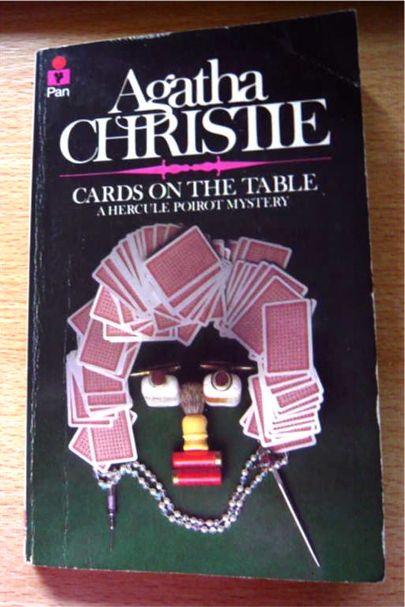
Cards on the Table

From the back cover:

Mr Shaitana is a collector. He collects snuff boxes, Egyptian antiquities … and … murderers.

His murderers are of the very finest. Not the second rate individuals who are caught and convicted. Delighting in his role as a modern Mephistopheles, Shaitana gathers his four murderers for an evening of cards.

Before the evening ends, Mr Shaitana will himself be a murder victim. How very fortunate that he invited a fifth guest to his gathering, M. Hercule Poirot.

One of the things that pleased me about this book is Agatha Christie’s Foreword in which she states that it is not the sort of detective story where the least likely person is the one to have committed the crime. This story has just four suspects and any one of them ‘given the right circumstances‘ might have committed the crime. She goes on to explain that there are four distinct types, the motives are peculiar to each person and each would employ a different method. She concludes:

The deduction must, therefore, be entirely psychological, but it is none the less interesting for that, because when all is said and done it is the mind of the murderer that is of supreme interest.

All of which suits Poirot down to the ground as he considers the psychology of each of the four suspects, Dr Roberts, a very popular doctor who may have killed a patient or two, Mrs Lorimer, a first-class bridge player and a widow who husband died under suspicious circumstances, Major Despard, a daring character, an explorer who possibly killed a botanist whilst on an expedition up the Amazon, and Anne Meredith, a young woman, a timid and careful bridge player, who may have poisoned her employer.

Poirot is not on his own, also at the bridge party were Superintendent Battle, a stolid officer from Scotland Yard (he first appeared in The Secret of Chimneys), Colonel Race, a Secret Service agent (he first appeared in The Man in the Brown Suit), and Mrs Ariadne Oliver, writer of popular detective fiction, (meeting Poirot for the first time). It helps if you can play bridge to understand  how Poirot uncovered the murderer, but it’s not necessary – I managed with just a minimal memory of the card game, and it all hinges on the psychology of the characters anyway.

As Ariadne Oliver is used by Agatha Christie to convey some of her own opinions I wondered whether this description of her physical appearance was how she viewed herself:

… she was an agreeable woman of middle age, handsome in a rather untidy fashion with fine eyes, substantial shoulders and a large quantity of rebellious grey hair with which she was continually experimenting. One day her appearance would be highly intellectual – a brow with the hair scraped back from it and coiled in a large bun in the neck – on another Mrs Oliver would suddenly appear with Madonna loops, or large masses of slightly untidy curls. On this particular evening Mrs Oliver was trying out a fringe. (page 13)

I think there is no doubt that Ariadne’s views on writing and on the character of her detective are Agatha Christie’s own views. For ‘Finn’ in the extract quoted below read ‘Belgian’:

… I regret only one thing – making my detective a Finn. I don’t really know anything about Finns and I’m always getting letters from Finland pointing out something impossible that he’s said or done. (page 55)

And this must be from her own experience too:

I’m always getting tangled up in horticulture and things like that. People write to me and say I’ve got the wrong flowers all out together. As though it mattered – and, anyway, they are all out together in a London shop. (page 110)

And this about writing?:

One actually has to think, you know. And thinking is always a bore. And you have to plan things. And then one gets stuck every now and then, and you feel you’ll never get out of the mess – but you do! Writing’s not particularly enjoyable. It’s hard work, like everything else. …

Some days I can only keep going by repeating over and over to myself the amount of money I might get for my next serial rights. That spurs me on, you know. So does your bank-book when you see how much overdrawn you are. …

‘I can always think about things,’ said Mrs Oliver happily. ‘What is so tiring is writing them down. I always think I’ve finished, and then when I count up I find I’ve only written thirty thousand words instead of sixty thousand, and so then I have to throw in another murder and get the heroine kidnapped again. It’s all very boring.’ (pages 110 – 111)

But back to the mystery, Mr Shaitana is murdered whilst his guests are playing bridge. Two games were set up – one made up of the four people he considered were murderers and the other in a separate room made up of the four detectives or investigators of crime. Mr Shaitana sat by the fire in the room with the murderers. When the four detectives finished their game they return to the other room where they find the game still in progress and Mr Shaitana still sitting by the fire – stabbed in the chest with an ornamental dagger.

What follows is that each detective carries out their own investigations and as I read I swung from one suspect to the other, but I was never really sure who the culprit was. Poirot is his usual brilliant self even though at one point he is astonished and upset at the possibility that he might be wrong:

‘Always I am right. It is so invariable that it startles me. But now it looks as though I am wrong. And that upsets me. (page 163)

But was he wrong?

Saturday Snapshots

This Saturday I’m continuing to post photos from our recent holiday in Scotland.

This is Loch Morlich  is in the Glenmore Forest Park, 300 metres above sea level, between Aviemore and Cairngorm Mountain.

Loch Morlich P1080591

Loch Morlich P1080595

There is a level circular walk around the Loch, which has a Sailing Club. I took the two photos shown above on a wet and cloudy afternoon when there weren’t many people around. I hadn’t expected to find a beach so close to the mountains and about 30 miles from the sea!

Later in the week on a brighter day we went back to Loch Morlich, just a bit further round the shore. This part of the Loch is the home of Loch Morlich Watersports Centre and we arrived just as groups of young people were leaving, so we had the beach to ourselves: :

Loch Morlich P1010773 There is a Beach Cafe:

Loch Morlich watersports 01

Loch Morlich Boathouse Cafe

Loch Morlich is managed by Forestry Commission Scotland and is the first and only fresh water loch to ever have received the Rural Beach Award in Keep Scotland Beautiful’s (KSB) Seaside Award campaign.Loch Morlich watersports 02

Click on the photos to enlarge.

For more Saturday Snapshots see Melinda’s blog West Metro Mommy.

Sarah Thornhill by Kate Grenville

A few thoughts on Sarah Thornhill:

I wrote about the opening paragraphs of this book in a Book Beginnings post; paragraphs that made me want to read on with promise of a good story. And that is what I got – it’s basically a love story set in 19th century Australia, where the convicts, transported or ‘sent out‘ are  now called ‘old colonists‘.

There is prejudice – some people, those who had ‘come free‘,  thought being ‘sent out‘ meant you were tainted for all time, but for others having money and land overcame their distaste. And then there is the prejudice about the ‘blacks’. When Sarah, the daughter of William Thornhill, an ‘old colonist’ and now a landowner on the Hawkesbury River, falls in love with Jack Langland, whose mother was a native woman, racial prejudice and hatred rear their ugly heads.

I loved this book, which kept me captivated from start to finish, as the secrets of the Thornhill family are brought to light. I liked the narrative, told in Sarah’s voice, that of an uneducated young woman, struggling to understand what had happened and why. I found the dialogue convincing, and I could visualise the landscape and the hardships of life in that place and time. I was also totally involved with the characters, all of which made the book come alive for me.

I think it stands well alone, but it is the sequel to The Secret River and it does reveals a significant part of that book, so be aware of that if you haven’t read The Secret River.