Book Beginnings: Dracula by Bram Stoker

JONATHAN HARKER’S JOURNAL

(Kept in shorthand)

3 May. Bistritz. – Left Munich at 8.35 pm on 1st May, arriving at Vienna early next morning; should have arrived at 6.46, but the train was an hour late. Buda-Pesth seems a wonderful place, from the glimpse which I got of it from the train and the little I could walk through the streets. I feared to go very far from the station, as we had arrived late and would start as near the correct time as possible. The impression I got was that we were leaving the West and entering the East; the most Western part of splendid bridges over the Danube, which is here of noble width and depth, took us among the traditions of Turkish rule.

With such an ordinary straight forward paragraph Bram Stoker begins his Gothic novel of the tale of Count Dracula and the Un-Dead.

I have no interest whatsoever in the modern vampire books, but for a while now I have been thinking about reading Dracula and now in the middle of Carl’s RIP Challenge I decided the time had come.

The opening surprised me a little, so matter-of-fact and such attention to detail. So I knew from the start that this was going to be a meticulously detailed book and that the character of Jonathan Harker was going to be that of a reliable narrator. I also guessed that after such a factual start Jonathan’s Journal would reveal more startling and scary events – well, this is Dracula! And it’s not long before he is on his way to Castle Dracula, his journey accompanied by queer dreams and warnings to go no further. As he approaches the castle he ‘felt a sort of paralysis of fear.’

I’m reading a hard-back copy of Dracula. There are many editions available and the link above is to the Kindle original and unabridged version.

Book Beginnings on Friday is hosted by Katy at A Few More Pages.

A Summer Bird-Cage by Margaret Drabble: a Book Review

I wrote about the beginning of Margaret Drabble’s first novel A Summer Bird-Cage last Friday. I finished reading it only four days ago and already my memory of it is fading. I really should have made notes or at least marked pages with post-it notes, because there were so many passages I wanted to remember, but I read it too quickly to pause long enough for that.

The title comes from this quotation from John Webster’s play The White Devil:

‘Tis just like a summer bird-cage in a garden: the birds that are without despair to get in, and the birds within despair and are in a consumption for fear they shall never get out.

I think  this sums up my impression of the book as a whole – it’s about dissatisfaction and not knowing what you want, about family relationships (sisterly rivalry in particular), and the nature of marriage – the cages we live within. Drabble illustrates this through her depiction of two sisters, both on the brink of changes in their lives – the younger sister Sarah, recently down from Oxford University and completely at a loss what to do with her life, and Louise, the ‘beautiful’ one, marrying for money not for love, equally floundering and mixed-up about her life.  Sarah, the narrator, can’t understand why Louise has  married the unlikeable Stephen and it soon becomes apparent that Louise is having an affair with John Connell, an actor.

The two sisters do not get on. Sarah says:

I used to laugh at her with my school-friends, to borrow her clothes without asking, and to steal her books. Once I read her diary. She would have read mine, had I kept one. In the end she taught me the art of competition, and this is what I really hold against her: I think I had as little desire to outdo others in my nature as a person can have, until she insisted on demonstrating her superiority. She taught me to want to outdo her.  And when, occasionally, I did so, her anger hurt me, but as I had won it by labour from indifference, I treasured it. And when, finally, I took over one of her men at Oxford, the game was out in the open, I thought, for the rest of our lives. (page 103)

Their mother is also dissatisfied with her life, who is not at all happy when Sarah decides she wants to live in London, sharing a flat with her friend, Gill, not liking the idea of her not having a ‘proper job’.  She admits. however, that as it’s Sarah’s own life and grudgingly says that no one can accuse her of trying to keep her at home – which, of course, she is. Sarah describes her as

… poor brave twittering Mama, pretending everything has been so lovely, ignoring the facts because they were the only ones she knew. (page 21)

Whilst not a lot as regards plot happens in this short novel, it contains many ideas, attitudes and character studies. And it’s beautifully written, such as in this passage:

It was a wonderful blue cold day, with the last yellow leaves reprieved in the terrace of plane trees by the bus stop: almost one of those aqueous and lunar days when everything is charged with its own clarity. The colours of the houses and the brick were glowing and profound, and the small children playing in the streets looked as though they were on their way to an entrancing future. (page 81)

I think I’d like to re-read it one day.

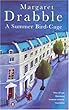
Note: the cover shown above is my own copy, a Penguin edition, reprinted in 1967, which I bought secondhand.

The House at Sea’s End by Elly Griffiths: a Book Review

The House at Sea’s End by Elly Griffiths is the third Ruth Galloway Investigation. I enjoyed the first two more than this last one. I found the use of the present tense in this book grated on me more than the other two and I thought the mystery element less than satisfactory – I solved it straight away! But having said all that it was still an enjoyable book, because of the characters.

It’s all about Ruth, her job as a forensic archaeologist, her baby and its father, and how she copes with juggling work and bringing up a child, or rather how she struggles with it all.

The bones of six people are found in a gap in the cliff, a sort of ravine, where there had been a rock fall at Broughton Sea’s End. Sea’s End House stands perilously close to the cliff edge above the beach.

High up on the furthest point of the cliff, is a grey stone house, faintly gothic in style, with battlements and a curved tower facing out to sea. A Union Jack is flying from the tower. (location 51)

These bones aren’t as ancient as those Ruth usually investigates and date back to about fifty or sixty years earlier. Chemical tests indicate they are of German origin and there are local stories about strange happenings concerning the Home Guard during the war. The captain of the Home Guard was Buster Hastings, the father of the current owner of Seas End House, Jack Hastings. Does he know more than he is admitting?  Added to this mystery there is also the death of Dieter Eckhart, an investigative journalist to solve. Who wanted him dead and why?

This brings DCI Harry Nelson into the picture and as in the earlier books Ruth is drawn into great danger as she delves further into both mysteries. Other characters from the earlier books are also here – Ruth’s friends, Shona and Cathbad, the part-time Druid. I found some of the back stories slowed the action down too much for my liking and I just wanted it to move along. I found this at odds with the present tense, which does rush my reading. I really, really do wish these books weren’t written in the present tense!

  • Format: Kindle Edition
  • File Size: 475 KB
  • Print Length: 352 pages
  • Publisher: Quercus (6 Jan 2011)
  • Sold by: Amazon Media EU S.à r.l.
  • Language English
  • ASIN: B004MME2H4
  • Source: I bought it

Looking forward to …

… P D James’s new book – Death Comes to Pemberley, which is due out on 3 November.

I don’t usually like sequels to books written by a different author, but I think I’ll have to make an exception for this one. It’s set six years after the events of Pride and Prejudice, Jane Austen’s tale of romance and social advancement and sees Darcy and Elizabeth’s marriage thrown into disarray when Lydia Wickham arrives unannounced and declares her husband has been murdered.

For more information see this BBC page after P D James’s talk on Radio 4 the other day, although she declined to give any further details saying, “It’s rather secret at the moment, because it’s something entirely new.”

Saturday Snapshot

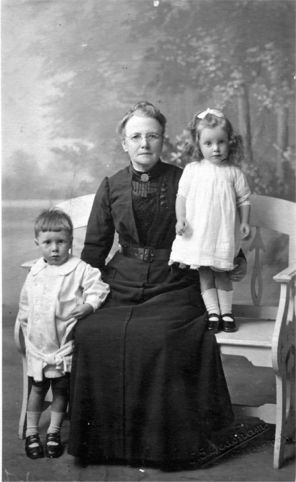
I’ve been looking at old family photos again:

This is my Great Grandmother, my mother and her older brother. I don’t know how old my mother was at the time, but this was probably taken in about 1917/18.

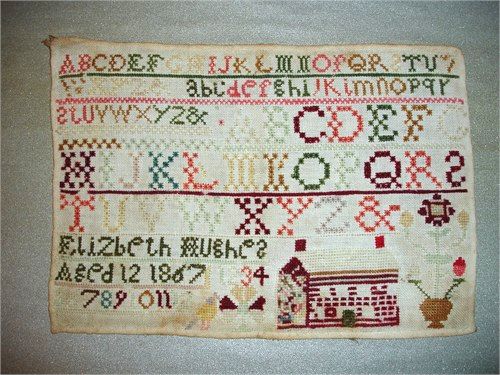
I know very little about my Great Grandmother – her name was Elizabeth, she was born in 1855 in Wales. When she was 12 she made this sampler:

Saturday Snapshot is hosted by Alyce of At Home with Books.

Book Beginnings: A Summer Bird-Cage by Margaret Drabble

Last Friday I quoted the opening sentences of Life Support by Tess Gerritsen, which was going to be the next book I read. I did read on for a couple of chapters but had to stop as I was just not in the mood for reading a medical thriller set in a hospital – too close to the bone! I fancied reading something less disturbing, so I took A Summer Bird-Cage by Margaret Drabble down from the bookcase and began to read that:

I had to come home for my sister’s wedding. Home is a house in Warwickshire, and where I was coming from was Paris. I was keen on Paris, but will refrain from launching into a description of the Seine. I would if I could, but I can’t. (page 7)

A Summer Bird-Cage was Margaret Drabble’s first novel. It was first published in 1963 and is set at the in the early 1960s, about the lives of two sisters – Sarah, the narrator who has just graduated from Oxford University and is wondering what to do with her life, and her beautiful sister Louise who at the start of the book is about to marry, Stephen, a rich novelist. From what I’ve read so far, neither of them seem happy and there is definitely tension between them.

Interesting I think, and I’m wondering if it maybe a bit autobiographical – Margaret Drabble is the younger sister of A S Byatt. Maybe this sentence was personal, comparing the two sisters, when Sarah says – ‘As far as tags go she is grande dame where I am jeune fille, and she leads all her life to match it.’ Or maybe I’m reading too much into that.

Book Beginnings on Friday is hosted by Katy at A Few MorePages.