Sunday Salon – Current Books

This week I’ve finished reading two crime fiction books:

and posts on these books will be on my blog this coming week.

I’m still reading Eden’s Outcast: the story of Louisa May Alcott and Her Father by John Matteson. So far I’ve been reading about Bronson Alcott and his unorthdox ideas about educating and bringing up children.  It was quite a coincidence I thought, when I was reading the Daily Express in the coffee shop recently and came across a review of Fruitlands: The Alcott Family and their Search for Utopia by Richard Francis. The reviewer describes this book as a

… richly textured history of the life and times of a back’‘to’‘nature community in 19th-century America. It was called Fruitlands, though Fruitcakes would have been more apt.
(Read more from this review.)

I haven’t got up to this venture so far in Eden’s Outcasts. There are many entries in the index under ‘Fruitlands’ so I expect to find out much more about it. His career as a teacher was not a success and it seems that his venture into communal farming wasn’t either.

I spent other reading time this week downloading more books onto my Kindle and have read the opening paragraphs of most of them. It really is so easy to get carried away and add more books to my to-be-read lists! But I only bought one book this week, so that’s not too bad.

It’s Reading Like a Writer by Francine Prose and it’s been on my wish list for a long time. I read fairly quickly and know that I often read too quickly to take in all the detail. Prose writes that reading quickly can be ‘a hindrance‘ and that it is ‘essential to slow down and read every word‘. She also contradicts the advice to novice writers ‘to show, not tell‘, when ‘the responsibility of showing should be assumed by the energetic and specific use of language‘. Using Alice Munro’s short story Dulse as an example, she says:

There are many occasions in literature in which telling is far more effective than showing. A lot of time would have been wasted had Alice Munro believed that she could not begin her story until she had shown us Lydia working as an editor, writing poetry, breaking up with her lover, dealing with her children, getting divorced, growing older, and taking all the steps that led up to the moment at which the story rightly begins.

Most interesting, I thought.

I still haven’t got used to Kindle’s use of locations as opposed to page numbers – the extract above is from Location 409 – 12. Nor have I mastered the technique of transferring my highlighted passages and notes from the Kindle to the computer!

I’m also reading The Matchmaker of Kenmare by Frank Delaney. This is an Advance Uncorrected Proof; the book is scheduled to be on sale on 8 February. It’s the first book I’ve read by Delaney, described by the publisher as a

… lush and surprising historical novel, rich as a myth, tense as a thriller …

From what I’ve read of it so far I’d go along with that description, except for the tenseness – but it’s early days yet. It’s set in 1943 in Ireland, a neutral country in the Second World War. It’s a long book and takes its time in setting the scene and introducing the characters. It promises well.

Booking Through Thursday – Firsts (on Friday)

Although it’s now Friday I wanted to answer this Booking Through Thursday question:

Do you remember the first book you bought for yourself? Or the first book you checked out of the library? What was it and why did you choose it?

Teddy Robinson

I can’t remember which was the first library book I borrowed – it cold have been Dear Teddy Robinson by Joan G Robinson. My mum took me to the library before I started school and I remember that whichever book it was I liked it so much I didn’t want to return it and was only consoled when mum said I could borrow another book.

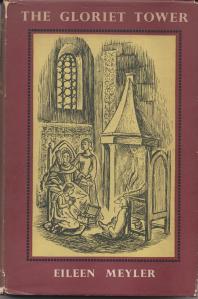
I think The Gloriet Tower by Eileen Meyler is the first book I bought for myself. I still have this hardback book. The description on the book jacket describes it as a

… tale for older children set in Corfe Castle a few years before the beginning of the Hundred Years War. The family there who found themselves drawn into a strange and cruel plot had no existence except in the Author’s imagination. Nevertheless a thin thread of fact runs through the story. The death of Edward II and the power wielded by his widowed Queen and her favourite Mortimer belong to history. The plot to ensnare the King’s brother and the merry-making and the dancing on the walls are true enough and true also is the story of the capture of the Earl of Kent.  … the castle and the wild heath, lapped by the waters of the harbour, are true until this day. They are there for all to see for themselves.

As far as I remember I chose this book because of its historical setting in a castle – I loved castles (still do), and I liked the cover picture. And so began my love of historical fiction. Looking at it today I think I’d like to read it once more.

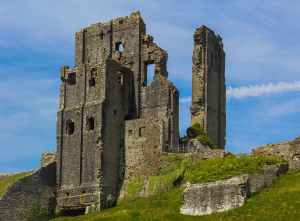
Many years later I visited Corfe Castle in Dorset, now owned by the National Trust. It was swarming with people and I wished I could have seen it in years gone by when it wasn’t a tourist attraction.

Farewell Lucy

Last night our little cat, Lucy died. She was nearly 17 and was diagnosed with hyperthyroidism two years ago. Since then she did improve and coped with us moving house at the end of 2009. For a while it seemed she had a new lease of life, enjoying the garden and its wildlife. Last week she stopped eating and just declined. The vet said she had a growth in her stomach and an enlarged heart.

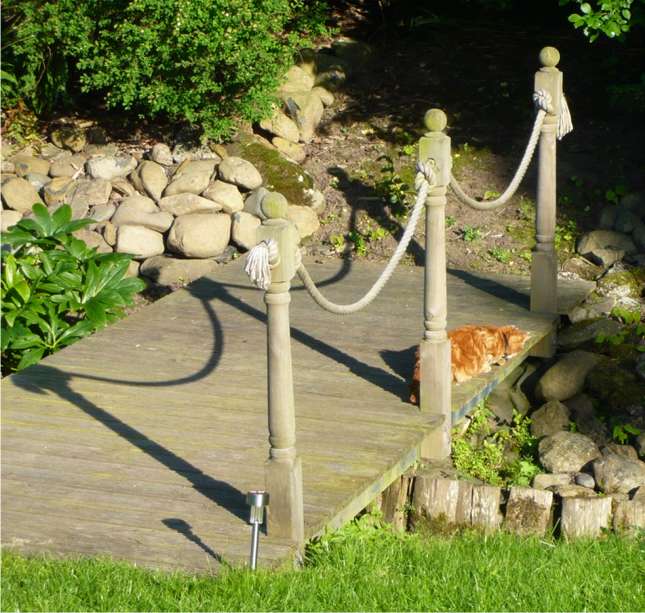
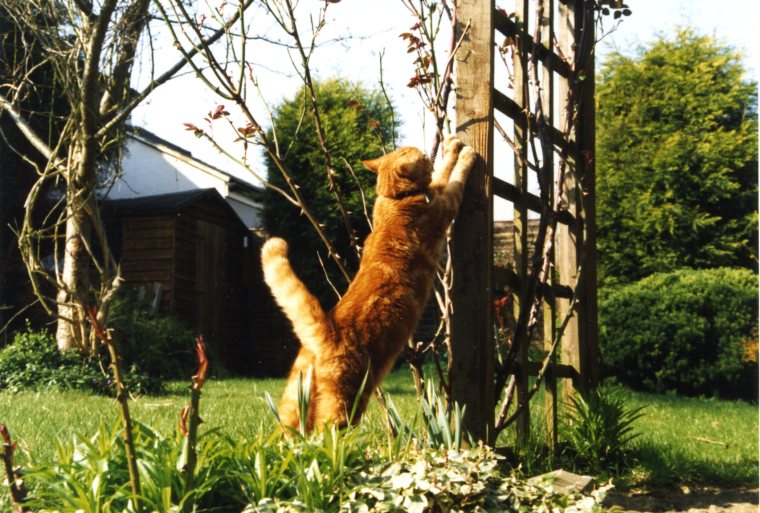
She was a wonderful companion, who stayed by our side like a dog, even wanting to come on walks with us. I’ve written many blog posts about her and have many photos that I’m going to bring together as a set on Flickr. Here are just a few of our favourites.

Now you see me

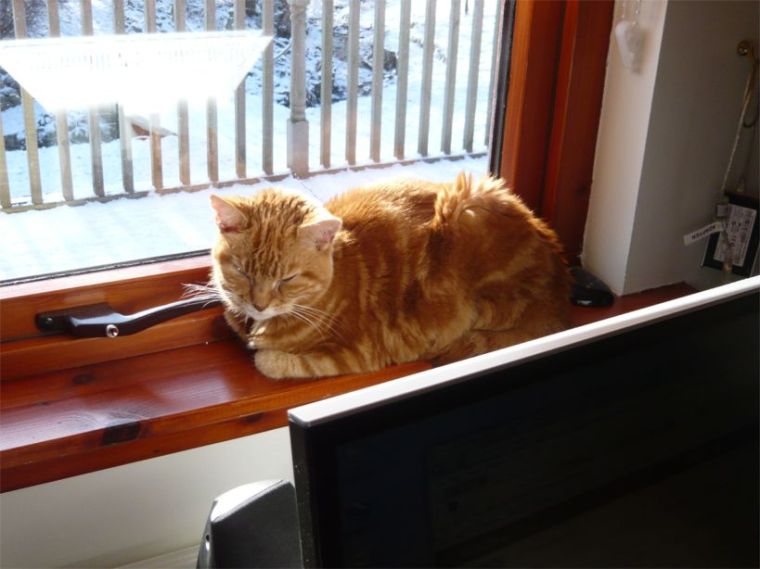
She often sat with me when I was blogging, sometimes on the windowsill and more often right in front of the keyboard whilst I was trying to type.

lucypainting

This is a painting of her by our friend John.

She is sadly missed!

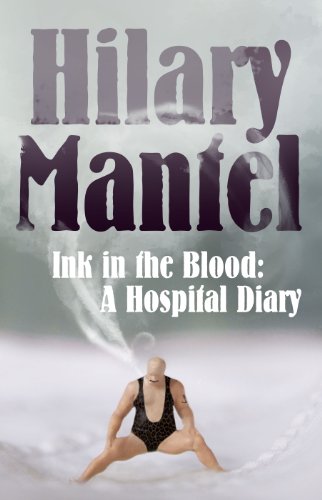
Ink in the Blood: A Hospital Diary by Hilary Mantel

This is a short memoir which I read quickly and easily on my Kindle – it’s only available on Kindle! Quite ironic that the first ebook (ie inkless) I read should be called ‘Ink in the Blood’! I was really pleased to find this because I loved Wolf Hall and had tickets for Hilary Mantel’s talk at the Borders Book Festival at Melrose in the summer.  She had to cancel that because she wasn’t well – I didn’t know just how ill she was. Ink in the Blood reveals all – how she had surgery to remove an intestinal obstruction that ended up in a marathon operation, followed by intense pain, nightmares and hallucinations.

Illness she found knocks down our defences, revealing things we should never see, needing moment by moment concentration on breathing, on not being sick and being dependent on others for your well-being. She read Virginia Woolf’s On Being Ill, which she thought was piffle, describing decorous illnesses such as fainting, fevers and headaches. She wonders what sort of wuss Woolf was, as she obeyed her doctors when they forbade her to write, whereas writing was Hilary Mantel’s lifeline – it was the ink, as she wrote in her diary, that reassured her she was alive.

It’s amazing how much she has managed to pack into this short memoir and one that repays more than one reading.

Product Description  from Amazon

During the summer after Hilary Mantel won the Man Booker Prize for Wolf Hall, she fell very ill. Just how ill is described in her extraordinary diary, Ink in the Blood. Originally published in the London Review of Books, it is one of the most incredible and haunting essays published in a very long time. In the diary she explores in forensic detail her loss of dignity, her determination, the concentration of the senses into an animalistic struggle to get through, and the attendant hallucinations she was plagued by.

  • Format: Kindle Edition
  • File Size: 134 KB
  • Publisher: Fourth Estate (15 Dec 2010)
  • Sold by: Amazon Media EU S.à r.l.
  • ASIN: B004GJXQ0C
  • Source: I bought it

Crime Fiction Alphabet – A is for …

… Agatha Christie

For the first of this year’s Crime Fiction Alphabet hosted by Kerrie I’ve chosen a double A – Agatha Christie – An Autobiography.

I finished reading it at the end of December. I can’t remember exactly when I began reading it. I think it was the end of May because in a Sunday Salon post then I wrote that I was thinking about starting it. I read short sections of it most days since I started it and felt quite sad when I came to the end. It was like having a daily chat with Agatha.


It took her fifteen years to write it. She stopped in 1965 when she was 75 because she thought that it was the ‘right moment to stop’. It seems right that a book that took her so long to write should take me a long time to read. As well as being a record of her life as she remembered it and wanted to relate it, it’s also full of  her thoughts on life and writing. I’ve written about her Autobiography in a few posts as I was reading it:

It struck me as I was reading her Autobiography that  it’s not very easy to work out the dates of many of the events she described. It follows on chronologically but is so interspersed with her thoughts and reflections that I forgot the date, or she hadn’t mentioned it. She wrote about her childhood, teenage years, friends and family, and her marriage to Archibald Christie; but although she wrote about their divorce she didn’t write about her disappearance in 1926. She wrote about her travels around the world, the two world wars, her interest and involvement with archaeology and her marriage to Max Mallowan.

Towards the end of the book she wrote that she had decided not to tidy up her Autobiography too much:

Nothing is more wearying than going over things you have written and trying to arrange them in proper sequence or turn them the other way around. I am perhaps talking to myself – a thing one is apt to do when one is a writer. (page 455)

What she remembered most were things that were most vivid and it was places that remained most clearly in her memory. She never had a good memory for people, apart from her own dear friends:

A sudden thrill of pleasure comes into my mind – a tree, a hill, a white house tucked away somewhere by a canal, the shape of a hill. Sometimes I have to think for a moment to remember where and when. Then the picture comes clearly, and I know. (page 416)

She wrote quite a lot about her writing methods, writing criticism, hearing your own voice, economy in wording, writing detective stories, adapting plays and writing them herself, the right length for a detective story (50,000 words), writing two novels at once, writing books set in historical periods and the joy of creation. The one book that satisfied her completely is not one of her detective books but one she wrote under the name of Mary Westmacott – Absent in Spring – and she wrote it in three days flat (pages 516 -7).

She ended the book with these words:

A child says ‘Thank God for my good dinner’.

What can I say at seventy-five? ‘Thank God for my good life, and for all the love that has been given to me.’ (page 551)