The Gardens of the Dead by William Brodrick: Book Review

The Gardens Of The Dead

The Gardens of the Dead by William Brodrick is his second novel. Although this book is a page turner I felt it was rather disjointed in parts. I had to backtrack a few times to make sure I was following the plot and the timeline is occasionally confusing. But on the whole I thought the book was pretty good.

Elizabeth Glendenning QC dies of a weak heart at the start of the book. Ten years earlier she had successfully defended a guilty man, Graham Riley. Just before her death she devised a scheme to bring Graham Riley back to court and to implement this scheme she had enlisted the help of Father Anselm, the barrister turned monk and her son Nick. She left a safety deposit box key with Father Anselm along with instructions that he should open it in the event of her death. Once he does this a sequence of events is triggered as Father Anselm and Nick follow the trail laid out by Elizabeth.

Part of me, the cynical part, wondered why she did this – it would have been much simpler to simply leave a written account rather than set what turns out to be a puzzle to be solved. But another part of me enjoyed seeing the mystery unfold. There are several surprising and some not so surprising elements to this story of good and evil, of revenge, family loyalties, justice and morality.

I liked the character of Anselm. He is kind and patient, well versed in analysing information and questioning people from his work at the Bar and also a good listener. My favourite character though is Father Andrew, the Prior, who was fond of a saying from a Desert Father:

Don’t use wise words falsely.

So he didn’t talk much and was always cautious when he spoke, but throughout the book he has several conversations with Anselm which are always perceptive and wise.

I borrowed this book from the library and at the time I thought the author’s name was familiar to me but couldn’t remember reading anything by him or reading any reviews of his books. Later I realised that I have the first novel he wrote The Sixth Lamentation, languishing somewhere in my to-be-read piles. Now I really must dig it out to read more about Anselm.
Library Loot

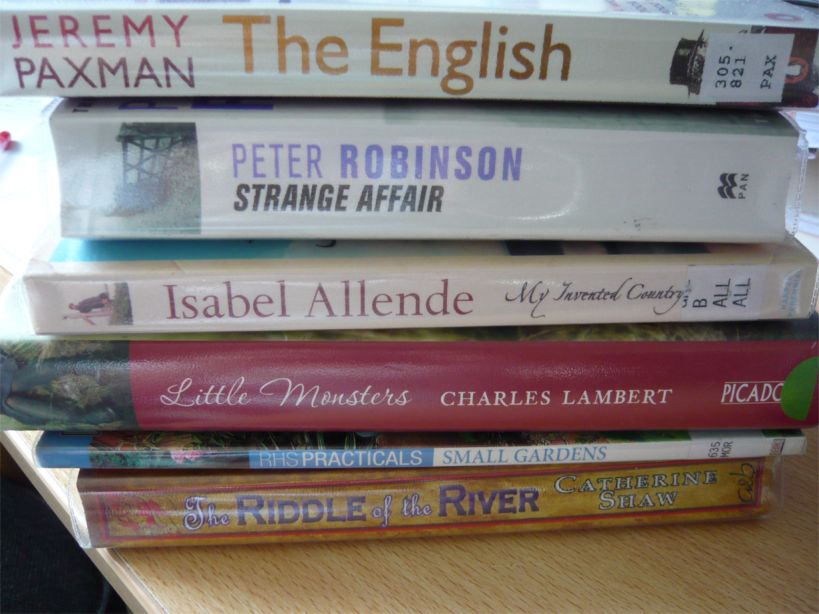
I came back from the library today with this pile of books.

library-loot-paxman

I’ve been thinking about how I choose books since writing my last Weekly Geeks post – am I influenced by the cover, just what is it about a book that makes me want to read it? Here are my reasons for choosing this pile:

  • The English: a Portrait of a People by Jeremy Paxman. I like to vary reading fiction with non-fiction, so I browsed in the non-fiction section and this caught my eye because of its title and author. I haven’t read anything by Jeremy Paxman but his TV programmes are always interesting and often controversial. I thought I’d like to find out how he defines Englishness. The chapter headings look interesting such as “The Land of the Lost Content”, “Funny Foreigners” and “The Ideal Englishman”. It also looks as though no one else has borrowed this book and it’s always nice reading a brand new book.
  • Strange Affair by Peter Robinson. I looked for a book by this author based on Roberta’s recommendations in her blog Books To the Ceiling.
  • My Invented Country by Isabel Allende. South America is largely unexplored by my reading and I have two of Allende’s books waiting to be read. She was on my mind since writing the Weekly Geeks post and so I looked in the Biography section and found this memoir. It promises to be a ‘highly personal tour through Chile.’
  • Little Monsters by Charles Lambert. I’ve not read anything at all about this book or its author. It’s from the New Books section and its cover was on full display. I don’t like the cover and I don’t like the title, but what attracted me initially is this quote from Beryl Bainbridge on the front cover: ‘Charles Lambert is a seriously good writer.’ I like her books, so I picked it up and on the back cover this quote from Griff Rhys Jones (why him, I wondered) made me curious enough to look further: ‘Sharp like sherbet, poignant and gripping.’ I opened the book and the first pages looked interesting.
  • Small Gardens – a Royal Horticultural Society Guide. This was in the library sale. We have a small garden, sadly not too flourishing, so I thought it would be useful.
  • The Riddle of the River by Catherine Shaw – another author I’ve never come across before and in this case it was the title on the spine that drew my eye.  The cover is OK, but it was the sub-title and the subject matter that made me decide to borrow the book – ‘Murder and mystery in Victorian Cambridge’. The book summary on the back helped plus the opening pages.

How do other people choose books? Do let me know.

Weekly Geeks – Reading Globally

weekly-geeksThis week’s Weekly Geeks is brought to us by Terri who asks us about our world travels through books.

Are you a global reader? How many countries have you “visited” in your reading? What are your favorite places or cultures to read about? Can you recommend particularly good books about certain regions, countries or continents? How do you find out about books from other countries? What countries would you like to read that you haven’t yet?

I’ve included books both set  in the country and by a native or resident of the country. I don’t have favourite places or cultures to read about – my choice of books is purely haphazard as far as location is concerned. Looking at the map there are large “white” areas indicating countries I’ve yet to visit. Brazil is the only country I’ve “visited” in South America through reading The Alchemist by Paulo Coelho, who is Brazilian. I’ll be reading more from South America with Isabel Allende’s City of the Beasts and The House of Spirits.


Create Your Own Map at The World 66 site

Some of my favourites are:

Musing Monday – Book Covers

Musing Mondays (BIG) Today’s MUSING MONDAYS post is about book covers€¦

We all know the old adage about not judging a book by it’s cover, but just how much sway does a book cover have when it comes to your choice of book €“ whether buying or borrowing? Are there any books you’ve bought based on the cover alone?

The book cover doesn’t have much effect on me when I’m deciding whether to buy a book. If I know the author or am looking for a specific title I take no notice of the cover. If I’m browsing then it’s the title that attracts me more often than than the cover and I’ll look at books even if the covers aren’t to my taste. If it has an attractive cover that’s a plus. Above all it’s the content I go by not the cover, so if the blurb reads well, plus the opening pages then I’ll pick that book.

If I’m at the library I have a slightly different approach and it’s there that I’ll sometimes just go for an attractive cover as a sort of “mystery” buy, without checking the content. Sometimes this works and other times it’s a complete failure.

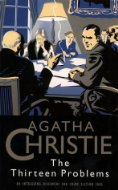
The Thirteen Problems by Agatha Christie

agatha_christie_rcIn The Thirteen Problems by Agatha Christie a group of friends, including Miss Marple meet on a Tuesday night and tell sinister stories of unsolved mysteries. It was first published in the UK in 1933, collecting together short stories previously published in various magazines. The first story The Tuesday Night Club introduces the character of Miss Marple.

The members of the Tuesday Night Club are Miss Marple, her nephew Raymond West a writer, Joyce Lempriere an artist, Sir Henry Clithering the ex-Commissioner of Scotland Yard, Dr Pender a clergyman and Mr Petherick a solicitor. Raymond wonders what type of person succeeds best at unravelling mysteries and puts forward that the ‘art of writing gives one an insight into human nature’, but Miss Marple questions him thinking that ‘so many people seem to me not to be either bad or good, but simply, you know, very silly.’ Mr Petherick thinks imagination is dangerous and that it needs a legal mind to sift through the evidence looking only at facts to arrive at the truth. Whereas Joyce believes it takes a woman’s intuition, such as hers – an artist who has ‘knocked about among all sorts and conditions of people’. She discounts Miss Marple thinking she cannot possibly know about life only having lived in St Mary Mead.thirteen-problems

So they each tell a tale and are amazed when it is Miss Marple, sitting primly, ‘knitting something white and soft’ who comes up with the right solution each time by using her knowledge of human nature gleaned from observing similar cases in St Mary Mead. She sees similarities and makes connections the others overlook.

The second set of stories are told at Colonel and Mrs Bantry’s house, when the guests tell their after-dinner stories. Sir Henry is visiting them and suggests they invite Miss Marple to make a sixth guest at dinner, along with Jane Helier the beautiful and popular actress, and the elderly Dr Lloyd.  Again Miss Marple correctly solves the mysteries, seeing through the red herrings to discover even the crimes that no one even knew had been committed. As she says

a lot of people are stupid. And stupid people get found out, whatever they do. But there are quite a number of people who aren’t stupid, and one shudders to think of what they might accomplish unless they had very strongly rooted principles.

The Thirteen Problems is an easy read and the short stories are ideal for reading quickly and in isolation. They are not complicated and once Miss Marple starts her explanations the crimes are easily solved.

I particularly liked the first description of Miss Marple, sitting erect in a big grandfather chair she

wore a black brocade dress, very much pinched in round the waist. Mechlin lace was arranged in a cascade down the front of her bodice. She had on black lace mittens, and a black lace cap surmounted the piled up masses of her snowy hair.

Kerrie recently ran a poll asking Who is the Best Miss Marple? My answer was Joan Hickson because I liked her portrayal, and the way she spoke and behaved seemed to me to be Miss Marple. But even though she looked nothing like this description I still prefer to ‘see’ Joan Hickson as Miss Marple. A strange case (for me) of a TV portrayal taking precedence over a book.