Sunday Salon – Reading The Sixth Wife

tssbadge1Yesterday I started reading The English by Jeremy Paxman. It’s entertaining but I felt I wanted a story – something to get lost in. So I picked up  The Sixth Wife by Suzannah  Dunn. I’ve had this book for a long time and I decided it was now time to read it. I’m so glad I did because I have difficulty putting it down. It’s the story of Katherine Parr as told by her friend Catherine, Duchess of Suffolk after the death of Henry VIII, when Katherine had married Thomas Seymour.

Reading one book often leads me on to reading others. I was sure I had a copy of David Starkey’s The Six Wives of Henry VIII but I can’t find it – I wanted to read what he had to say about Katherine, so I must have just borrowed it from the library. I know I’ve read it.

I find this period of English history so fascinating and most of what I know has come from reading novels or books like Starkey’s because we only touched on it at school and my later historical study was all a lot later. I’d like to visit Sudeley Castle where Katherine lived with Thomas – he renovated it in 1547/8. And I’d also like to read more about both Katherine and her friend, Catherine. So much from one book.
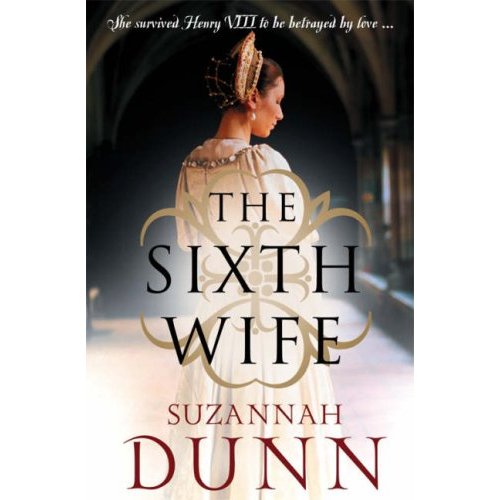
sixth-wife

Note: See my final thoughts here. My enthusiasm for this book waned.

The Meme of 4

This meme was passed to me by Kerrie at Mysteries in Paradise. It  is built around questions involving the number four and it seems that people have adjusted it to suit themselves. So, here is my version, which has taken me ages to write – but most enjoyable.

4 places I’ve lived:

  1. Timperley, Cheshire where I was born and grew up.
  2. Cheadle Heath, Stockport, Cheshire for about 1 year when we were first married.
  3. Baguley, Greater Manchester for about 4 years – then we moved back to Timperley. (I’ve lived in three different houses there.)
  4. Great Kimble, Buckinghamshire for about 11 years when we first moved south.

4 places I’ve visited outside the UK

  1. Bergen in Norway and other places on a hitch hiking/Youth Hostel holiday as a student.
  2. Rome – twice.
  3. Florence – stayed near Vinci, the birthplace of Leonardo. From here we visited Florence and San Gimignano.
  4. Jerusalem – on a tour of Israel.

4 places in the UK I’ve visited

  • Snowdonia – I’ve spent many holidays in Wales. At one time we had a caravan near Llanberris and went there many weekends during the season (March – October). I’d love to go to the top of Snowdon again, even if it’s on the mountain railway rather than on foot.
  • Broadway Tower – the second highest point in the Cotswolds. An 18th century folly tower, William Morris and his friends Edward Burne-Jones and Dante Gabriel Rossetti used it as a holiday retreat. On a clear day you can see 13 counties from the top of the tower.
  • The Smallest House in the UK is in Conwy, Wales – it’s dimensions are 3.05 metres by 1.8 metres. It dates back to the 16th century.
  • Kinder Scout in the Derbyshire Peak Distict – the highest point in the Peak District and Kinder Downfall the highest waterfall. The place where the ‘Right to Roam’ was born with the mass public trespass on 24 April 1932 when 400 ramblers climbed the downfall to the Kimber plateau and came into conflict with the Duke of Devonshire’s gamekeepers.

4 places I want to visit

  1. Venice – one of the places in Italy I still haven’t visited.
  2. The Grand Canyon – it’s not very likely that I’ll ever go.
  3. Hadrian’s Wall – easier to get to, so maybe I will get there one day.
  4. China to see the Great Wall and the Terracotta Warriors etc – most unlikely that I’ll ever go! Sadly,  I missed seeing the exhibition when it was in London.

4 Four works of art before which I have stood (or sat) and gazed at with wonder

  1. Ophelia by John Millais in the Tate Britain
  2. The Fighting Temeraire by J M W Turner in the National Gallery
  3. fighting-t
    © Copyright The National Gallery 2009
  4. Pegwell Bay, Kent by William Dyce in Tate Britain
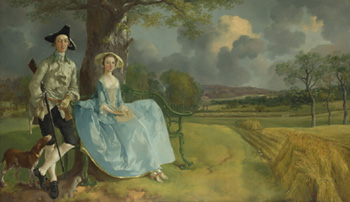
  5. Mr and Mrs Andrews by Thomas Gainsborough in the National Gallery

    mr-mrs-andrews
    © Copyright The National Gallery 2009

4  Favourite  things I like to eat (not in any order)

  • Pasta – all types, particularly penne
  • Bread – fresh crusty wholemeal or granary is best
  • Creme Caramel – although I also love chocolate desserts this is my favourite
  • Yoghurt – plain, natural – preferably Greek

4 of the latest blogs  I’ve found (not new, just new to me)

4 books I could read again tomorrow

So now I’m supposed to choose “victims” to carry on the meme. As this has been going the rounds for some time I expect most people (who want to) have already done it, but if you haven’t please feel free to have a go.

Turbulence by Giles Foden: Book Review

turbulence001

I received an uncorrected proof of Turbulence from the publishers Faber and Faber through LibraryThing’s Early Reviewers Program. I should have found it boring because most of the characters are scientists – meteorologists, to be precise – and a lot of the dialogue is scientific concerning the theory of weather forecasting and mathematical forecasting in particular. Maths is not my strong subject and a lot of this was beyond me. There was just too much detailed information. Yet, strangely this book gripped me and once I’d got through the first chapter, which was very technical and odd, about making a ship out of ice to transport water to Saudia Arabia, it was compelling reading.

The main action takes place during 1944 in the run up to D-Day. The narrator is Henry Meadows a young meteorologist working for the Met Office. He is sent up to Scotland to find out about the “Ryman number”  from Wallace Ryman, a pacifist and former meteorologist who devised the formula that will make forecasting the weather over a longer period more accurate. This is just what the Allies need to know in preparing for the invasion of Normandy. Ryman is based on Lewis Fry Richardson, who devised the Richardson number, which enables the turbulence of different weather systems to be measured (hence the title of the book). I don’t have a clear picture from the novel of what this actually is or how it works, but it was his work in forecasting a  break in the bad weather conditions in the Channel that fixed the date of D-Day as 6 June 1944.

Ryman is the most interesting character in the  book. He is opposed to war, now  pursuing peace studies and is known as a difficult, stubborn character. Henry finds him awkward, uncooperative and reluctant to talk about his work at first. The book began to come to life for me in this section when Henry and Ryman and his wife Gill start to get to know each other, made more interesting by the tensions in the Rymans’ marriage. At this stage Henry’s own fragility becomes obvious from passages where he recalls his childhood in Africa and the death of his parents.

The action moved back to London and began to drag a little, but picked up as Henry became more involved in the disagreements between the meteorologists from different countries, brought together over the phone to pool their resources about methods and interpretation. Henry is assigned to go with the invasion forces as Met liaison between the British and Americans. This provides a dramatic ending to the book as he is injured on landing in France.

Turbulence is a combination of theoretical and scientific information, philosophical musings (which were more meaningful to me), and a portrayal of complex and emotional characters. In the end I thought it was well worth the effort of reading it.

Friday Finds

friday-finds1

This week I came across these books:

love-all

Love All by Elizabeth Jane Howard. This is her first new novel in nine years! I’m a bit late “discovering” it as it was published in hardback last October, but the paperback is due out on 7 August. It’s set in the West Country in the 1960s with a group of people orgainsing an arts festival. I loved her Cazalet books and have her memoir Slipstream (tbr), so I’ll be looking for Love All in the bookshops.

all-made-of-glue

We Are All Made of Glue by Monica Lewycka was published a couple of weeks ago. I heard her talking about the book with Mariella Frostrup last Sunday on Open Book. It sounds good, covering some serious issues with added comedy and romance. Georgie, a failed novelist becomes a contributor to an adhesives publication. Her husband has left her and she meets her elderly Jewish neighbour Mrs Shapiro. Mrs Shapiro lives in a crumbling, filthy house along with a load of incontinent cats. We Are All Made of Glue combines together such disparate strands as the Arab-Israeli conflict, care for the elderly and different types of glue that binds us all together.

Good Evening, Mrs Craven by Mollie Panter-Downes

good-eveningThere are 21 short stories in Good Evening Mrs Craven: the War-time Stories of Mollie Panter-Downes. These portray the lives of people on the Home Front, getting on with their lives set against the backdrop of war. They’re not stories of action but their subjects are psychological, emotional and social.  They offer a glimpse into what life was like then – the mood, the atmosphere, the tension and the fear, the hopes and the devastation, the loss and the loneliness, the stress and the tragi-comedy of life.

Mollie Panter-Downes’s style is fluent, a touch journalistic, sometimes subtly ironic and most pleasurable to read. There are stories of housewives, evacuees, billeted soldiers and Home Front volunteers, of the ladies in the Red Cross sewing party who met ‘twice a week to stitch pyjamas, drink a dish of tea, and talk about their menfolk’,  the effects of food rationing, of lovers separated by the war and of ‘The Woman Alone’.

Social changes are highlighted in stories such as ‘Cut Down the Trees’. Forty Canadian soldiers are billeted at Mrs Walsingham’s big house by the river. Her maid, Dossie is horrified by the changes. She mourns the passing of the old way of life, blaming the Canadians:

Of course it wasn’t precisely their fault they were there, but it made her sick to hear their big boots clattering up and down the stairs and to see their trucks standing in line along thelime avenue. (page 150)

She looks forward to the end of the war:

When peace came, sane existence would be immediately resumed. Dossie sincerely believed that the big house, quietly chipping and mouldering above its meadows, would be instantly repopulated, as though by a genie’s wand, with faceless figures in housemaid’s print dresses, in dark-blue livery and gardener’s baize aprons. She believed that the lawns would be velvet again, that visiting royalty would once more point a gracious umbrella towards Mrs Walsingham’s Himalayan poppies, that the gentry would know their places and sit over their claret in the dining room, where they belonged.

In contrast, Mrs Walsingham is more realistic and accepts the inevitable change. When the trees are cut down to make space for the soldiers’  ‘paraphernalia’ she thinks it is an improvement, letting in more air and light. She says

It’s altered the view from this side of the house, but what’s a view? Everything else is changing so fast I suppose we shouldn’t bother about trees and water staying the way they were. (page 153)

TBR – Booking Through Thursday

btt button

Follow-up to last week’s question:

Do you keep all your unread books together, like books in a waiting room? Or are they scattered throughout your shelves, mingling like party-goers waiting for the host to come along?

bookcase2I have a bookcase where a lot of my unread books are shelved – that’s the waiting room. I also have unread books in piles in various rooms because I don’t have enough shelves – these are on the waiting list for places to come available. But now I come to think of it the unread bookcase also holds books I’ve read as well because there’s nowhere else left to move the unread books to once I’ve read them. And I have a feeling that there are some unread books mingled in amongst the other bookcases too.

The only place I’ve found to keep them under some form of order is in LibraryThing. But now LT has a category of Books To Read I see that I have 285 books in that category, whereas I’ve tagged 275 of them as TBR.  I’m so inconsistent! Anyway that’s a lot of unread books.