
Week 2 November 9-15 – Nonfiction Journeys – This week choose a book that reflects a journey for its author or for the reader or both. This can be a physical journey, an emotional, psychological or spiritual journey or a combination of these. Any nonfiction title that leaves its author/protagonist and/or reader in a different place at the end from the start point is good for this challenge. (Hosted by Volatile Rune)
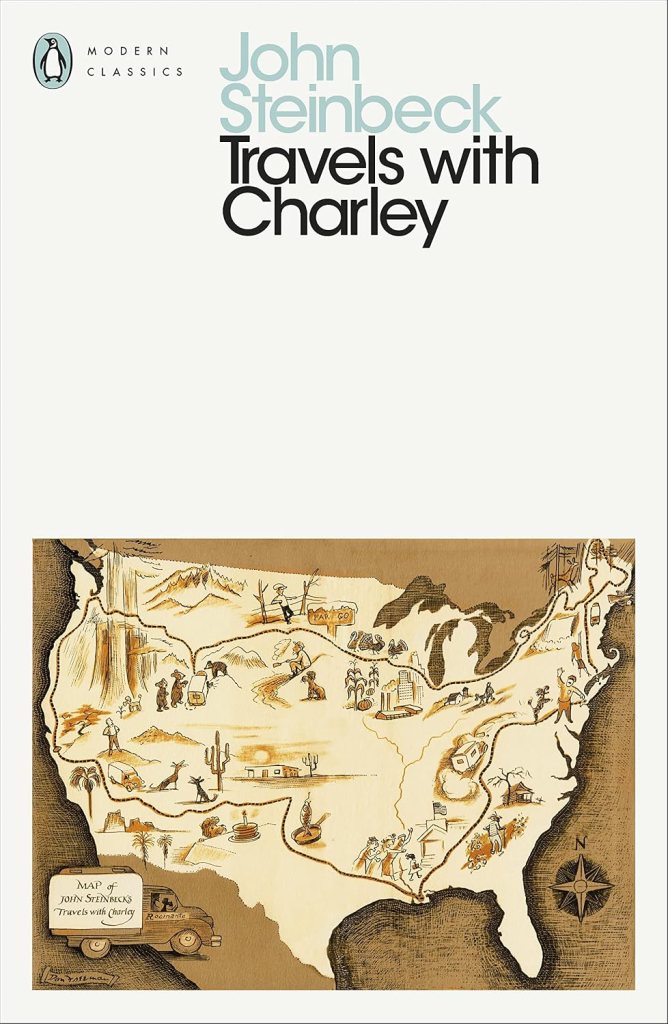
John Steinbeck is one of my favourite authors and I’ve owned Travels with Charley: in Search of Anerica for six years. First published in 1962, it’s a travelogue, a record of the journey he made in 1960 and also a fascinating memoir. However, there is some controversy surrounding the book with claims that it is a fictionalised account. Whether or not this is so, it doesn’t bother me, apart from the fact that I’m using this book as an example of a nonfiction travel book for the purposes of Nonfiction November. I can see fictional aspects in his recording of the conversations he had, but I think that is acceptable – how often can we remember exactly what was said? Maybe it can be described as ‘based on a real road trip’.
Description from Goodreads:
A quest across America, from the northernmost tip of Maine to California’s Monterey Peninsula
To hear the speech of the real America, to smell the grass and the trees, to see the colors and the light—these were John Steinbeck’s goals as he set out, at the age of fifty-eight, to rediscover the country he had been writing about for so many years.
With Charley, his French poodle, Steinbeck drives the interstates and the country roads, dines with truckers, encounters bears at Yellowstone and old friends in San Francisco. Along the way he reflects on the American character, racial hostility, the particular form of American loneliness he finds almost everywhere, and the unexpected kindness of strangers.
Steinbeck begins by describing how he had felt urge to be somewhere else from his youth and it was still with him at the age of fifty-eight. He had spent many years travelling in different parts of the world and then felt he did not know his own country – he only knew its changes from books and newspapers – his memories were distorted by twenty-five intervening years. So he wanted to try to rediscover it. And then he began to plan his journey – a round trip starting in Long Island, New York and covering approximately 10,00 miles and taking about 75 days in the autumn of 1960. I did find it somewhat difficult to follow the route though and the map on the front cover could do with place names and an indication of the direction of travel. I think the main focus for me is on his interactions with the people he met, and his philosophical thoughts. And I loved his beautiful descriptive writing of the landscape he passed through.
Apart from Charley, his French poodle and his wife, Elaine, who joined him at times Steinbeck was alone on his journey. I loved Charley and felt sorry for him when he became ill, having increasing difficulty in emptying his bladder. Simply put he could not pee. It was eventually diagnosed as prostatitis and was relieved by a vet in Amarillo with pills.
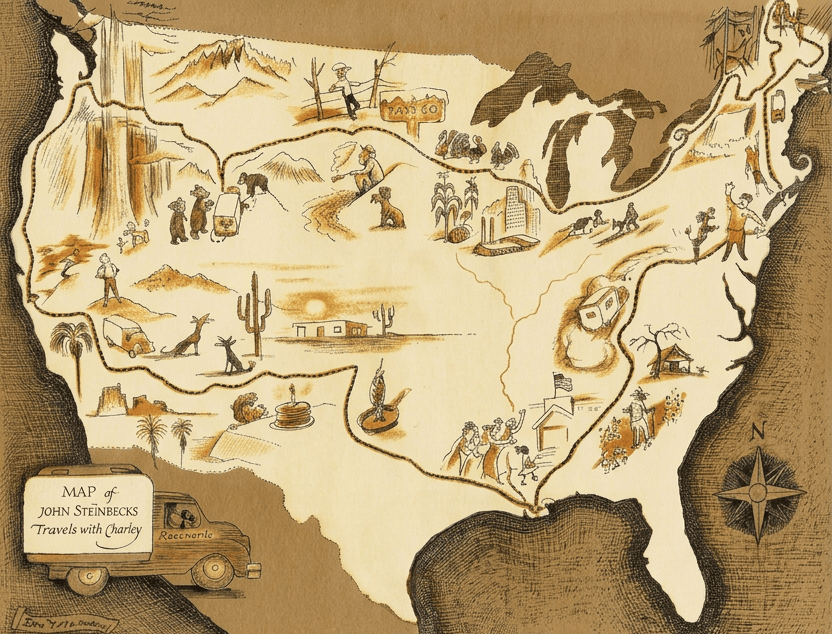
First he acquired a pick-up truck
… a tough, fast, comfortable vehicle, mounting a camper-top – a little house with double bed, a four-burner stove, a heater, refrigerator and lights operating on butane, a chemical toilet, closet space, storage space, windows screened against insects … (page 2)
He named it Rocinante, the name of Don Quixote’s horse, and equipped it with numerous items, writing that he took far too many things, because he didn’t know what he would find. I’m always fascinated by what people take with them on their travels and just like Robert Louis Stevenson in his book Travels with a Donkey in the Cevennes, Steinbeck gives detailed descriptions of the equipment and supplies that he took on his journey. They both loved travel and used their travels to provide them with material for publication.
Steinbeck took paper, carbon, typewriter, pencils, notebooks and also dictionaries, a compact encyclopedia and a dozen other heavy reference books, plus enough writing material for ten volumes and many of those books he had never got round to reading and those books one isn’t ever get round to reading! I think it’s interesting that he noted that he ‘knew from thirty years of his profession that I cannot write hot on event. It has to ferment. I must do what a friend calls “mule” it over for a time before it goes down.’ I’m not comparing myself to him but I do the same writing this blog. I can’t write about a book I’ve read straight after I’ve finished reading it.
It’s not a long book, just 166 pages, but despite this it has great depth of detail, beautiful descriptive writing and his philosophical thoughts on many aspects of life. This extract gives a taste of his writing. It’s about the giant redwoods in southern Oregon. He and Charley had passed several groves of trees
… and then on a level meadow by a stream we saw the grandfather, standing alone, three hundred feet high and with the girth of a small apartment house. The branches with their flat, bright green leaves did not start below a hundred and fifty feet up. under that was the straight, slightly tapering column with its red to purple to blue. It’s top was noble and lightning riven by sum ancient storm. I coasted off the road and pulled to within fifty feet of the godlike thing, so close that I had to throw my head back and raise my eyes to vertical to see its branches.
… I stayed two days close to the bodies of these giants, and there were no trippers, no chattering troupes with cameras. There’s a cathedral hush here. Perhaps the thick soft bark absorbs sound and creates a silence. The trees rise up to zenith; there is no horizon. Then the green fernlike foliage so far up strains the sunlight to a green-gold and distributes it in shafts or rather in stripes of light and shade. After the sun passes zenith it is afternoon and quickly evening with a whispering dusk as long as was the morning. (page 114 and 115)
He gives memorable details of some of the places and people he met. I am not American and have never visited America, but I think I’ve absorbed through Steinbeck’s writing a little bit of what it was like at the beginning of the 1960s. He gives a snapshot of what life was like then. By then he had become disappointed in some aspects of American life, especially in New Orleans where he witnessed a group of middle aged women, who became known as the Cheerleaders, who gathered every day, accompanied by a crowd of people who enjoyed and applauded their performance, to scream at two little Negro children as they entered or left school. He said ‘the naked face of racism, witnessed in the Cheerleaders filled him with a “weary nausea”. It showed the effect of three hundred years of fear and and anger and the terror of change in a changing world. (page 148)
I found it all fascinating, particularly when he was writing about his concerns about such topics that are current today, such as urban sprawl (the amount of waste left lying around cities), consumerism and race relations for example. And throughout the book there flashbacks to his childhood and young adulthood in Salinas,. He visited his sisters in Monterey when they disagreed about politics ‘ending each session panting and spent with rage‘. He was able to visit places he remembered from his youth, but it had changed -‘ the place of my origin had changed and having gone away I had not changed with it. In my memory it stood as it once did and its outward appearance confused and angered me.’ (page 123) The poignacy of it touched me.

