
Nigel Slater’s Toast is the story of his childhood and adolescence told through food; food he liked and food he hated. Reading it was a nostalgic remembrance of my childhood, even though mine was so very different from his, apart from the food. My mother, unlike his, was a good cook, but she did stick to recipes she knew and we had the same meals each week. She cooked English food, so meals such as spaghetti bolognese were not on the menu in our house. The only spaghetti we ate was out of a tin. Nigel’s description of the first and only time his family cooked and tried to eat spaghetti is hilarious – “the slithery lengths of spaghetti” escaped through the holes in the colander and curled “up in the sink like nests of worms”. His Aunt Fanny thought she was being poisoned and the smell of the Parmesan cheese turned their stomachs.
Toast is not at all like his Kitchen Diaries; there are no recipes, although you could make trifle from his description of his father’s sherry trifle, made with bought Swiss Roll, tinned peaches, jelly, custard and cream, the success of which depended upon the noise it made when the first spoonful was lifted out:
The resulting noise, a sort of squelch-fart, was like a message from God. A silent trifle was a bad omen. The louder the trifle parped, the better Christmas would be.
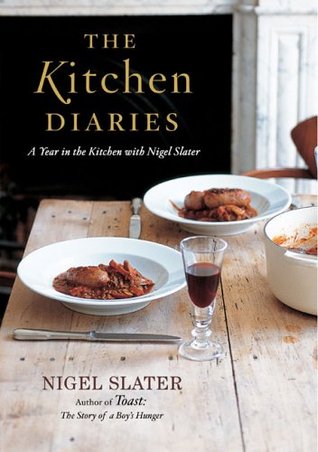
Contrast this trifle with “Nigel’s Delightful Trifle” in his Kitchen Diaries made with sponge cake, eggs, sugar, mascarpone cheese, vanilla extract, cream and blackcurrants. The cream and marscapone are whipped together and spooned on top of the trifle in “deep, billowing folds”, chilled and then topped with more fresh blackcurrants and crystallised violets.
Kitchen Diaries is an account of more or less everything Nigel cooked in the course of a year, presented as an illustrated diary. The photographs are sublime, and they are done in ‘real time’; they are photos of the food he cooked and ate on that day.The book follows the seasons so you can find suggestions about what is worth eating and when – a book to dip into throughout the year and for years to come. There are recipes for Onion Soup Without Tears, Thyme and Feta Lamb, Roast Tomatoes with Anchovy and Basil, Mushroom Pappardella, Stilton, Onion and Potato Pie and many many more.
In Toast Nigel charts his way through childhood with descriptions of toast, cakes, puddings, jam tarts, pancakes, sweets and toffee, tinned ham, lamb chops – you name it and it’s in this book. It’s not just food he liked but also food he detested, in particular milk and eggs. I felt so sorry for him after reading of the way his teacher made him drink his school milk. How it brought back memories of that warm milk we had each day at school – warm because the bottles had been kept standing in the crate in the sun and the cream sat in a thick layer at the top of the bottle! I hated it too.
It’s a very frank book about a young boy’s feelings and a teenager’s sexual experiences, and his relationship with his mother whom he loved, and his father who sometimes scared him. It’s both funny and sad, unsettling and moving; the pathos when his mother no longer makes the mashed potao he loves, but gives him Cadbury’s Smash,
grainy and salty, wet but possessed of a dry, almost powdery feel in the mouth. ‘The mash tastes funny, Mummy.’ Quietly but firmly, in a tone heavy with total and utter exasperation, and with a distant rasp after the first word, she said, ‘Nigel … Just eat it.’
I read it quickly, almost devouring it, enjoying the remembrance of food of times past. There is so much in the book that I’m tempted to make a food index to go with it – here’s just a few I could name –
Arctic Roll, Banana Custard, Crumpets, Damson Jam, Eggs (Scrambled), Flapjack, Grilled Grapefruit, Haddock (smoked), Ice Cream, Jelly, Kraft Cheese Slices, Lemon Drops, Marshmallows, Nestle’s (pronounced Nessles) Condensed Milk, Oxtail Soup (tinned), Prawn Cocktail, Quick-Gel, Rabbit, Spinach, Tapioca, Victoria Sandwich, and Walnut Whips (my favourites).
Toast is the winner of six literary awards, including the National Book Awards British Biography of the Year. I love Nigel Slater’s TV series A Taste of My Life and I’ve just discovered he’s written another book – Eating For England: the delignts and eccentricities of the British at Table – I must read that!
An entry in the Soup’s On Challenge.


 BooksPlease
