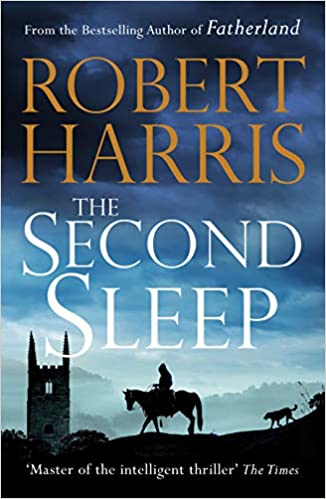
The Second Sleep by Robert Harris

Rating: 4 out of 5.

I decided to read The Second Sleep because I enjoy Robert Harris’ books and when I saw him on a TV programme talking about this book I thought it sounded interesting and a bit different. I’m glad I did because I thoroughly enjoyed most of it – it was the ending that I felt was rather flat.

I read it at the end of June and I wish I’d written about it straight away – but I didn’t, it got left because I’ve been finding it difficult to concentrate on writing reviews. So, this is one of my catching up posts that can’t do justice to the books. But, I really do think that you should go into reading this book with an open mind, without knowing too much about it.

The blurb certainly made me want to read it:

Dusk is gathering as a young priest, Christopher Fairfax, rides across a silent land.

It’s a crime to be out after dark, and Fairfax knows he must arrive at his destination – a remote village in the wilds of Exmoor – before night falls and curfew is imposed.

He’s lost and he’s becoming anxious as he slowly picks his way across a countryside strewn with the ancient artefacts of a civilisation that seems to have ended in cataclysm.

What Fairfax cannot know is that, in the days and weeks to come, everything he believes in will be tested to destruction, as he uncovers a secret that is as dangerous as it is terrifying …

As I began reading I had that feeling that this is a book I was going to enjoy – historical fiction, with a mystery to it as well. There is something not quite right about Faifax’s mission as he approaches that remote village in the dark, something menacing and dangerous. The signs are all there – a cataclysmic disaster and a terrifying secret await him when he reaches that village.

But then – all is not as it first appears and I wondered if all this is a smoke screen – what is really going on, is this really the medieval England I’ve read about in history books? And here it is – the nub of the matter – what is going on, where and when are these events taking place? This is an imagined world, a piece of speculative fiction, a bleak and brutal world under a strict authoritarian rule. It’s about progress, or lack of it, about the rule of law, and the power of knowledge.

As I expect in Harris’ novels, apart from that abrupt ending, it is paced well, as more and more information about this strange time and place are revealed the tension rises and rises. The characters became real to me and I could easily visualise all the scenes – in other words I was gripped and involved in the story. So, it was with a sense of an anti-climax that I reached the ending – was that it? I wanted to know more. Even so, I can say that this is a book I thoroughly enjoyed and I think I’d like to re-read it sometime, prepared for the ending.

I was interested in the title, the second sleep, referring to the characters’ sleep pattern of having a period of wakefulness of a couple of hours in the middle of the night and then returning to bed for a second period of sleep. I wondered if that was historical fact – these days it’s not considered to be good to have a broken sleep pattern. It was – I found this BBC article, which explains there is a wealth of historical evidence that humans used to sleep in two distinct chunks and that during the waking period people were quite active – as they are in this book. They often got up, went to the toilet or smoked tobacco and some even visited neighbours. Most people stayed in bed, read, wrote and often prayed. Countless prayer manuals from the late 15th Century offered special prayers for the hours in between sleeps.

  • Format: Kindle Edition
  • File Size: 2384 KB
  • Print Length: 330 pages
  • Publisher: Cornerstone Digital (5 Sept. 2019)
  • Source: I bought it

My Friday Post: The Second Sleep by Robert Harris

Every Friday Book Beginnings on Friday is hosted by Gillion at Rose City Reader where you can share the first sentence (or so) of the book you are reading, along with your initial thoughts about the sentence, impressions of the book, or anything else the opener inspires.

My choice this week is a book that I’ve just started to read – The Second Sleep by Robert Harris and it promises to be good.

It begins:

Chapter One – The Hidden Valley

Late on in the afternoon of Tuesday the ninth of April in the Year of Our Risen Lord 1468, a solitary traveller was to be observed picking his way on horseback across the wild moorland of that ancient region of south-western England known since Saxon times as Wessex. If this young man’s expression was troubled, we may grant he had good cause.

Also every Friday there is The Friday 56, hosted by Freda at Freda’s Voice.

30879-friday2b56

These are the rules:

  1. Grab a book, any book.
  2. Turn to page 56, or 56% on your eReader. If you have to improvise, that is okay.
  3. Find any sentence (or a few, just don’t spoil it) that grabs you.
  4. Post it.
  5. Add the URL to your post in the link on Freda’s most recent Friday 56 post.

Page 56:

One letter, however, had been sealed in its own plastic wallet, and this was found to be in near-perfect condition. Mr Shadwell had made a copy, and asked permission to read it aloud to the society. His proposal was approved unanimously

Imperial College, London, 22 March 2022

Blurb:

Dusk is gathering as a young priest, Christopher Fairfax, rides across a silent land.

It’s a crime to be out after dark, and Fairfax knows he must arrive at his destination – a remote village in the wilds of Exmoor – before night falls and curfew is imposed.

He’s lost and he’s becoming anxious as he slowly picks his way across a countryside strewn with the ancient artefacts of a civilisation that seems to have ended in cataclysm.

What Fairfax cannot know is that, in the days and weeks to come, everything he believes in will be tested to destruction, as he uncovers a secret that is as dangerous as it is terrifying …

~~~

If the quotation from the Sunday Times is right, this is exactly what I want to read right now:

thoroughly absorbing, page-turning narrative in which the author, with his customary storytelling skills, pulls us ever deeper into the imaginative world he has created. It [also] poses challenging questions about the meaning of the past, the idea of progress and the stability of civilisation. It is a fine addition to Harris’s diverse body of work. Sunday Times

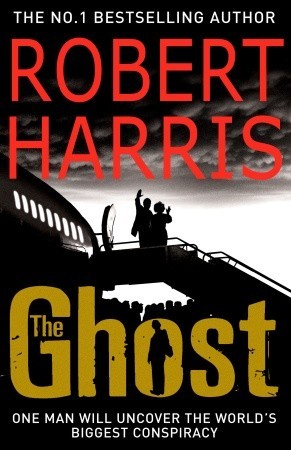
The Ghost by Robert Harris

The Ghost

4*

I have enjoyed all of Robert Harris’s books that I’ve read and The Ghost is no exceptionThe ‘ghost’ in this novel is a professional  ghostwriter employed to finish writing the memoirs of recently retired prime minister of Great Britain, Adam Peter Benet Lang. McAra, Lang’s long-term assistant, had nearly completed Lang’s memoir when he was found dead, drowned. He had gone overboard during the ferry crossing to Martha’s Vineyard, where Lang and his wife, Ruth are staying.

The setting of Martha’s Vineyard in winter reflects Lang’s mood, it is out-of-season, closed down, practically empty – as isolated as Lang himself, disconnected from the world of power he once dominated and stuck on this bleak island with his volatile wife and his aide, the beautiful Amelia Bly, who Ruth suspects is having an affair with Lang. The ghostwriter soon discovers that Lang has secrets in his past that are returning to haunt him – secrets with the power to kill. And he suspects that McAra’s death was neither an accident nor a suicide.

This is fiction, but Adam and Ruth, do have similarities to Tony and Cherie Blair. Lang is charming, personable, full of restless energy, with an engaging smile and thick wavy hair. The narrator, an unnamed writer, who Adam calls ‘man’, is a likeable character more used to ghostwriting the memoirs of footballers than politicians, who has just one month to complete Lang’s memoirs. But soon after he arrives this is reduced to two weeks when news breaks that Lang is accused of war crimes. The International Criminal Court in The Hague are investigating the allegations of Richard Rycart, the former British Foreign Secretary, that Lang had ordered the illegal handover of suspects for torture by the CIA.

I liked the details about ghostwriting from the quotes heading each chapter taken from Andrew Crofts handbook, Ghostwriting. But what I liked most about The Ghost is that it is fast- paced, full of tension and written in a straightforward linear narrative – no flashbacks or fly forwards, or multiple narrators. As in his other books  I’ve read it’s written in such a way that I feel as though I’m there with the characters taking part in the action. And his characters are distinct people, easily distinguishable from each other. In so many books I’ve read recently I’ve come across a character and have been unable to place them and have had to backtrack to find out who they are and how they fit into the plot, or the characters have similar sounding names or all begin with the same letter. Not so with The Ghost the characters have depth, the structure is clear, and there is a twist at the end that revealed the menace implied through the whole novel. Harris is a great storyteller.

My copy:

  • Paperback: 416 pages
  • Publisher: Arrow; Reprint edition (3 July 2008)
  • Language: English
  • ISBN-13: 978-009952749
  • Source: I bought the book
  • My rating: 4*


First Chapter First Paragraph: The Ghost by Robert Harris

Every Tuesday First Chapter, First Paragraph/Intros is hosted by Vicky of I’d Rather Be at the Beach sharing the first paragraph or two of a book she’s reading or plans to read soon.

I’m currently reading The Ghost by Robert Harris, about a ghostwriter, not a tale of the supernatural.

The Ghost


The moment I heard how McAra died I should have walked away. I can see that now. I should have said, ‘Rick, I’m sorry, this isn’t for me, I don’t like the sound of it,’ finished my drink and left. But he was such a good storyteller, Rick – I often thought he should have been the writer and I the literary agent – that once he’s started talking there was never any question I wouldn’t listen, and by the time he had finished, I was hooked.

Blurb:

Britain’s former prime minister is holed up in a remote, ocean-front house in America, struggling to finish his memoirs, when his long-term assistant drowns. A professional ghostwriter is sent out to rescue the project – a man more used to working with fading rock stars and minor celebrities than ex-world leaders. The ghost soon discovers that his distinguished new client has secrets in his past that are returning to haunt him – secrets with the power to kill.

What do you think? Would you keep reading?

Munich by Robert Harris

Munich

Munich is about  the 1938 Munich Conference and I found it absolutely fascinating  as I know very little about the period beyond the basic facts – PM Neville Chamberlain was trying to maintain the peace in the face of Hitler’s aims to expand German territory (but I was a bit vague about the actual details) and in 1938 came back from the Munich conference with a piece of paper signed by Hitler, proclaiming that it meant ‘peace for our time‘.

MunichAgreement

Munich is a mix of fact and fiction. Harris uses two fictional characters, Hugh Legat as one of Chamberlain’s private secretaries and Paul Hartmann, a German diplomat and a member of the anti-Hitler resistance to tell his story. Harris’ interest in the Munich Agreement began thirty years ago when he made a BBC TV documentary, ‘God Bless You Mr Chamberlain’ to mark the fiftieth anniversary of the conference in 1988. He has thoroughly researched the subject, consulting many books (listed in the Acknowledgements) and has seamlessly woven the facts into the novel. It has a a strong sense of place, based no doubt on his visits to what was once the Führerbau, now the Faculty of Music and Theatre and Hitler’s old apartment in Prinzregentenplatz, now used as a police headquarters.

Munich explores the moral dilemma of appeasement, and of making a stand. It portrays Chamberlain as a man of high moral principals, deeply concerned that the horrors of World War One should not be repeated and not as a weak appeaser easily fooled by Hitler. His objective was:

… to avert war in the short term, and then to try to build a lasting peace for the future – one month, one day at a time, if needs be. The worst act I could possibly commit for the future of mankind would be to walk away from this conference tonight. (page 267)

Reading this book has made me want to know more about Neville Chamberlain and I hope to read one of the biographies that Harris lists.

The fictional story of Hugh and Paul, who had been friends at university six years earlier adds additional tension and drama to the already tense story of the Munich conference. As in his earlier books Harris has captured the atmosphere and mood of the times, making me feel as though I’m there with the characters taking part in the action. The key characters are seen through Hugh’s and Paul’s perspectives – Chamberlain and Hitler – and others such as Mussolini, Goering and the other British politicians who travelled with Chamberlain to Munich.  Among the later was Lord Dunglass, described by one of Chamberlain’s secretaries as ‘one of the cleverest politicians she had ever encountered‘; she considered that he would ‘be Prime Minister one day‘. At the time it was inconceivable that a premier could sit in the House of Lords and her prediction was dismissed. However, Dunglass went on to inherit his father’s title and become the 14th Earl of Home and as Sir Alec-Douglas-Home (renouncing his peerage) he did indeed become Prime Minister.

I really like Harris’ straight forward writing style with no flashbacks, fly forwards or ambiguities. I learned a lot from this book and as far as I can tell (as I said I don’t know much about the period) it is an accurate version of what happened at Munich. It is a dramatic story well told – definitely a 5* book!

  • Hardcover: 352 pages
  • Publisher: Hutchinson; 01 edition (21 Sept. 2017)
  • Language: English
  • ISBN-10: 0091959195
  • ISBN-13: 978-0091959197
  • Source: Library book
  • My rating: 5*

My Tuesday Post: Munich by Robert Harris

Every Tuesday First Chapter, First Paragraph/Intros is hosted by Vicky of I’d Rather Be at the Beach sharing the first paragraph or two of a book she’s reading or plans to read soon.

Teaser Tuesdays is hosted by The Purple Booker. Post two sentences from somewhere in a book you’re reading. No spoilers, please! List the author and book title too.

My first paragraph this week is from Munich by Robert Harris, which I’m currently reading.

Munich


It begins:

Shortly before one o’clock on the afternoon of Tuesday 27 September 1938, Mr Hugh Legat of His Majesty’s Diplomatic Service was shown to his table beside one of the floor-to-ceiling windows of the Ritz restaurant in London, ordered a half-bottle of 1921 Dom Perignon that he could not afford, folded his copy of The Times to page seventeen and began to read for the third time the speech that had been delivered the night before in Berlin’s Sportpalast by Adolf Hitler.

Here is a teaser from page 99. 

The Prime Minister, Neville Chamberlain is talking to Legat about the suffering endured through the last war (the First World War):

… Afterwards, whenever I saw a war memorial, or visited one of those vast cemeteries in France where so many dear friends are buried, I always vowed that if ever I was in a position to prevent such a catastrophe from happening again, I would do anything – sacrifice anything – to maintain peace. You understand that?’

Blurb:

September 1938. Hitler is determined to start a war. Chamberlain is desperate to preserve the peace. The issue is to be decided in a city that will forever afterwards be notorious for what takes place there. Munich. 

As Chamberlain’s plane judders over the Channel and the Fürher’s train steams relentlessly south from Berlin, two young men travel with secrets of their own.

Hugh Legat is one of Chamberlain’s private secretaries, Paul Hartmann a German diplomat and member of the anti-Hitler resistance. Great friends at Oxford before Hitler came to power, they haven’t seen one another since they were last in Munich six years earlier. Now their paths are destined to cross again as the future of Europe hangs in the balance.

When the stakes are this high, who are you willing to betray? Your friends, your family, your country or your conscience?

I’ve read just a few pages on from my teaser and am firmly fixed in the pre-war years and hoping, futilely I know, that Chamberlain would succeed in preventing the coming war. I also want to know more about him. As Harris has portrayed him so far in this book he seems a man out of his time – a Victorian figure – and a man who like Hitler was egocentric, a man who ‘always conflated the national interest with himself.‘ (page 37)