Throwback Thursday: Curtain by Agatha Christie

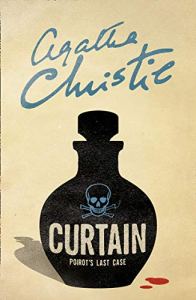
Today I’m looking back at my post on Curtain: Poirot’s Last Case by Agatha Christie, one of my favourite Agatha Christie books. I first reviewed it on December 2, 2010.

My review begins:

Curtain was first published in 1975, but it was written in the 1940s during the Second World War. Agatha Christie had written it with the intention that it be published after her death, but in 1975 her publishers persuaded her to release it so that it could appear in time for the Christmas season – a ‘Christie for Christmas’.

In this book Poirot and Hastings have come full circle, returning to Styles, the scene of their first case. Poirot is now an old man (just how old is not revealed  – I think if you go by the chronology of the novels he must have been about 120, but there is no need to be too precise), and close to death.  Hastings is the narrator of this mystery. He is saddened by the devastation age has had on Poirot

Click here to read my full review

The next Throwback Thursday post is scheduled for February 3, 2022.

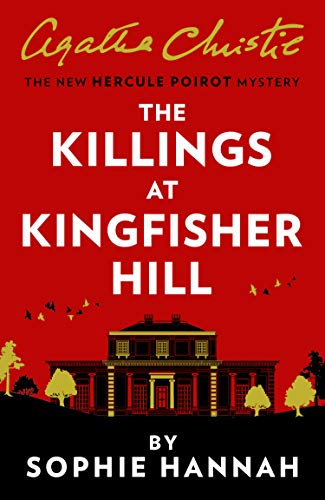
The Killings at Kingfisher Hill by Sophie Hannah

HarperCollins/ 20 August 2020/ Print length 346 pages/ Kindle edition/ 3*

The Killings at Kingfisher Hill is Sophie Hannah’s fourth Hercules Poirot mystery novel and the first one I’ve read. I have read some of Hannah’s books previously. So, I know that she writes complicated and tricky plots. Whilst not attempting to reproduce Christie’s Poirot this book is loosely based on Christie’s books, as Hannah incorporates all the twists and turns, red herrings and misdirections that you find in them. There’s a country house setting, a number of suspects, and a gathering together at the end where Poirot reveals all.

Blurb:

Hercule Poirot is travelling by luxury passenger coach from London to the exclusive Kingfisher Hill estate, where Richard Devonport has summoned him to prove that his fiancée, Helen, is innocent of the murder of his brother, Frank. But there is a strange condition attached to this request: Poirot must conceal his true reason for being there.
 
The coach is forced to stop when a distressed woman demands to get off, insisting that if she stays in her seat, she will be murdered. Although the rest of the journey passes without anyone being harmed, Poirot’s curiosity is aroused, and his fears are later confirmed when a body is discovered with a macabre note attached…

Could this new murder and the peculiar incident on the coach be clues to solving the mystery of who killed Frank Devonport? And if Helen is innocent, can Poirot find the true culprit in time to save her from the gallows?

I wasn’t expecting a cloned Poirot and Hannah’s Poirot is not Christie’s Poirot. There’s no Captain Hastings in this book, Poirot’s faithful friend. Instead Poirot is accompanied by Inspector Catchpole from Scotland Yard. How on earth he got to be an inspector is beyond me – he comes across as rather dim and stupid and Poirot treats him as such, endlessly explaining things to him and telling him what to do in an officious manner.

There are three strands to the plot – who killed Frank Devonport; who is the hysterical woman with an ‘unfinished face’ who insists she will be murdered if she sits in a specific seat on the coach; and who is the mysterious woman who tells Poirot she is a murderer – what a stupid thing to do when she knows he is a ‘world-renowned detective’? And I wondered what makes Richard so sure that Helen didn’t kill Frank when she had immediately confessed that she had? And I’m still wondering why when he was invited to Kingfisher Hall, an exclusive and private country estate, he went by coach with 30 other passengers – even if it was a ‘luxury’ coach. I just can’t see Poirot travelling by coach!

This all makes the book extremely convoluted, confusing and tangled as well as long-winded. Poirot though works his way methodically through the mess and gets to the truth. However, I found it quite dull and repetitive and rather contrived. So, my rating for this book is 2.5 stars, rounded up to 3.

My thanks to HarperCollins for a review copy via NetGalley.

Teaser Tuesday

Currently I’m reading Agatha Christie’s The Clocks, which incidentally, is on ITV on Boxing Day -one of the Agatha Christie’s Poirot series. Reading the preview it doesn’t sound as though they have stuck too closely to the plot, but never mind.

This description of a bookshop near the British Museum appealed to me:

Inside, it was clear that the books owned the shop rather than the other way about. Everywhere they had run wild and taken possession of their habitat, breeding and multiplying and clearly lacking any strong hand to keep them down. The distance between bookshelves was so narrow that you could only get along with great difficulty. There were piles of books perched on every shelf or table.

On a stool in a corner, hemmed in by books, was in a old man in a pork-pie hat with a large flat face like a stuffed fish. He had the air of one who has given up an unequal struggle. He had attempted to master the books, but the books had obviously succeeded in mastering him. He was a kind of King Canute of the book world, retreating before the advancing tide of books. (page 170)

I don’t suppose this will be included in the drama, but I hope it will.

I’m about halfway through the book and Poirot has yet to appear!

For more Teaser Tuesdays go to Should Be Reading.

The ABC Murders by Agatha Christie: Book Review

As I’ve written an ABC of Agatha Christie for the Agatha Christie Blog tour and found the ABC Wednesday site, I thought I’d carried on with the alphabet theme and read Agatha Christie’s The ABC Murders. I’m so glad I did because it’s one of her best, or at least I think it is.

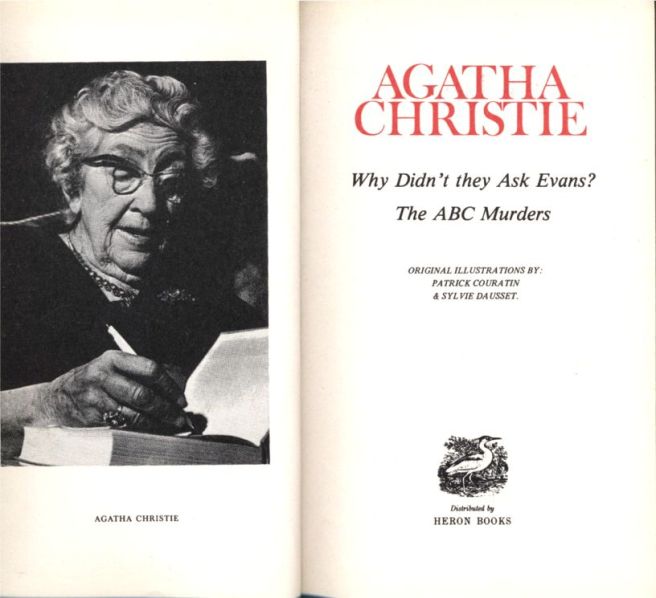
My copy is in a compilation volume along with Why Didn’t They Ask Evans. The ABC Murders was first published in 1936.

It’s narrated by Captain Hastings, for the most part, interspersed by chapters written in the third person, which Hastings assures us are accurate and have been ‘vetted’ by Poirot himself. I thought that was interesting and it alerted me to read those chapters carefully. What follows is a series of murders advertised in advance by letters to Poirot, and signed by an anonymous ‘ABC’. An ABC Railway is left next to each of the bodies. So the first murder is in Andover, the victim a Mrs Alice Ascher; the second in Bexhill, where Betty Barnard was murdered; and then Sir Carmichael Clarke in Churston is found dead. The police are completely puzzled and Poirot gets the victims’ relatives together to see what links if any can be found.

The only thing that seems to link them is that they were killed by the same person and that in each case there is a person who be the obvious suspect as the murderer if it hadn’t been for the ABC murderer. Poirot was convinced that one or possibly all of the relatives ‘knows something that they do not know they know.’ And indeed that was so. In Poirot’s final explanation of the case he admitted that all along he had been worried over the why? Why did ABC commit the murders and why did he select Poirot as his adversary?

Quite early on the book I had my suspicions about the identity of ABC but Agatha Christie was an expert at providing plenty of red herrings and twist and turns, and of course I was actually just as baffled as the police (quite an array of police, including a Chief Constable and an Assistant Commissioner, were involved from different forces around the country as well as Inspector Japp) and Doctor Thompson, a ‘famous alienist’. It was only right at the end that I worked out this ingenious mystery.