It’s time again for Six Degrees of Separation, a monthly link-up hosted by Kate at Books Are My Favourite and Best. Each month a book is chosen as a starting point and linked to six other books to form a chain. A book doesn’t need to be connected to all the other books on the list, only to the one next to it in the chain.
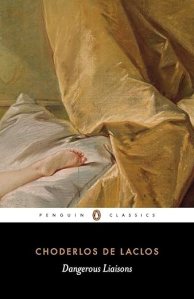
This month we start with Dangerous Liaisons by Pierre Choderlos de Laclos first published in 1782 as Les Liaisons Dangereuses. I read this many years ago when I was taking an Open University course and I’ve not reviewed this on my blog. It’s an epistolary novel, told through the letters written by different characters to one another. I loved it. The Goodreads summary describes it as a:
novel of moral and emotional depravity is a disturbing and ultimately damning portrayal of a decadent society. Aristocrats and ex-lovers Marquise de Merteuil and Vicomte de Valmont embark on a sophisticated game of seduction and manipulation to bring amusement to their jaded lives. While Merteuil challenges Valmont to seduce an innocent convent girl, he is also occupied with the conquest of a virtuous married woman. Eventually their human pawns respond, and the consequences prove to be more serious—and deadly—than the players could have ever predicted.
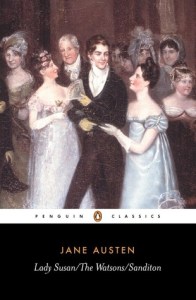
My first link is Lady Susan by Jane Austen, which see wrote between 1794 and 1795, adding a conclusion in 1805, but not published until James Edward Austen-Leigh, her nephew, published it in his Memoir of Jane Austen in 1871.
Lady Susan is about Lady Susan Vernon, told in a series of letters, just like Laclos’s Les Liaisons Dangereuses. Both have manipulative and evil characters without any moral scruples, who delight in their power to seduce others. It’s the story of an unscrupulous widow who plans to force her daughter into a marriage against her wishes. Lady Susan is an attractive and entertaining and totally wicked character, who nevertheless almost manages to fool people for some of the time at least. She is also trying to captivate her sister-in-law’s brother, whilst still holding on to the affections of a previous lover.
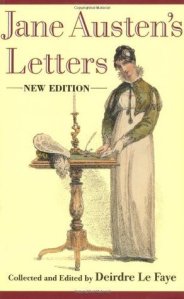
My second link is also a book of letters, but real letters, not fictional ones – Jane Austen’s Letters edited by Deirdre Le Faye, First published in 1932 in this edition Le Faye has added new material that has come to light since 1932, and reordered the letters into their correct chronological sequence. She provided new biographical, topographical and general indexes, annotation, and information on watermarks, postmarks and other physical details of the manuscripts. This gives a unique insight into the daily life of the novelist both intimate and gossipy, observant and informative. The letters bring Jane’s family and friends to life, as well as her surroundings and contemporary events. This is one of my TBRs, but I have dipped into it and read some of the letters.

For my third link I’m staying with Jane Austen with The Genius of Jane Austen: Her Love of Theatre and Why She Is a Hit in Hollywood by Paula Byrne, a radical look at Jane Austen as you’ve never seen her – as a lover of farce, comic theatre and juvenilia. It also looks at stage adaptations of Austen’s novels (including one called Miss Elizabeth Bennet by A. A. Milne) to modern classics, including the BBC Pride and Prejudice and Persuasion, Emma Thompson’s Sense and Sensibility, and Clueless, adapted from Emma.
This book explores Jane Austen’s love of the theatre — she acted in amateur productions, frequently attended the theatre, and even scripted several early works in play form. Austen’s letters show, says Byrne, that she was steeped in theatre and that was a keen theatregoer, watching actors like Dora Jordan.

My fourth link is the theatre and Dora Jordan in Mrs Jordan’s Profession by Claire Tomalin, the biography of Dora Jordan who was acclaimed as the greatest comic actress of her day. Dora and the third son of George III, William, the Duke of Clarence , who, although not legally married, lived together as Mr and Mrs Bland. She was known as ‘Mrs Jordan’, although there was never a Mr Jordan. She made her stage debut in 1777 at the age of 15 and her first Drury Lane appearance in 1785. The two met and she became his mistress in 1790. The book is packed with information, brilliantly bringing the late 18th and early 19th centuries to life as she tells the story of Dora and her relationship with the Duke of Clarence, later King William IV.
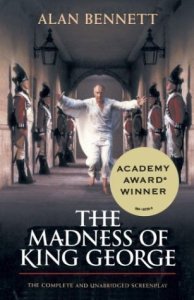
My fifth link is to George III in Alan Bennett’s The Madness of King George. This play premiered on 28 November 1991 and was made into a film in 1994. The introduction to the screenplay includes Bennett’s production diary, notes comparing his stage and screen versions, and the political background to the Court of George III. Also included are a selection of stills from the film. I’ve seen the 1994 film with Nigel Hawthorne as King George and Helen Mirren as Queen Charlotte, which I thought was excellent, but have not read the the book or the play itself.
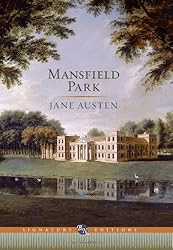
My final link takes me back to Jane Austen’s books and also to Paula Byrne’s book The Genius of Jane Austen and the theatre. It’s Mansfield Park, which I read about 10 years ago. Fanny Price, as a child of 10 goes to live with her wealthy aunt and uncle, Sir Thomas and Lady Bertram at Mansfield Park. The younger members of the family, convert the library into a theatre and stage a risqué play called Lover’s Vows. I’ll be rereading Mansfield Park later on to refresh my memory and consider what it reveals about Jane Austen’s own views of the theatre in the light of Paula Byrne’s book.
The links in my chain are epistolary novels, Jane Austen’s letters and books, the theatre, and George III, using fiction and nonfiction.
What is in your chain, I wonder?
Next month (March 1, 2025), we’ll start with the 2023 Booker Prize winner, Prophet Song by Paul Lynch.
 BooksPlease