Top 5 Tuesday:Top 5 books with sizes in the titles

Top 5 Tuesday was created by Shanah at Bionic Book Worm, and it is now being hosted by Meeghan at Meeghan Reads. You can see the Top 5 Tuesday topics for the whole of 2025 here

Today the topic is top 5 books with sizes in the titles.

These are all books I’ve read with links to my posts on them:
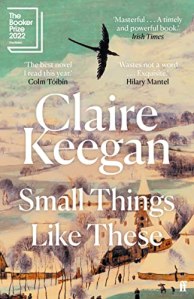
Small Things Like These by Claire Keegan. This won the 2022 Orwell Prize for Political Fiction, an award for outstanding novels and collections of short stories, first published in the UK or Ireland, that illuminate major social and political themes, present or past, through the art of narrative. It also won the Kerry Group Irish Novel of the Year 2022.

It is 1985 in a small Irish town. During the weeks leading up to Christmas, Bill Furlong, a coal merchant and family man faces into his busiest season. Early one morning, while delivering an order to the local convent, Bill makes a discovery which forces him to confront both his past and the complicit silences of a town controlled by the church.

Claire Keegan’s style of writing is a refreshing change from so many of the long and complicated books I so often read. It is precise, focused, and beautifully written bringing her characters to life – these are real, ordinary people, living ordinary lives in 1980s Ireland. And the detail is there too in all the particulars of everyday life – it packs a lot into its pages. 
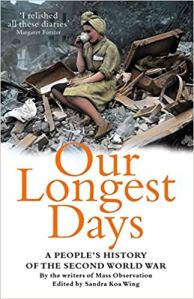
Our Longest Days: A People’s History of the Second World War by the writers of Mass Observation. For six years the people of Britain endured bombs and the threat of invasion, and more than 140,000 civilians were killed or seriously wounded. Men and women were called to serve in the armed forces in record numbers, and everyone experienced air raids and rationing. In these terrible times, volunteers of almost every age, class and occupation wrote diaries for the “Mass Observation” project, which was set up in the 1930s to collect the voices of ordinary men and women.

Using many diaries that have never been published before, this book tells the story of the war – the military conflict, and, mainly, life on the home front – through these voices. Through it all, people carry on living their lives, falling in love, longing for a good meal, complaining about office colleagues or mourning allotment potatoes destroyed by a bomb.
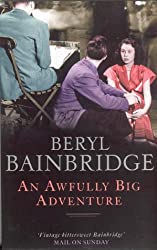
An Awfully Big Adventure by Beryl Bainbridge. First published in 1989 and shortlisted for the Booker Prize, this is set in 1950, as a Liverpool repertory theatre company are rehearsing its Christmas production of Peter Pan. The story centres around Stella, a teenager and an aspiring actress who has been taken on as the assistant stage manager.

It’s semi-autobiographical based on Beryl Bainbridge’s own experience as an assistant stage manager in a Liverpool theatre. On the face of it this is a straight forward story of the theatre company but underneath it’s packed with emotion, pathos and drama. And it’s firmly grounded in a grim post-war 1950s England, food rationing still in operation and bombed buildings still in ruins overgrown with weeds.

The title is taken from Peter Pan, the play about the boy who never grew up, whose attitude to death was ‘To die will be an awfully big adventure.’ Bainbridge’s use of Peter Pan emphasises the themes of reality versus imagination, the loss of childhood innocence, and the quest for love.
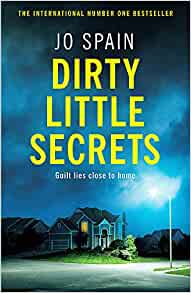
Dirty Little Secrets by Jo Spain, a psychological thriller, set in Withered Vale, a small, gated community of just seven houses, outside the small village of Marwood in Wicklow in Ireland. On the surface it is a perfect place where the wealthy live their  privileged lives and keep themselves to themselves – until a cloud of bluebottles stream out of the chimney of number 4 and Olive Collins’ dead and disintegrating body is discovered inside. She had been dead for three months and none of the neighbours had bothered to find out why she hadn’t been seen all that time. But someone must have known what had happened to her – the question being who?
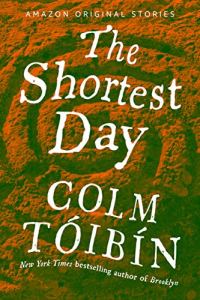
The Shortest Day by Colm Toibin, a short story about the mythical past, about the strange carvings found on certain stones, about archaeology, and about the unknown customs and rituals of our ancient past. It’s storytelling at its best – a tale of wonder and mystery.

Professor O’Kelly is writing notes about Newgrange, also called Bru na Boinne, a circular mound with a retaining wall that had a narrow passageway leading into a vaulted central chamber. There are spirals and diamond shaped designs cut into some of the stones both inside the chamber itself and outside the entrance to the passageway. It’s a burial chamber, a prehistoric monument in County Meath in Ireland, that was built around 3200 BC – older than Stonehenge and the Egyptian pyramids. It’s ringed by a stone circle, stones brought from the Mournes and Wicklow Mountains.

Meanwhile deep within the chamber there were whispers among the dead that the professor was coming again. They are concerned that he would discover the secret of the light penetrating the chamber on the winter solstice – the shortest day of the year. Some of the local inhabitants know of the secret but they never talk about it, except in whispers between themselves. When he arrives they put up a number of obstacles to prevent him from entering the chamber.

Sunday Salon – Our Longest Days

This week I’ve concentrated on reading Our Longest Days: A People’s History of the Second World War by the writers of Mass Observation, edited by Sandra Koa Wing. I’ve been completely immersed in the war years through this fascinating and personal book.

Mass Observation is a social research organisation, founded in 1937, with the aim of creating an “anthropology of ourselves” – a study of the everyday lives of ordinary people in Britain. The information was gathered in various ways, including a team of paid observers and a national volunteer panel of writers. People were interviewed on a number of topics and filled in monthly ‘directives’ on themes such as jokes, eating habits, money and marriage. In August 1939, with war approaching, the organisation asked its panel to keep diaries to record their daily lives and selections from fifteen of these diaries are included in Our Longest Days. They make fascinating reading.

From Sandra Koa Wing’s introduction:

It is worth noting, however, that the diarists did not represent a true cross-section of British society during the war. Although they came from a variety of backgrounds, and from different regions, most of them were middle-class, well-read and articulate. They tended to be people with a natural capacity for observing – and for recording what they observed. Moreover, on the whole their political leanings tended towards left of centre; several were pacifists or conscientious objectors.

Because they are personal accounts there is that sense of being actually there during the air raids, hearing Churchill’s speeches, reading the newspaper reports, experiencing the grief at the number of casualties and deaths and the terrible devastation of the war, the food and clothes rationing and the excitement of D-Day. There is also the hopelessness of the defeats during the first years of the war, the weariness as it went on and on, the yearning for peace and then the excitement, the anticipation and the anti-climax of VE Day and VJ Day.

The main events of each year are summarised before the diary entries for that year, which I found very useful as a quick guide to set the diaries in the context of world events. I began to feel as though I knew the people who wrote the diaries, so the brief biographies are the end were also interesting as there were brief details about what happened to them after the war. There are also a number of photographs, an excellent index and a selection of further reading of Mass Observation publications and other histories of Britain in the Second World War together with a list of related websites.

I think one of my favourites is Muriel Green, who was 19 when the war began. She became a land girl and moved around the country. On her 21st birthday she was working as an under-gardener at Huntley Manor in Gloucester. She wrote:

I shan’t forget my 21st birthday. Apart from getting two greetings telegrams and achieving the first bath for nearly a month it has been the last word in flat. Totally depressing in fact. Life wasn’t all depressing for Muriel and she is one person who kept mainly optimistic and in October 1944 she reflected: It seemed strange to think that the war had been on over five years and how little different it was for us in spite of the ravages of war and what some had gone through. Of course it will never be the same again, but there are many families with far greater losses than our petty grumbles.

Muriel’s family was among the lucky ones. Not so Kenneth Redmond, whose brother Tom was killed in action. His entry on 11 November 1944 reads:

This day only means Remembrance of Tom – War and its horrors, Peace and the best of life that it can bring – all these things will mean to me Tom. I get very morbid when I think of it.

Herbert Brush was 70 in 1939. He was living in south London, a keen gardener, art lover, reader and writer of verse. He wrote diary entries from September 1940 to March 1951 and I particularly liked the personal details he included. He couldn’t buy any razor blades in June 1942 and at the same time he was wondering how accurate the reports of the numbers of casualties reported by the Germans and Russians were, thinking of how pleasant it was ‘to read about so many Nazis being slaughtered and noting the number of different pronunciations of ‘Nazi’.

Churchill says ‘Nazzi’, others say ‘Nartzi’, or’Nertzi’ or ‘Nassie’. I like Churchill’s best as he puts a snarl into the word.

My dad must have liked Churchill’s best too as that is how he said it.

Margaret Forster is quoted on the front cover: ‘I relished all these diaries’. Me too. An excellent book.

The Sunday Salon – Looking Back at Wartime Britain

This week I’ve been reading more of Our Longest Days: a People’s History of the Second World War by the Writers of Mass Observation. It’s composed of diary entries from a number of people of their personal observations, thoughts, and hopes. The one criticism I have of it is that I’m finding it difficult to remember the details of each person. Their first entry is annotated in the margin with their name, age, occupation and location. After that there is just the name, so I have to flick to the end of the book where there are brief biographies for each person. But I am gradually getting used to each person. This morning I was reading about April 1941 with the declaration of war on Yugoslavia and Greece. In Eastern Europe, Hungary, Rumania and Bulgaria were effectively Nazi puppet states. Maggie Blunt, a writer living alone with her beloved cats in a cottage in Slough, wrote on 21 April 1941,

‘Are we really going to lose this war? The Nazis sweep from triumph to triumph making no mistakes while we make all the mistakes. ‘ God alone knows what we shall be called upon to endure these next few years but as others wiser than I have said, it is not what one endures but how one endures it that counts. There were bad raids again on London last week. Planes overhead again tonight. The horror of the sound has become dulled by familiarity and resignation.’

It seems strange to say I’m enjoying reading this, but I am. It is an amazing insight into how ordinary people felt about the war. I remember hearing the stories my mother told about her wartime experiences and thinking how terrible it must have been, yet at the same time how much fun they managed to have despite the circumstances.

I also picked up at the library a week or so ago London War Notes 1939 – 1945 by Mollie Panter-Downes (I read about this first on Danielle’s blog). I’ve just started to read this in conjunction with Our Longest Days. Together these books throw so much light on those years. Mollie Panter-Downes covered the war from England for the New Yorker. The letters are witty, humorous and full of poignancy. I can’t decide whether to read until I’ve caught up with Our Longest Days, or to just stick to one book and then read the other one.

I’ve also got Wartime Britain 1939 – 1945 by Juliet Gardiner (recommended by Litlove). I’ve only dipped into this so far and looked at the photographs. It’s a long, detailed book with many endnotes and an extensive bibliography. In the foreword it states that is about the pervasiveness of the war and how it affected people’s lives. So that’s up next too.

One last book for today is The Ration Book Diet by Mike Brown, Carol Harris and C J Jackson. This uses the wartime diet as a model and includes sixty recipes, some taken straight from cookery books of the time, with only minor adjustments, but most are new dishes created using the ingredients that were available during the war. From the introduction:

When VE-Day finally came in May 1945, Britain was a very different place from the country it had been in 1939. Six years of war had taken their toll on the fabric of the nation. In many cases the effects were far-reaching in terms of Britain’s social, economic and demographic characteristics. But if there was one good thing to have come out of the war then it was food rationing: the war left us healthier as a nation than we had ever been before or have been since.

This is a lovely book and I’ll be writing more about it at a later date.

It’s a glorious day here, hot and sunny, with no breeze. I’m not sure I really like this weather; it makes me feel drained and languid. I shan’t be reading much more today as the family are coming over this afternoon and the garden calls. We’ll be getting the paddling pool out for the children, although my son and husband will be firmly indoors from 3.00pm onwards watching their team Manchester United play the last game of the Premier League against Wigan. The championship hangs on this match. See my son’s post here for a more informed view.