Stacking the Shelves: 26 August 2025

Stacking the Shelves is hosted by Marlene at Reading Reality and the details are on her blog, as well as a huge amount of book reviews. Why not visit her blog if you haven’t already found it? The gorgeous graphic is also used courtesy of the site.

The idea is to share the books you are adding to your shelves, may they be physical or virtual. This means you can include books you buy in physical stores or online, books you borrow from friends or the library, review books, gifts and of course e-books!

I’ve been away on holiday near Gatehouse of Fleet in Dumfries and Galloway, Scotland. We had a brilliant time in a lodge overlooking Fleet Bay, part of the Solway Firth.

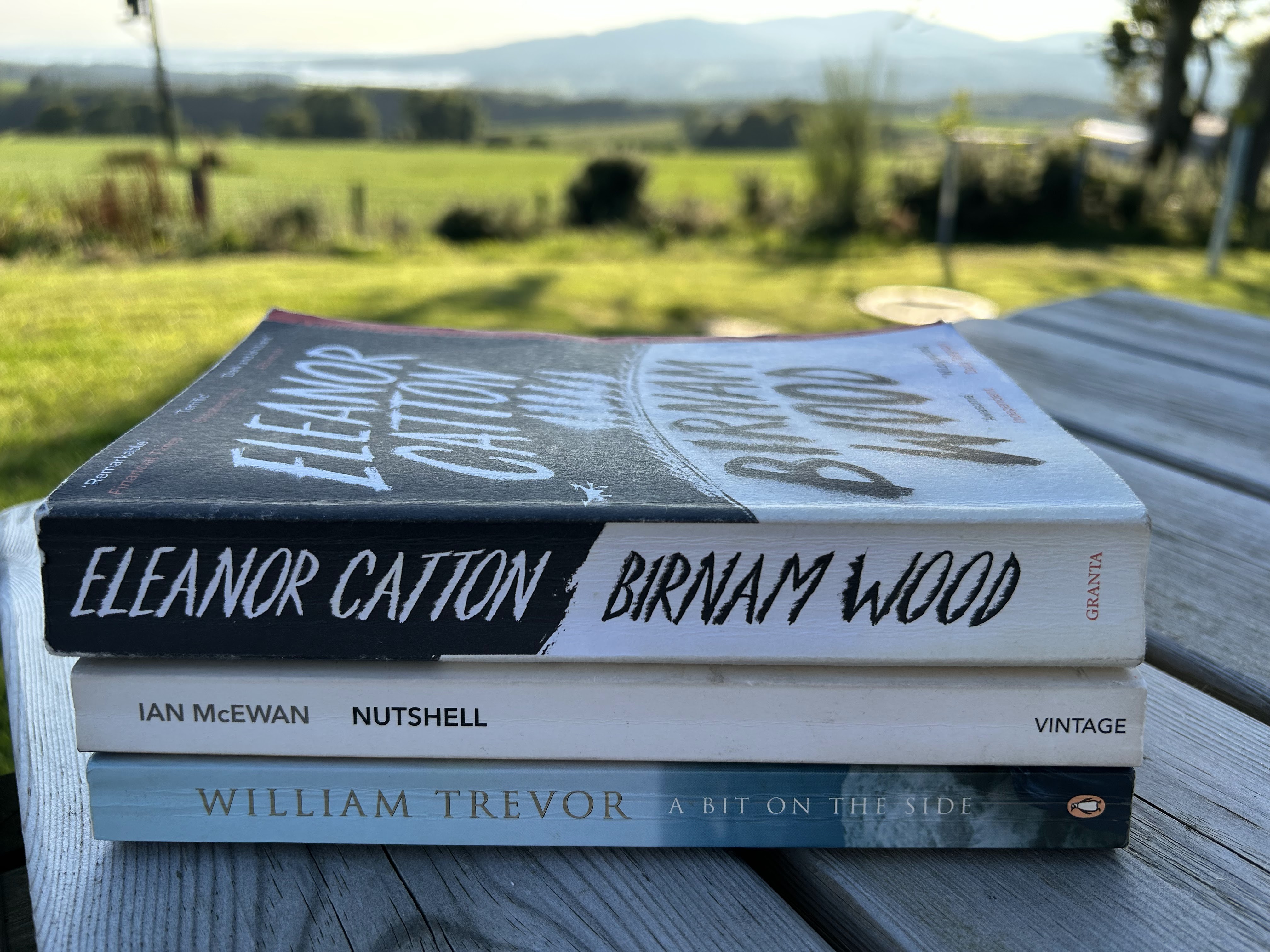
I bought these three paperbacks from a charity shop in Gatehouse of Fleet:

Birnam Wood by Eleanor Catton – Like her previous novel The Luminaries, which I loved, this book is set in a fictionalised New Zealand, primarily in and around a national park in the South Canterbury region. The title is taken from a line in Macbeth. It follows members of a guerilla gardening collective, Birnam Wood as, with the help of a charismatic tech billionaire, they undertake a new project on abandoned farmland.

Nutshell by Ian McEwan, a version of Hamlet. Trudy has betrayed her husband, John. She’s still in the marital home – a dilapidated, priceless London townhouse – but not with John. Instead, she’s with his brother, the profoundly banal Claude, and the two of them have a plan. But there is a witness to their plot: the inquisitive, nine-month-old resident of Trudy’s womb. I’ve enjoyed some of McEwan’s books, but this one looks rather different and, having read a few pages, I’m not sure about it.

A Bit on the Side by William Trevor, a collection of twelve short stories. I don’t think I’ve read any of Trevor’s books, but I thought this one looks interesting, with stories about adultery, secret passions and domestic infidelities. ‘A treat … each meditate[s] on the subject of love – adulterous, unspoken, clandestine, sometimes cruel. Whether set in rural Ireland or London, their pages whisper of relished secrets and dreams foolishly clung to’ Mail on Sunday.

These are e-books I’ve either bought for 99p or acquired for free this month:

The Testaments – Margaret Atwood’s sequel picks up the story more than fifteen years after Offred stepped into the unknown, with the explosive testaments of three female narrators from Gilead. The Republic of Gilead is beginning to rot from within. At this crucial moment, two girls with radically different experiences of the regime come face to face with the legendary, ruthless Aunt Lydia. But how far will each go for what she believes?

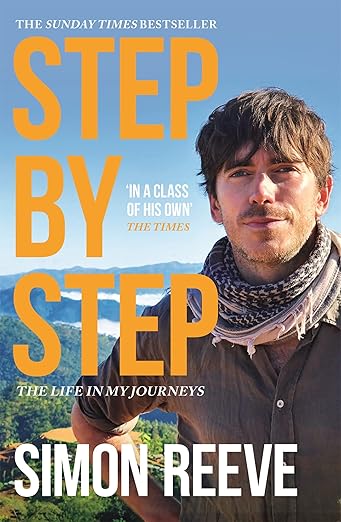
Step by Step: The Life In My Journeys by Simon Reeve. I love his TV travel programmes, so this was a 99p must for me. It’s his autobiography describing how he has journeyed across epic landscapes, dodged bullets on frontlines, walked through minefields and been detained for spying by the KGB. His travels have taken him across jungles, deserts, mountains and oceans, and to some of the most beautiful, dangerous and remote regions of the world. He gives the full story behind some of his favourite expeditions, and traces his own inspiring personal journey back to leaving school without qualifications, teetering on a bridge, and then overcoming his challenges by climbing to a ‘Lost Valley’ and changing his life … step by step.

The First Witch of Boston by Andrea Catalano, her debut novel. This was free from Amazon Prime this month. It is based on the true story of Margaret Jones, the first woman to be found guilty of witchcraft in Massachusetts Bay Colony, 1646. When Thomas and Margaret Jones arrive from England to build a life in the New World Margaret’s skill with healing herbs rouses suspicion of black magic. Personal tragedies, religious hysteria, and wariness of the unknown turn most against her, and even the devotion Margaret and her husband share is at risk.

I enjoy historical fiction and Mist Over Pendle by Robert Neill, (American title, The Elegant Witch) is one of my favourite novels. It tells the tale of witchcraft set in a wild inaccessible corner of Lancashire leading up to the trials of the famous Pendle witches in 1612. So, I thought it would be interesting to compare the two books.
The Testaments by Margaret Atwood: Book Beginnings on Friday & The Friday 56

Every Friday Book Beginnings on Friday is hosted by Gillion at Rose City Reader where you can share the first sentence (or so) of the book you are reading. You can also share from a book you want to highlight just because it caught your fancy.

The Testaments by Margaret Atwood is one of the time limited deals on Amazon at the moment and because I read The Handmaid’s Tale many years ago before I’d even heard of book blogs, I jumped at the chance to buy it.

The book begins:

Only dead people are allowed to have statues, but I have been given one while still alive. Already I am petrified.

Also every Friday there is The Friday 56, hosted by Freda at Freda’s Voice, but she is taking a break and Anne at My Head is Full of Books has taken on hosting duties in her absence. You grab a book and turn to page 56 (or 56% of an eBook), find one or more interesting sentences (no spoilers), and post them.

Page 56:

I don’t remember that school day very much, because why would I? It was normal. Normal is like looking out a car window. Things pass by, this and that and this and that, without much significance.You register such hours; they’re habitual. like brushing your teeth.

Description from Goodreads:

When the van door slammed on Offred’s future at the end of The Handmaid’s Tale, readers had no way of telling what lay ahead for her–freedom, prison or death.

With The Testaments, the wait is over.

Margaret Atwood’s sequel picks up the story more than fifteen years after Offred stepped into the unknown, with the explosive testaments of three female narrators from Gilead.

In this brilliant sequel to The Handmaid’s Tale, acclaimed author Margaret Atwood answers the questions that have tantalized readers for decades.

I’m probably way behind many other bloggers who have read this book! If you have read it what do you think? Did you like it?

Spell the Month in Books – March 2025

Spell the Month in Books is a linkup hosted by Jana on Reviews From the Stacks on the first Saturday of each month. The goal is to spell the current month with the first letter of book titles, excluding articles such as ‘the’ and ‘a’ as needed. That’s all there is to it! Some months there are optional theme challenges, such as “books with an orange cover” or books of a particular genre, but for the most part, any book you want to use is fair game!

This option this month is Science Fiction. I don’t read much science fiction these days, but I used to read a lot. I’ve chosen some books I read long before I began writing about books, some I’ve read more recently and some books that I own but haven’t read yet. The descriptions in italics are taken either from Amazon UK or from Goodreads.

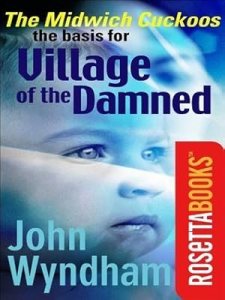
M is for The Midwich Cuckoos by John Wyndham (my review).

The story is set in an ordinary village, with a village green and a white-railed pond, a church and vicarage, an inn, smithy, post office, village shop and sixty cottages and small houses, a village hall, and two large houses, Kyle Manor and The Grange. A very ordinary village where not much goes on, which makes what happens there even more extraordinary. It’s eerie and very chilling, a story of alien invasion and the apparent helplessness of humanity to put up any resistance.

The Midwich Cuckoos is the classic tale of aliens in our midst, exploring how we respond when confronted by those who are innately superior to us in every conceivable way.

In the sleepy English village of Midwich, a mysterious silver object appears and all the inhabitants fall unconscious. A day later the object is gone and everyone awakens unharmed – except that all the women in the village are discovered to be pregnant.

The resultant children of Midwich do not belong to their parents: all are blonde, all are golden eyed. They grow up too fast and their minds exhibit frightening abilities that give them control over others and brings them into conflict with the villagers just as a chilling realisation dawns on the world outside . . .

A is for Artemis by Andy Weir – a TBR, a book I bought after watching, The Martian, the film of his first book.

WELCOME TO ARTEMIS. The first city on the moon.
Population 2,000. Mostly tourists.
Some criminals.

Jazz Bashara is one of the criminals. She lives in a poor area of Artemis and subsidises her work as a porter with smuggling contraband onto the moon. But it’s not enough.

So when she’s offered the chance to make a lot of money she jumps at it. But though planning a crime in 1/6th gravity may be more fun, it’s also a lot more dangerous.

When you live on the moon, of course you have a dark side…

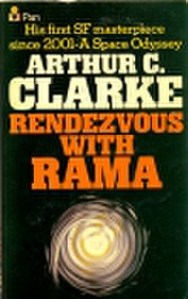
R is for Rendezvous with Rama. This is a book that we bought many years ago. I’m not sure whether I’ve read it or not. It was first published in 1973, so I’m guessing we bought it in the 1970s, the period when we were reading lots of science fiction.

The multi-award-winning SF masterpiece from one of the greatest SF writers of all time

Rama is a vast alien spacecraft that enters the Solar System. A perfect cylinder some fifty kilometres long, spinning rapidly, racing through space, Rama is a technological marvel, a mysterious and deeply enigmatic alien artefact.

It is Mankind’s first visitor from the stars and must be investigated …

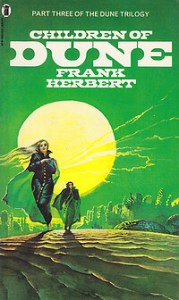
C is for Children of Dune by Frank Herbert, the third Dune novel. I read all the Dune books many years ago.

The Children of Dune are twin siblings Leto and Ghanima Atreides, whose father, the Emperor Paul Muad’Dib, disappeared in the desert wastelands of Arrakis nine years ago. Like their father, the twins possess supernormal abilities–making them valuable to their manipulative aunt Alia, who rules the Empire in the name of House Atreides.

Facing treason and rebellion on two fronts, Alia’s rule is not absolute. The displaced House Corrino is plotting to regain the throne while the fanatical Fremen are being provoked into open revolt by the enigmatic figure known only as The Preacher. Alia believes that by obtaining the secrets of the twins’ prophetic visions, she can maintain control over her dynasty.

But Leto and Ghanima have their own plans for their visions–and their destinies….

H is for The Handmaid’s Tale by Margaret Atwood – another book I read long before I began reviewing books.

Discover the dystopian novel that started a phenomenon.

Offred is a Handmaid in The Republic of Gilead. She is placed in the household of The Commander, Fred Waterford – her assigned name, Offred, means ‘of Fred’. She has only one function: to breed. If Offred refuses to enter into sexual servitude to repopulate a devastated world, she will be hanged. Yet even a repressive state cannot eradicate hope and desire. As she recalls her pre-revolution life in flashbacks, Offred must navigate through the terrifying landscape of torture and persecution in the present day, and between two men upon which her future hangs.

The next link up will be on April 5, 2025 when the theme will be: Animal on the Cover or in the Title.

Book Beginnings on Friday & The Friday 56: The Year of the Flood by Margaret Atwood

Every Friday Book Beginnings on Friday is hosted by Gillion at Rose City Reader where you can share the first sentence (or so) of the book you are reading. You can also share from a book you want to highlight just because it caught your fancy.

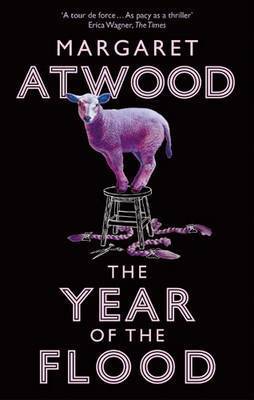
I’m featuring The Year of the Flood by Margaret Atwood this week. It’s the second in the Maccadam trilogy. According to Wikipedia this book focuses on a religious sect called the God’s Gardeners, a small community of survivors of the same biological catastrophe depicted in Atwood’s earlier novel Oryx and Crake, which I read soon after it was first published in 2003. 

In the early morning Toby climbs up to the top of the rooftop to watch the sunrise. She uses a mop handle for balance: the elevator stopped working some time ago and the back stairs are slick with damp, and if she slips and topples there won’t be anyone to pick her up.

Also every Friday there is The Friday 56, hosted by Freda at Freda’s Voice, where you grab a book and turn to page 56 (or 56% of an eBook), find one or more interesting sentences (no spoilers), and post them.

Page 56:

‘Get rid of that scalped look. We Gardener women all wear our hair long’. When Toby asked why, she was given to understand that the aesthetic preference was God’s.

Description from Goodreads:

The sun brightens in the east, reddening the blue-grey haze that marks the distant ocean. The vultures roosting on the hydro poles fan out their wings to dry them. The air smells faintly of burning. The waterless flood – a manmade plague – has ended the world.

But two young women have survived: Ren, a young dancer trapped where she worked, in an upmarket sex club (the cleanest dirty girls in town); and Toby, who watches and waits from her rooftop garden.

Is anyone else out there?

~~~

What do you think, does it appeal to you? What are you currently reading?

Library Books 18 June 2022

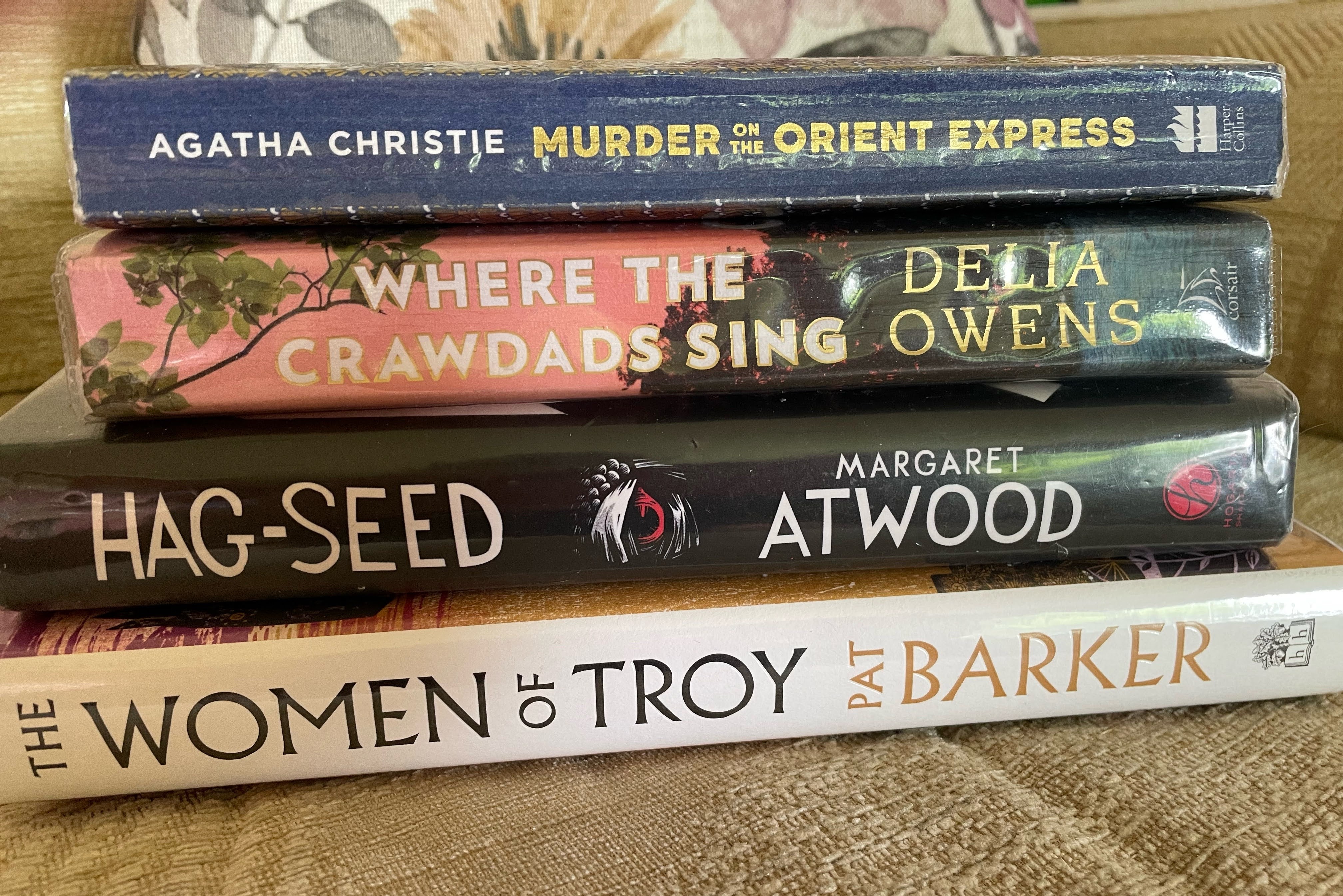
It’s time for another Library Books post – here are my current library loans. From the bottom up they are:

The Women of Troy by Pat Barker – the continuation of the story of Troy following on from The Silence of the Girls (which I have, but have not read yet). It is a retelling of The Iliad from the perspective of the women of Troy who endured it. I hope I’ll be able to read both before I have to return it.

Hag-Seed by Margaret Atwood, a retelling of Shakespeare’s The Tempest, one of my favourites of his plays. I’ve seen it performed on stage twice, once at the Barbican in London and then at the Royal Shakespeare Company Theatre in Stratford-upon-Avon. Margaret Atwood is one of my favourite authors, so I’m expecting this will be good.

Where the Crawdads Sing by Delia Owens. Now, this is a book I’ve wondered about reading ever since I saw other book bloggers’ reviews. It seems to be a book that some people love and others don’t, varying from five to one star ratings. I started to listen to the audiobook, but had to return it unfinished. It’s described as ‘part murder-mystery, part coming-of-age novel’ set in the North Carolina marshlands.

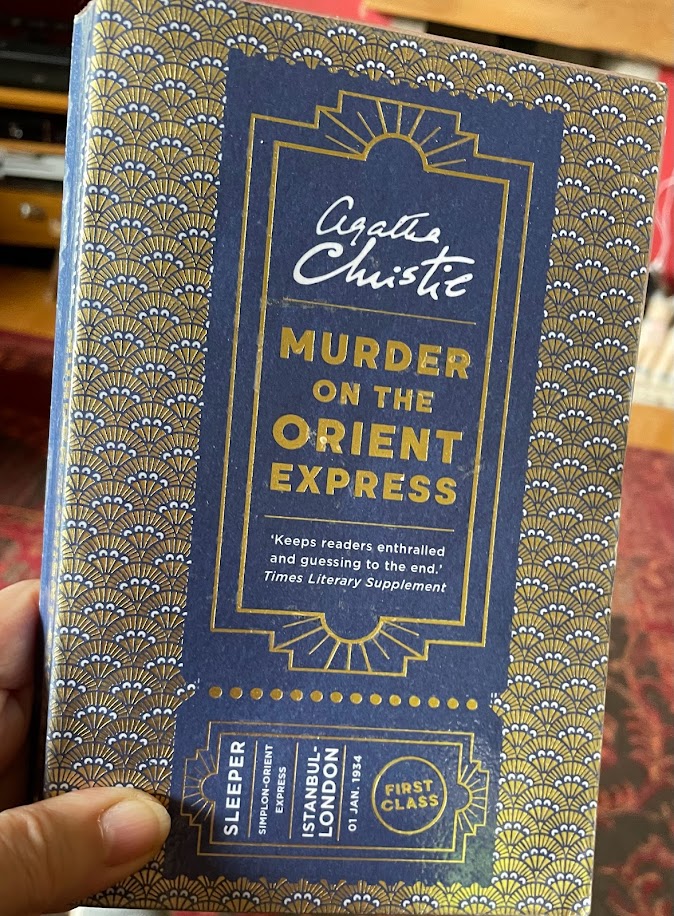
Murder on the Orient Express by Agatha Christie, a Poirot murder mystery. I have read this book, but I fancied reading it again, even though I do know who murdered Mr Ratchett, an American tycoon who was murdered in his compartment, stabbed a dozen times, his door locked from the inside. I really like the cover of this book!

What have you been reading from the library recently?

A – Z of TBRs: X, Y and Z

And so I come to the last letters in the alphabet,  X, Y and Z in my A – Z of TBRs, a series of posts in which I’ve been taking a look at some of my TBRs  to decide whether I really do want to read them all. Some of them were impulse buys, or books I bought as part of those 3 for 2 offers, but most of them are books I bought full of enthusiasm to read each one – and mainly because I wanted to finish books I was already reading, they have sat on the shelves ever since. And then other books claimed my attention.

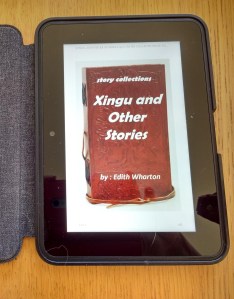
X  – is for Xingu and other stories by Edith Wharton Xingu is the first story in this IMG_20180517_155637127_HDR.jpgcollection of seven short stories. It’s about a group of ladies who form a book group called The Lunch Club – but it’s more
‘And what do you think of “The Wings of Death”? Mrs Roby abruptly asked her.  It was the kind of question that might be termed out of order, and the ladies glanced at each other as though disclaiming any share in such a breach of discipline. They all knew there was nothing Mrs Plinth so much disliked as being asked her opinion of a book. Books were written to read; if one read them what more could be expected? To be questioned in detail regarding the contents of a volume seemed to her as great an outrage as being searched for smuggled laces at the Custom House. (location 77)

Why, I wonder, would anyone want to smuggle laces – and why would it be necessary?

img_20180610_124437297_hdr

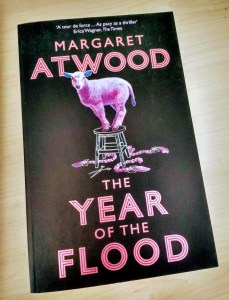
Y – is for The Year of the Flood by Margaret Atwood. I’ve had this book for 8 years. According to Wikipedia this book focuses on a religious sect called the God’s Gardeners, a small community of survivors of the same biological catastrophe depicted in Atwood’s earlier novel Oryx and Crake, which I read soon after it was first published in 2003. The earlier novel contained several brief references to the group.

Figuring out the Gardener hierarchy took her some time. Adam One insisted that  all Gardeners were equal on the spiritual level, but the same did not hold true for the material one: the Adams and the Eves ranked higher, though their numbers indicated their areas of expertise rather than their importance. In many ways it was like a monastery, she thought. The inner chapter, then the lay brothers. And the lay sisters, of course. Except that chastity was not expected.

Since she was accepting Gardener hospitality, and under false pretences at that – she wasn’t really a convert – she felt she should pay by working very hard. (pages 55 -56)

img_20180610_124417342

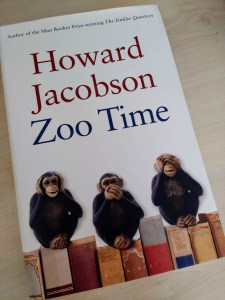
Z– is for Zoo Time by Howard Jacobson, a book I’ve had for eighteen months. It’s described on the book jacket as ‘By turns angry, elegiac and rude’,’ a novel about love – love of women, love of literature, love of laughter. It shows our funniest writer at his brilliant best.’

I haven’t read any of his books, although I have a copy of The Finckler Question, the 2010 Man Booker Prize winner still to read. Looking at Zoo Time today I’m wondering of I really do want to read it – I’m not very good with ‘funny’ books, often wondering what’s so funny about them. It’s about a writer, whose readership is going downhill, with lots of problems.

Things had not being going well in my neck of the woods: not for me, on account of being a writer whose characters readers didn’t identify with, not for my wife who didn’t identify with my characters or with me, not for Poppy Eisenhower, my wife’s mother, where the problem, to be candid, was that we had been identifying with each other too well, not for my local library which closed only a week after I’d published a florid article in the London Evening Standard praising its principled refusal to offer Internet access, and not for my publisher Merton Flak who, following a drunken lunch in my company – I had been the one doing the drinking – went back to his office and shot himself in the mouth. (page 23)

What do you think? Do you fancy any of them? Would you ditch any of them?