Exit Music by Ian Rankin: Book Review

Exit Music: an Inspector Rebus Novel

Paperback: 496 pages
Publisher: Orion (7 Aug 2008)
Language English
ISBN-10: 0752893513
ISBN-13: 978-0752893518

Exit Music is the 17th Inspector Rebus novel.  The Crime Thriller Award for  Author of the Year 2008 was awarded to Ian Rankin for this book. I thoroughly enjoyed it.

Having read all the Rebus books in sequence I feel I’ve come to the end of an era as Rebus comes to the end of his career. Actually I felt that he was overdue for retirement, much as he was dedicated to his job he was also weary and disenchanted. At the beginning of this book Rebus is 10 days from his retirement and is anxious to tie up all the loose ends in his current cases, trying to get DS Siobhan Clarke interested in them. So when the body of the dissident Russian poet Alexander Todorov is found dead this is Rebus’s last case. He throws himself into the investigation, desperate to take his mind off the end of his career.

Was it a senseless mugging or was it politically motivated? The Russian Consulate want  Todorov’s death to be seen as a mugging gone wrong but a group of Russian businessmen in Scotland are concerned that the attack was racially motivated. Scottish MSP Megan Macfarlane is also concerned that nothing jeopardised the links and relationships between the two countries.

Todorov had been giving a poetry reading earlier in the evening and was found with his head bashed in. A trail of blood lead to a car park where he’d been killed. Later the body of Eric Riordan, the sound recordist at the poetry reading is found burnt to death in his house. Are the two deaths connected? Various links with the Edinburgh gangland boss, Cafferty further complicate the case.

Rebus is his usual obstinate and difficult self ending up being suspended from the investigation three days from his retirement and it is left to Siobhan to lead the case. Rebus, of course pursues his own investigations regardless -argumentative, opinionated and relentless to the end. He is also obsessed with his battle to take Cafferty down:

Cafferty, he realised, stood for everything that had ever gone sour – every bungled chance and botched case, suspects missed and crimes unsolved. The man wasn’t just the grit in the oyster, he was the pollutant poisoning everything within his reach. (page 170)

It appears that Cafferty is reformed and is now involved in legitimate business transactions with the Russian, but Rebus doesn’t believe it.  When Cafferty ends up in intensive care after a lonely meeting with Rebus on a canal footbridge, Rebus is suspected of attacking him. Has Rebus gone too far in his desire to bring Cafferty to justice?

Exit Music, in which the worlds of crime, politics and business interconnect, provides a fitting end to Rebus’s career, although somehow I don’t think this is the last we’ll see of him. Rebus is the perpetual outsider, and the job has been his whole world. It had cost him his marriage, friendships and shattered relationships and he feels he will just become invisible. But will he?

The Naming of the Dead by Ian Rankin: Book Review

As the police prepare for the G8 Conference at Gleneagles in July 2005, DI Rebus is apparently surplus to requirements, not much more than a year away from retirement. No-one would blame him for coasting, but that’s not his way. The Naming of the Dead begins with a funeral, that of Michael, Rebus’s brother which fills him with remorse and nostalgia. But true to form he puts work before family when DS Siobhan Clarke phones to tell him of progress in the search for Cyril Colliar’s killer.

Colliar had been killed six weeks earlier and his death was the first in a series of killings of convicted rapists who had recently been released from prison. Items of clothing were found at the Clootie Well, leading forensics to identify the victims. The police had not gone overboard in trying to find the killers, but Colliar was one of Big Ger Cafferty’s men, and the gangleader wants his killer found. He leads Rebus and Siobhan to BeastWatch , a website giving details of rapists and their release dates.

Matters are complicated by the death of Ben Webster, a Labour MP at the conference. He fell from the ramparts of Edinburgh Castle. It’s not clear whether his death was an accident, suicide, or murder. Rebus’s investigation is hampered by Steelforth from Special Branch. Siobhan’s attention is diverted when her parents arrive in Edinburgh to take part in the protests and her mother is injured. Siobhan is determined to find the culprit, particularly if it’s one of the police. Then there is the local councillor Gareth Tench, who gets involved and is then killed.

As with all of Ian Rankin’s Rebus books this has a convoluted plot, with several sub-plots and many characters. Rebus as ever, is dogged and determined, cynical and weary, fighting against the odds and wishing for and fearing his retirement – what would he do? Cafferty and Rebus have their usual sparring matches and Siobhan seems to be drawn into Cafferty’s web.

There is an emphasis on family relationships and loyalties, and reflections on power and the effects of the loss of power as both Rebus and Cafferty are feeling their age:

It struck Rebus that what Cafferty feared was a loss of power. Tyrants and politicians alike feared the self-same thing, whether they belonged to the underworld or the overworld. The day would come when no one listened to them any more, their orders ignored, reputation diminished. New challenges, new rivals and predators. Cafferty probably had millions stashed away, but a whole fleet of luxury cars was no substitute for status and respect. (page 257)

For me there is too much in this book about the G8 conference and the political scene and I got restless in the middle of the book because of that. But overall I enjoyed this last but one book before Rebus finally retires.The title comes from the ritual of reading out the names of a thousand victims of warfare in Iraq. Siobhan reflects that this summed up her whole working life.

She named the dead. She recorded their last details, and tried to find who they’d been, why they’d died. She gave voice to the forgotten and the missing. A world filled with victims, waiting for her and other detectives like her. Detectives like Rebus too, who gnawed away at every case, or let it gnaw at them. Never letting go, because that would have been the final insult to those names. (page 135)
Fleshmarket Close by Ian Rankin: Book Review

The latest Rebus book I’ve read is Fleshmarket Close. As usual with Ian Rankin’s books this is a complex novel, based around the issues of asylum seekers, illegal immigrants and racial prejudice. Rebus, himself is tolerant, pointing out that his grandfather was Polish and an immigrant. But Rebus hasn’t mellowed at all. He is still a loner and now an outsider, shipped out of his old office, St Leonard’s to Gayfield Square where there is no office or even desk space for him. He’s impatient with his superiors, realising they think it’s time for him to retire.

There is plenty going on in this book, a lot of characters and sub-plots, so it needs concentrated reading. There’s the murder of an unknown immigrant found dead in Knoxland, high-rise blocks of flats, the discovery of two skeletons under the concrete floor in the cellar of the Warlock pub in Fleshmarket Close, the disappearance of Ishbel Jardine, whose sister, a rape victim, had committed suicide, and the murder of the convicted rapist, Donny Cruickshank. 

Rebus is relentless in his pursuit of the truth, despite his drinking problems and his difficulties in maintaining any meaningful relationships. DS Siobhan Clarke is also feeling more and more as though she is turning into Rebus, with her late-night lone drinking and methods of working,and there are signs that she and Rebus are drawing closer.  How all the cases connect, or indeed if they do connect, is not clear until near the end of the book, when Big Ger Cafferty makes a brief appearance. Although Rebus can’t prove it he knows that Cafferty was behind the scenes using, abusing, conning and manipulating people.

A Question of Blood by Ian Rankin: Book Review

I’ve recently finished reading Ian Rankin’s A Question of Blood, the 14th Inspector Rebus book, only three more left to read now!
Lee Herdman, is an ex-SAS loner who shoots and kills two teenagers, injuring another at a private school in South Queensferry near Edinburgh, before killing himself. Rebus, also ex-Army and a loner is the ideal man to investigate and he becomes obsessed with discovering what drove Herdman to do it.

But the book begins with Rebus in hospital having scalded his hands by tripping into his bath, or so he says. With his hands in bandages, DS Siobhan Clarke helps him out by being his driver. She is also becoming more and more like Rebus, a loner who has no life outside her job, and drinks alone. She has panic attacks as a result of being stalked by Marty Fairstone, a housebreaker with several convictions for assault. When Fairstone is found burned to death in his house, after a late night drinking session with Rebus, Rebus is the number one suspect for his murder.

Rebus is forced to think of his family,  because one of the dead teenagers is a relation – Derek Renshaw, his cousin’s son. Family ties are highlighted in this book, not only through Rebus, but also through the relationship between the surviving teenager, James Bell and his father, the disreputable MSP Jack Bell, and also the Cotter family – the Goth teenager, Myss Teri, her parents and her brother who died in a car crash involving Derek Renshaw.

Rebus is his usual tormented self, but it is Siobhan who comes just as much into focus as Rebus and by the end of the book the relationship between them is strengthened:

He’d been thinking about families: not just his own, but all those connected to the case. Lee Herdman, walking away from his family; James and Jack Bell, seemingly with nothing to connect them but blood; Teri Cotter and her mother … And Rebus himself, replacing his own family with colleagues like Siobhan and Andy Callis, producing ties that oftentimes seemed stronger than blood. (pages 437-8)

I don’t think this is the best Rebus book Rankin has written, for me it dragged a bit in the middle and I think it could have been a bit less drawn out, but it’s still a good read, addressing more issues than just the crimes.

Resurrection Men by Ian Rankin: Book Review

I’m on a roll now with Ian Rankin’s Rebus books. Resurrection Men is excellent, so good that I couldn’t wait to get back to it each time I had to stop reading. And when I finished it I immediately got out the next book in the series A Question of Blood, which promises to be just as good.

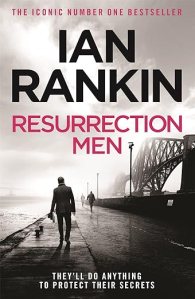
Resurrection Men isn’t about body-snatchers (as I wondered it might be), but about the cops who need re-training, including Rebus. They’re at Tullialian, the Scottish Police College and they are a tough bunch indeed, ‘the lowest of the low‘ as one of them, DI Gray tells a witness he is interrogating:

We’re here because we don’t care. We don’t care about you, we don’t care about them. We could kick your teeth down your throat, and when they come to tell us off, we’d be laughing and slapping our thighs. Time was, buggars like you could end up inside one of the support pillars for the Kingston Bridge. See what I’m saying? (page 326)

To help them become team players – fat chance of that I thought – they’ve been given on old, unsolved case to work on. But Rebus was involved in the case at the time and begins to get paranoid about why is on the course. It’s a tough, gritty story and as with other Rebus books, there’s more than one investigation on the go, several, in fact, needing concentration to keep tabs on each one. Siobhan Clarke is now a DS and with Rebus away she is in charge of the case of the murdered art dealer. Siobhan is getting more and more like Rebus and has a much bigger part in this book than in previous books.

Rankin is great on characterisation – they’re all credible, I feel I know the main characters. His dialogue rings true to life and I felt like a fly on the wall throughout, a bit uncomfortable at times as Rebus gets into tricky situations and tries to work out who he can trust. Both he and I were unsure right to the end.

Sunday Salon – Today’s Books

This morning I’ve been reading The Border Line by Eric Robson, of interest because we live near the border – the one between England and Scotland. This is the account of Robson’s walk following the border line from the Solway Firth to Berwick-upon-Tweed. It’s also interesting because Robson includes anecdotes, snippets of history and personal memories as well. For all the disputes over the border and the reivers’ raids there is a similarity between English and Scottish Borderers:

For more than four centuries the Borderlands were seen as the scrag end of their respective countries, the frayed edges of monarchy. English borderers and Scottish borderers at least had that much in common. The Border was a remote battleground where national ambitions could be fought over. Northumberland, Cumberland and Westmorland were excluded from the Domesday Book. They were regarded as a military buffer zone. They became a bearpit. (page 51)

The Reivers were romanticised by Sir Walter Scott,  who gave them ‘the spit-and -polish treatment’ and a ‘romantic bearing and heroic stature.’ Robson also sheds light on the derivation of words, such as ‘reiver’: a ‘reef” in Old English meant a line, a Shire Reeve was a man who protected boundaries, thus the reiver raided across the Border Line. ‘Blackmail’ has two possible derivations – greenmail was agricultural rent and blackmail was money taken at night, or protection money. Alternatively it could be that it came from the fact that the reivers blacked their armour to ride as shadows in the moonlight (page 49).  I prefer the alternative derivation.

Then I moved north of the Border Line into Scotland with my reading and finished Ian Rankin’s book The Falls, a book I first read a couple of years ago. I wrote about it at the time and I haven’t much to add to that post. The Falls combines so much of what I like to read – a puzzling mystery, convincing characters, well described locations, historical connections and a strong plot full of tension and pace. Rebus has morphed in my mind into a combination of the actors who’ve played him – John Hannah and Ken Stott – and his creator Ian Rankin. But there is no doubt that the books are far superior to the TV productions. The next Rebus book I’ll be reading is Resurrection Men.