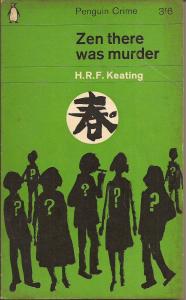
I don’t think I’ve read anything like Zen There Was Murder, a mixture of Zen Buddhism and murder. It was the second book H R F Keating wrote, first published in 1960 and then published in 1963 by Penguin Books in their green Penguin Crime series. (This cover is much more appropriate than the Bloomsbury Reader e-book cover showing guns)
It was the Zen Buddhist setting that made it difficult for me to get to grips with the murder. In fact it is practically halfway into the book before the murder actually takes place. The first half is taken up with introducing the characters, gathered together for a course on Zen Buddhism. There is a schoolteacher, Alasdair Stuart, a clergyman, the Rev. Cyprian Applecheek, Miss Olive Rohan, Miss Flaveen Mills, Honor Brentt, a jounalist and her husband, Gerry Manvers, and Jim Henderson, an Irishman from Ulster.
None of them know anything about Zen and much time is spent with them trying to understand what it is. Mr Utamaro, the lecturer comes out with various sentences, such as ‘Books about Zen are legs on a snake‘, saying you cannot understand Zen by reading a book about it and applying the principles of logic to what you read, and tweaking Alasdair’s nose saying, ‘this is Zen‘, as well as using koans, such as ‘what is the sound of one hand clapping?‘ But they fail to understand, saying it is nonsense. Mr Utamaro agrees.
Mr Utamaro shows them a sword, locked in a glass showcase. The sword, a wakizashi, is one of pair used by samurai for hari-kiri, and on the evening of the first day Mr Utamaro discovers that the sword has been taken from the case, leaving it intact and without setting off the alarm. And then Flaveen is found dead, the sword driven into her body up to the hilt.
The clue to discovering the identity of the murderer is in solving who is telling lies and why. For most of the time I was completely bamboozled and kept wondering just how the two German girls employed to make the beds and do the cooking fitted into the mystery. Their conversations regularly interrupt the narrative as they comment on the characters and the events taking place.
All in all this book has a surreal feel about it. It’s not just a puzzle type of murder mystery but as Keating explained in an interview with Dale Salwek in Mystery Voices: Interviews with British Crime Writers it is also making a point about something you believed:
And the thing I believed in, one of the things that bugged me most, was the subject of telling lies, which is fine for a detective story. And that was how I came to write my second, Zen There Was Murder, which is really more about telling lies than about Zen.
…
When writing the second book, I thought I could say something about telling lies. At that time, too, Zen Buddhism was a fad over here, and so for the background of the book, I took Zen, which does reflect very much on lies. I found I could say things about lies by giving each of the characters a different viewpoint on telling lies – ranging from one of those people who absolutely objects to lying in any way to the sort of pathological liar. And I made the whole book turn on that. (pages 64-65)
H R F Keating (1926 – 2011) was chairman of the Crime Writers’ Association (CWA) (1970’“71), chairman of the Society of Authors (1983’“84) and president of the Detection Club (1985’“2000). He was a fellow of the Royal Society of Literature. His most famous novels are the Inspector Ghote books (I have just one on my TBR shelves – Inspector Ghote’s Good Crusade, the second in the series). For more information about Keating see this article by Martin Edwards.
I’ve had this book for about three years, so it qualifies for the Mount TBR Reading Challenge 2015 and it is also one of the books I listed for the 10 Books of Summer Challenge, and the TBR Pile Challenge.
 A Detective at Death’s Door is the first book by H R F Keating that I’ve read. I was expecting it to be good because Keating, a Fellow of the Royal Society of Literature is a winner of the Crime Writers’ Association’s Gold Dagger Awards. From the information in the book I see that his most famous novels are the Inspector Ghote books. A Detective at Death’s Door is the fifth Harriet Martens novel. For more information about Keating see
  BooksPlease