Spell the Month in Books May 2024: Nature

Spell the Month in Books is a linkup hosted by Jana on Reviews From the Stacks on the first Saturday of each month. The goal is to spell the current month with the first letter of book titles, excluding articles such as ‘the’ and ‘a’ as needed. That’s all there is to it! Some months there are optional theme challenges, such as “books with an orange cover” or books of a particular genre, but for the most part, any book you want to use is fair game!

This month’s theme is Nature. This is a vast topic and looking through my books, both read and those I’ve yet to read, I have lots to choose from, but I only found a few that fit this theme in titles that begin with letters to spell the word MAY. I have read two of these books and the other one is one of my TBRS.

M is for The Man Who Climbed Trees by James Aldred 5*
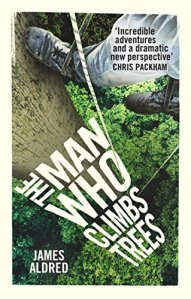
If you have ever wondered how wildlife/nature documentaries are filmed this book has the answers.

James Aldred, a professional tree climber, wildlife cameraman, and adventurer, explains how he discovered that trees are places of refuge as well as providing unique vantage points to view the world. Trees enthral him, right from the time he first climbed into the canopy of an oak tree in the New Forest. Climbing trees gives him peace within himself and with the world around him. Since he first began climbing trees he has travelled the world climbing many of the world’s tallest trees, filming for the BBC and National Geographic magazine.

The Man Who Climbs Trees is a wonderful book, full of James Aldred’s adventures and his views on life and spirituality. I loved it. His travels brought him into contact with dozens of different religions and philosophies all containing ‘profound elements of truth’ that he respects very much, concluding that ‘spirituality is where you find it’ and he finds it ‘most easily when up in the trees’.

A is for All Among the Barley by Melissa Harrison, a TBR.

I bought this book because I enjoyed Melissa Harrison’s novella, Rain: Four Walks in English Weather, which is about four rain showers, in four seasons, across Wicken Fen, Shropshire, the Darent Valley and Dartmoor. I like the way she writes about the natural world and All Among the Barley looks as though it will bring to life a world governed by the old rural traditions, in an evocation of place and a lost way of life. It’s a novel set in the autumn of 1933 on a farm describing rural traditions as harvest time approaches.

Y is for The Year Without Summer by Guinevere Glasfurd 5*

The volcanic eruption of Mount Tambora on Sumbawa Island in Indonesia in 1815 had a profound and far reaching impact on the world. It led to sudden cooling across the northern hemisphere, crop failures, famine and social unrest in the following year, which became known as The Year Without Summer and in North America as Eighteen hundred and froze to death. But it wasn’t until the mid twentieth century that volcanic eruptions were shown to affect climate change.

Guinevere Glasfurd’s novel illustrates how the impact of the extreme weather conditions affected the lives of six people. They never meet, or know each other, but their stories are intertwined throughout the book in short chapters, giving what I think is a unique look at the events of 1816. I enjoyed all the stories.

The next link up will be on June 1, 2024 when the optional theme will be History.
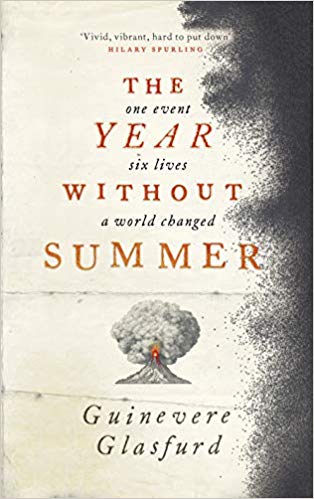
The Year Without Summer by Guinevere Glasfurd

Year without summer

Two Roads| 6 February 2020| 416 pages| e-book| review copy via NetGalley| 5 stars

The Year Without Summer: 1816 – one event, six lives, a world changed by Guinevere Glasfurd is a most remarkable book, telling how the volcanic eruption of Mount Tambora on Sumbawa Island in Indonesia in 1815 had a profound and far reaching impact on the world. It led to sudden cooling across the northern hemisphere, crop failures, famine and social unrest in the following year, which became known as The Year Without Summer and in North America as Eighteen hundred and froze to death. But it wasn’t until the mid twentieth century that volcanic eruptions were shown to affect climate change.

Guinevere Glasfurd’s novel illustrates how the impact of the extreme weather conditions affected the lives of six people. They never meet, or know each other, but their stories are intertwined throughout the book in short chapters, giving what I think is a unique look at the events of 1816. I enjoyed all the stories.

Henry Hogg was the ship’s surgeon on the Benares, the ship sent to investigate the eruption of Mount Tambora in 1815. He discovered the sea full of floating pumice and charred bodies, whilst the decks of the ship were covered a foot thick with ashes. The immediate effects of the eruption were simply tremendous and horrific, within a hundred miles forests, towns were covered, deep valleys were filled in and the contours of the coast were changed.

In 1816 Mary Shelley travelled to Switzerland with Percy Shelley and her son Willmouse, her step-sister, Claire and Lord Byron and Dr Polidori and after a month of rain, Byron suggests that they should each write a ghost story and that led to her writing Frankenstein.

John Constable’s love of landscapes is deeply unfashionable and his hopes to marry Maria Rebow depend upon him gaining a commission from her parents. His father is near to death and as he has passed his business to Abram, John’s younger brother, John has few prospects other than to make a living from his painting.

Farmworker Sarah Hobbs in the Fens is finding work hard to get and has to settle for shovelling shit in the stables in her bare feet for a penny a day.  Always hungry and with work getting even more scarce she gets involved in the Littleport hunger riots. Her story is based loosely on a real person who was condemned to hang for her part in the riots, but her sentence was eventually commuted to transportation. The suppression of these riots was repeated in the 1819 Peterloo Massacre when protesters had gathered in Manchester demanding political reform

The other two people are fictional – preacher Charles Whitlock in Vermont is struggling, having persuaded his flock not to travel to Ohio to escape the draught, only to find that this is followed by periods of hard frost and snow in August. Their prospects are very bleak and death soon follows.

The other fictional character is Hope Peter, a soldier returned from the Napoleonic wars, who finds his mother has died, his family home demolished and a fence has gone up in its place, enclosing the land. He too ends up taking part in a riot – this one at Spa Fields at Islington.

 I thoroughly enjoyed this book. It’s more like a collection of short stories than a novel, but it works very well for me, highlighting the global connections. It is of course about climate change, showing the far-reaching effects of the Tambora eruption, which weren’t limited to 1815 and 1816. It led to hardships in 1817 and 1818 with the outbreak of cholera and typhoid epidemics triggered by the failure of monsoons. As Guinevere Glasfurd explains in her afterword the eruption is ‘credited with social change throughout the nineteenth century and with the pressure for social reform.’

This was the first book by Guinevere Glasfurd  that I’ve read, but it’s not her first book – that was The Words in My Hand, shortlisted for the Costa First Novel Award and Authors’ Club Best First Novel Award and was also longlisted in France for the Prix du Roman FNAC. She is currently working on her third novel, a story of the Enlightenment, set in eighteenth century England and France. I’ll be reading more of her work.

Many thanks to Two Roads for a review copy via NetGalley.