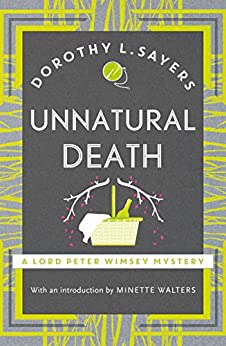
Unnatural Death by Dorothy L Sayers

From the back cover:

‘No sign of foul play,’ says Dr Carr after the post-mortem on Agatha Dawson. The case is closed. But Lord Peter Wimsey is not satisfied.

With no clues to work on, he begins is own investigation. No clues, that is, until the sudden, senseless murder of Agatha’s maid.

What is going on in the mysterious Mrs Forrest’s Mayfair flat? And can Wimsey catch a desperate murderer before he himself becomes one of the victims?

This is the third book in the Lord Peter Wimsey series by Dorothy L Sayers, first published in 1927. My copy was reprinted in 2016 and I bought it secondhand five years ago. I’ve been reading this series totally out of order – I’ve already read the first two and several of the later books too. I think they each read well on their own.

Miss Climpson makes her first appearance in Unnatural Death, helping Lord Peter, working undercover. She is an elderly spinster, who runs what Wimsey calls ‘My Cattery’, ostensibly a typing bureau, but actually an amateur detective/enquiry agency. As in the first two books he works with his friend, Inspector Charles Parker, who is a Scotland Yard detective. Bunter, his manservant, only has a very minor role in this book. I think it’s an interesting mystery, not so much about discovering who killed Agatha Dawson and her maid, Bertha, but more about how the murders were committed.

Uncertain Death is most definitely a book of its time – that is the early 20th century. There is much banter, wit and humour, and plenty of snobbery of all types, clearly showing the class distinctions between the working and upper classes. Racism is prevalent and also lesbianism, although that is not directly stated. It is a clever story, well told, with colourful characters. There is a biographical note at the end of the book that reveals much about Lord Peter’s background, about his early years, school and university, and his experiences during the First World War.

Whose Body? by Dorothy L Sayers

I’ve read some of Dorothy L Sayers’s Lord Peter Wimsey Mystery series and enjoyed them immensely. But up until now have not read the first book in the series, Whose Body?, first published in 1923. It’s an amusing Golden Age mystery that kept me entertained throughout. Lord Peter is a wealthy amateur detective, a friend of Inspector Charles Parker, a Scotland Yard detective. He called ‘Lord’ as he is the younger son of a duke.

When the naked body of a man, wearing only a pair of pince-nez is found in Mr Alfred Thipp’s Battersea bathroom, Lord Peter is asked by his mother, the Dowager Duchess of Denver, to help solve the mystery of whose body had found its way into the bath. The police investigation is being led by Inspector Sugg, who doesn’t welcome what he calls Lord Peter’s ‘interference’ in the case. He thinks the dead body might be that of Sir Reuben Levy, a wealthy London financier who had vanished from his bedroom, leaving no trace. Meanwhile Charles is investigating Sir Reuben’s disappearance himself. Although the body in the bath at first appears to be Sir Reuben it soon becomes clear that it is not and that the two cases are not connected. But are they?

As I began reading I was a bit put off by the dialogue between Lord Peter and his valet Bunter, who used to be his batman in the army. The dialogue is supposed to be witty banter between the two of them but to my mind it was irritating and superficial, definitely dated, and reminded me a just a tiny bit of the Jeeves and Wooster stories. But that was just at the start – it’s not at all like Jeeves and Wooster! I enjoyed watching the mystery unfold, which put Lord Peter’s life into grave danger. There are many complications and twists and turns that did stretch my credulity. It has a serious side too as events trigger traumatic memories for Lord Peter of his time in the trenches of the First World War

My rating: 4*

There are 15 books in the series (linked to my reviews when I’ve read the book):


   1. Whose Body? (1923)
   2. Clouds of Witness (1926)
   3. Unnatural Death (1927)
   4. Lord Peter Views the Body (1928)
   5. The Unpleasantness at the Bellona Club (1928)
   6. Strong Poison (1930)
   7 Five Red Herrings (1931)
   8. Have His Carcase (1932)
   9. Hangman’s Holiday (1933)
   10. Murder Must Advertise (1933)
   11. The Nine Tailors (1934)
   12. Gaudy Night (1935)
   13. Busman’s Honeymoon (1937)
   14. In the Teeth of the Evidence (1939)
   15. Striding Folly (1972)

Clouds of Witness by Dorothy L Sayers

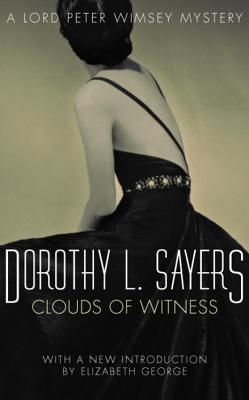
Clouds of Witness by Dorothy L Sayers, is the second Lord Peter Wimsey book and one of my 20 Books of Summer. It was first published in 1926. My copy was reprinted in 1984 and I bought it secondhand four years ago.

Clouds of witness Sayers

From the back cover of my paperback:

A man is found shot, and the Duke of Denver is charged with his murder. Naturally, it is his brother, Lord Peter Wimsey, who is called in to investigate the crime. This is a family affair, for the murdered man was the fiancé of the sister of Denver and Wimsey.

Why, then, does the Duke refuse to co-operate with the investigation? Is he really guilty, or is he covering up for someone? Why is Wimsey attacked by an enraged farmer on the lonely moors? Why is an attempt made on his life in a Soho street?

My thoughts:

So many questions! And as I read even more popped into my mind – why did Lady Mary, Wimsey’s sister, leave the house at 3am on the morning of the murder? Why is she feigning illness? Whose footprints are those near the body of Denis Cathcourt (the murdered man)? What is the significance of the diamond cat charm with eyes of bright emeralds? And why won’t the Duke defend himself? Then there are the bloodstains and signs that the body had been dragged to the door of the conservatory where it was found, leading into the nearby thicket. If the Duke didn’t kill Cathcart who did and why?

The evidence against the Duke is circumstantial. So, Wimsey has his work cut out to prove his innocence and save him from the death penalty. Together with his friend, Inspector Charles Parker (who is in love with Lady Mary), and Bunter, his manservant, they look for clues and interview the family’s guests on the night of the murder. There are several strands to the story and minor characters who all manage to confuse the mystery.

There are some memorable scenes, such as Wimsey and Bunter’s escapade on the moors when they attempted to get to Grider’s Hole. The fog had come on them suddenly, blotting out their surroundings and they had no idea what direction to take. They strode forward gingerly unable to distinguish uphill from downhill – then Wimsey tripped into a bog, and found himself sinking up to his thighs. As well as struggling in the foggy bog, Wimsey also got shot and rather dramatically flew to New York in pursuit of evidence, a dangerous journey in a fragile plane as a deep depression was crossing the Atlantic bringing storms with heavy rain and sleet, rising to a gale as the plane lurched from gust to gust.

The trial scene in the House of Lords is fascinating:

The historic trial of the Duke of Denver for murder opened as soon as Parliament reassembled after the Christmas vacation. The papers had leaderettes on ‘Trial by his Peers’, by a Woman Barrister, and ‘The Privilege of Peers: should it be abolished?’ by a Student of History. The Evening Banner got into trouble for contempt by publishing an article entitled ‘The Silken Rope’ (by an Antiquarian), which was deemed to be prejudicial, and the Daily Trumpet – the Labour organ – inquired sarcastically why, when a peer was tried, the fun of seeing the show should be reserved to the few influential persons who could wangle tickets for the Royal Gallery. (pages 217 -218)

Clouds of Witness is a book of its time, there is much banter, wit and humour, and plenty of snobbery of all types clearly showing the class distinctions between the working and upper classes. It is a clever story, well told, with colourful characters and I liked the details it gives about Wimsey’s family as I’ve been reading these books totally out of order.

All in all, I enjoyed it – 4*.

Reading challenges: 20 Books of Summer, Calendar of Crime, and Mount TBR challenge 2019

My Friday Post: Clouds of Witness by Dorothy L Sayers

Book Beginnings Button

Every Friday Book Beginnings on Friday is hosted by Gillion at Rose City Reader where you can share the first sentence (or so) of the book you are reading, along with your initial thoughts about the sentence, impressions of the book, or anything else the opener inspires.

I’m currently reading Clouds of Witness by Dorothy L Sayers, the second Lord Peter Wimsey book and one of my 20 Books of Summer.

Clouds of witness


Lord Peter Wimsey stretched himself luxuriously between the sheets provided by the Hôtel Meurice.

Also every Friday there is The Friday 56, hosted by Freda at Freda’s Voice.

30879-friday2b56These are the rules:

  1. Grab a book, any book.
  2. Turn to page 56, or 56% on your eReader. If you have to improvise, that is okay.
  3. Find any sentence (or a few, just don’t spoil it) that grabs you.
  4. Post it.
  5. Add the URL to your post in the link on Freda’s most recent Friday 56 post.

Page 56:

From amid the mud and the fallen leaves he retrieved a tiny glittering object – a flash of white and green between his finger-tips.

It was a little charm such as women hang upon a bracelet – a diminutive diamond cat with eyes of bright emerald.

Blurb:

The Duke of Denver, accused of murder, stands trial for his life in the House of Lords.
Naturally, his brother Lord Peter Wimsey is investigating the crime – this is a family affair. The murder took place at the duke’s shooting lodge and Lord Peter’s sister was engaged to marry the dead man.
But why does the duke refuse to co-operate with the investigation? Can he really be guilty, or is he covering up for someone?

What do you think? Would you keep reading?

Six Degrees of Separation from The Tipping Point to Five Red Herrings

I love doing Six Degrees of Separation, a monthly link-up hosted by Kate at Books Are My Favourite and Best. Each month a book is chosen as a starting point and linked to six other books to form a chain. A book doesn’t need to be connected to all the other books on the list, only to the one next to it in the chain.

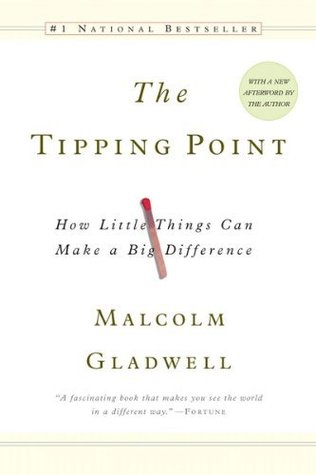
This month the chain begins with The Tipping Point: How Little Things Can Make a Big Difference by Malcolm Gladwell, a book I haven’t read. The tipping point is that magic moment when an idea, trend, or social behaviour crosses a threshold, tips, and spreads like wildfire. 

The Tipping Point: How Little Things Can Make a Big Difference

My chain is made up of a mixture of books that I’ve read or are on my TBR shelves and they are all crime fiction.

The Secret Place: Dublin Murder Squad:  5 (Dublin Murder Squad series) by [French, Tana]A Lesson in Secrets (Maisie Dobbs Mysteries Series Book 8) by [Winspear, Jacqueline]Dead Scared: Lacey Flint Series, Book 2 by [Bolton, Sharon]Time is a Killer: From the bestselling author of After the Crash by [Bussi, Michel]Five Red Herrings: Lord Peter Wimsey Book 7 (Lord Peter Wimsey Series) by [Sayers, Dorothy L.]

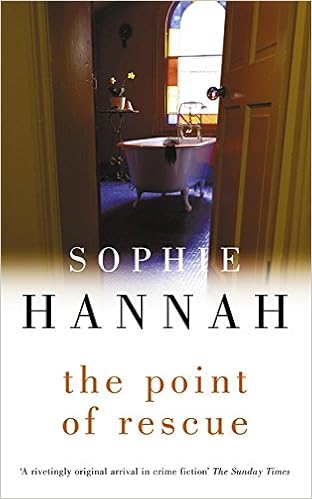
My first link in the chain is to the word ‘point’ in the book title – The Point of Rescue by Sophie Hannah, also a book I haven’t read. It’s a psychological thriller in which Sally Thorning has a secret affair.

The Secret Place by Tana French is another book about secrets that bind  a group of adolescent girls together in a girls’ boarding school when they become involved in a murder investigation. It’s the 5th book in the Dublin Murder Squad Series. Another book I haven’t read yet.

A Lesson in Secrets by Jacqueline Winspear – historical crime fiction set in 1932. Maisie Dobbs directed by Scotland Yard’s Special Branch and the Secret Service goes undercover as a lecturer at Cambridge University to monitor any activities ‘not in the interests of the Crown.’ Yet another TBR book.

Another crime fiction book set in Cambridge University is Sharon Bolton’s Dead Scared in which DC Lacey Flint is posted at the University, after  a spate of student suicides, with a brief to work undercover, posing as a vulnerable, depression-prone student.

Sticking with the theme of crime fiction takes me to my next link – Time is a Killer by Michel Bussi, a murder mystery set in Corsica. Clotilde is determined to find out what  happened in a car crash that killed her parents and brother 27 years earlier. There is a plan showing the Revellata Peninsula, a wild and beautiful coastline, where Clotilde’s grandparents lived, and all the key locations.

I think maps and plans are really useful in crime fiction. Another book that has a map is Five Red Herrings by Dorothy L Sayers. Lord Peter is on holiday in Scotland, in a fishing and painting community when Campbell, a local landscape painter and fisherman is found dead in a burn. The map at the beginning of the book helped me follow the action – I needed the map!

 ~~~

My chain this month is linked by: crime fiction, books about secrets, books set in Cambridge and books with helpful maps. And in a way the books all link back to The Tipping Point as they all demonstrate how the little, minute things in the details of each case add up to help solve the crimes.

Next month (July 7, 2018), we’ll begin with Tales of the City, the first in the much-loved series by Armistead Maupin – yet another book I haven’t read or even heard of before!

New-To-Me Books August 2015

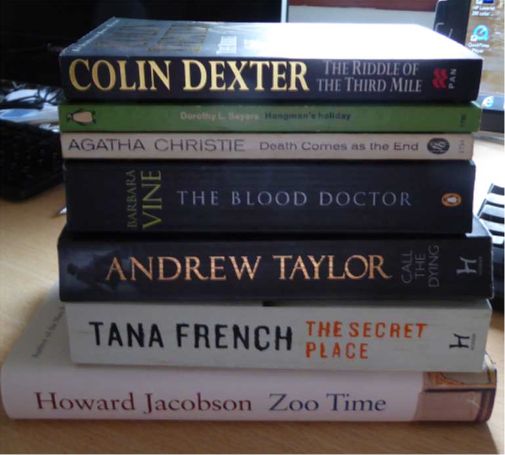
Another visit to Barter Books in Alnwick resulted in another pile of books to add to my TBR shelves.

From top to bottom they are:

  • The Riddle of the Third Mile by Colin Dexter – to fill in my gaps in reading his Inspector Morse books. This is the 6th in the series – Inspector Morse isn’t sure what to make of the truncated body found dumped in the Oxford Canal. He suspects it may be all that’s left of an elderly Oxford don last seen boarding a London train days before.
  • Hangman’s Holiday and Other Stories by Dorothy L Sayers – the ninth in her Lord Peter Wimsey series, this includes  four Wimsey stories, six stories featuring Montague Egg (travelling salesman for Plummet & Rose, Wine & Spirits), and two more separate stories.
  • Death Comes as the End by Agatha Christie – this is one of the last few books of hers I have yet to read. It’s historical crime fiction set in Egypt 4,000 years ago, written drawing on her experience of several  expeditions to the Middle East with her husband, Max Malloran, an eminent archaeologist.
  • The Blood Doctor by Barbara Vine (Ruth Rendell) – one of her psychological thrillers, described on the back cover as ‘a chilling tale of ambition, obsession and bad blood.‘ I still have a lot of Barbara Vine/Ruth Rendell books to read.
  • Call the Dying by Andrew Taylor – I’m jumping into a series with this book as this is the 7th in the Lydmouth mysteries and I haven’t read any of the others. They are all are set in and around a fictional town on the Anglo-Welsh borders in the years after World War II.
  • The Secret Place by Tana French – the 5th in the Dublin Murder Mystery series. I read the first,  In the Woods a few years ago and liked its psychological elements and the twists and turns.  In this book Detective Stephen Moran investigates the murder of handsome, popular Chris Harper when sixteen-year-old Holly Mackey brings him a photo of Chris with the caption, I KNOW WHO KILLED HIM.
  • Zoo Time by Howard Jacobson – a complete change from crime fiction – a book I bought in Tescos for £1. It’s described on the book cover as  ‘a novel about love – love of women, love of literature, love of laughter. It shows our funniest writer at his brilliant best.‘ I felt like reading something different.

If you’ve read any of these books I’d love to know what you think about them.